How Life Works
From Creation to Angel Through Many Lives
An Explanation of Life, Death, Reincarnation, and Purification According to Spirits of High Degree, Often Called Angels
Intro
What is life? Why are we here? Why are some people born into comfort, while others are born into hardship? Why do good people suffer, and why do evil people sometimes seem to prosper? And what happens after death?
The teachings that follow are based on The Spirits' Book, published by Allan Kardec in 1857. Its contents were communicated by spirits of high degree, often called angels, through human mediums.
God
Life begins with God.
God did not begin at some point in time. God always existed. God is the Supreme Intelligence, the First Cause of all things.
Nothing can exist without a cause. The universe exists, so it must have a cause. That cause cannot be matter, because matter itself is created, limited, and changing. It cannot be chance, because chance cannot explain order, harmony, law, and intelligence. So behind everything is God: eternal, unchanging, immaterial, one, all-powerful, perfectly just, and perfectly good.
God is not the universe itself. God is not the sum of all beings. God is the Creator, and the universe is creation.
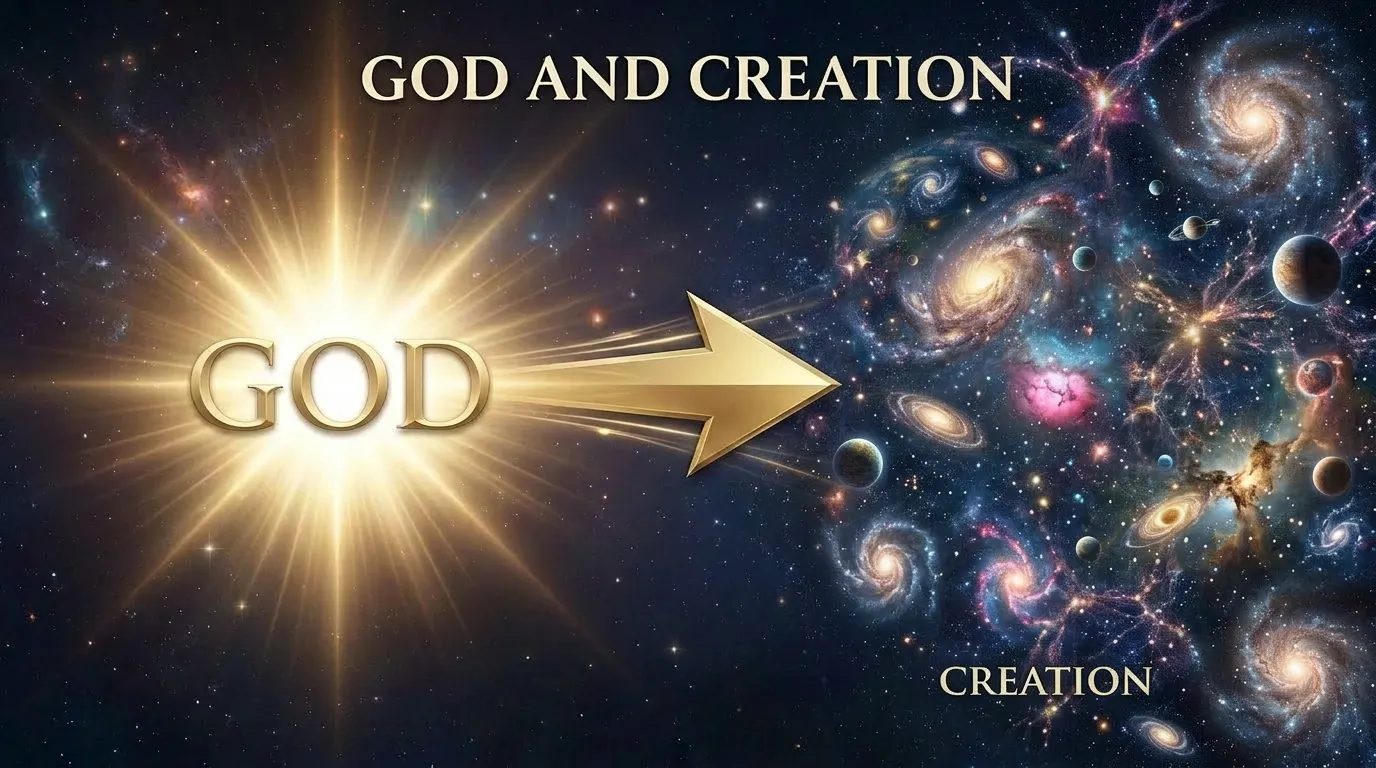
And creation is not static. It is not a finished machine abandoned by its maker. It is alive with movement, development, renewal, and purpose. Worlds are formed. Worlds develop. Worlds disappear. And their elements return to the great order of the universe.
Matter, Spirit, and Creation
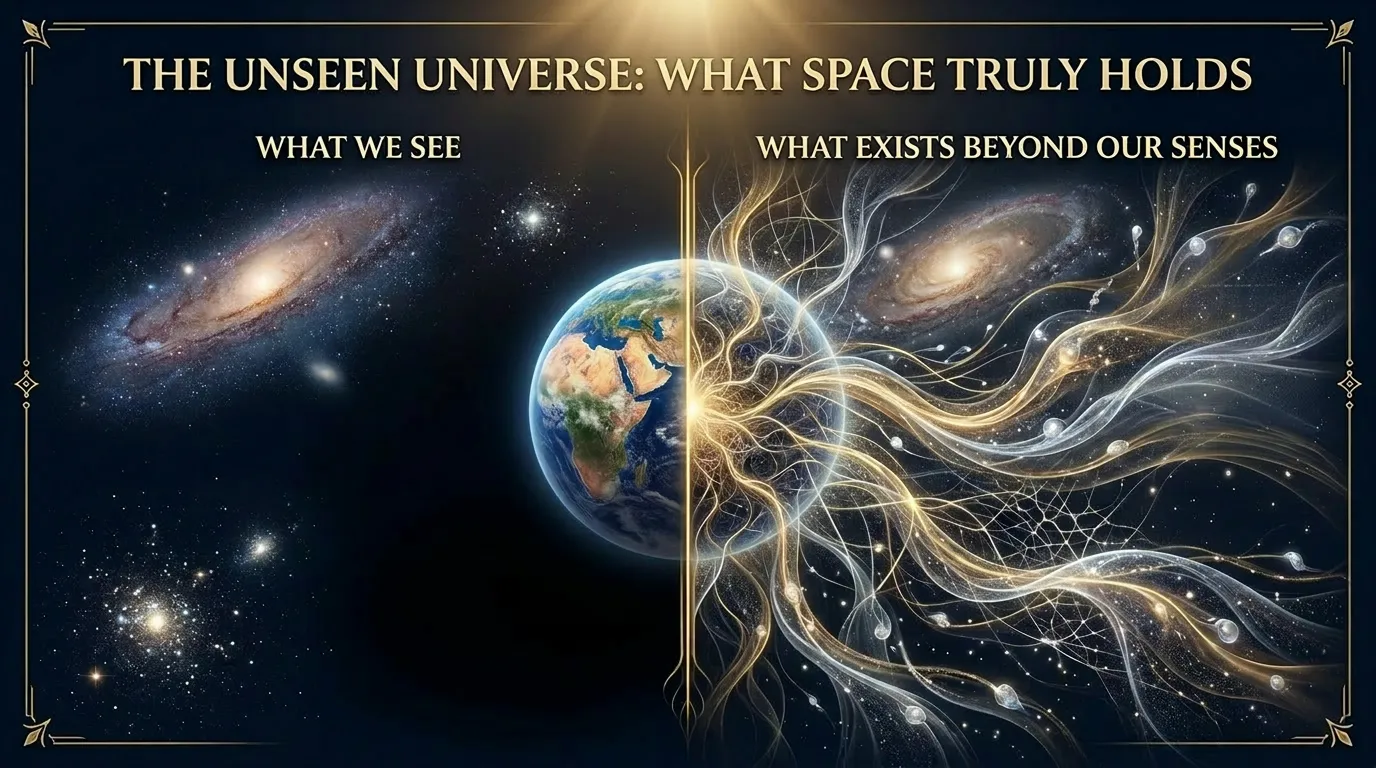
Universal space is infinite. What seems empty is not truly empty. It is filled with kinds of substance too subtle for our senses.
The universe is made of two great principles: matter and spirit. Matter is the material element. Spirit is the intelligent element. Above both is God.
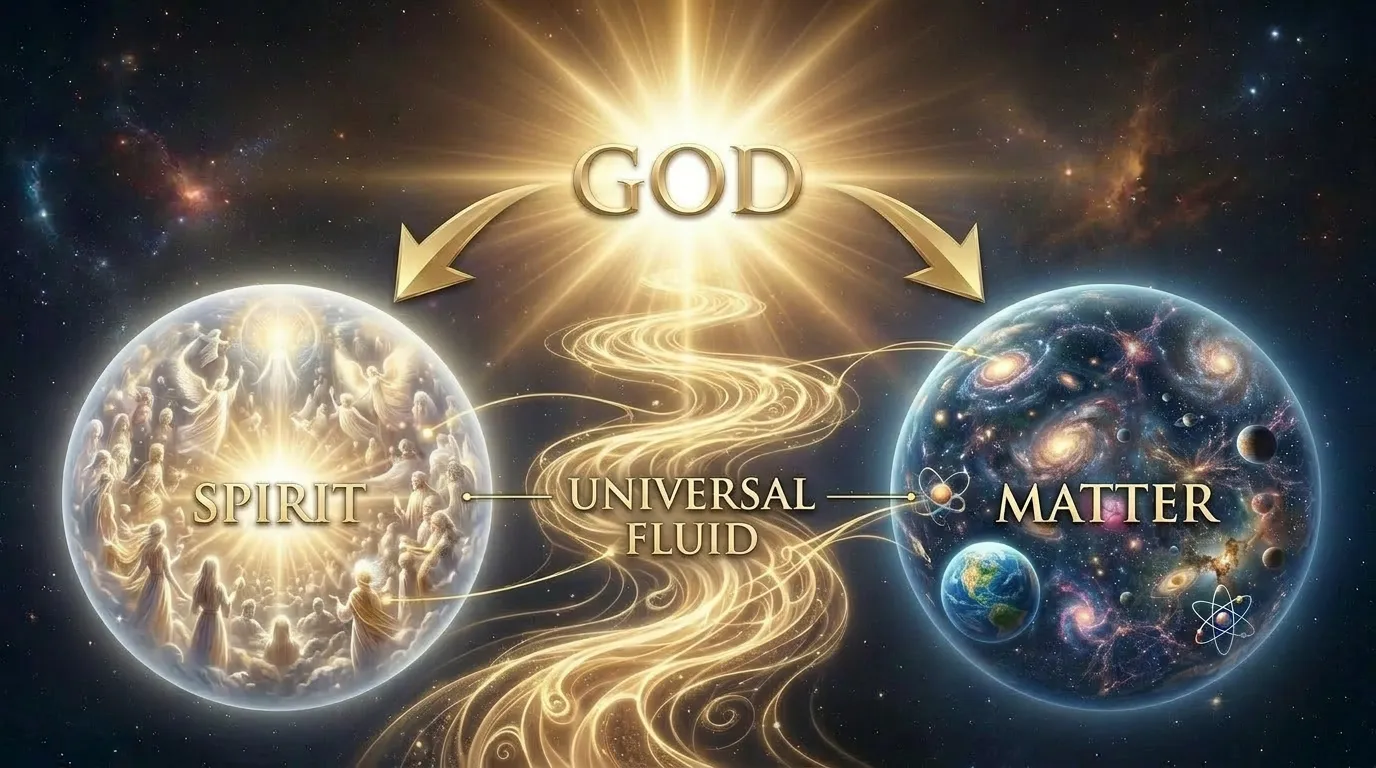
Between gross matter and spirit there is also a subtle intermediary, often called the universal fluid, a fine substance that acts as a bridge between spirit and matter. This fluid helps explain how spirit can act on matter, and how the visible and invisible worlds remain connected.
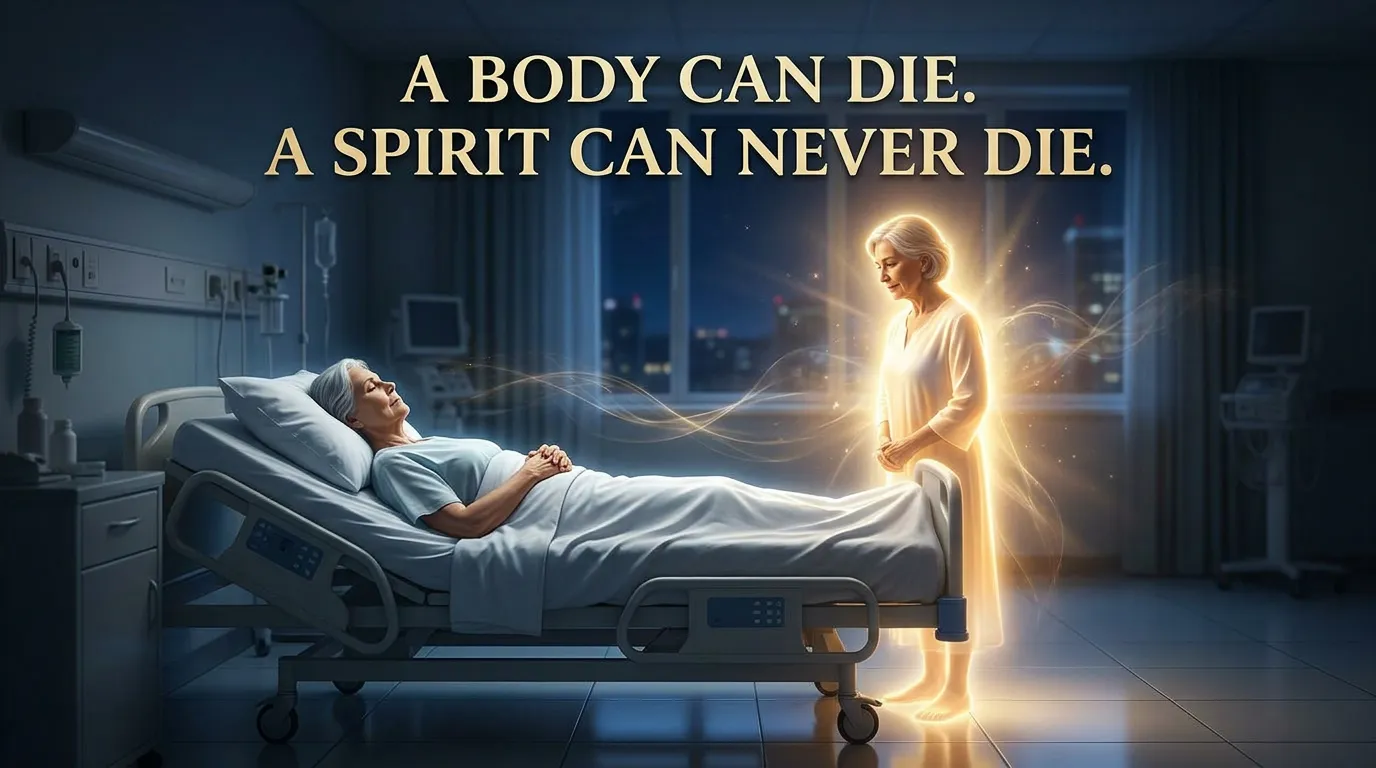
God created spirits. Spirits are not pieces of God. They are not self-created. They are created beings, individual and enduring. They had a beginning, although we do not know when or how their creation took place. But once created, they do not cease to exist. A body can die. A spirit cannot die.
Spirits Are Created Equal But Imperfect
At their beginning, all spirits are created equal. Not equal in achievement, but equal in origin and possibility.
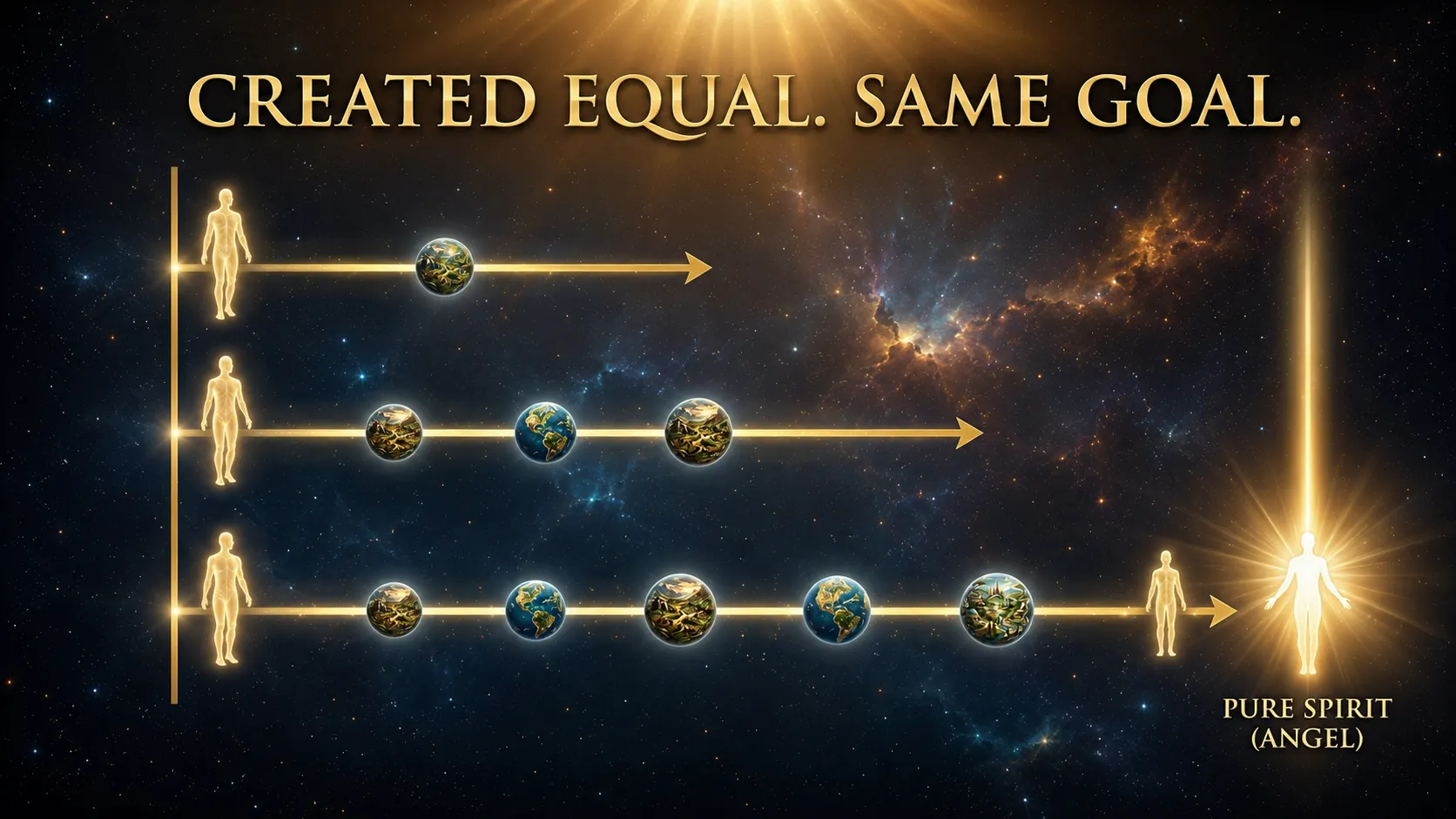
They are created simple and ignorant. Not perfect. Not wicked by nature. Not wise at the start. They begin like children of eternity, with freedom, the seed of intelligence, and the capacity to grow.
All spirits begin with the same destiny before them: progress. Their mission is to advance. Their goal is purification, meaning a state in which selfishness, pride, cruelty, and every moral stain have been overcome. They must rise, little by little, until they become pure spirits, also known as angels.
Why are they not created perfect from the beginning? Because perfection without struggle would have no merit. A spirit must learn. A spirit must choose. A spirit must be tested. Only then can goodness become truly its own.
Satan as a Figure of Evil
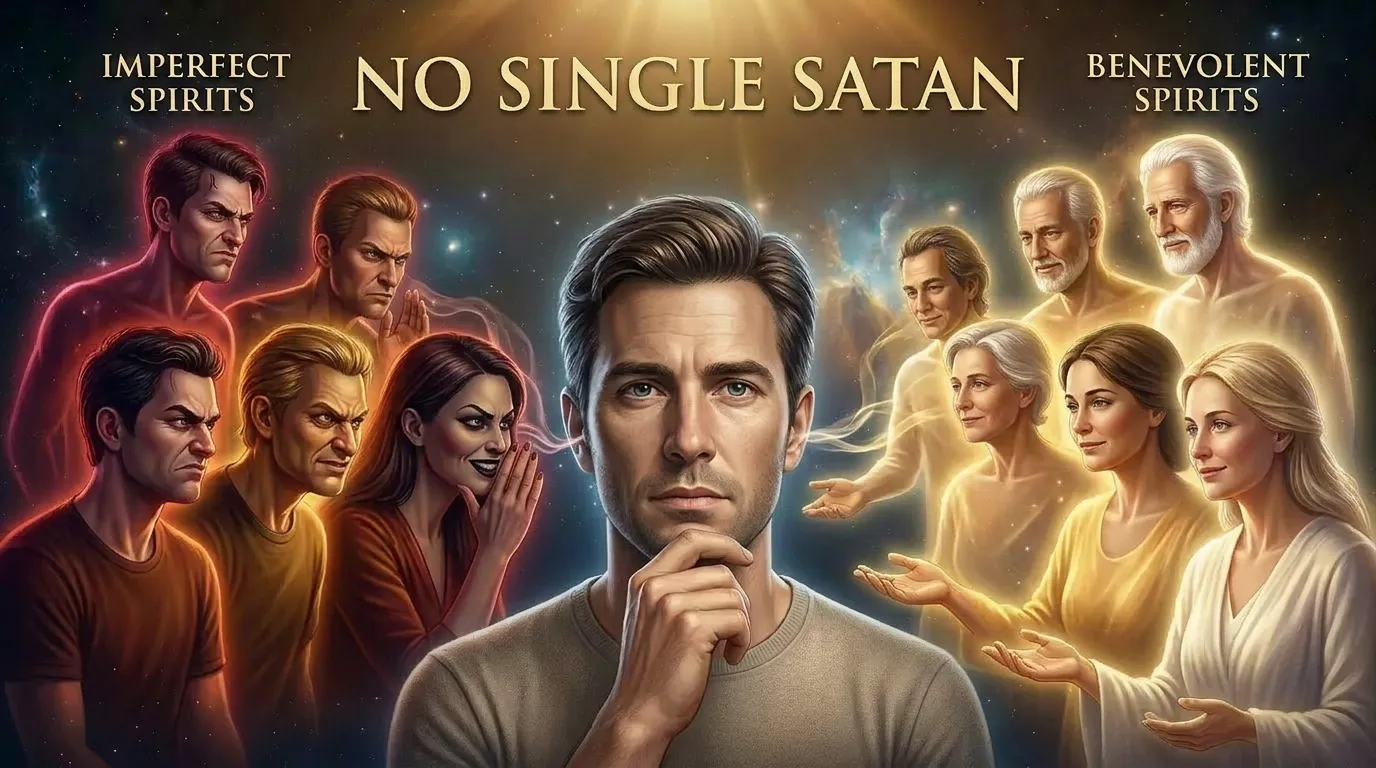
God does not create some spirits good and others evil. God does not create some to rule and others to be lost. What many people call Satan is not a rival power standing against God. In this view, Satan is a figure used to represent evil, not a being created evil forever. Still, there are imperfect spirits who remain stubborn in evil and try to influence human beings by suggesting harmful thoughts. In that sense, what many traditions personify as Satan or demons can refer to the action of such spirits. But no spirit is evil by nature or destined to remain so forever. Through suffering, repentance, expiation, and gradual reform, even the most evil spirits will eventually progress, though it may take a very long time.
Why Religions Sound Different
At this point, a question naturally arises. If this is true, why do religions, older revelations, and scriptures sometimes sound different?
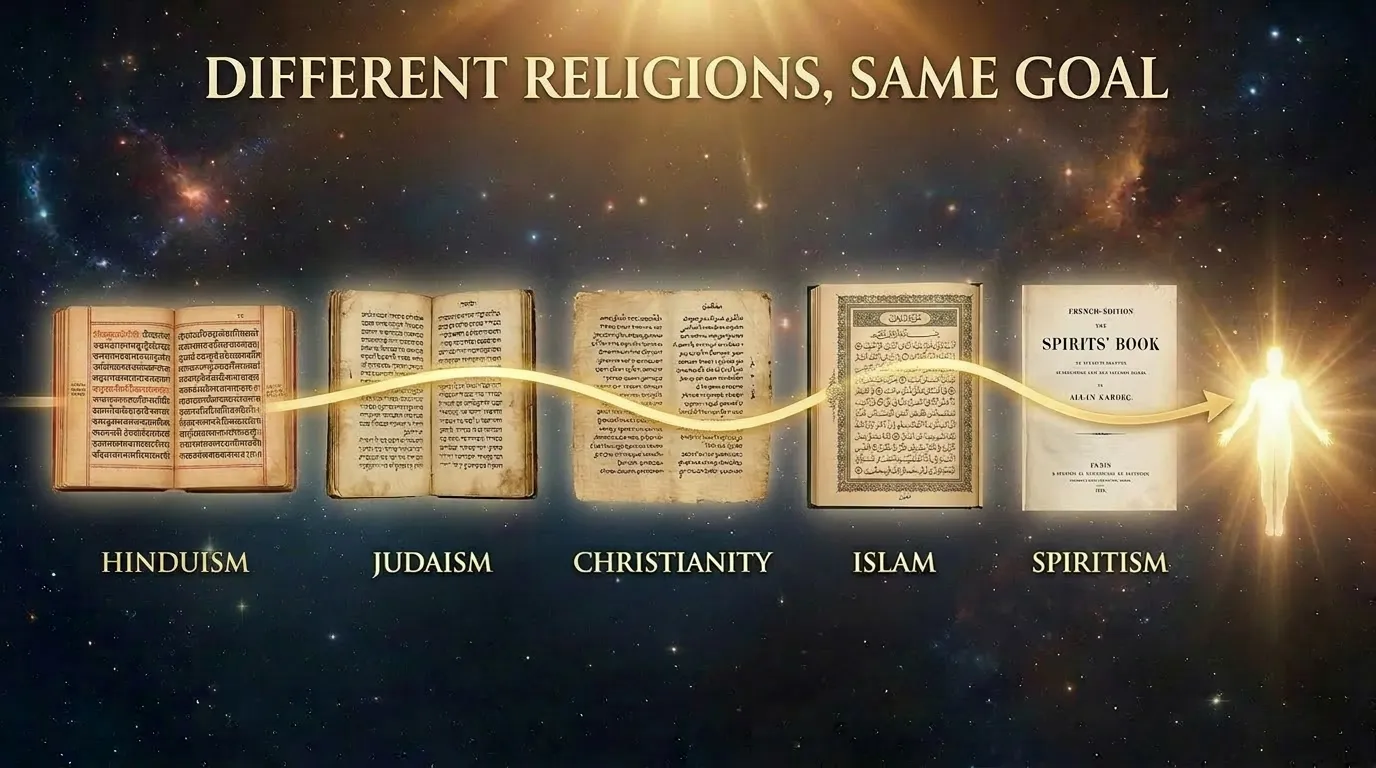
According to The Spirits' Book, the law of God does not change. But human understanding develops. Truth is given according to what people are ready to receive. And it must be expressed through the language, images, and mental world available at the time.
God could have given one identical scripture to all people all at once. But He did not. Instead, revelation came at different times, in different languages, and among different peoples. That, too, may be part of divine wisdom. People do not learn everything at once. And people in different conditions do not need every truth explained in the same way or at the same time. [1][2]
That is why older teachings were often expressed through symbol, parable, poetry, and partial ideas. The spiritual truth may be real, even when the form is limited. So the problem is not always that earlier revelation was false. Often it was incomplete, figurative, or adapted to the understanding of people at that time.
Human words are narrow. Invisible realities are difficult to describe. So people often spoke of spiritual things through earthly pictures.
This also helps explain why ancient peoples could mistake created powers for God. Some worshiped the sun. Some worshiped the stars. Some gave divine status to the sea, the sky, or other forces of nature. Later monotheistic revelation, like Judaism, Christianity, and Islam, clarified that there is only one God, and that created beings or powers must not be worshiped.
In the same way, some traditions preserved certain truths more clearly than others. The idea of repeated lives appears more explicitly in Hindu scriptures such as the Bhagavad Gita. In later monotheistic scriptures, it is much less explicit. Instead, one more often finds language about return, rising again, or resurrection, which some have read as pointing toward reincarnation, though not as a full and clear statement of reincarnation.
The same pattern appears with angels. Some scriptures, including the Quran, speak clearly about angels. In this view, angels can be understood not as a separate creation, but as spirits who reached purification. In that sense, angels aren't a different species. Becoming an angel is the goal and the end of the journey.
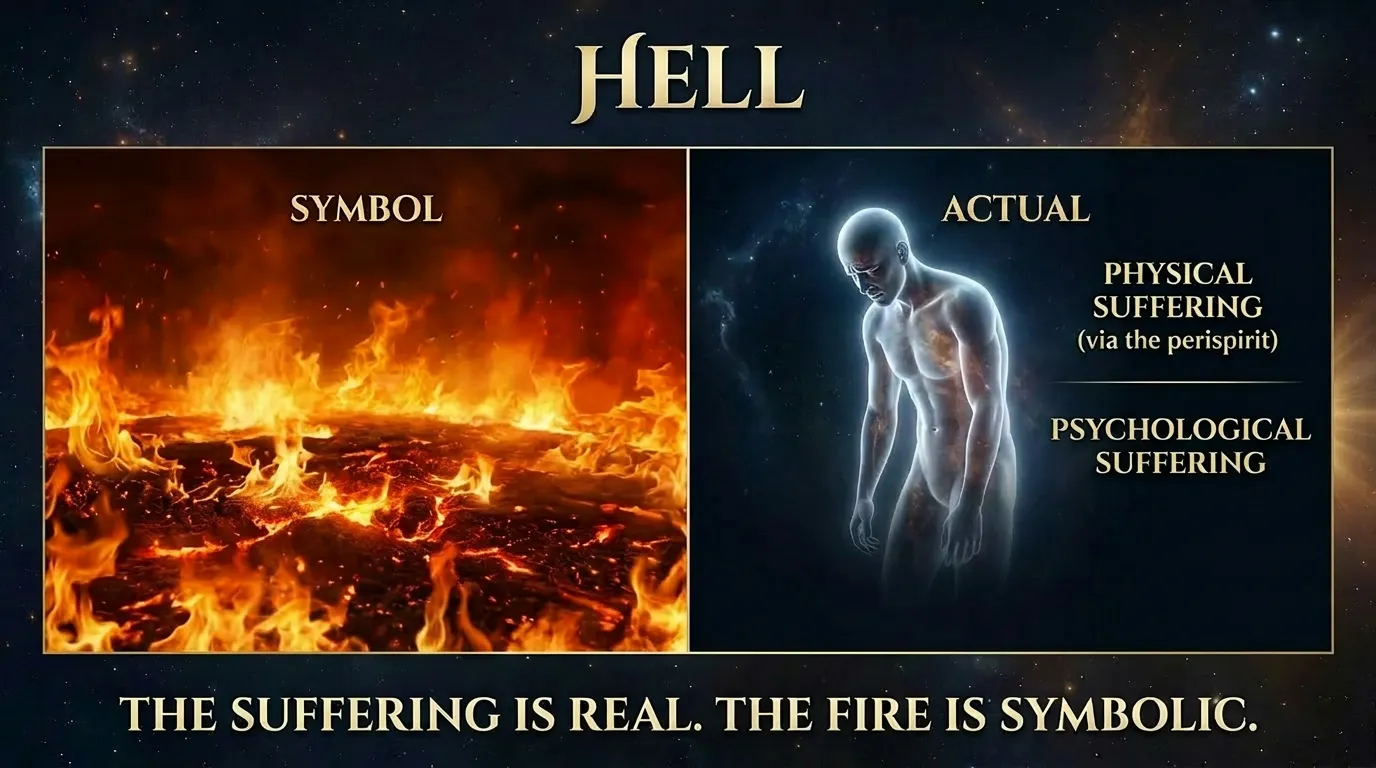
The same principle applies to heaven and hell. Some scriptures describe punishment as hell with fire. But spirits are not material bodies, so literal fire cannot be the cause their suffering. The true suffering is moral: remorse, shame, frustrated desire, separation from the good, and the clear sight of evil done.
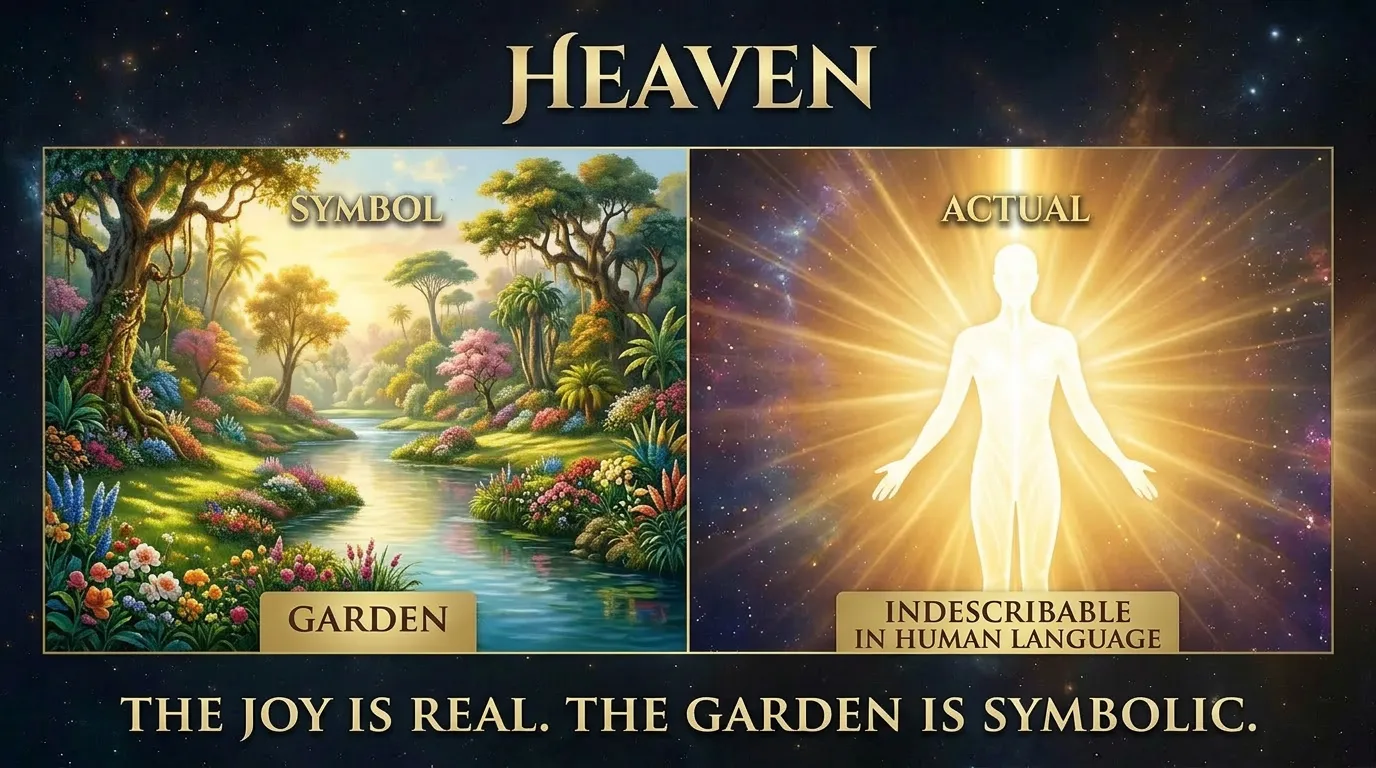
Some scriptures describe heaven through gardens, rivers, abundance, and beauty. For people living in harsh earthly conditions, such images could speak powerfully. They gave the mind something it could grasp. But the deeper reality is greater than the image suggests.
So later clarification does not destroy earlier revelation. It explains what was once expressed in forms suited to the time. Earlier teachings prepared the way for clearer understanding.
And the differences among religious forms may themselves become a moral trial. They test whether people will respond with humility, justice, and charity, or with pride, contempt, and violence. If morality and righteousness are the heart of revelation, then how people treat those who received a different form may reveal how much of that revelation they truly understood. [1]
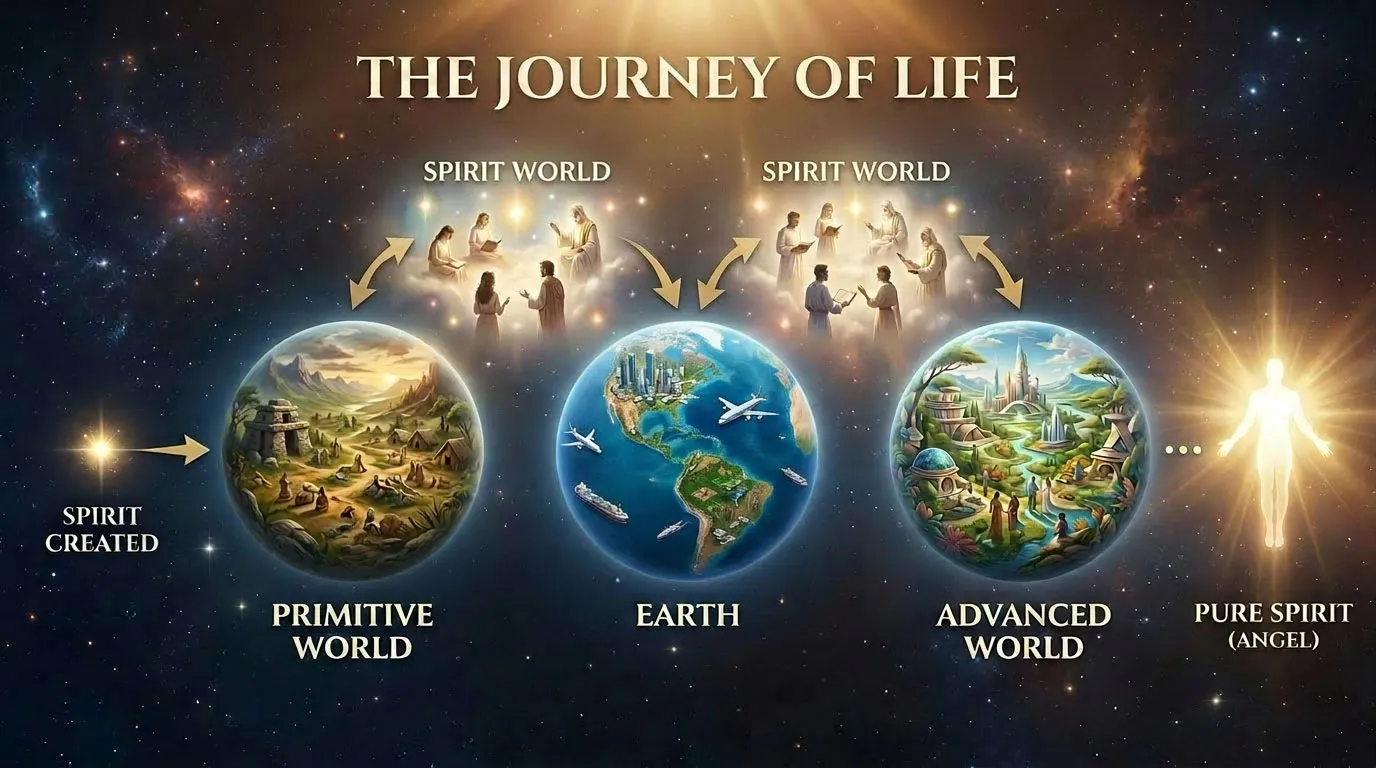
So the history of a spirit is the history of gradual progress. Not instant enlightenment. Not one single earthly life. But a long education across many conditions, many worlds, and many incarnations.
[1] This understanding happens to be mentioned specifically in chapter 5 verse 48 of the Quran.
[2] This understanding happens to be mentioned specifically in chapter 14 verse 4 of the Quran.
Life in the Spirit World
Before incarnation, the spirit exists in the spirit world. This is the primary world. It existed before the visible world, remains after it, and surrounds it constantly.
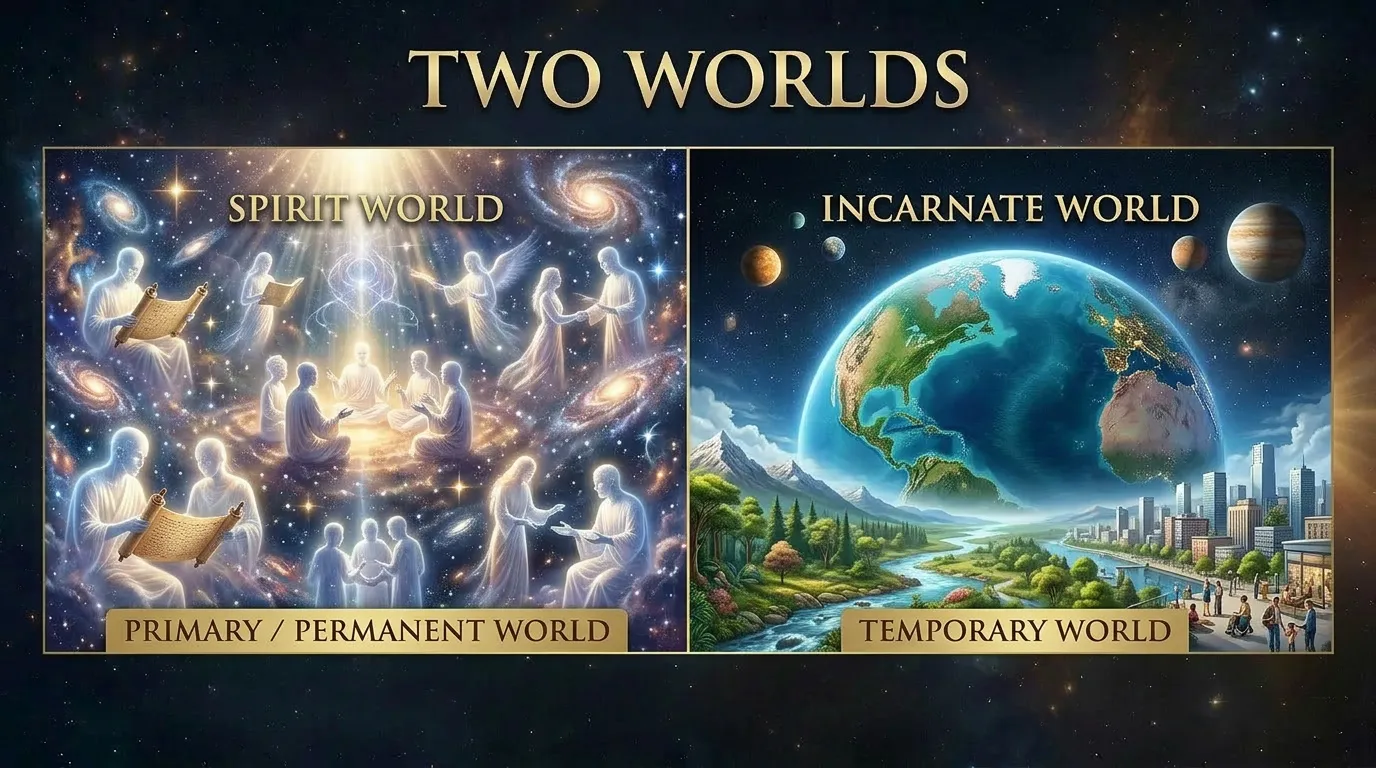
Spirits fill space. They are not confined to one point as human bodies are. They are described as moving with the speed of thought. In that sense, thought carries them where they direct themselves. Matter does not block them in the way it blocks bodily beings.
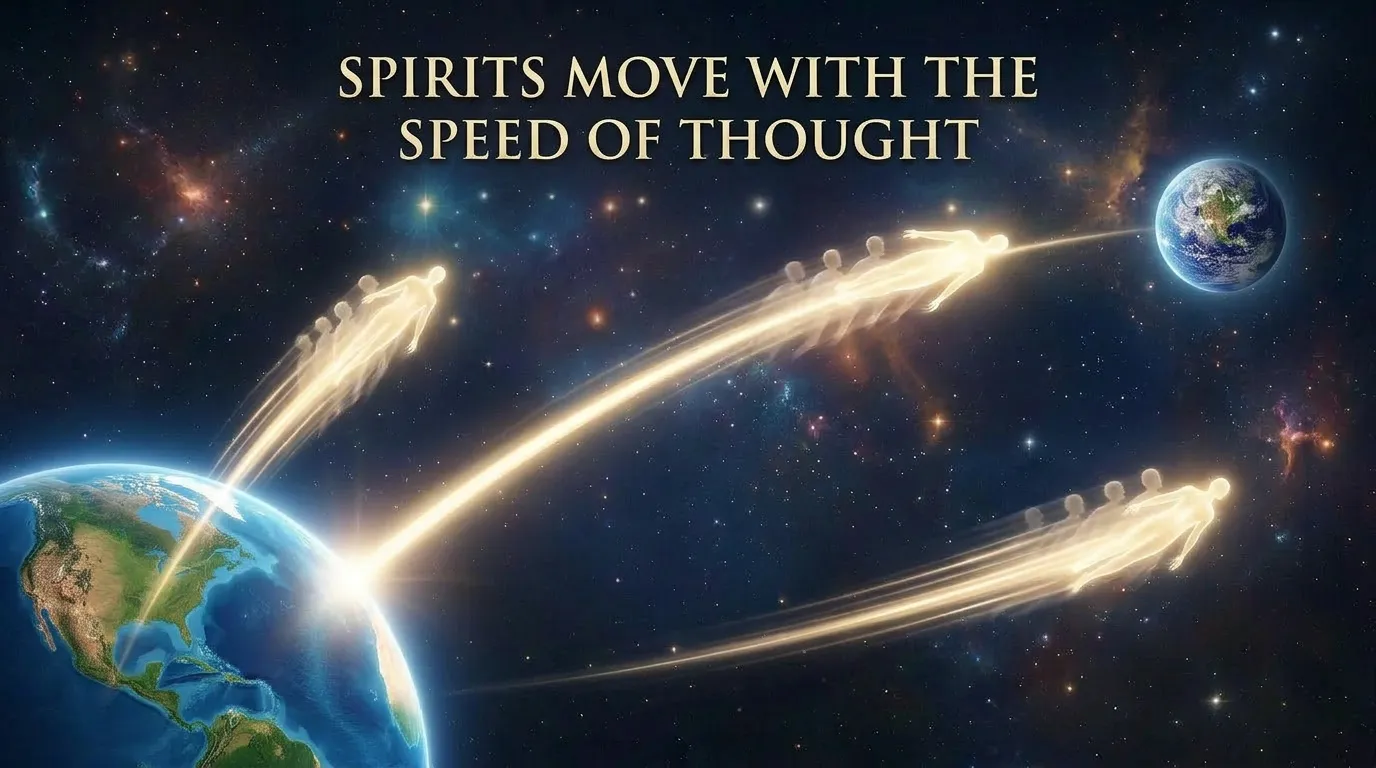
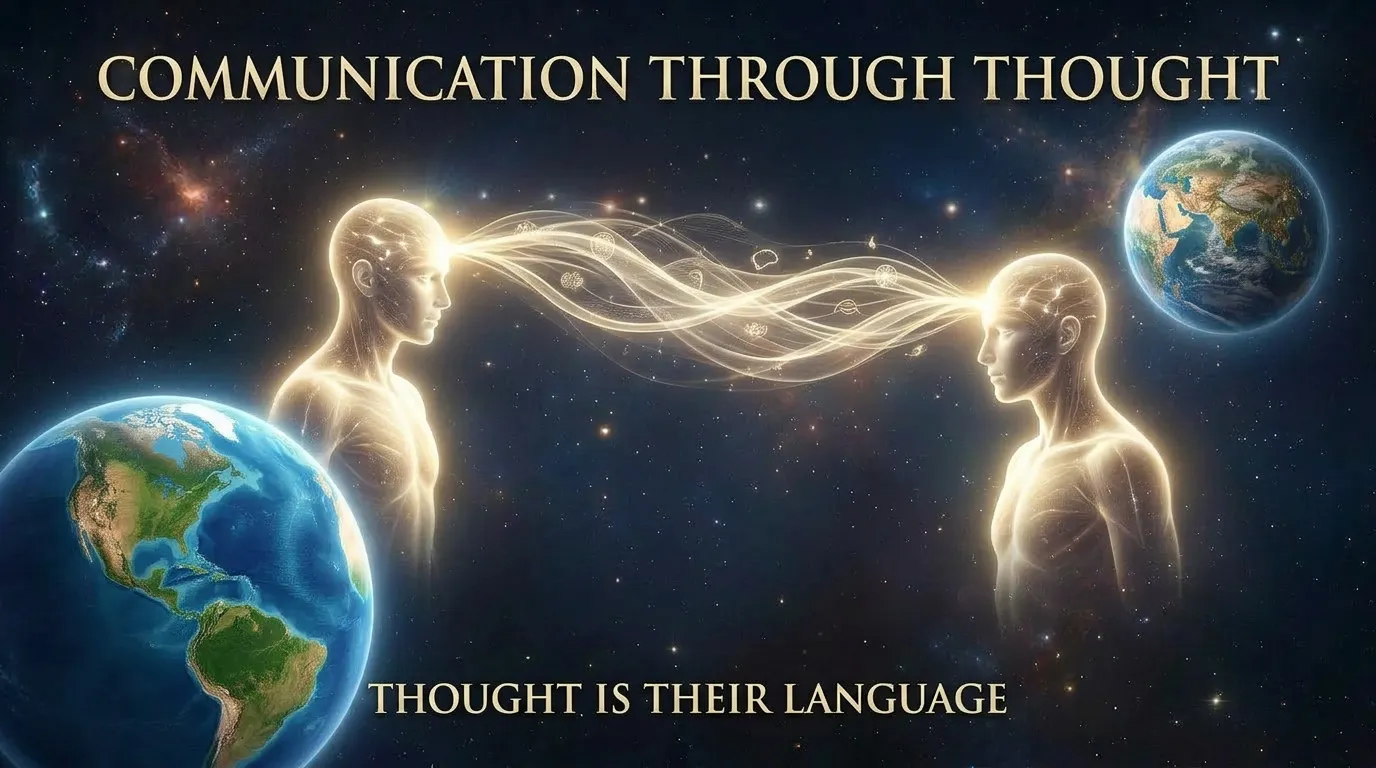
They do not speak by mouths or hear by ears in the earthly way. They communicate through thought. And as spirits become more purified, their influence can reach farther and act more freely.
The Perispirit
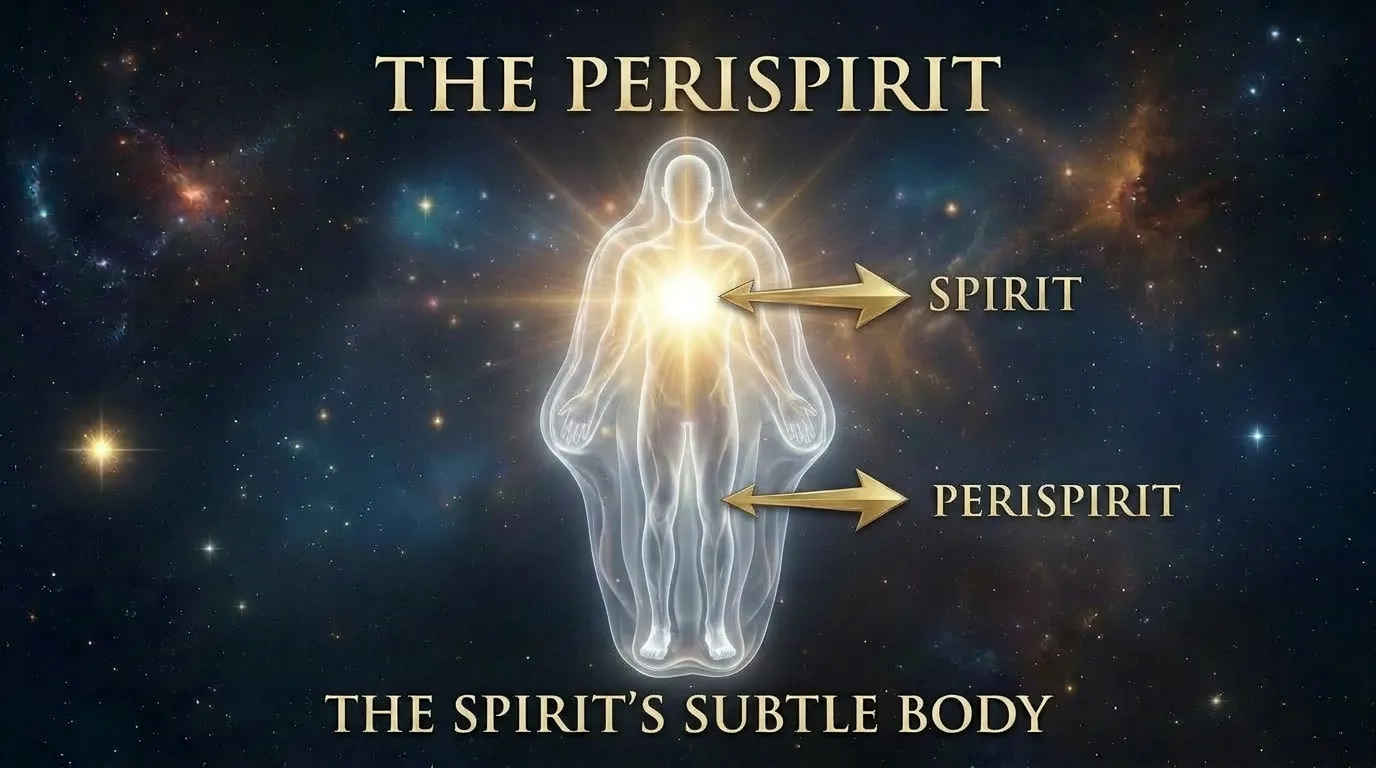
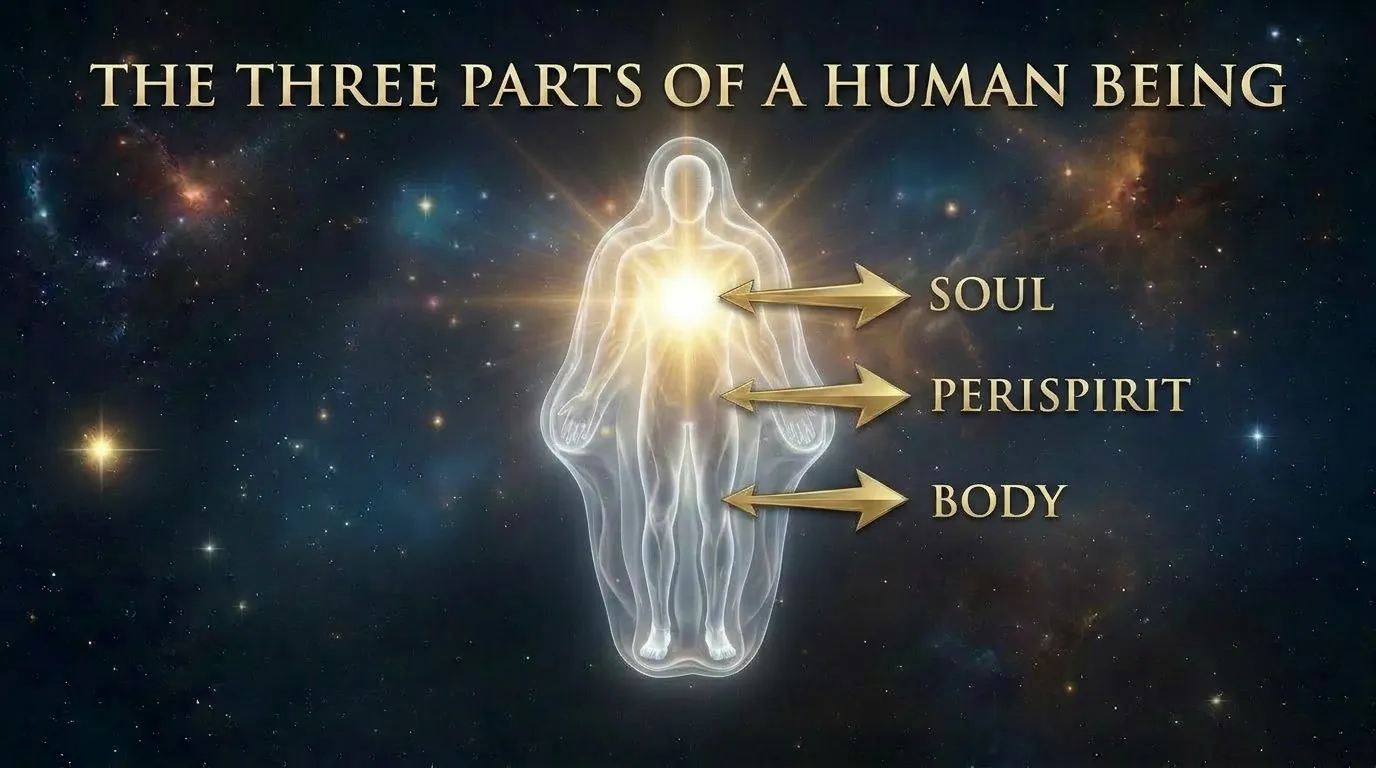
Every spirit is clothed in a subtle envelope called the perispirit, a fluid-like spiritual body that surrounds the spirit. This is not a tangible body, but it is still a real form. It allows the spirit to act, to appear, and to remain distinct. Through the perispirit, the spirit preserves individuality and can sometimes become perceptible.
Gender and the Spirit
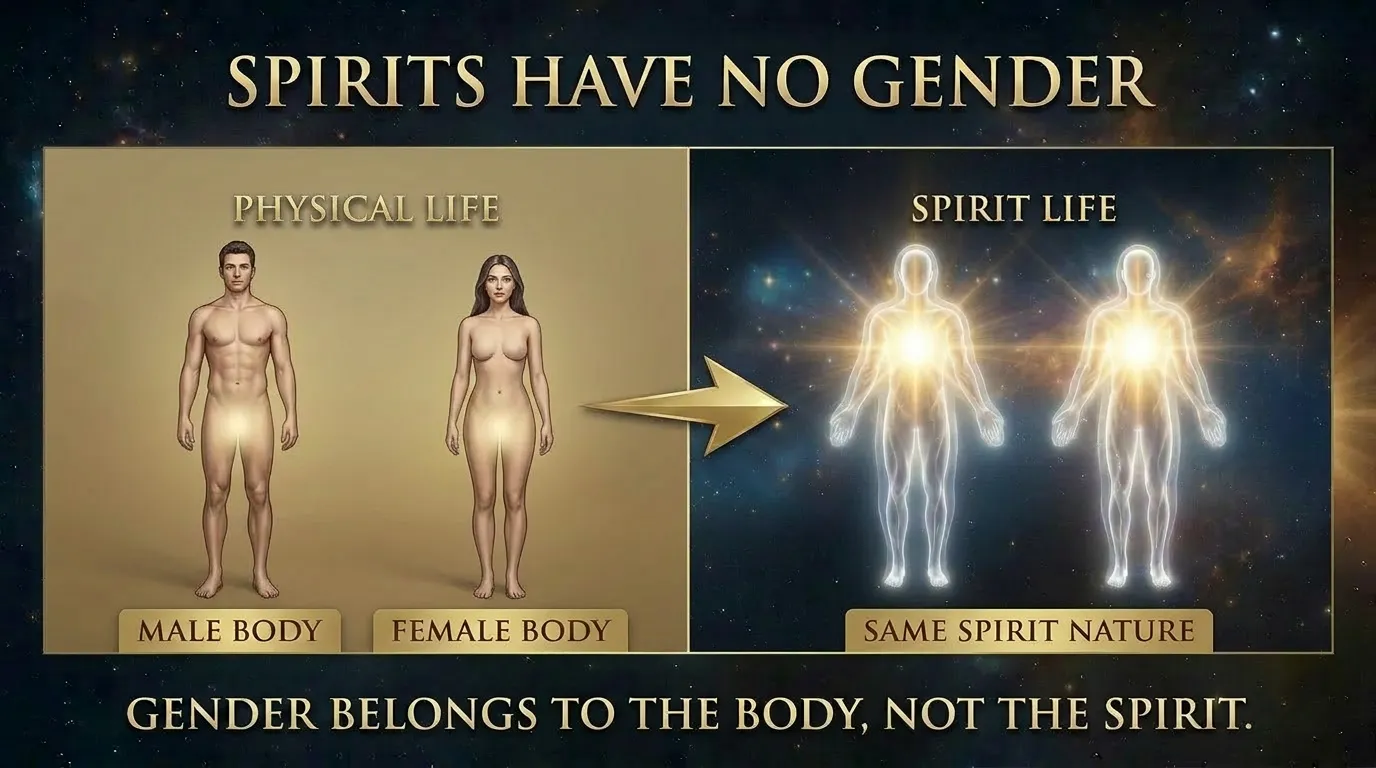
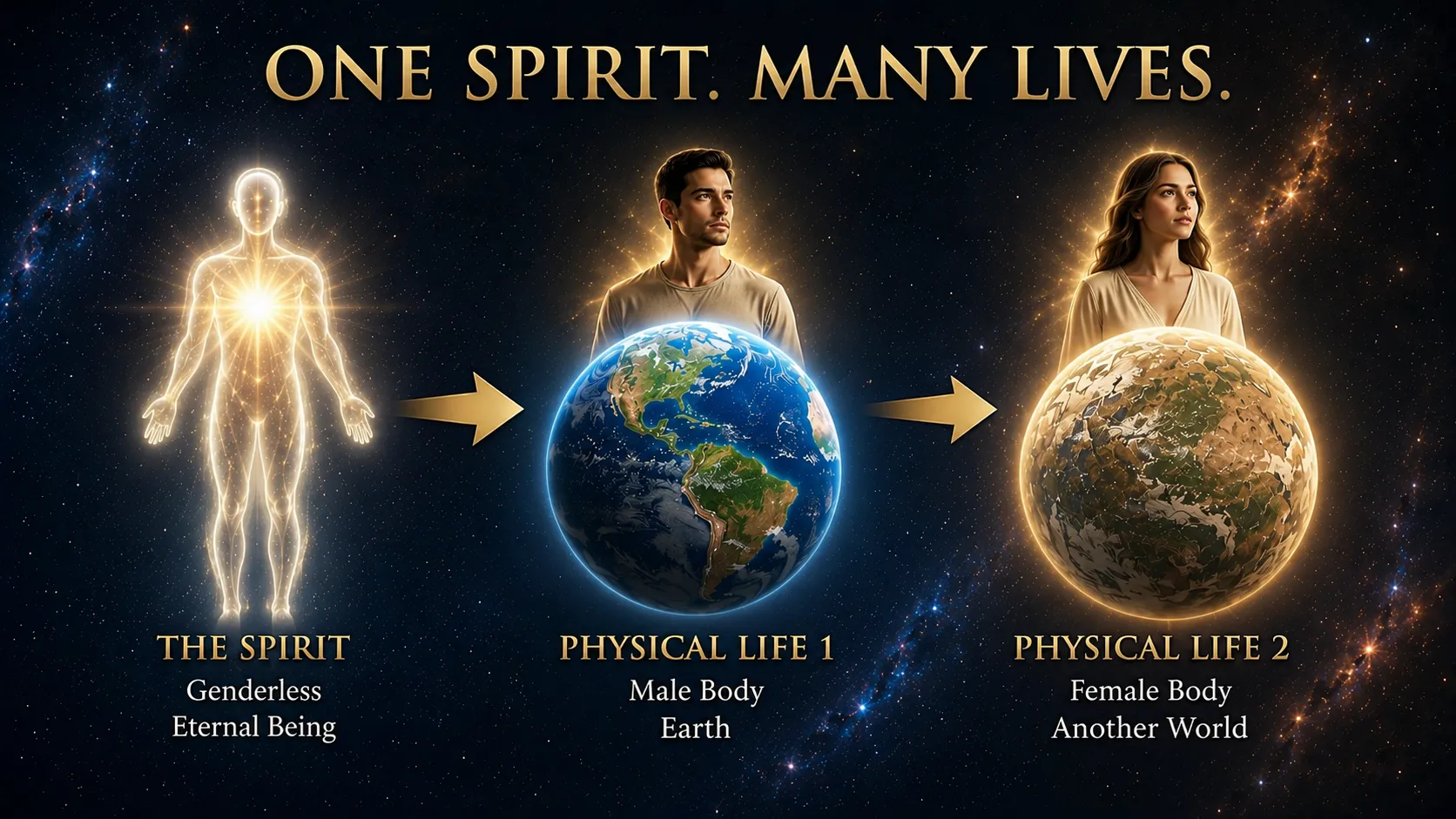
Spirits do not have gender in themselves. They are not male or female in the earthly sense. Gender belongs to the physical body, not to the spirit. Love, sympathy, and affection remain in spirit life, but they do not come from physical intimacy. They come from harmony of character, memory, and moral affinity.
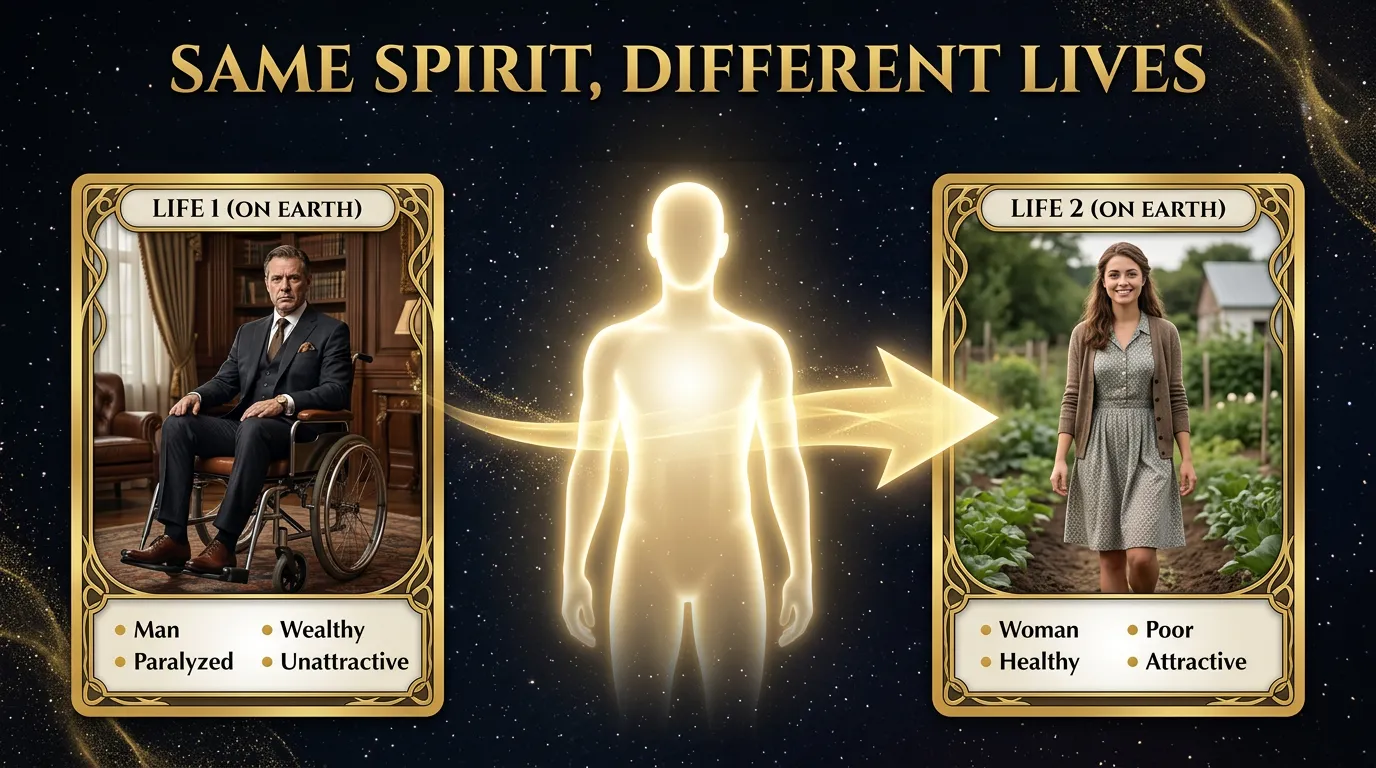
Because spirits are genderless in themselves, the same spirit can live one life in a male body and another in a female body. Why? Because each form of life offers different duties, relationships, trials, and lessons. So gender is part of embodied education, not part of the eternal essence of the soul.
Incarnation and Many Worlds
A spirit progresses through incarnation. Incarnation means taking on a material body suited to a world. On Earth, this means a human body. On other worlds, it may mean a body very different from ours.
Earth is not the only inhabited world. It is not the highest world. It is one world among many. Different worlds have different physical conditions, and spirits incarnate in bodies suited to those worlds. As spirits advance, they can move from more material worlds to more refined ones. On higher worlds, bodies are less dense, needs are less harsh, selfishness is weaker, and the beings there understand spiritual life more clearly.
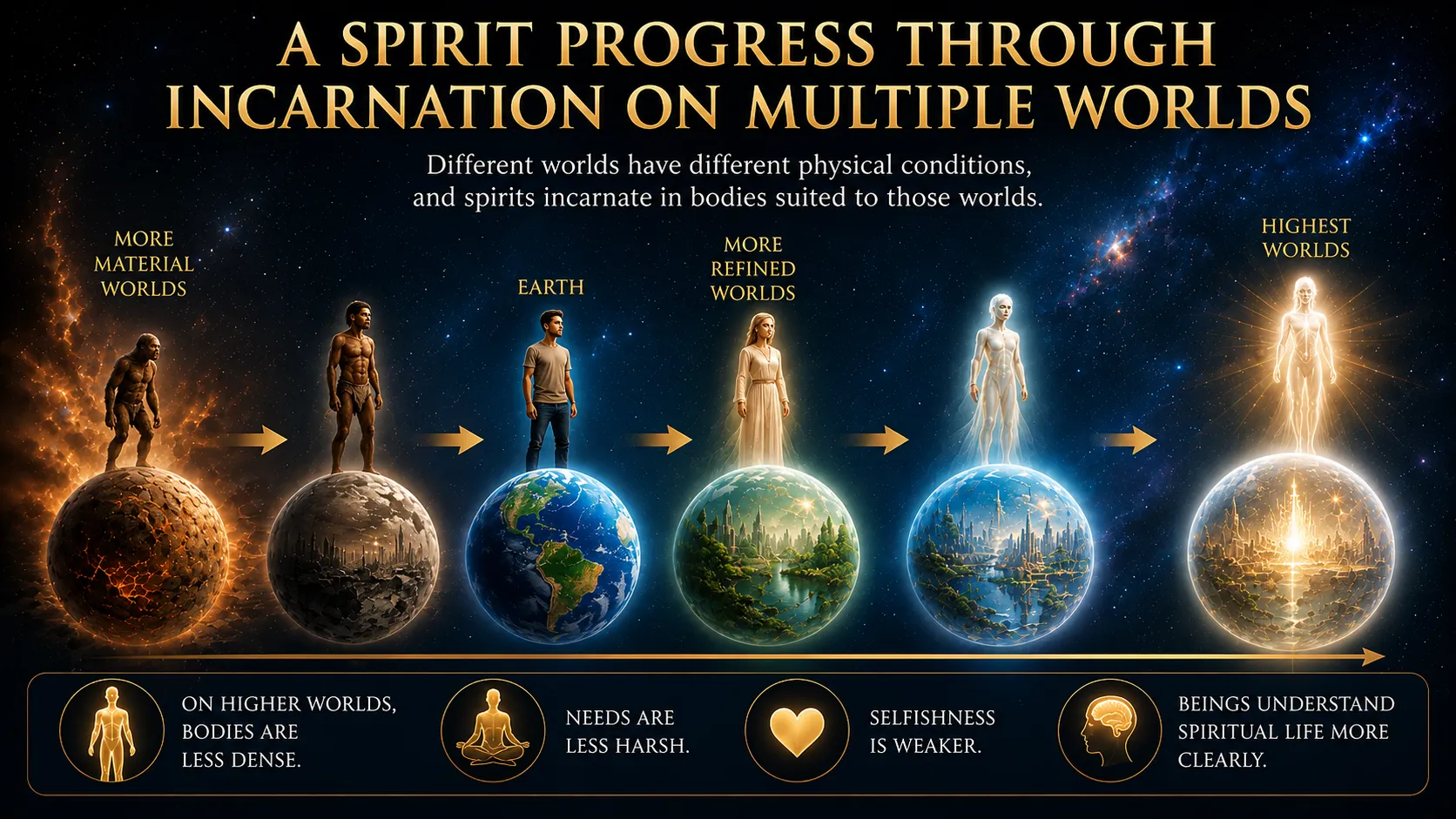
So the journey of a spirit is not limited to Earth. A spirit may incarnate many times on the same world if it still needs the lessons of that world. Or it may move on to another world when ready.
Transitional Worlds
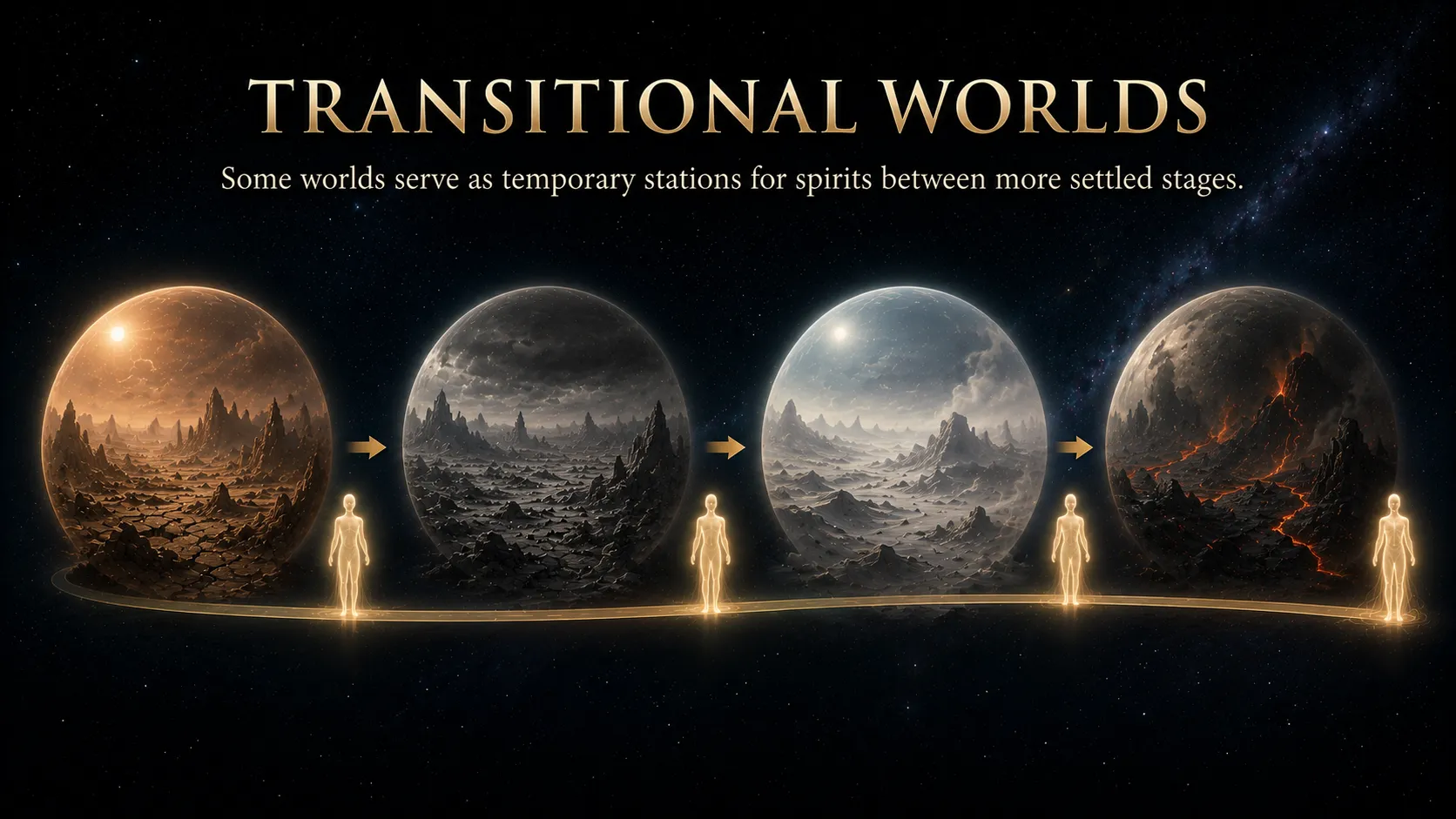
Some worlds serve as temporary stations for spirits between more settled stages.
They are not permanent homes.
They may be barren by earthly standards, yet still suited to the beings who dwell there.
Earth itself once passed through such a stage.
So life is not limited to the narrow forms familiar to us now.
Why Spirits Incarnate
Incarnation has two major purposes: expiation and improvement. Expiation means paying for and repairing past faults and sins through the trials of life. Improvement means gaining knowledge, moral strength, and purification, meaning moral cleansing and steady progress toward goodness.
Before a new life, the spirit often passes through a state between incarnations. That means it is no longer in a body, and has not yet entered a new one. In that state, it reflects on its past, sees more clearly what imperfections it still must overcome, receives guidance, and prepares for another incarnation.
Choosing Trials
Before reincarnating, the spirit may choose the kind of life it will undergo. Not every tiny detail. Not every event. But the general kind of trial.
It may choose poverty. Or wealth. Health. Or illness. Power. Or obscurity. Freedom. Or dependence. A difficult family. A short life. A body with severe limitations. A life among temptation. Or a life of service.
Why would a spirit choose suffering? Because from the spirit's point of view, earthly life is brief, but its consequences are lasting. A hard life may allow faster purification, meaning faster moral cleansing and correction. A spirit that once abused wealth may choose poverty. A spirit that once ruled harshly may choose subjection. A spirit that once caused physical suffering may choose a body that suffers.
A spirit may also choose not only expiation, but mission, meaning a life taken on in order to help others. A more advanced spirit may accept a life in a difficult environment in order to help others.
So not every hardship is punishment. Some hardships are chosen for growth. Some are chosen for repair as if to pay for past mistakes or sins. And some are accepted for service.
Still, the choice is not always fully free. If a spirit is too ignorant, too stubborn, or too blind to choose well, God may impose a life suited to its correction. So there is freedom, but not anarchy. There is responsibility, but always under divine law.
The Soul in Bodily Life
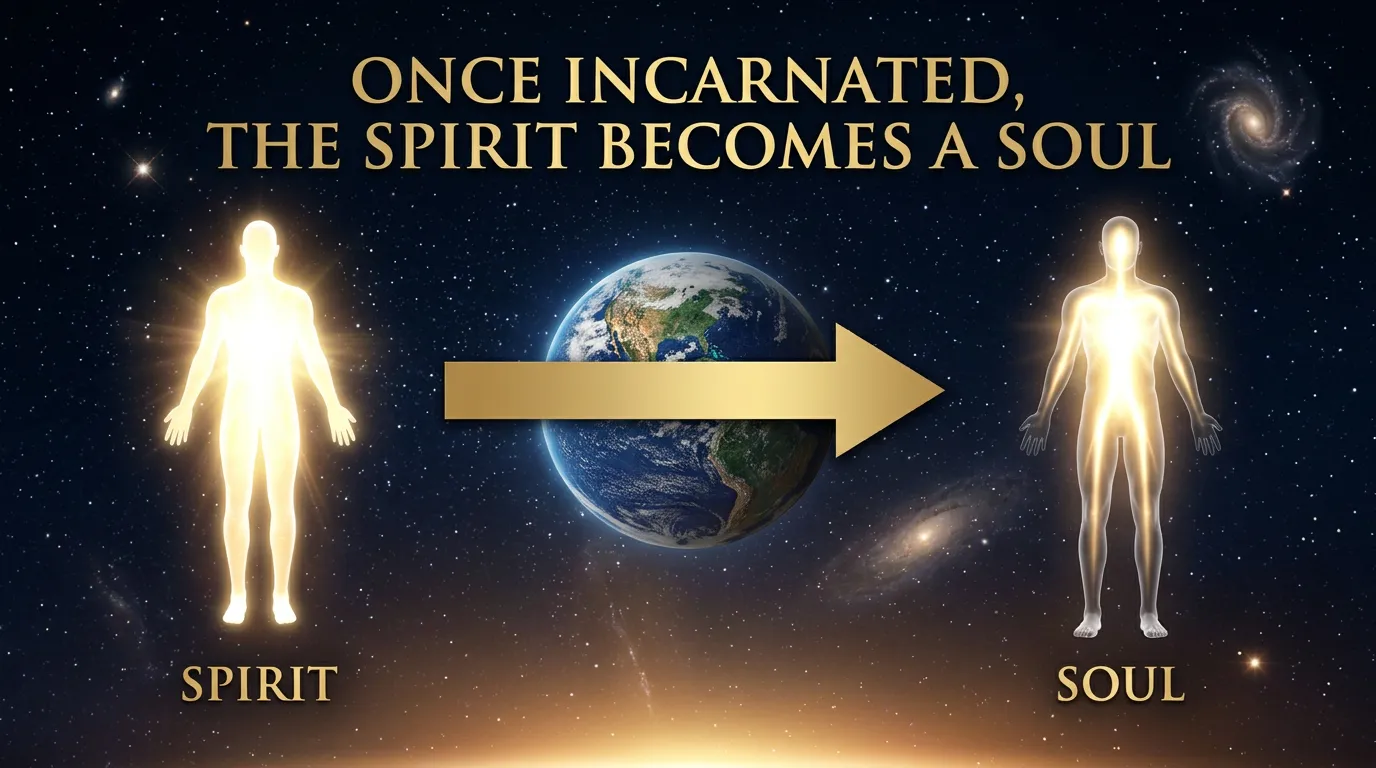
Once incarnated, the spirit becomes what we call a soul. The soul is simply the incarnate spirit.
Conception, Birth, and Incarnation
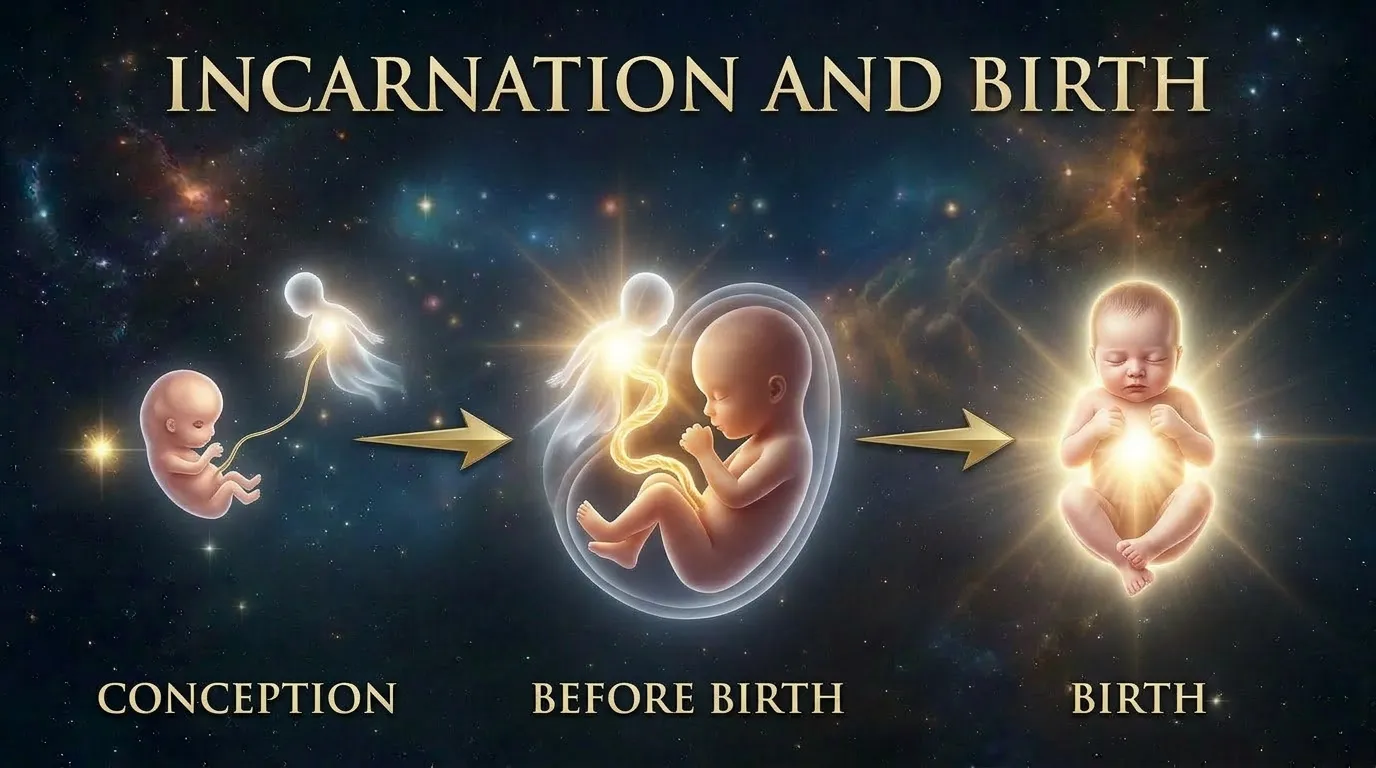
The human being has three main elements: the body, the soul, and the perispirit. The perispirit is the subtle fluid-like envelope that links the soul to the body.
That union begins at conception. The spirit meant for that body is linked to it from the beginning. At first, the bond is still weak. As the body develops, the bond grows stronger. If it breaks before birth, the child does not live.
The union is not complete until birth. So before birth, the spirit is attached. But it is not yet fully active in earthly life. In that sense, incarnation is not yet complete. Not every body lost before birth had reached a completed incarnation. The first cry marks the spirit's full entry into bodily life. From that point, the bond lasts until death breaks it.
The Body and the Soul
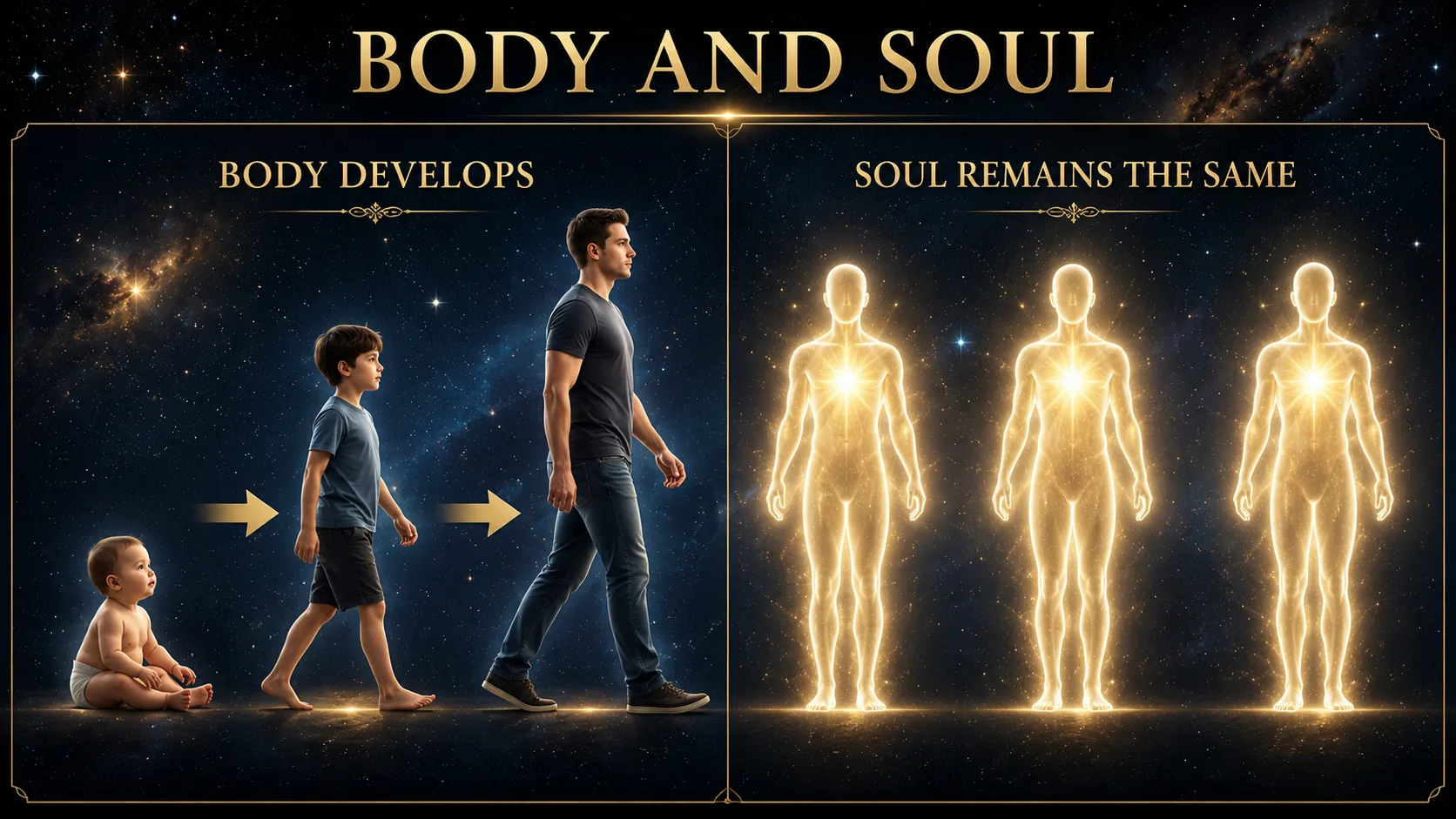
The body is an instrument. It is not the source of intelligence, conscience, or character. The soul already possesses its faculties. The body only allows those faculties to appear under material conditions.
This is why a child's spirit is not less complete than an adult's. What develops is not the soul itself, but the organs through which it can express itself.
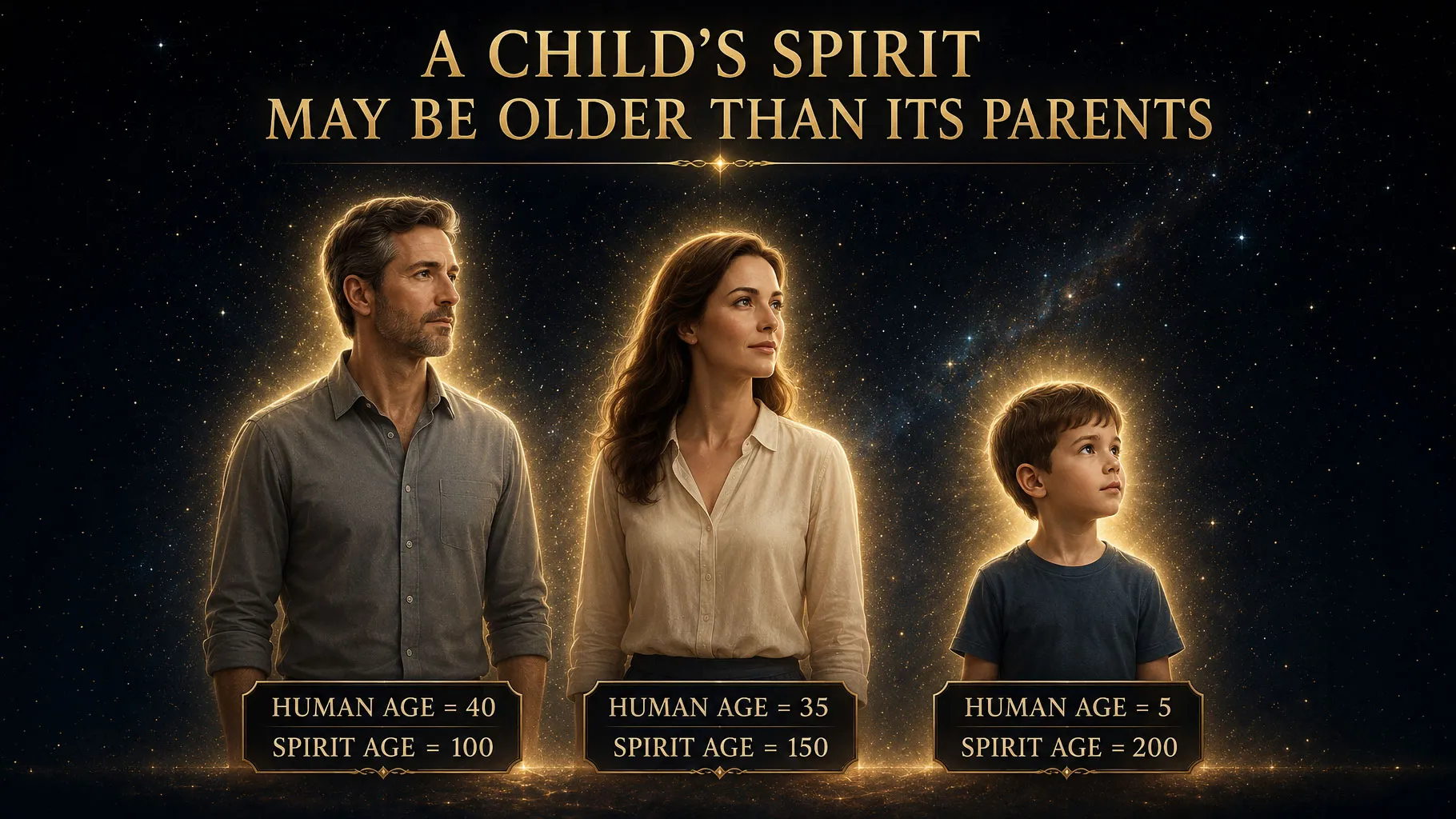
Parents give the body. They do not give the soul its conscience, intelligence, or deepest tendencies. So a child may be young in body, yet older in spirit than the parents.
Parents and Childhood
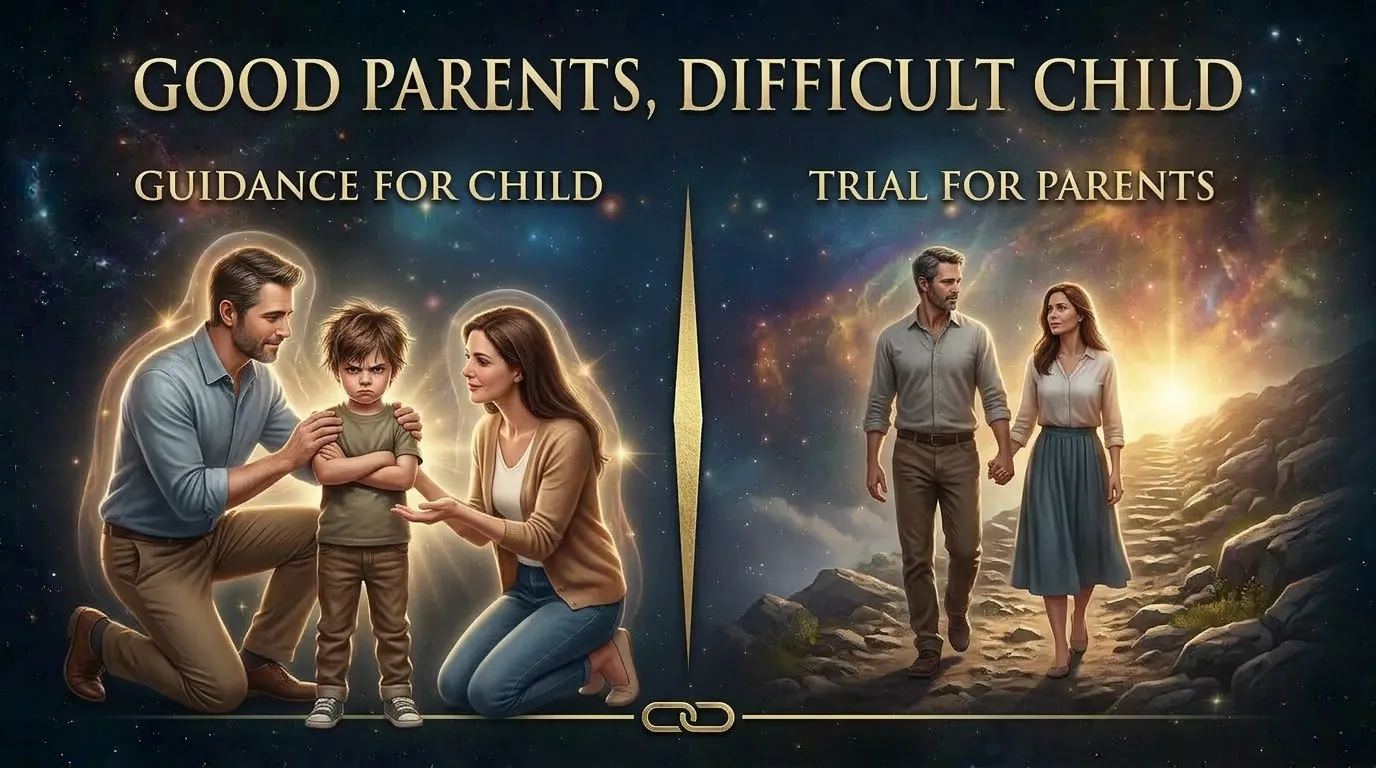
Good parents may receive a difficult child. That spirit may need guidance for its own reform. It may also become a trial for the parents.
Childhood is a period of adaptation. The spirit enters a new life under a veil. Its full character does not show at once. That is part of divine wisdom. Childhood makes the spirit more pliable and easier to guide. This is why education matters so much.
Parents and teachers are not shaping a blank machine. They are helping an already existing spirit continue its progress.
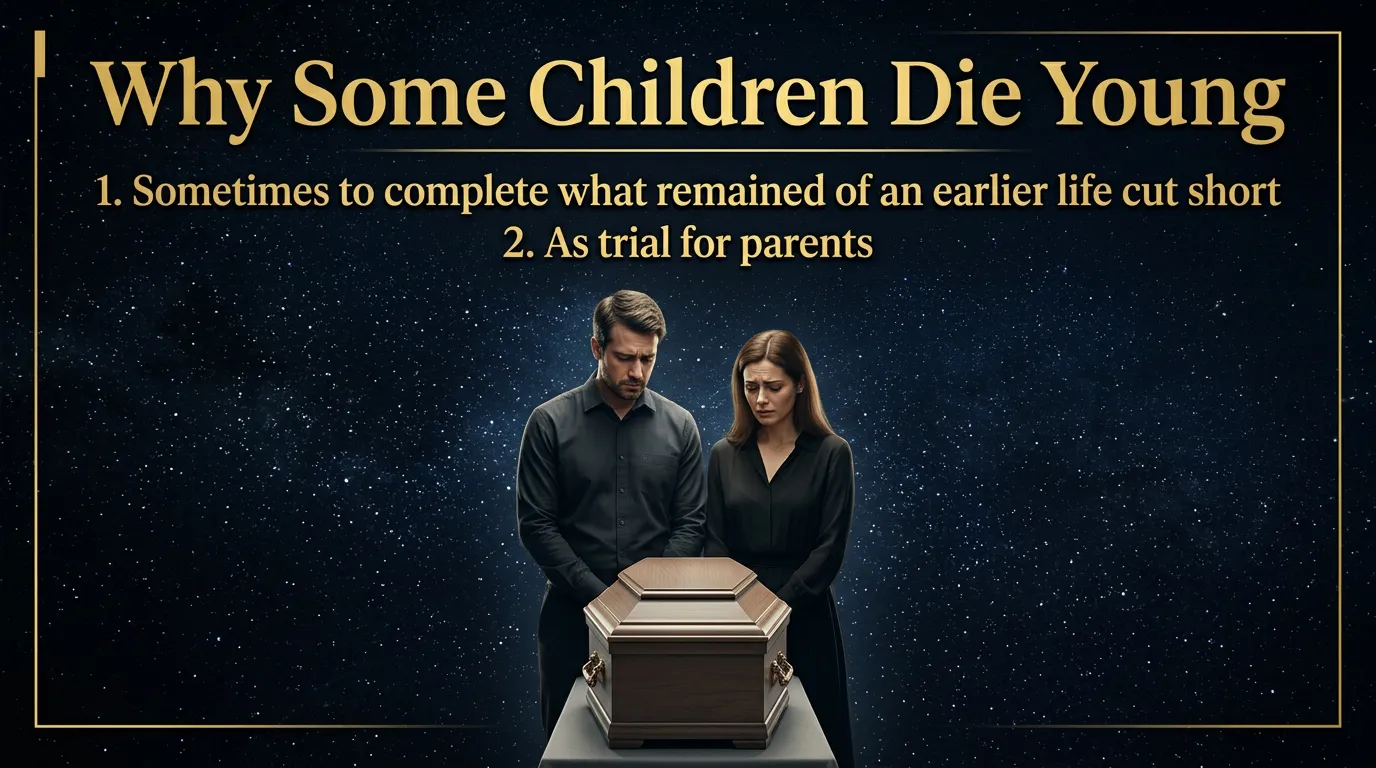
Why Some Children Die Young
Sometimes a child dies young because that brief life completed what remained of an earlier life cut short. But that does not mean the spirit was already pure. Dying young is not the same as finishing the whole journey.
The progress of that spirit is not complete. It enters another existence and continues its development. And for the parents, such a loss may also be a painful trial.
Mental Illness and Spiritual Influence
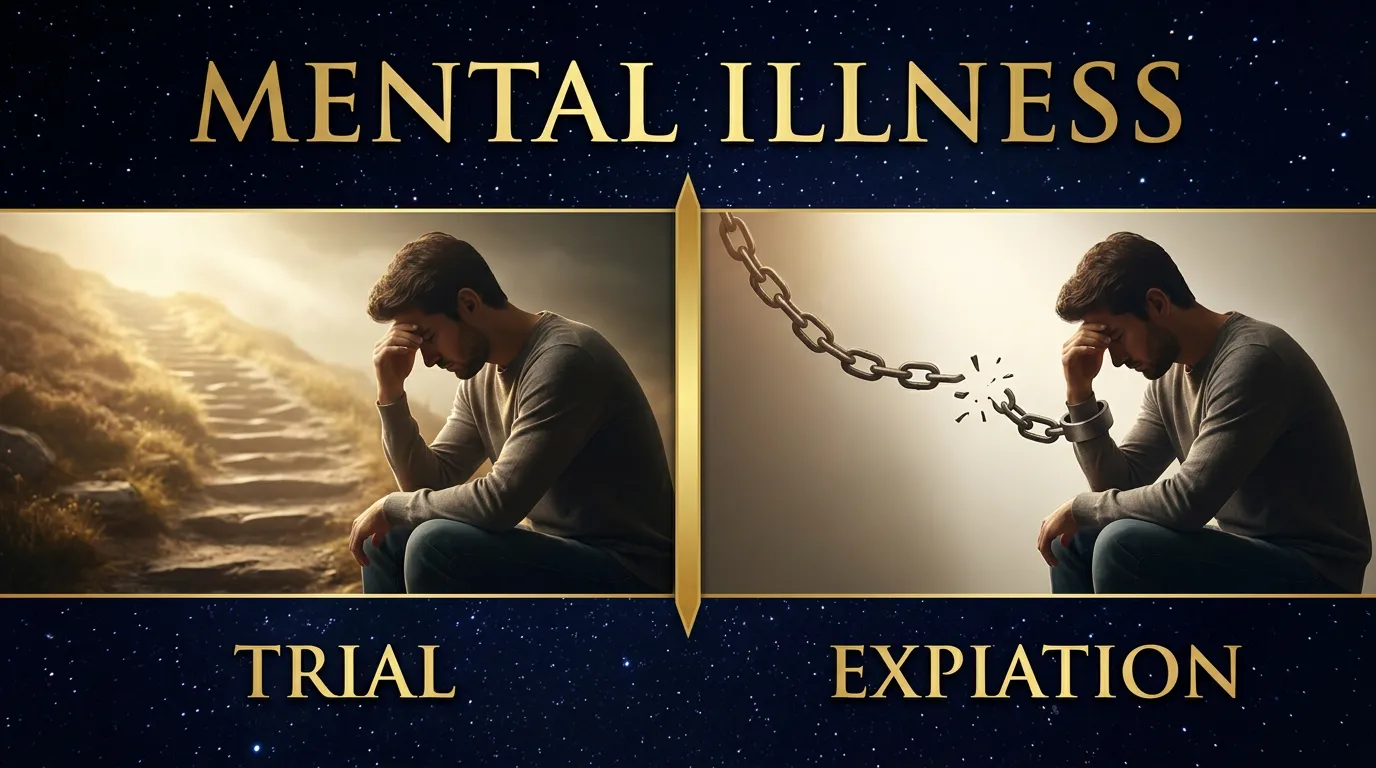
A damaged brain can hinder the soul's expression without diminishing the soul itself. So mental illness is not proof of a lesser spirit. Sometimes such a condition is a trial or an expiation. Responsibility is also lessened when reason cannot act freely through a disordered brain.
No other spirit literally replaces the incarnate soul in the body. But a person may still come under strong spiritual influence or subjugation. So some cases do involve spirit influence. And many cases once called demonic possession are really illness and belong to medicine.
Freedom, Influence, and Guardian Spirits
During incarnation, spirits remain free. That freedom is essential. Without free will, there would be no merit, no guilt, no growth.
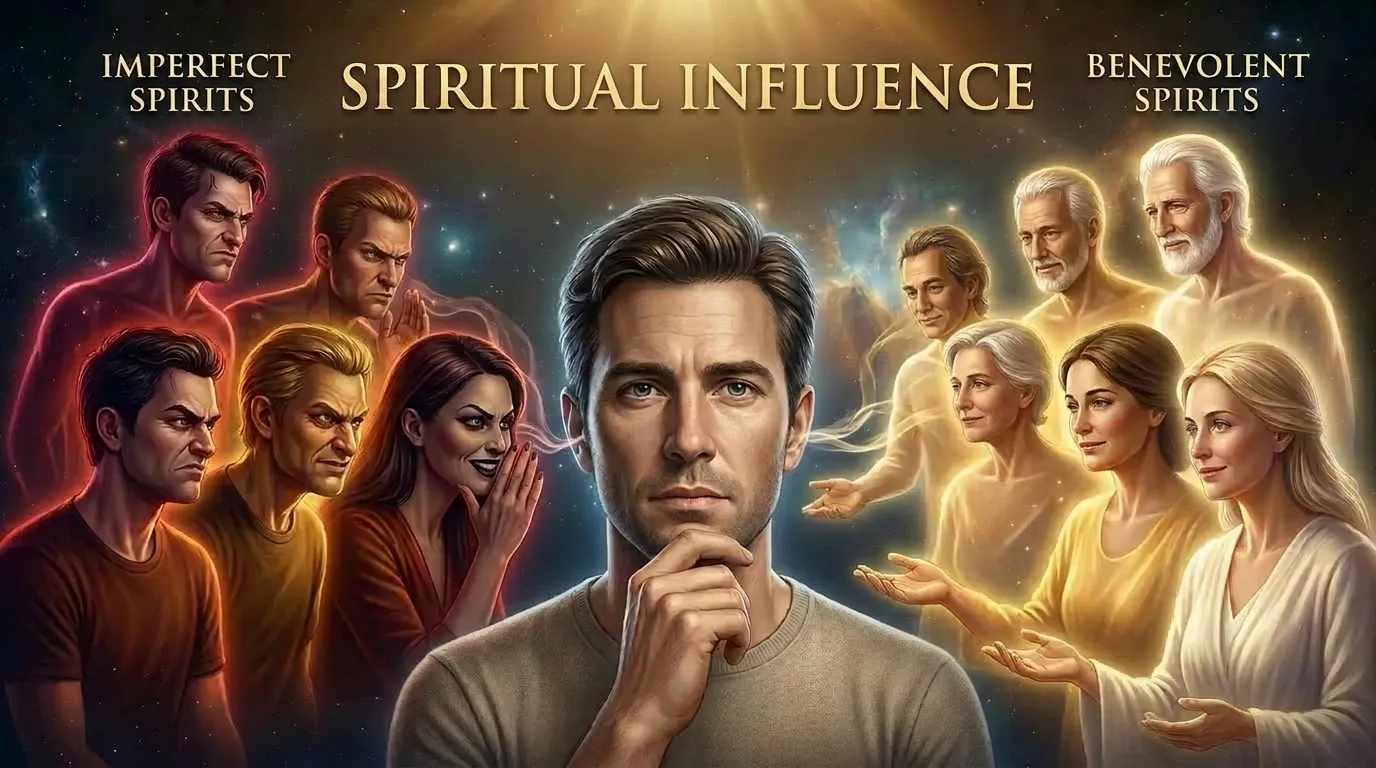
But incarnated spirits are not alone in their thoughts. They are constantly influenced by other spirits. Good spirits inspire good thoughts, courage, patience, and charity. Imperfect spirits may suggest selfishness, pride, despair, cruelty, envy, or sensuality.
This does not destroy freedom. The incarnated spirit still chooses. The influence is real, but responsibility remains personal. You are not innocent just because a bad thought was suggested to you. And you are not good merely because a good thought passed through your mind. Your merit lies in what you accept, what you resist, and what you do.
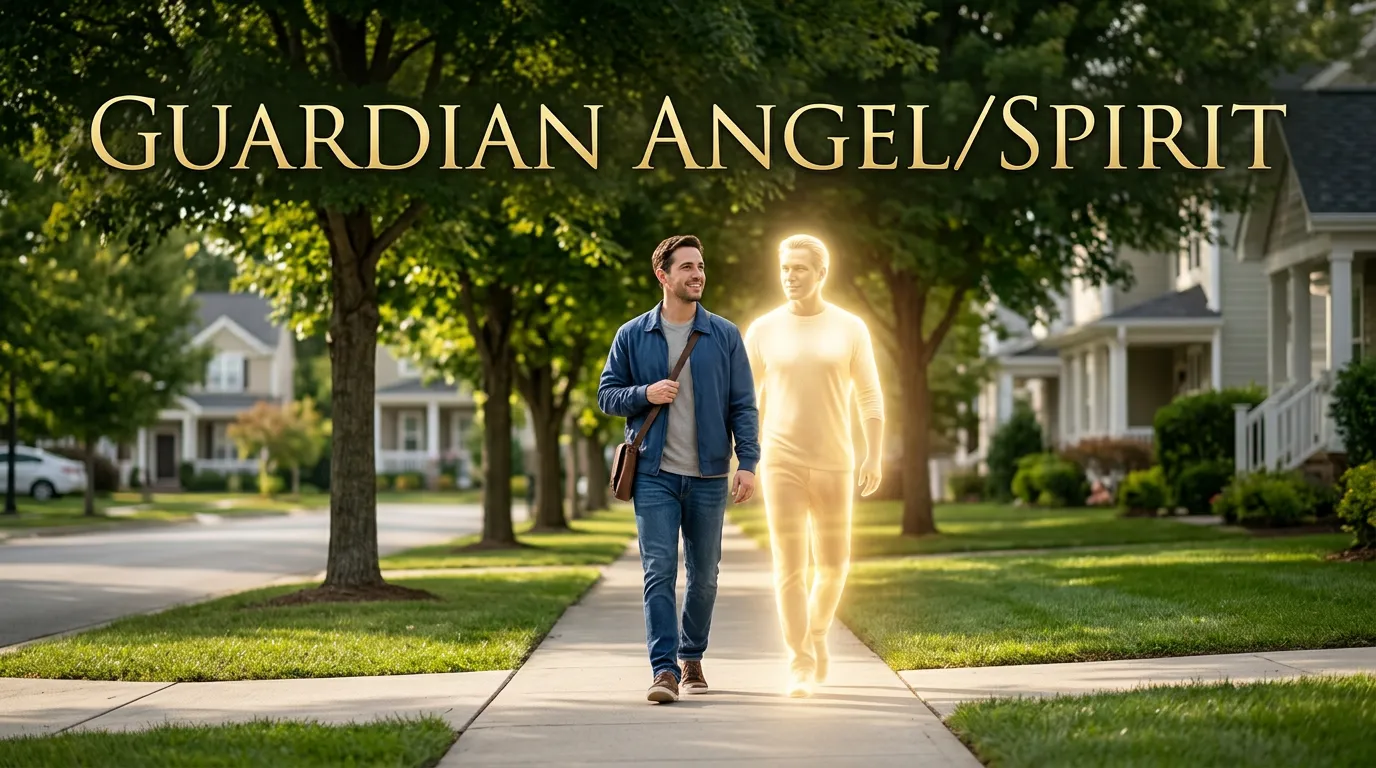
Every person also has the support of protecting spirits, often called guardian spirits or guardian angels. These are good spirits who try to guide, comfort, warn, and strengthen us. They do not remove struggle. They do not make our choices for us. They help quietly, often through conscience, intuition, inner encouragement, and good impressions.
Earthly Life as Trial and Progress
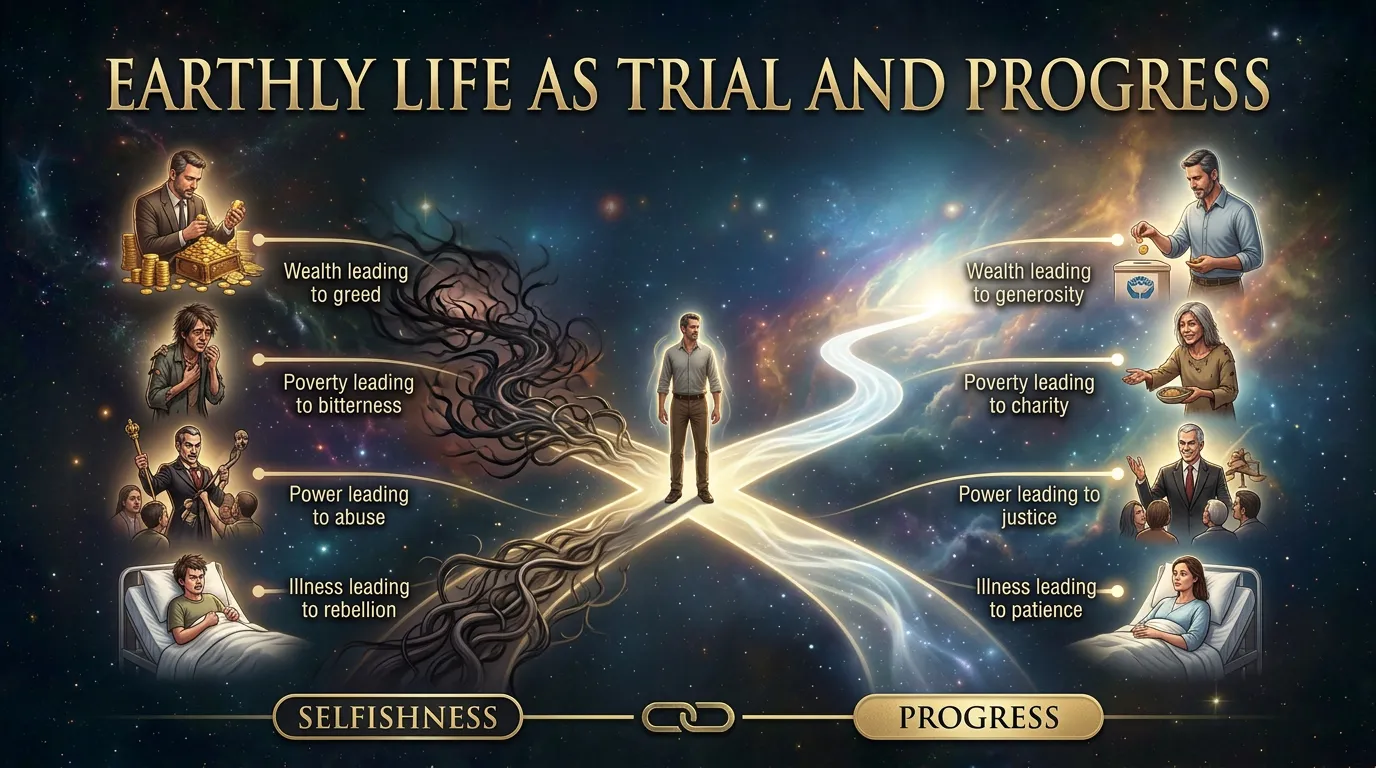
Life on Earth, then, becomes a field of trials. Poverty can test resignation, trust, and envy. Wealth can test pride, greed, and selfishness. Illness can test patience. Power can test justice. Dependence can test humility. Family life can test affection, forgiveness, and duty. Social humiliation can break vanity. Loneliness can reveal what we truly love.
The same outward condition can purify one spirit and harden another. A poor person may become bitter, or charitable. A rich person may become generous, or corrupt. An afflicted person may become patient, or rebellious.
So the trial does not save or condemn by itself. The spirit's response to the trial is what matters. If an incarnated spirit learns patience, practices charity, resists selfishness, rejects cruelty, masters pride, and freely chooses the good, progress becomes faster. If it gives itself over to vanity, hatred, greed, sensuality, injustice, and cruelty, progress slows.
But progress does not stop forever. No spirit is forever shut out from advancement and purification.
Death and the Return to Spirit Life
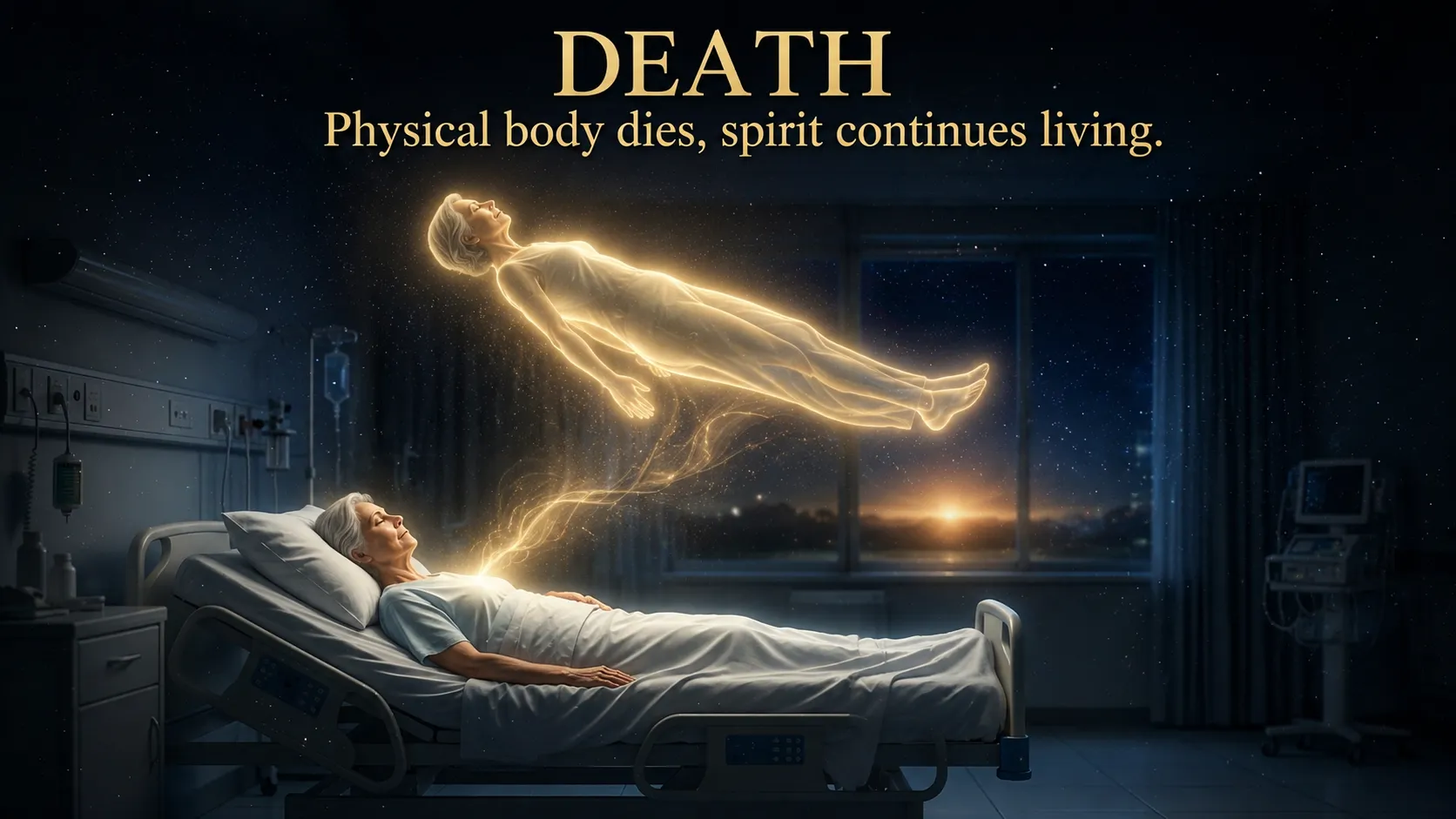
When bodily life ends, death comes. Death is not the end of the spirit. It is just the end of the body. The body returns to matter. The vital principle returns to its source. The soul becomes spirit again and returns to the spirit world.
In the book Heaven and Hell, Allan Kardec, the same author as The Spirits' Book, presents many reported communications from spirits through human mediums. In this view, these are not fictional parables. They are testimonies meant to show how different moral states can shape death and what follows it.
Different Experiences at Death
The separation of soul and body is not always the same. For some, especially those less attached to bodily life and earthly things such as possessions, status, pleasure, power, and the habits of the body, death is gentle. The ties loosen gradually, like a peaceful awakening. For a good spirit, the first experience after death may be relief, clarity, reunion, and joy. It is like a heavy burden falling away.
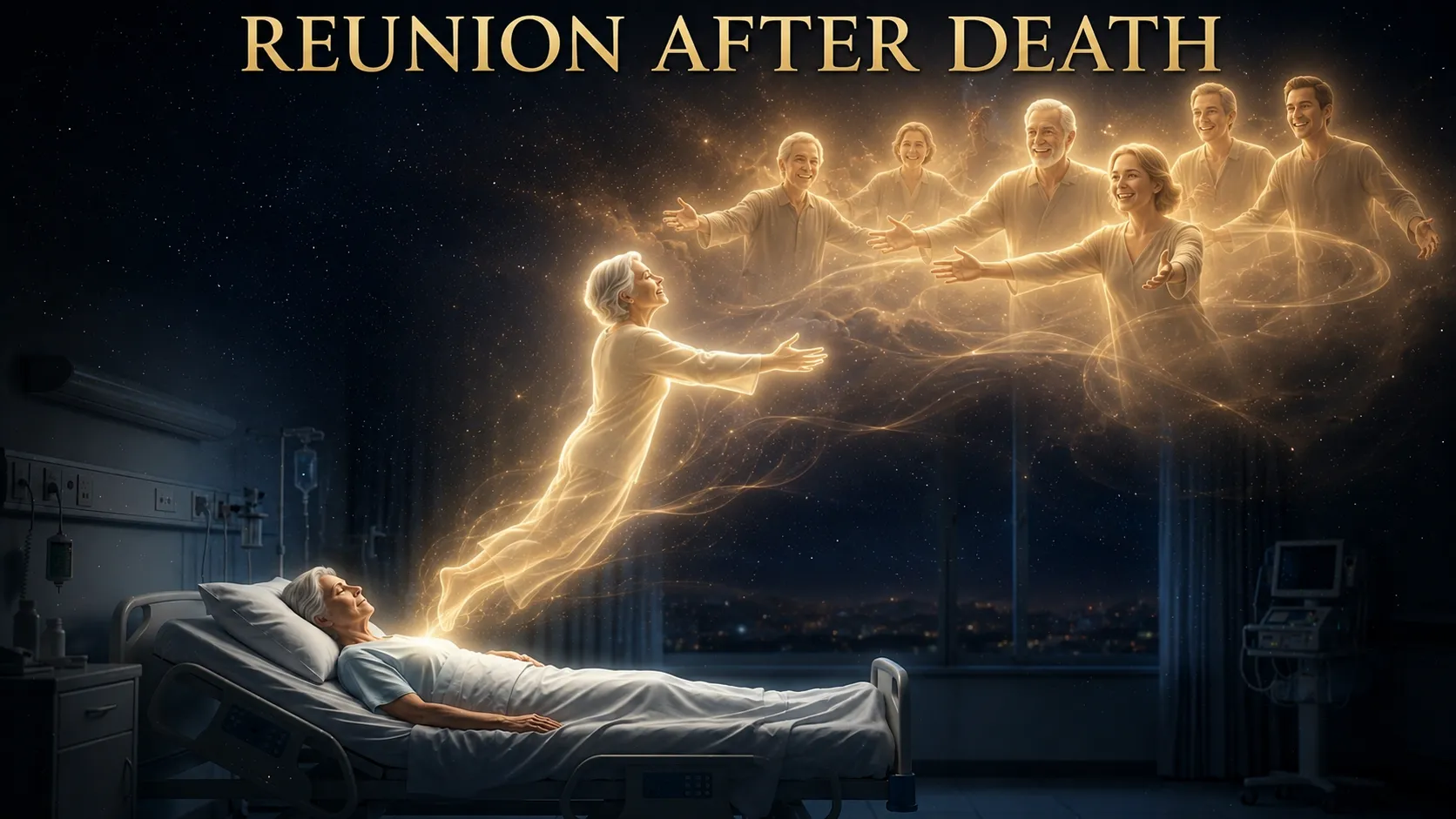
That reunion may include spirits known on Earth.
A good spirit may be welcomed by relatives, friends, or other spirits it loved and recognized before.
Death, in that sense, can be a return to familiar company.
But reunion is not based on blood alone.
It depends on sympathy, affection, and moral affinity.
Those who are united by love and goodness draw near to one another more easily.
Those separated by pride, hatred, or impurity may remain apart, even if they were family on Earth.
A few reported cases help make the contrast clearer.
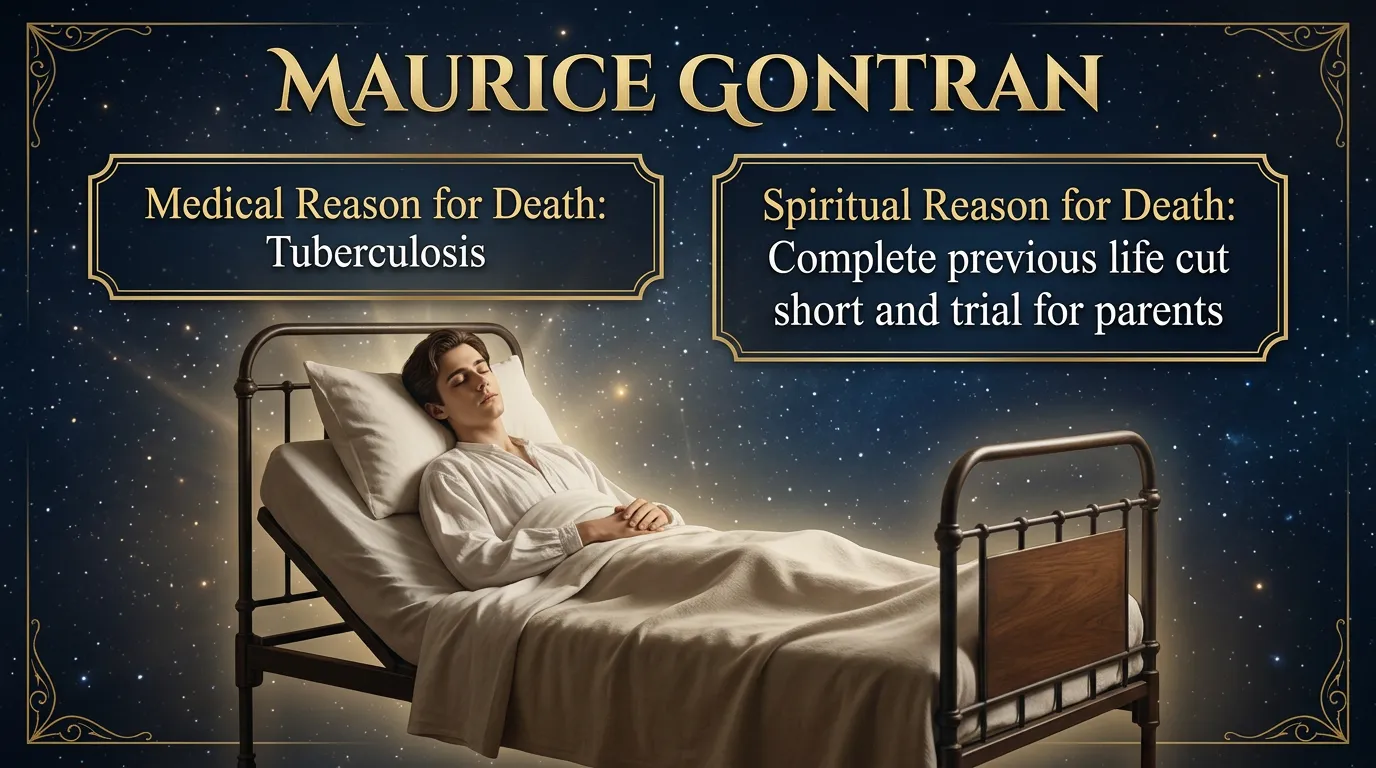
Some reported deaths are strikingly gentle. Maurice Gontran died at eighteen of tuberculosis, just after years of study. He said the illness hurt, but the dying itself was peaceful: the pain faded, he fell asleep, and he woke in the spirit world. He also said his studies were not wasted. The knowledge had strengthened his soul, had not been lost, and would be used more fully in a future life.
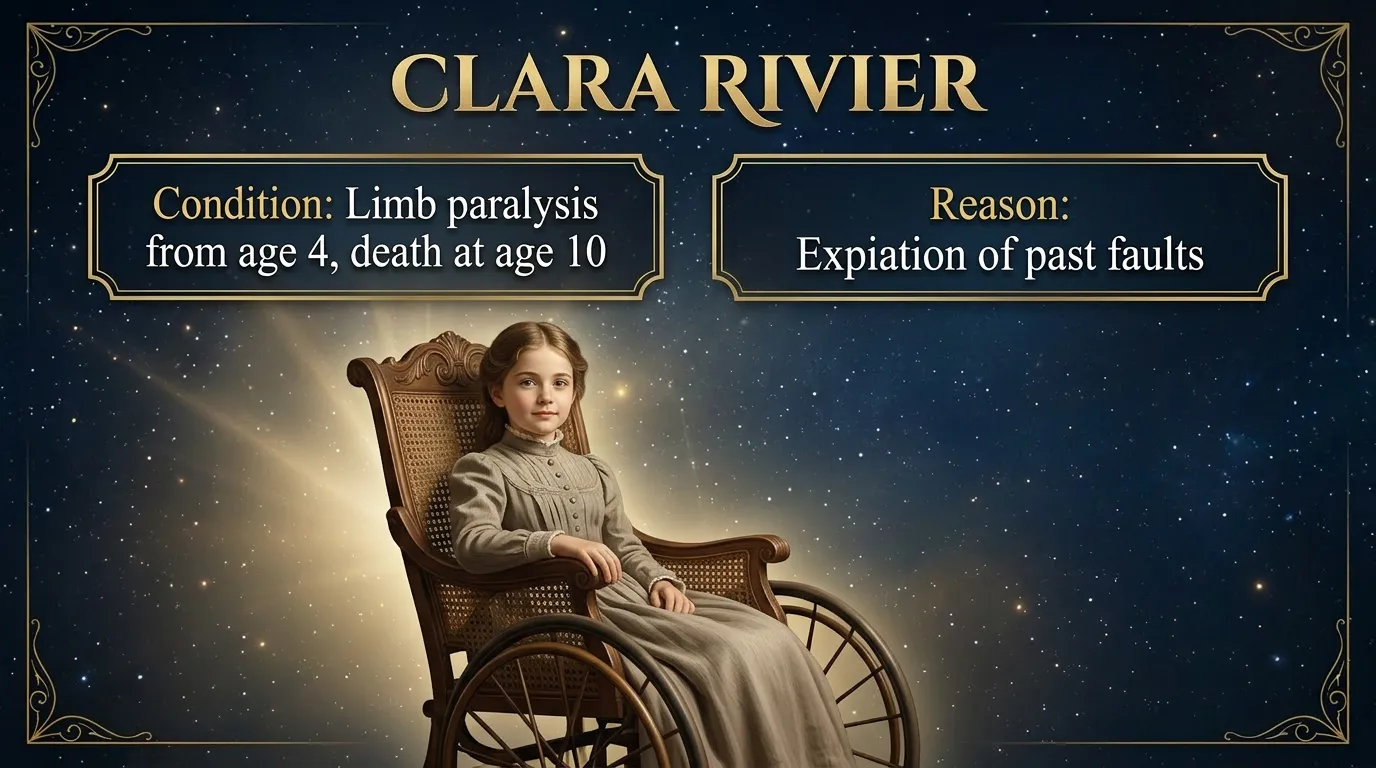
Clara Rivier had been paralyzed from age four and had lived through years of convulsions and pain. She said that suffering was expiation for faults from a former life, that her guardian angel sustained her, and that she knew in advance when death was near.
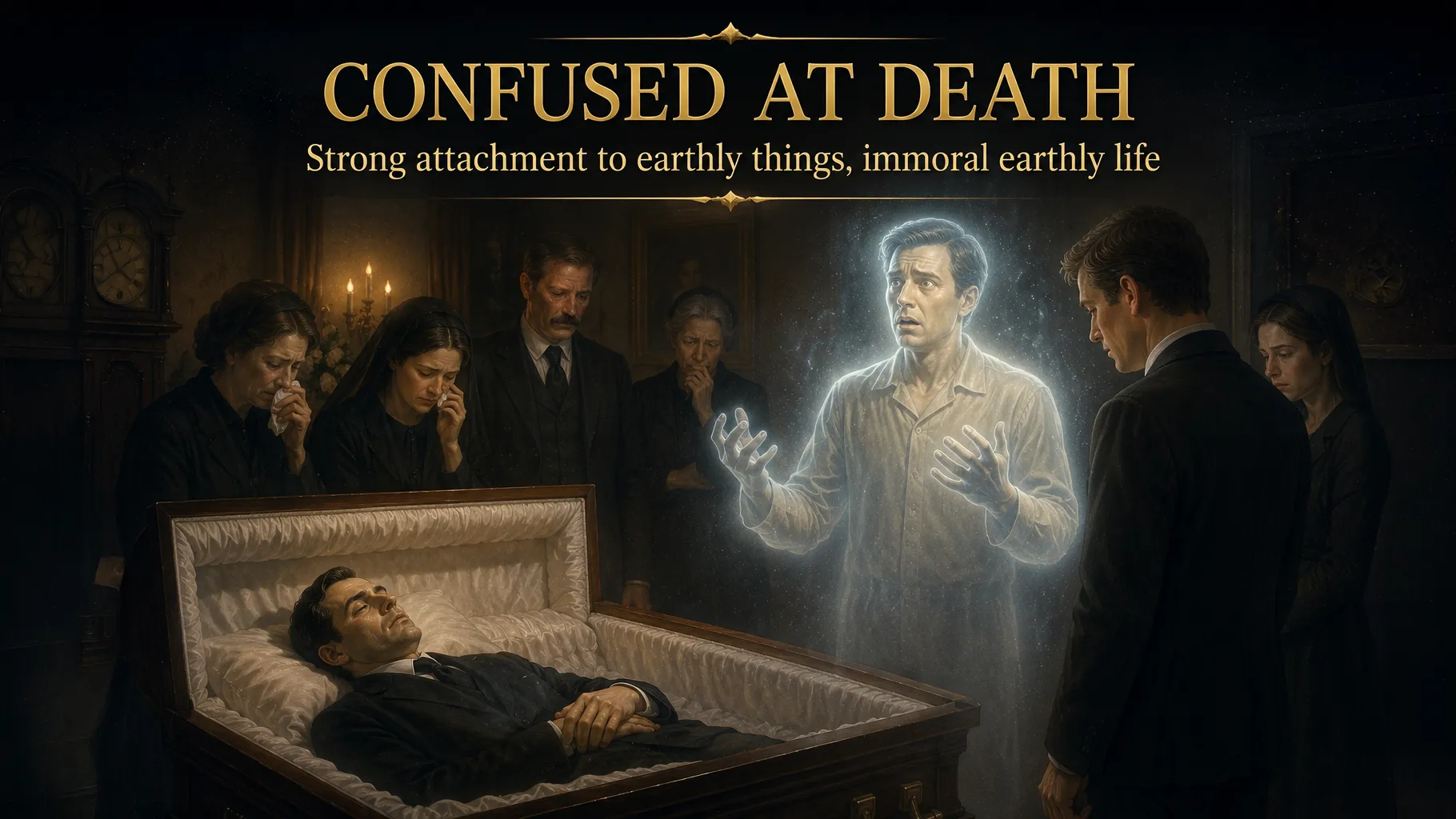
But for those strongly attached to bodily life and earthly things, such as wealth, status, pleasure, possessions, power, or the habits of the body, death can be troubled. The spirit may remain confused. It may not know at once that it is dead. It may see its own body, hear people mourning, and still try to speak, while no one around can hear it.
The Queen of Ood remained so attached to pride and status that even after death she still imagined herself a queen, adorned with jewels and royal ornaments.
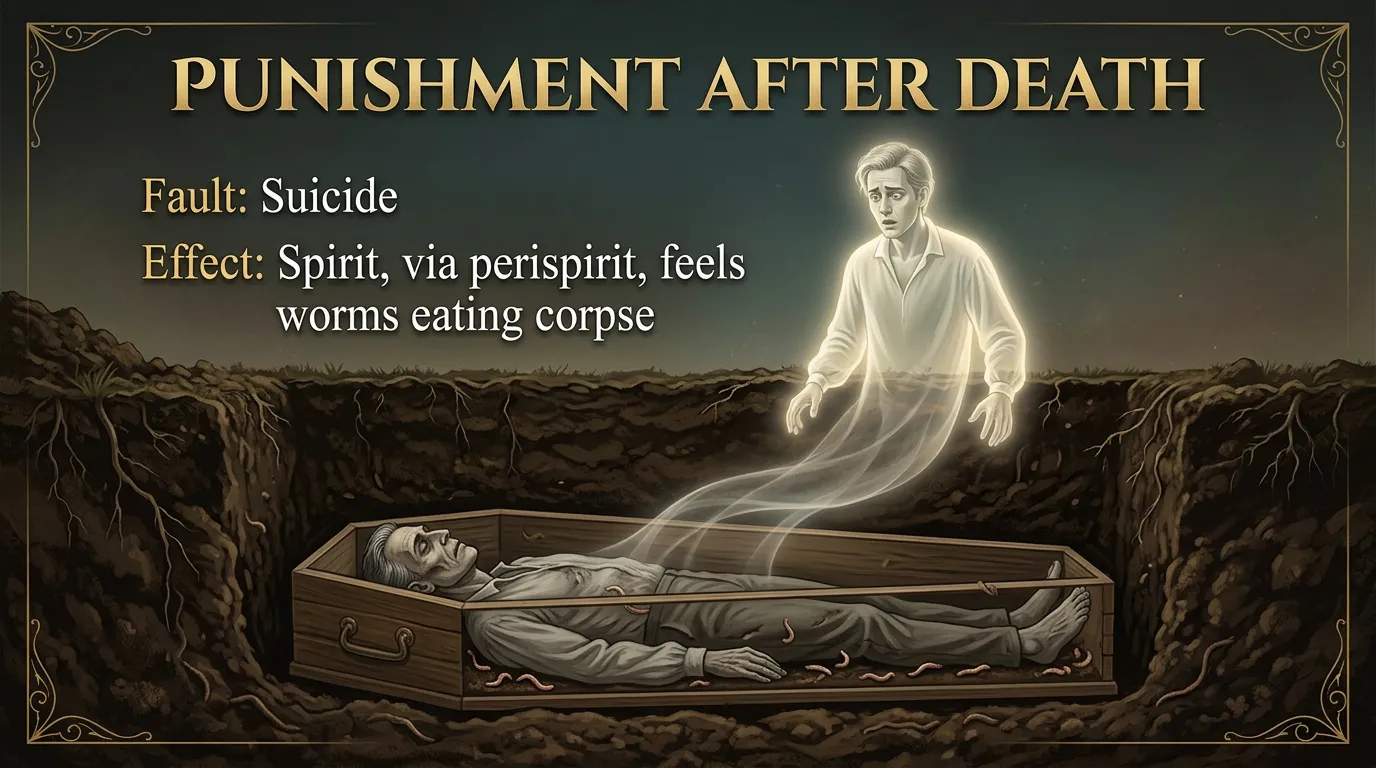
Violent death can intensify this confusion. Suicide can intensify it even more. The more impure, selfish, or guilty the spirit, the more painful this first stage may be.
One suicide victim said he still felt himself in the coffin and even felt the worms eating the corpse to which he remained bound.
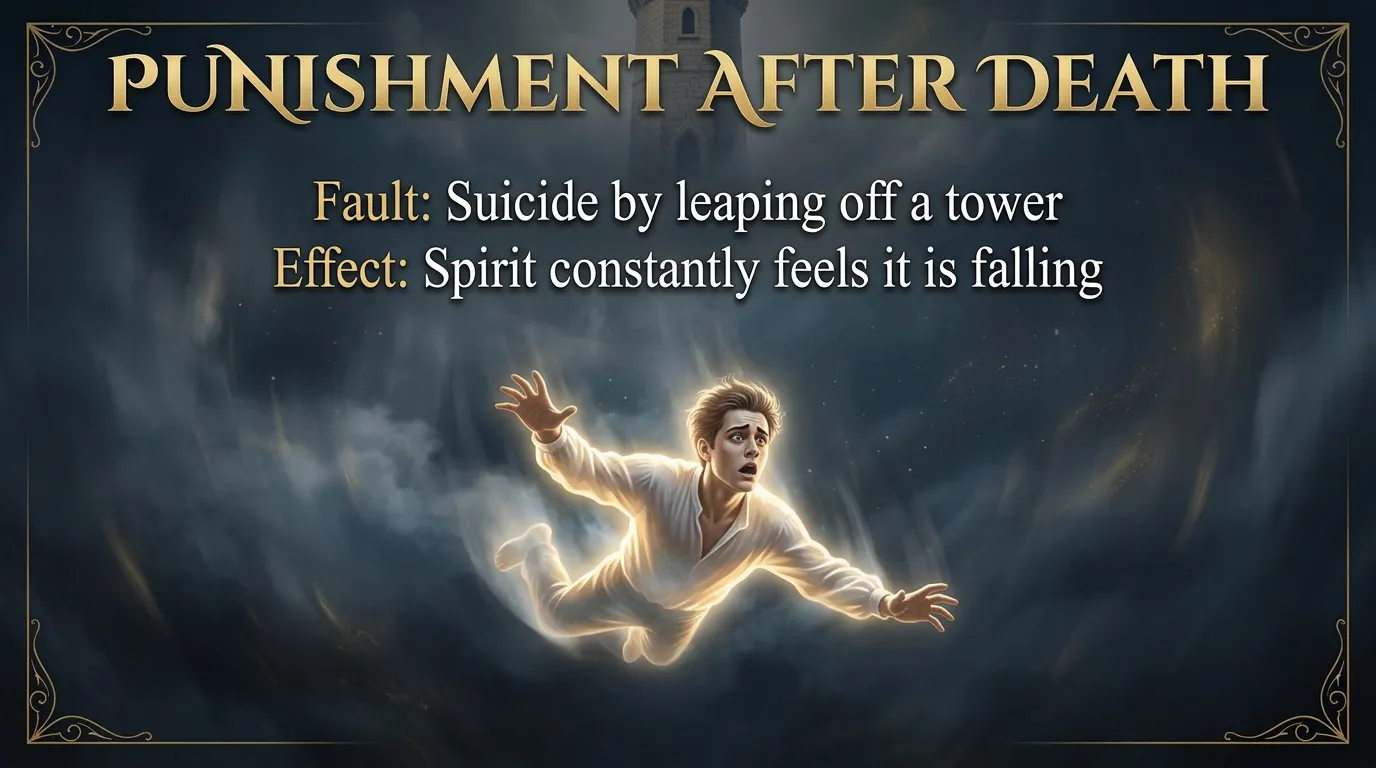
Francois Simon Louvet, who threw himself from a tower in despair, said he kept feeling the fall long after death, as if the plunge had never ended.
Suffering After Death
For those who knowingly loved evil, one of the first feelings is shame, because truth can no longer be hidden. And in the spirit world, secrecy is greatly diminished. Thought is more exposed. Spirits see one another more directly. The guilty cannot hide behind titles, status, or appearances.
A murderer may be confronted by those he murdered. A tyrant may stand before those he oppressed. A cruel person may feel, with terrible clarity, what was caused in others. This is part of spiritual suffering.
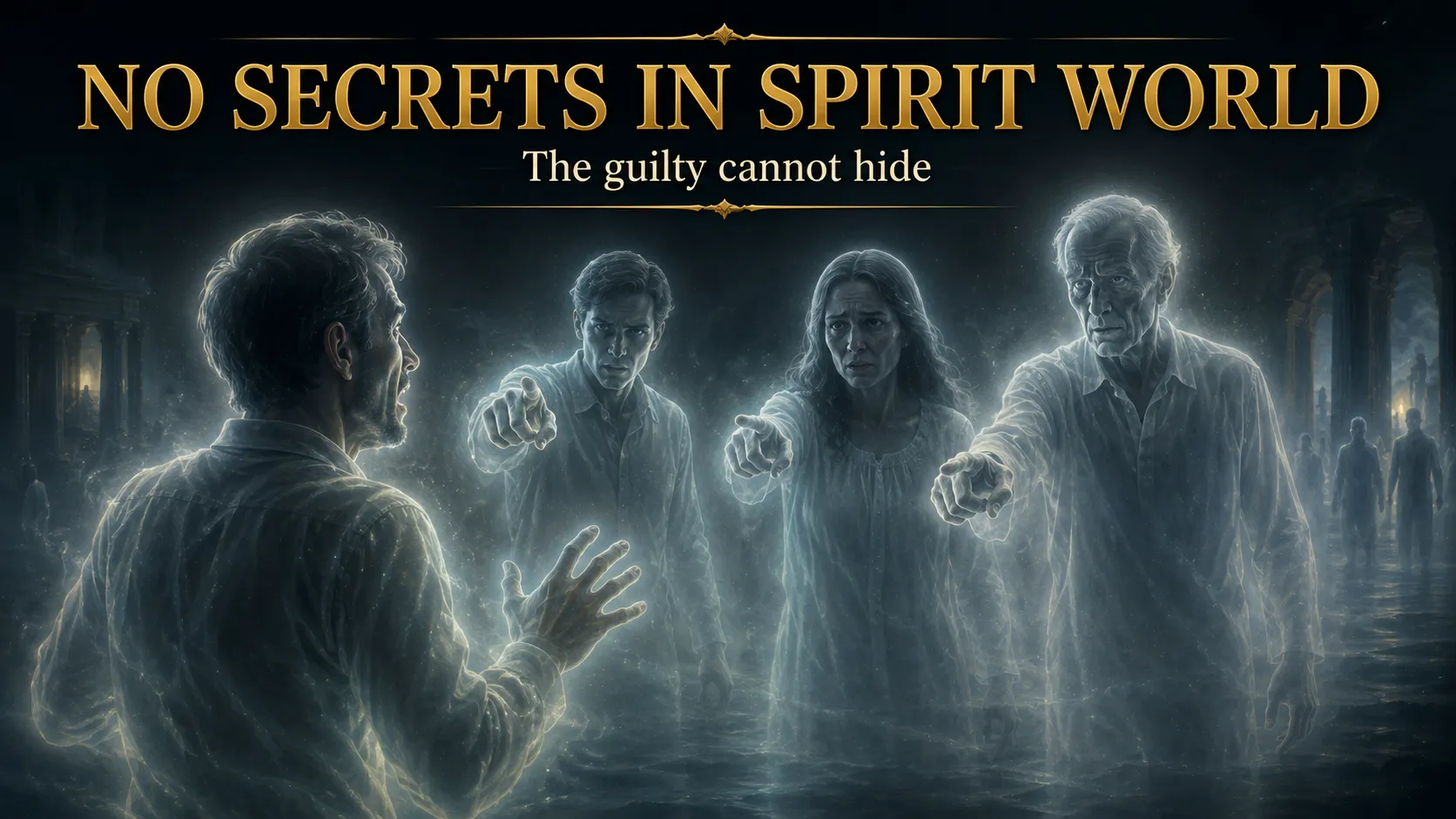
The suffering of spirits is usually moral rather than bodily. This is what many people call hell: not a place of fire, but a state of suffering, remorse, and separation from the good. There is no flesh there to wound as the body is wounded. But there is remorse. Shame. Fear. Longing. Confusion. Envy. Isolation. Frustrated desire. The memory of evil done. The pain of seeing good and not yet being able to share in that good.
Spirits no longer live under bodily needs in the way incarnated beings do. They are not subject to hunger, organic pain, or material necessity in the same manner.
They do not need bodily sleep.
Yet lower and more troubled spirits can still suffer intensely through the perispirit and through their attachment to earthly life. The impressions may resemble bodily pain, even though the flesh itself is gone.
Some accounts go further and describe suffering that reflects the fault itself.
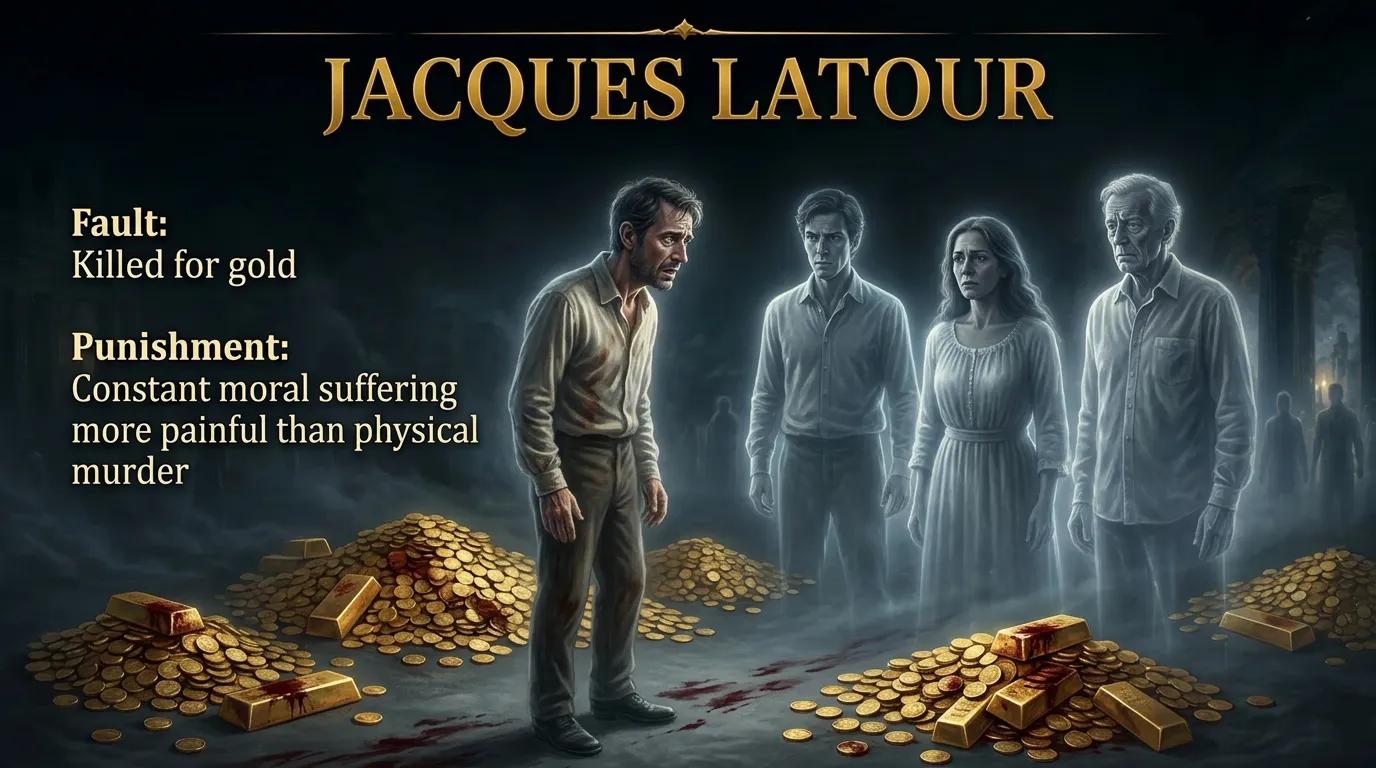
Some cases describe punishment that mirrors the fault. Jacques Latour, who killed for gold, said he saw his victims before him and even the gold stained with blood.
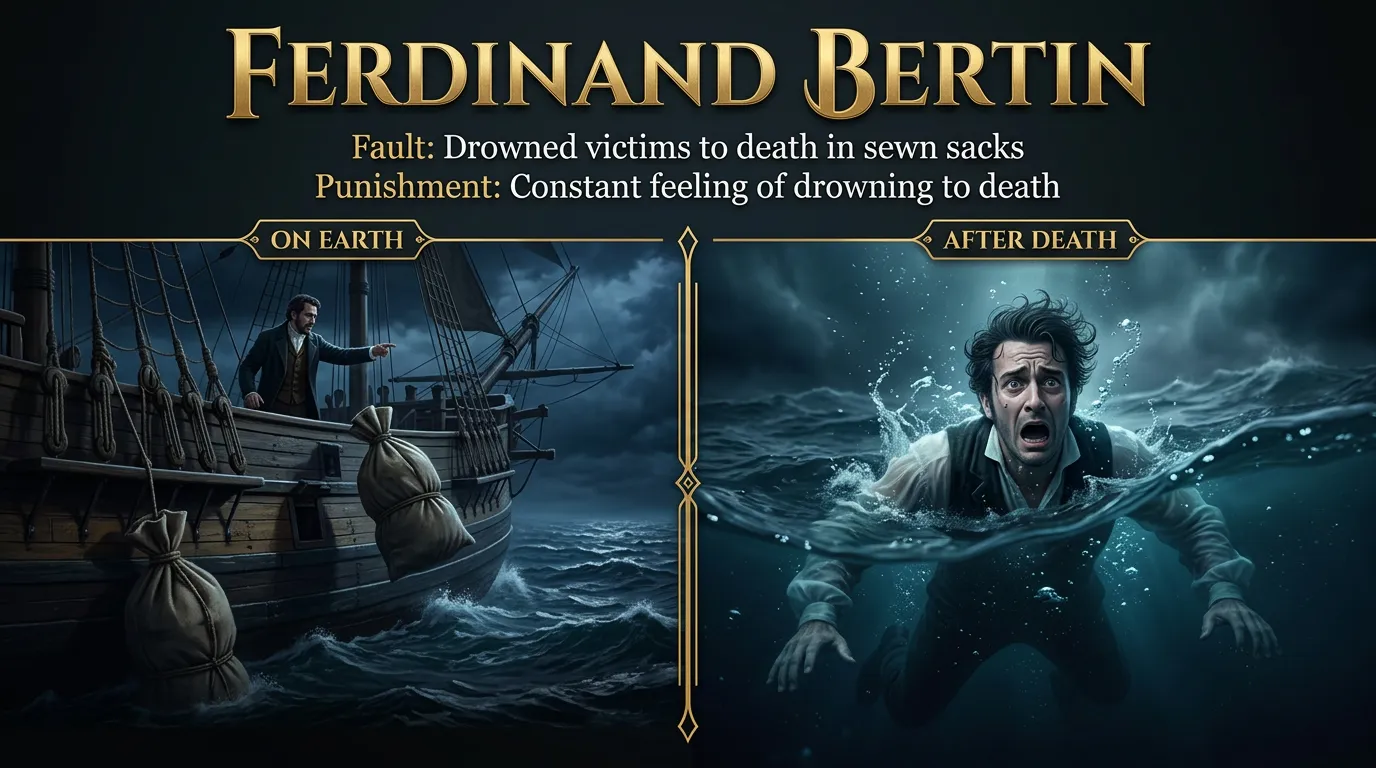
Ferdinand Bertin, who in a former life had victims sewn into sacks and thrown into the sea, said he kept reliving drowning after death.
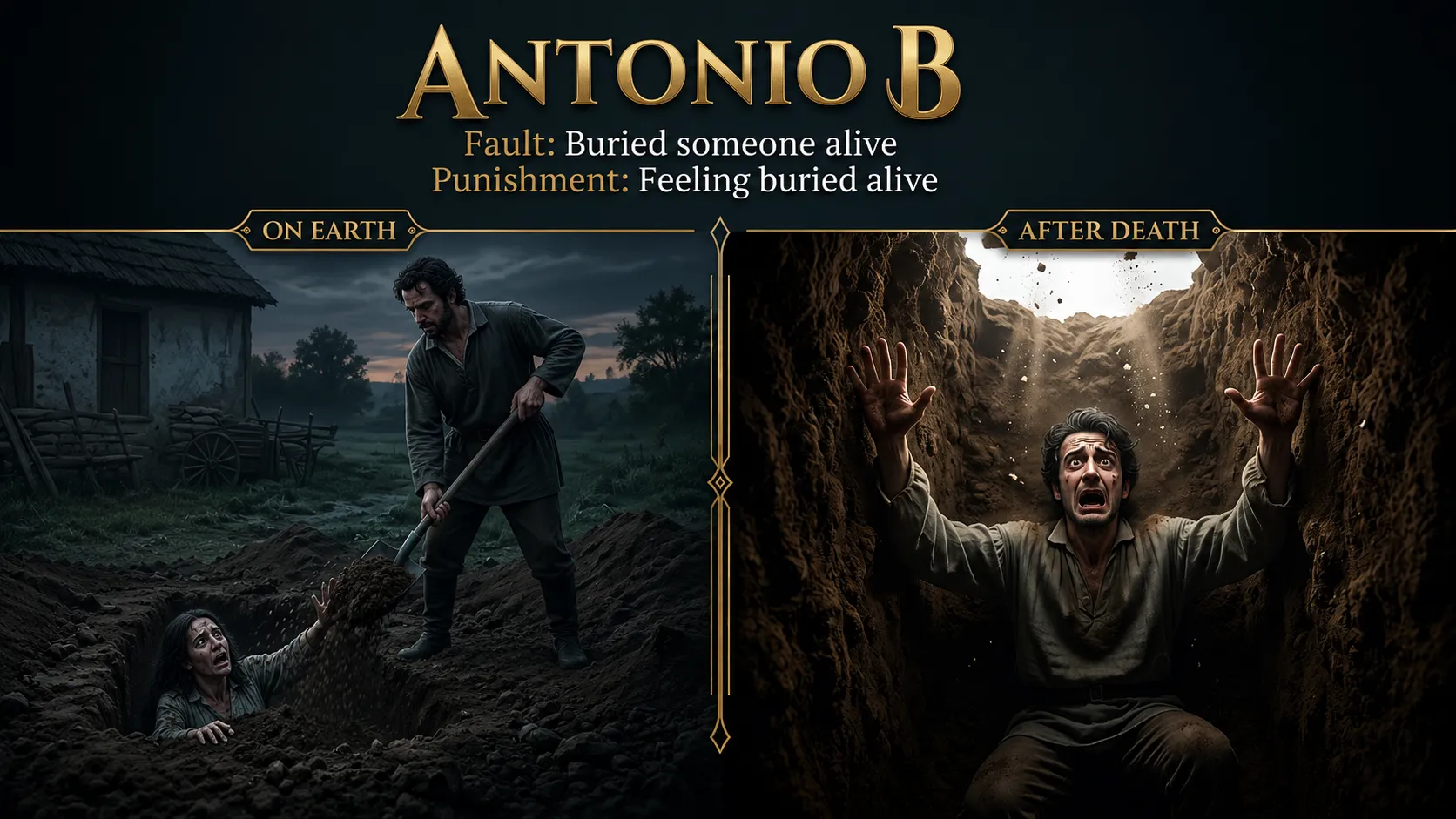
Antonio B., buried alive after an apparent death, said the horror matched an earlier crime in which he had buried another person up alive. One former tyrant said that after a former life of cruelty, he remained attached to his decaying corpse, felt the worms consuming it, and later had to face the suffering of his victims before repentance truly began.
Hell as a State, Not a Place
Some spirits remain attached to old passions even after death. A proud spirit remains proud. A selfish spirit remains selfish. A sensual spirit still desires what it can no longer satisfy.
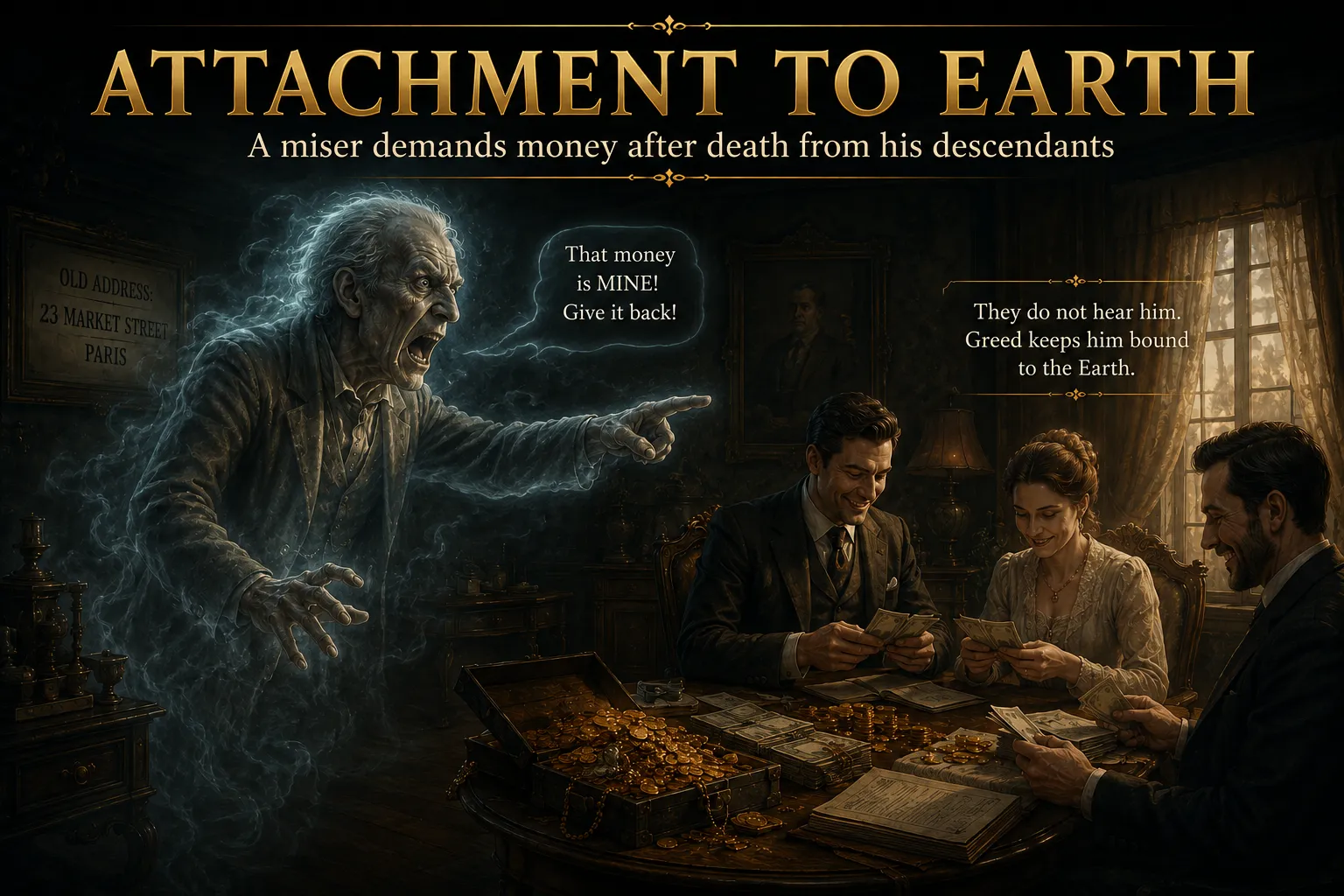
Attachment itself can become torment. A miser still demanded his money back after death. He even gave his old address as if he were still alive. It shows how greed can keep a spirit tied to Earth.
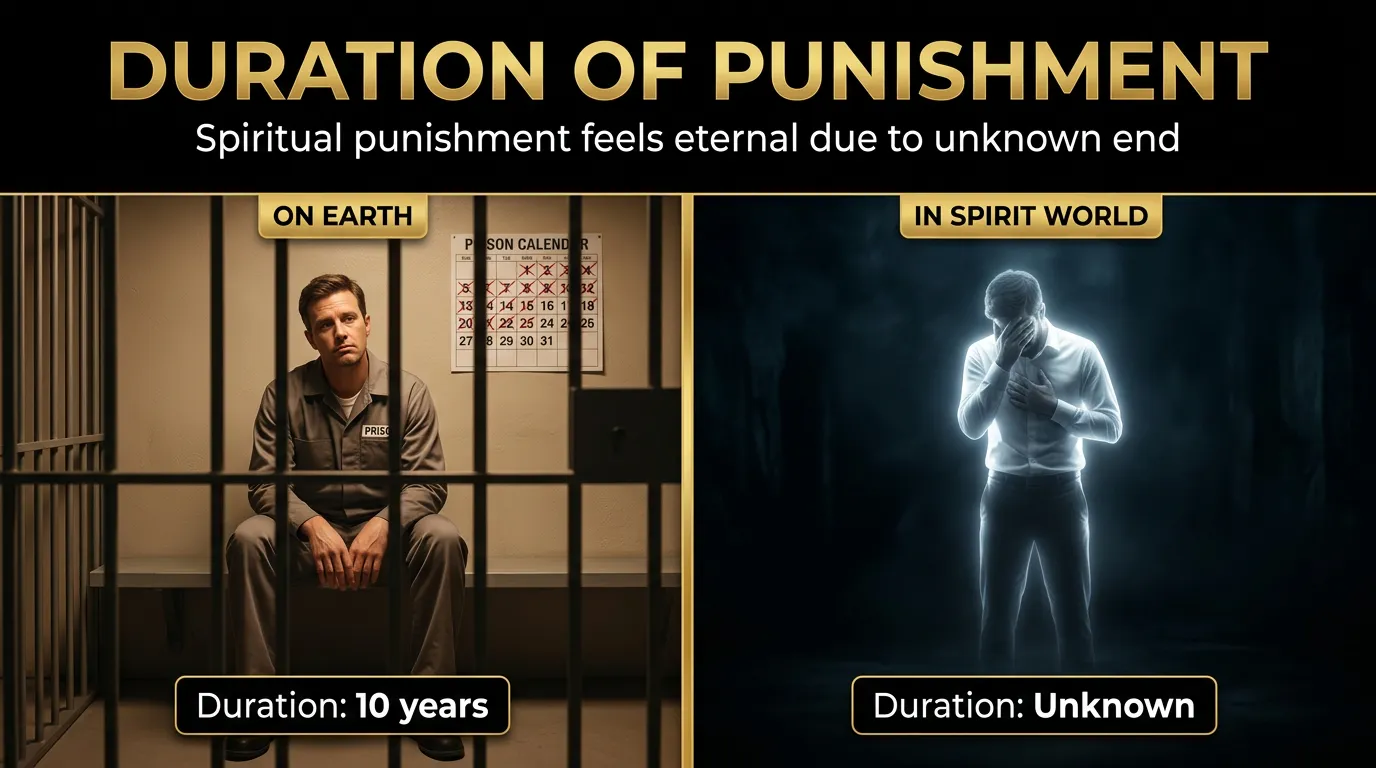
Suffering in the spirit world can feel like an eternity. Not because God has decreed endless torment for all the guilty. But because the spirit often does not see when its suffering will end. It feels no earthly clock. It does not measure time the way we do. And when there is no visible end, suffering can seem endless.
But it is not endless in the absolute sense. No spirit is condemned forever with no path for progress. As long as the spirit remains imperfect, suffering continues.
Spirit Manifestations Around the Living
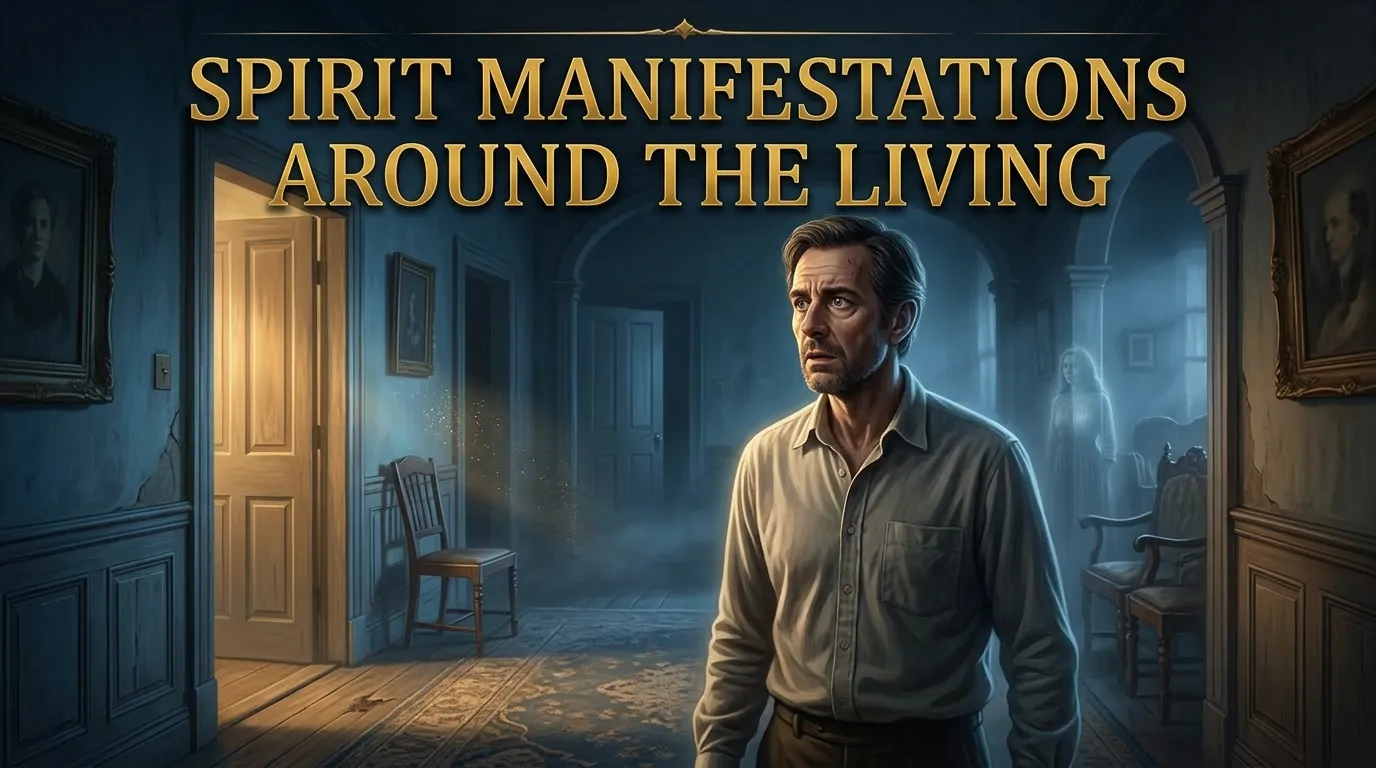
Some reports also describe spirits still acting around the living. Clara Rivier said the noises in her parents' house after her death were not meant to torment them. They were meant to help them, and even the neighborhood, believe in the unseen and in another life.
In another case, the spirit of a haunted house was said to be bound to the very house where he had murdered, reliving the crime in darkness until prayer gradually softened him.
Repentance, Repair, and Return
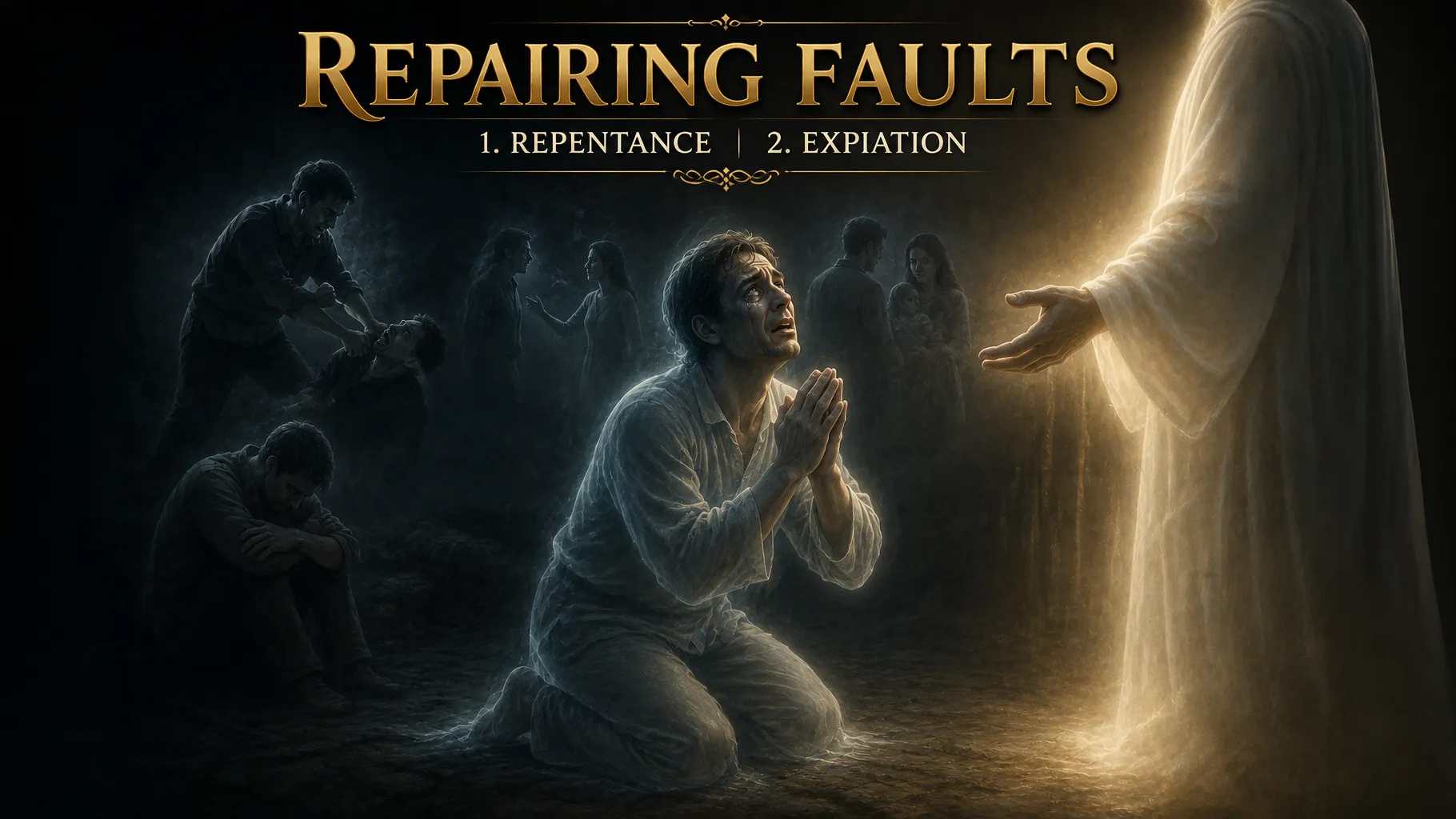
When the spirit repents, understands, and begins to repair, the path for progress opens. That repair may happen in spirit life, in future incarnations, or both.
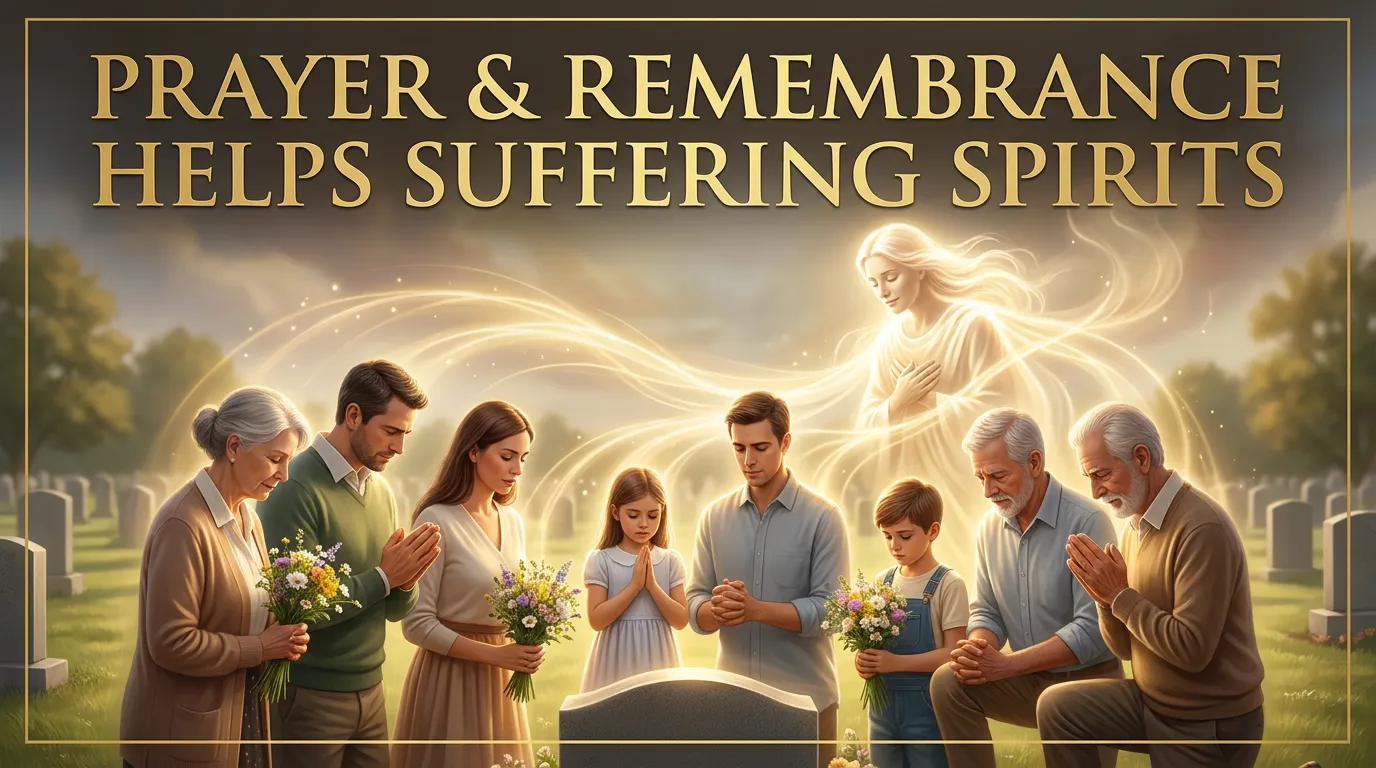
Some suffering spirits are helped by prayer. Some are softened by remorse. Some are moved when others forgive them. Some accept a new life of expiation, meaning a life designed to repay and repair past wrongs. Some undertake missions of repair.
More detached spirits care little for the grave or the remains of the body. What reaches them more is loving remembrance, sincere affection, and prayer from those still on Earth.
So a family shrine, a photograph kept in remembrance, a visit to a grave, or even a yearly memorial day can have value if they truly gather hearts in charity and recollection. But the power is not in the picture, the place, or the date itself. It is in the thought, the love, and the prayer.
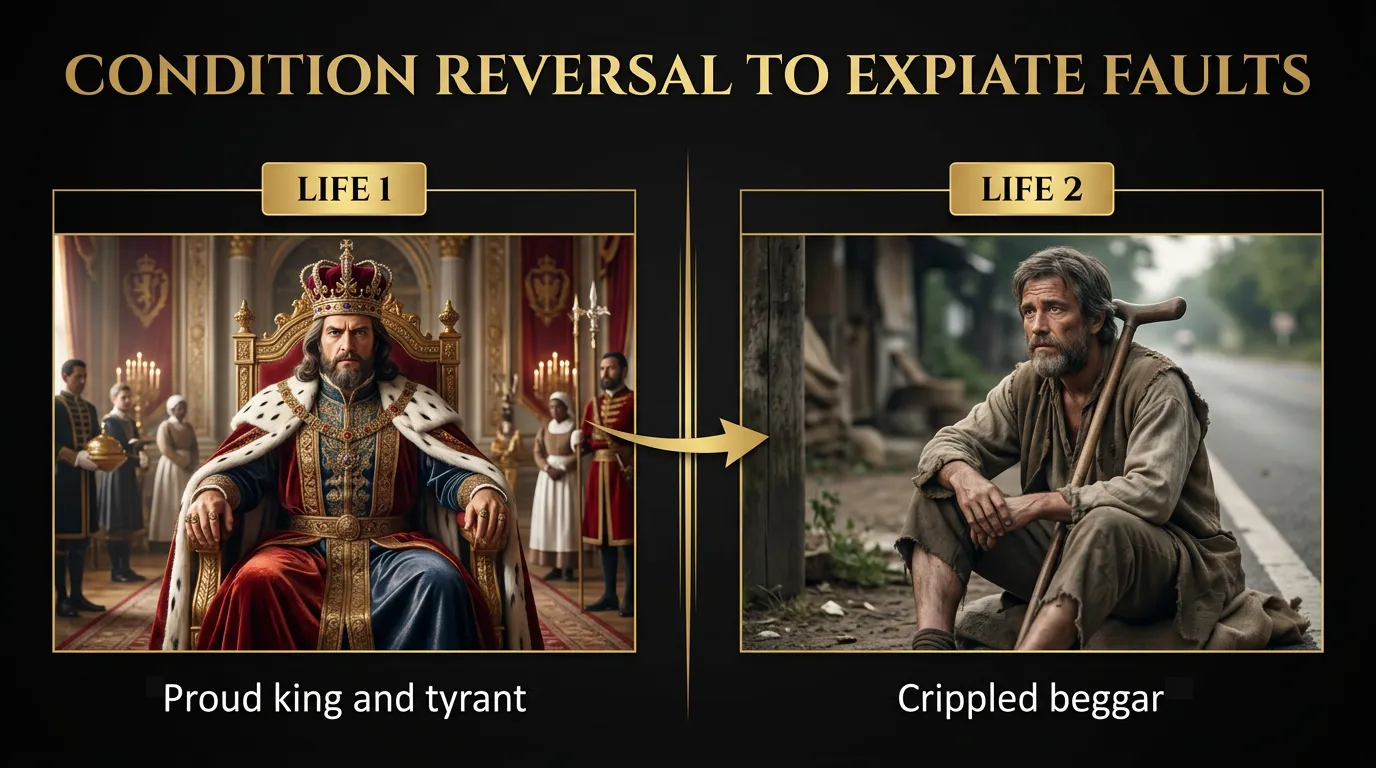
Some spirits repair by entering lives that directly reverse their former condition. A once-cruel ruler may return in humility. A miser may return in poverty. A persecutor may return under the same burden once imposed on others. Count Max said that after living as a proud noble who crushed the poor, he later returned as a crippled beggar on the same land he had once ruled. He even slept in the stables of his former castle.
Adelaide Margaret Gosse described the opposite kind of expiation. After earlier lives in high position, where doing good cost little because she was rich, she asked to return in poverty and hardship so charity would require real sacrifice and help her progress more quickly.
Even a formerly evil spirit may later help prevent evil in others. For example, a criminal spirit may warn future criminals.
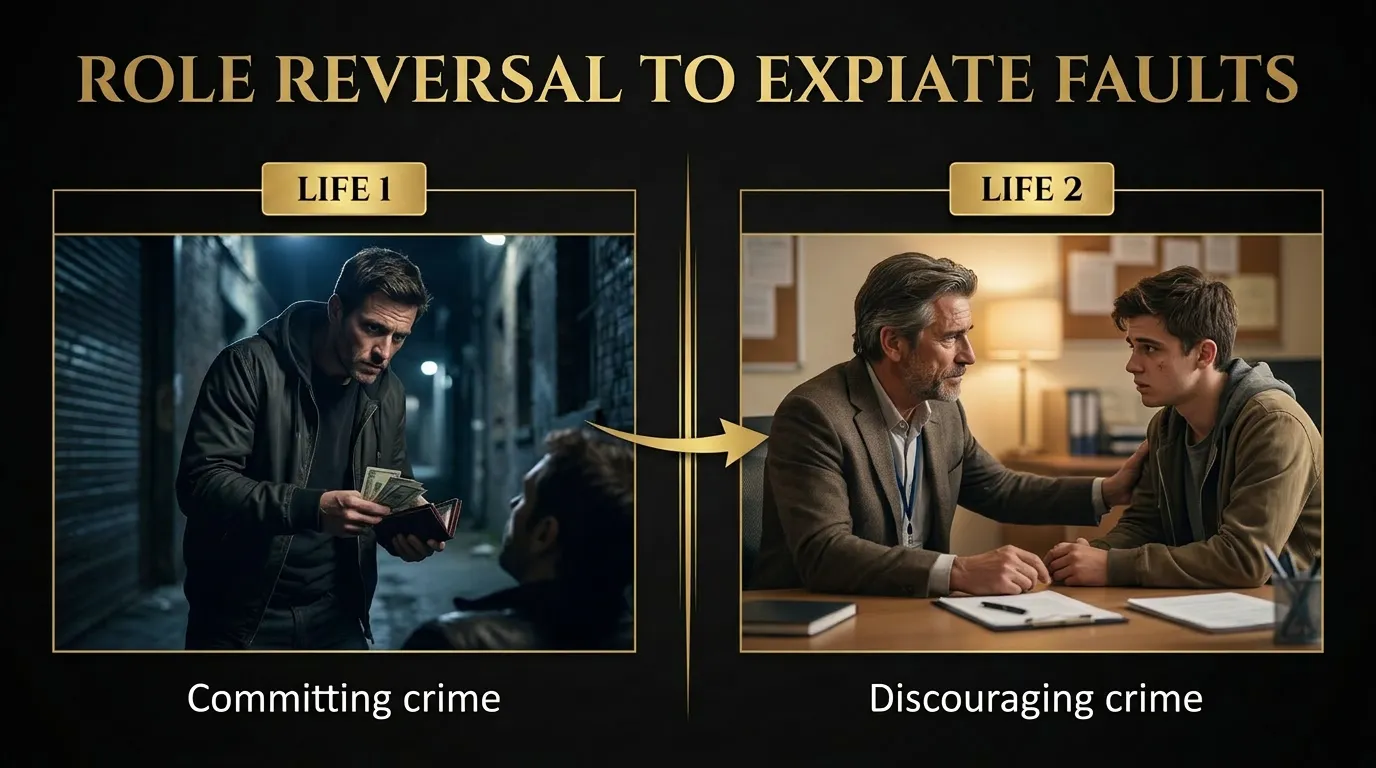
This is why earthly life is so serious in this view. Nothing is lost. Nothing is hidden forever. Nothing is without consequence. But also, no sincere effort is wasted. No repentance is useless. No spirit is abandoned forever.
The State Between Incarnations
After death, many spirits spend time in this state between incarnations before reincarnating. There they study, observe, remember more clearly, and prepare. They may visit more advanced worlds briefly. They may regret what they wasted. They may desire to return quickly. Or they may fear returning.
But no spirit can delay its progress forever. Eventually, it must continue the journey. And so reincarnation begins again.
Reincarnation and Human Inequality
Without repeated lives, many things would seem to make divine justice arbitrary. Why is one person born into health and another into suffering? Why does one begin with unusual talents in music, language, or mathematics and another with severe limitations? Reincarnation answers that by showing life as a continuity, not a single isolated episode. What looks unequal in one life may be the just consequence of earlier choices, the means of needed repair, or the opportunity for further growth. In that way, reincarnation preserves both justice and mercy: justice, because life is not arbitrary and suffering is not meaningless; mercy, because no spirit is condemned by one life alone.
A new body, perhaps male instead of female, healthy instead of unhealthy, attractive or unattractive, or weak instead of strong. A new family, perhaps in another country, language, religion, or race. A new social condition, perhaps born to wealth after poverty, or to poverty after privilege.
That is why discrimination is absurd. Whether based on language, religion, ethnicity, gender, race, or physical appearance. We are not permanently tied to any of these.
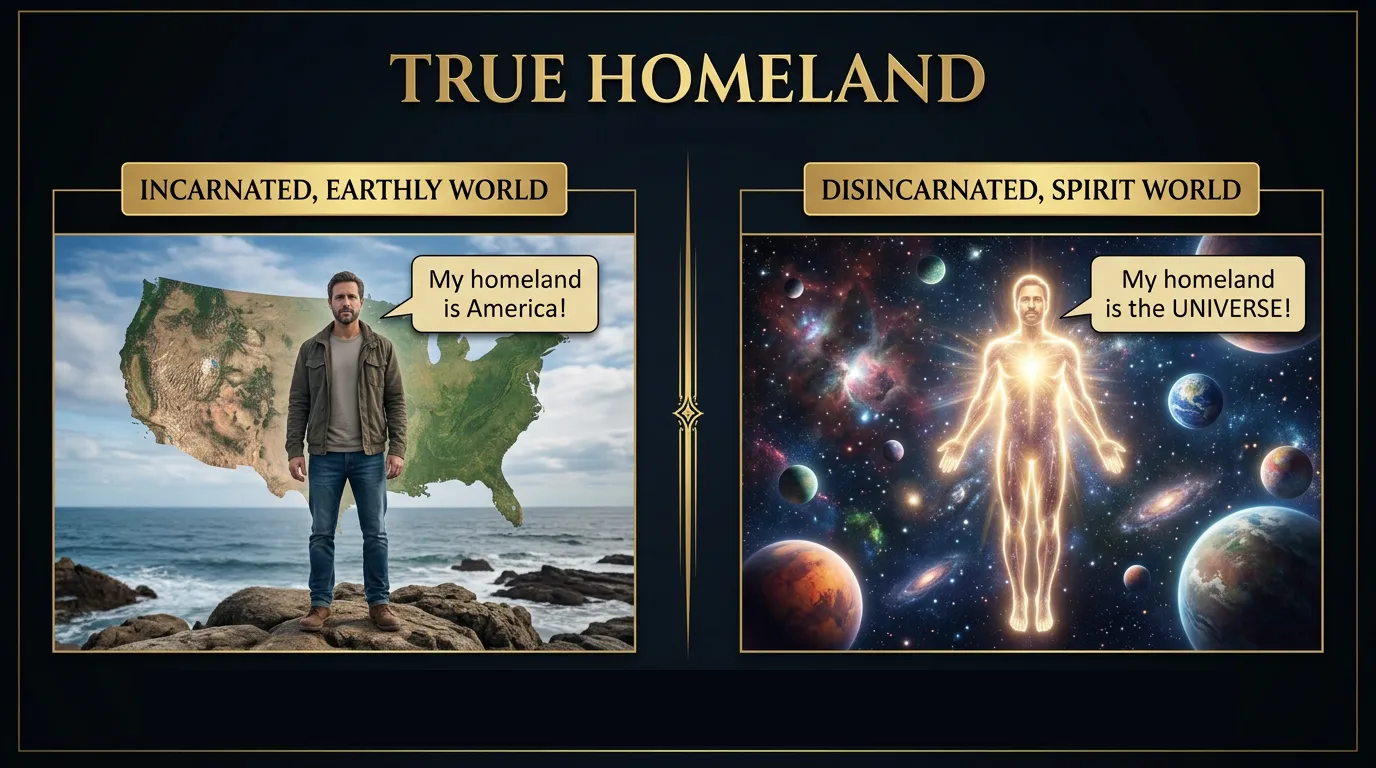
As spirits advance, their love becomes less narrow and less tied to one nation or soil. For highly advanced spirits, the true homeland is the universe. And when they return to Earth, they are drawn less by place itself than by the souls with whom they share sympathy and moral affinity.
Religion Across Many Lives
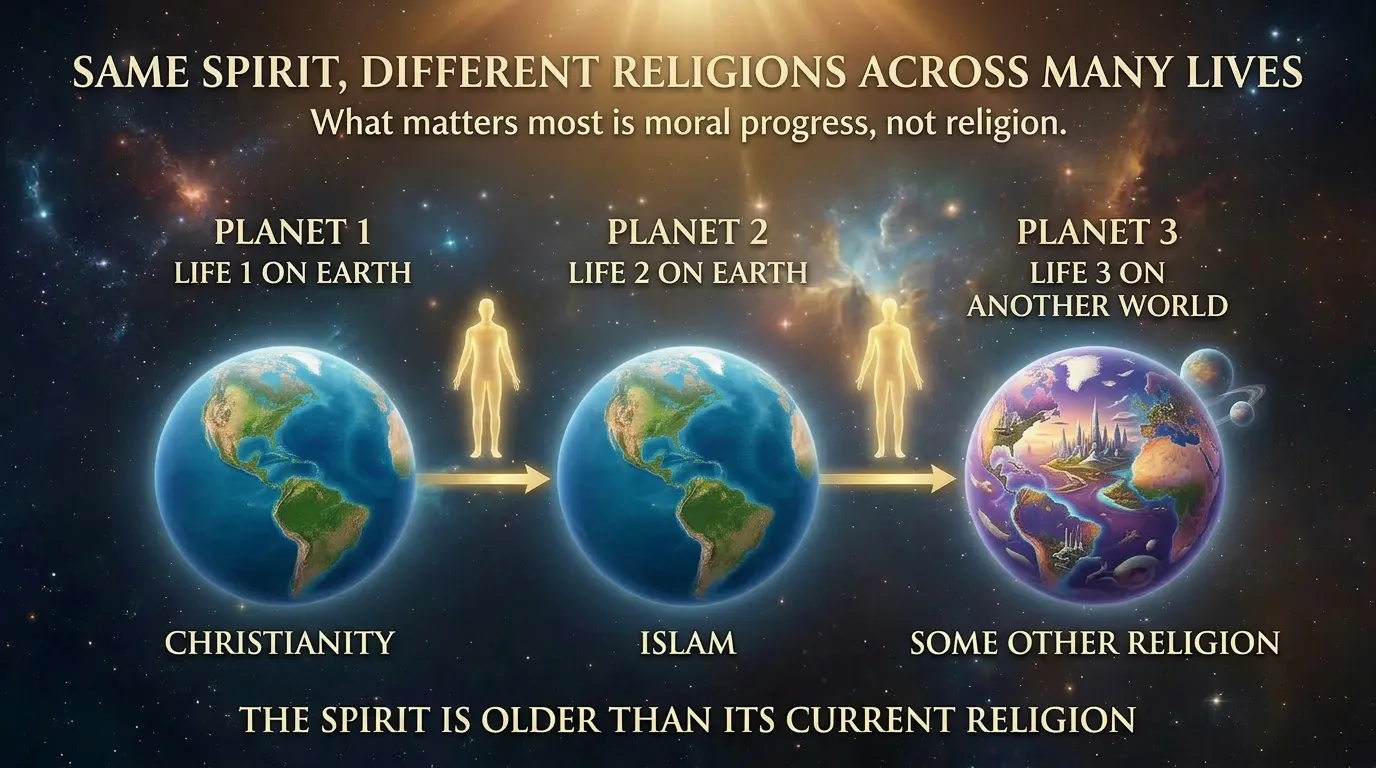
A spirit may live one life in Judaism. Another in Christianity. Another in Islam. And later in some other religion.
So the spirit is older than its present religion. What matters most is moral progress. Not the religious label worn in one lifetime. No one should treat a person's current religion or form of worship as proof of permanent superiority.
Why Past Lives Are Forgotten
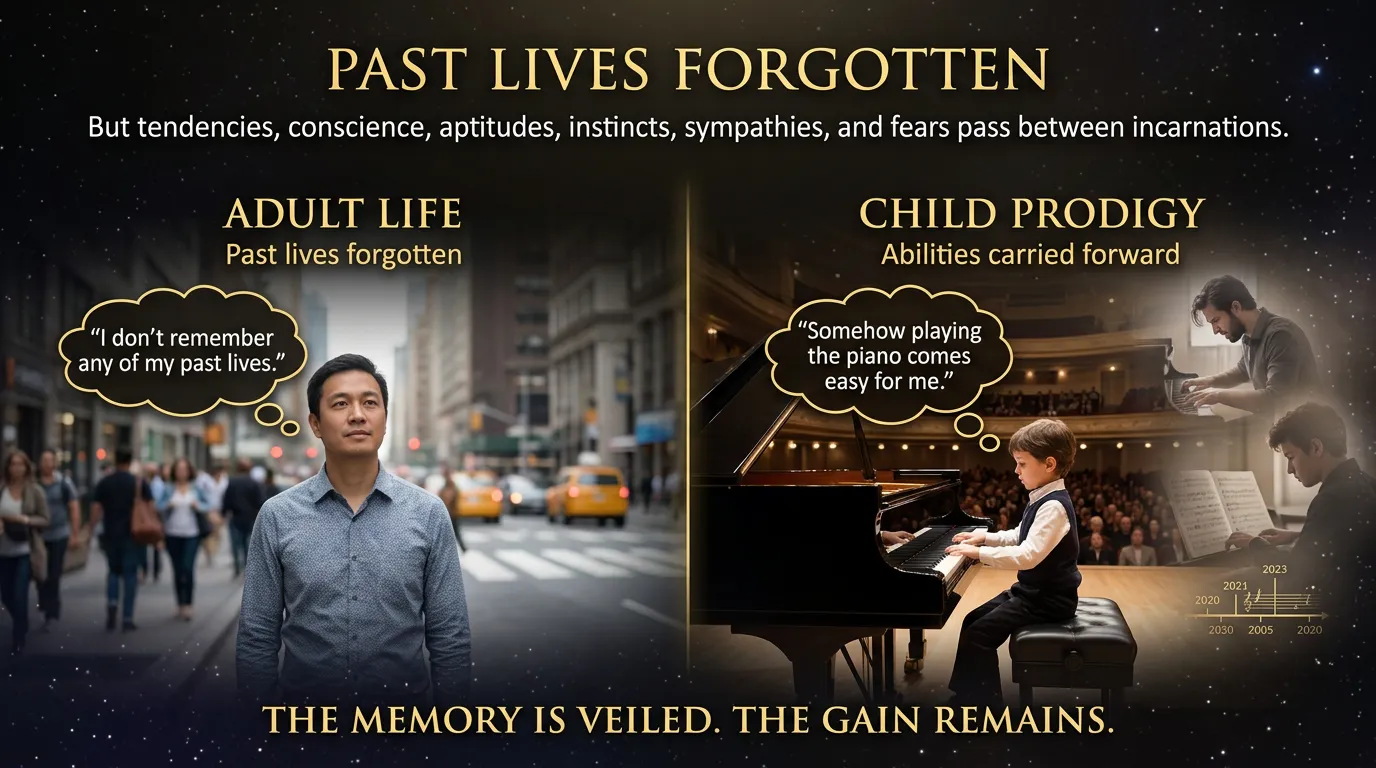
Usually, the spirit does not remember its past lives clearly while incarnated. This forgetfulness is described as an act of mercy. If people remembered every past fault, some would be crushed by shame. Others would be inflated by pride. Relationships would be poisoned by memory.
Instead, what remains is what matters most: tendencies, conscience, aptitudes, instincts, sympathies, fears, and the unfinished work of the soul. So a person does not remember everything. But a person carries everything important.
This also helps explain why some children seem extraordinary from the start. A child may show unusual ease in mathematics, music, language, or some other art long before ordinary training could explain it.
People often say God simply favored that child with a special gift. But if such unequal gifts were given without cause, divine justice would seem arbitrary. In this view, the difference is not favoritism at creation. It is prior acquisition.
The spirit brings into a new life what it has already gained in earlier ones. So a child prodigy may be an old spirit returning with abilities slowly built across multiple past lives. A mathematical genius may have cultivated reason and number from past incarnations. A young pianist may be showing abilities already developed through long practice in earlier incarnations.
That does not mean the child remembers those lives clearly. The memory is veiled. But the gain remains as aptitude, intuition, readiness, and unusual ease. So unequal talent does not mean unequal worth before God. It means unequal progress already made.
Pure Spirits, Angels, and Heaven
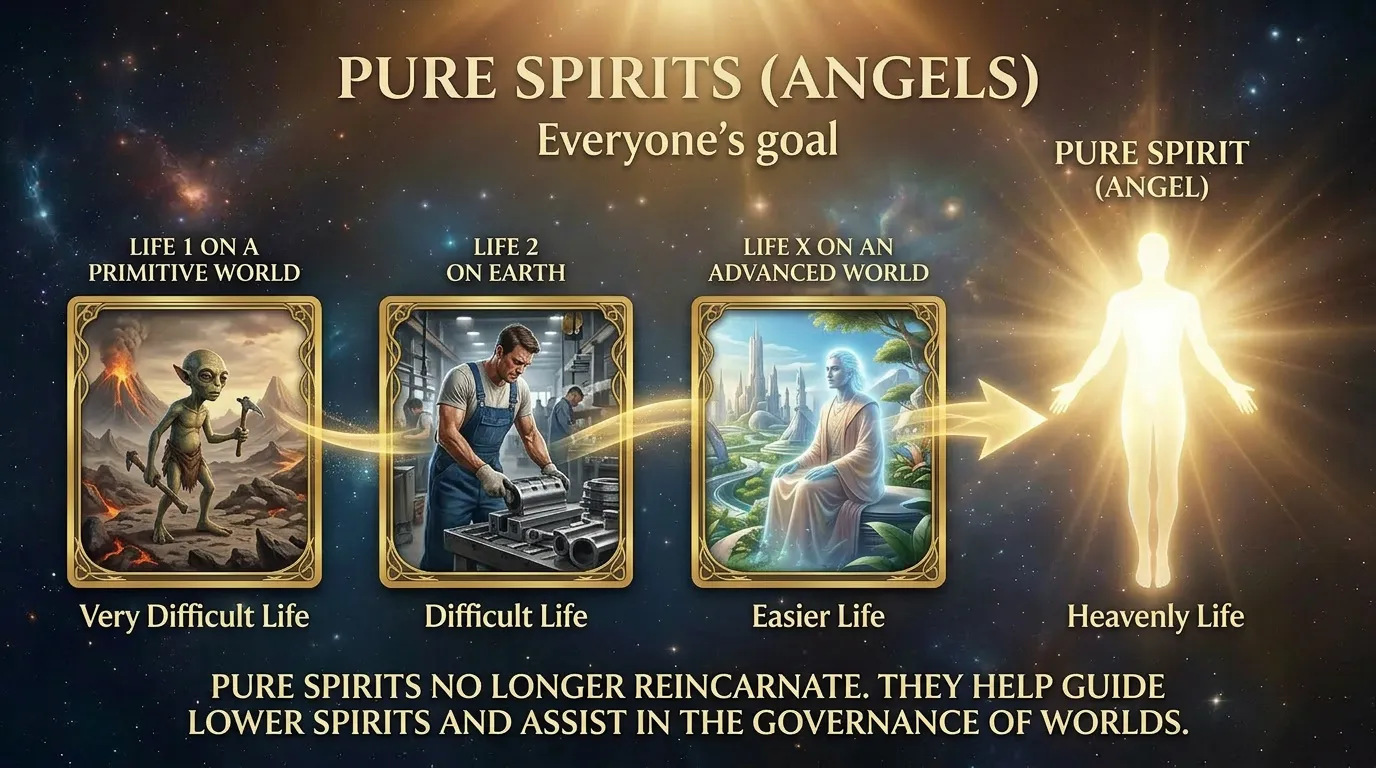
As spirits become more purified, incarnations become less difficult. Trials become fewer and less tied to earthly conditions. Eventually a spirit no longer needs bodily life at all.
When purification is complete, reincarnation ends. The spirit has overcome selfishness, pride, cruelty, and other serious moral stains, the faults that once held it back. That spirit becomes what is called a pure spirit.
A pure spirit is not a different species. It is not a special being created above the others. It is simply a spirit that completed the long ascent. A pure spirit is often called an angel.
So angels, in this view, were not created perfect at the beginning. They are spirits who reached full purification. They passed through lower degrees. They struggled. They learned. They purified themselves. They no longer need expiation. They no longer need reincarnation. And they are no longer ruled by matter or material desire.
Pure spirits, or angels, are in a state many people call heaven. Not a place in the earthly sense. But the state of purified and happy spirits. Their happiness is constant, but not idle. They do not sink into passivity.
They become messengers and ministers of God. They help guide lower spirits. They assist with human progress. They protect, inspire, and carry out missions suited to divine order. They can act across worlds. They can go where their work is needed.
Their freedom is far greater than that of ordinary spirits. Their thought reaches farther. Their influence is wider. Their joy is deeper. And their whole existence is aligned with the good.
Final Summary
To conclude, life is not a single accident between birth and death. It is a long ascent.
God creates the spirit. The spirit begins simple and ignorant. It learns through many lives. It chooses or receives trials. It falls. It rises. It suffers. It repairs. It helps. It grows. And at the end of that long journey, it becomes pure.
So what is a human being? A human being is not only a body. A human being is a spirit in temporary incarnation, passing through a world of trials.
What is death? Death is not extinction. It is the release of the spirit from one stage of its journey.
What is suffering? Suffering is sometimes consequence, sometimes correction, sometimes mission, sometimes warning, and sometimes a trial or preparation.
What is the purpose of life? The purpose of life is progress. To become less selfish, less proud, and less cruel. Less attached to bodily cravings, possessions, status, and material desire. More patient. More truthful. More charitable. More just. More loving. More free. And therefore, nearer to God.
That is how life works. Not as one short test ending in irreversible destiny after a single earthly life. But as a vast moral education under divine justice and divine mercy. Creation begins in God. The spirit begins in ignorance. And the end of the journey is purity.