Conclusion
CONCLUSION
I
C.1 Someone who knows Spiritism only from table-turning may treat it as a pastime and miss its relation to human destiny and social life.
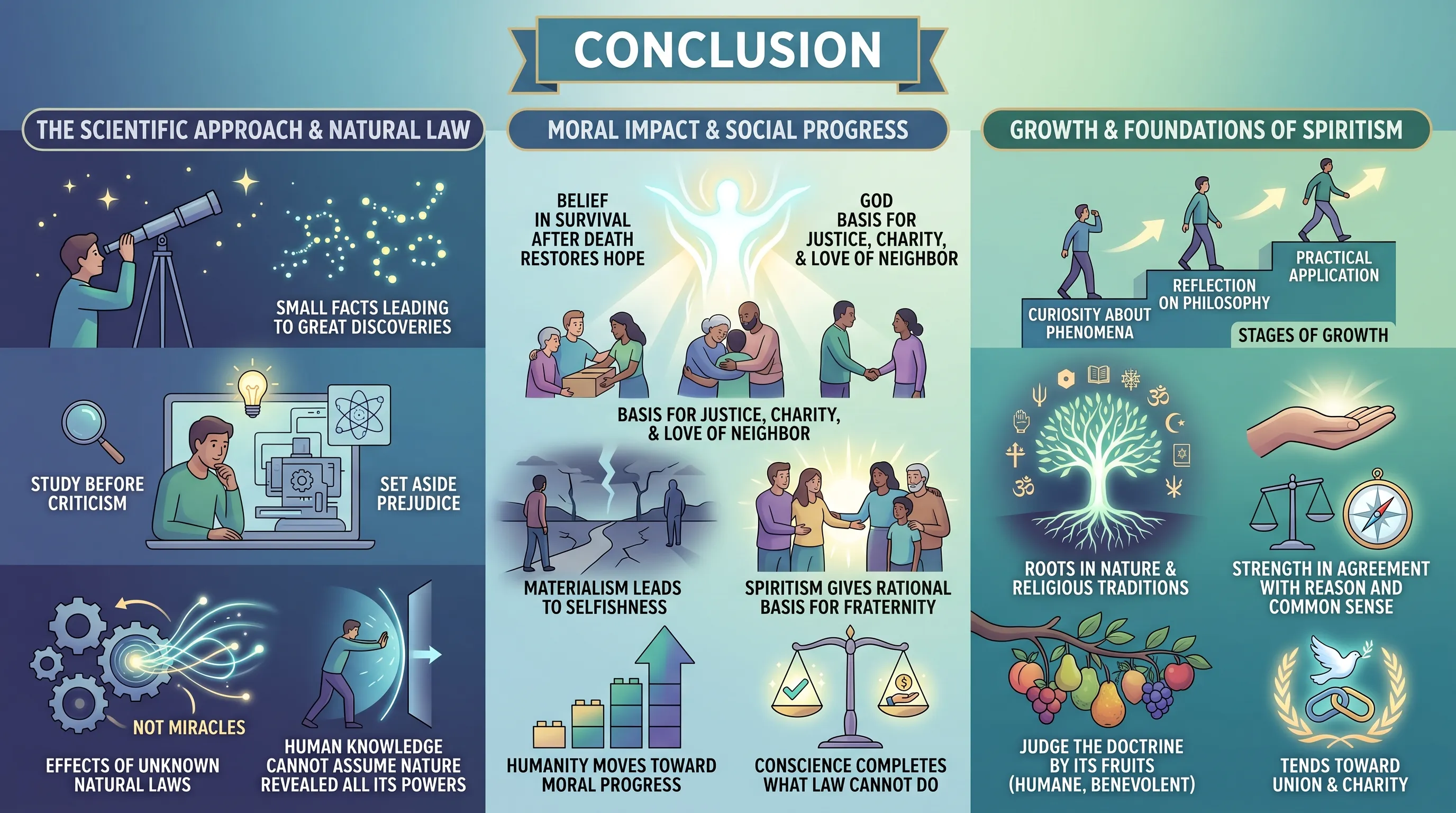
C.2 Many great discoveries began with small facts. In the same way, from a phenomenon many mocked, a body of knowledge has grown that addresses problems philosophy had not fully solved.
C.3 Criticism is valid only after real study. One should set aside prejudice, examine the doctrine carefully, and then judge it.
II
C.4 Spiritism meets resistance from materialism because it denies that matter is all that exists. Some reject it because they reject the extraordinary and the supernatural, yet in doing so they also reject religion itself, which rests on revelation and miracles.
C.5 Spirit phenomena are not violations of nature, but effects of laws not yet fully known.
C.6 Spiritism does not depend on miracles. It says these facts are only apparently supernatural and are consequences of general laws not yet understood.
C.7 To attack it as supernatural is to misunderstand it, since human knowledge cannot assume nature has revealed all its powers.
III
C.8 Those who spread disbelief in the soul and its future weaken the basis of moral life. Spiritism restores belief in survival after death and the future life. It revives hope, consoles sorrow, and helps people endure suffering.
C.9 Two doctrines stand opposed: one denies the future and leaves selfishness as the practical rule; the other affirms it and gives a rational basis for justice, charity, and love of neighbor.
C.10 Law cannot restrain every evil. Conscience and duty must complete what law cannot do. If life ends in nothing, “every one for oneself” becomes the logical rule, and fraternity an empty word.
IV
C.11 Human progress depends on justice, love, and charity, and these stand firmly only when the future is certain.
C.12 The progress of societies can be measured by how far these laws are understood and practiced. History shows movement in that direction: barriers fall, peoples grow more connected, and justice gains influence.
C.13 Much still remains to be done, but progress is a law of nature. After seeking intellectual progress for material gain, humanity learns that knowledge alone does not bring happiness without peace, justice, and trust. Then moral progress becomes necessary. In that movement, Spiritism is a powerful aid.
V
C.14 If Spiritism advances, it is because many find in it truth, consistency, and consolation.
C.15 Its growth often follows three stages: curiosity about the phenomena, reflection on the philosophy, and practical application.
C.16 Its force rests less on physical manifestations than on the light it throws on suffering, the future life, the destiny of the soul, and the moral purpose of existence.
C.17 To oppose it seriously, one must offer a better explanation of life’s great problems and show that Spiritism has not made people better or more faithful to moral law.
C.18 Spiritism draws strength from the foundations of religion: God, the soul, future consequences, and moral law. It teaches that rewards and punishments are natural results of conduct, not arbitrary decrees.
VI
C.19 The real power of Spiritism is not in material manifestations, but in its philosophy and its agreement with reason and common sense.
C.20 It does not ask for blind submission, but for belief grounded in knowledge and reflection.
C.21 Attempts to forbid manifestations cannot stop them, since mediumistic ability appears in every class and place. Even destroying books would not end Spiritism, because its source does not come from a single mind.
C.22 It is not the invention of one person. Modern Spiritist study has gathered into one whole what had long been scattered, explained what had been known only through allegory, and removed what superstition and ignorance had added.
C.23 Because its roots are deep in nature and religious experience, it cannot be destroyed by ridicule or persecution.
VII
C.24 Spiritism may be viewed in three ways: the manifestations, the philosophical and moral principles drawn from them, and the practical application of those principles. So too, some accept only the phenomena, others understand the morality, and others try to live by it.
C.25 From any of these viewpoints, it introduces a new order of ideas tending toward moral improvement.
C.26 Its opponents may also be grouped in three classes: those who reject what they have not studied, those who oppose it from personal interest, and those whose conduct feels condemned by its morality. In all these forms, the motives are pride, ambition, and selfishness.
C.27 Still, even limited results matter. If Spiritism did nothing more than prove the existence of a spiritual world beyond the body, it would already be a great blow to materialism.
C.28 More deeply understood, it awakens religious feeling, lessens fear of death, brings resignation in suffering, weakens the temptation to suicide, and encourages tolerance. Yet selfishness remains one of the hardest faults to uproot.
VIII
C.29 Spiritism does not bring a morality opposed to that of Jesus. It confirms it, explains it, and makes it more directly applicable.
C.30 The spirits come not only to repeat Christ’s teaching, but to show its practical necessity and to clarify what was often left in allegory.
C.31 There is nothing unreasonable in believing that God may again permit a broader reminder when pride and greed have obscured the same truths. The nearly simultaneous appearance of spirit manifestations in many lands has something providential in it.
C.32 Spirit communications show that an unseen world surrounds human life, that its inhabitants observe and influence us, and that all will one day enter that world.
C.33 Communication with those who have gone before gives a more concrete sense of future life and its moral consequences. In that way, Spiritism has struck a strong blow against materialism and has encouraged goodness by showing the unavoidable results of evil.
IX
C.34 Opponents point to disagreements on certain questions, but every new science passes through uncertainty, and weaker explanations fall away as observation grows.
C.35 The spirits themselves advise calm in the face of disagreement. Unity comes gradually. Their counsel may be summed up in one rule: judge spirits by the purity of their teaching.
C.36 A message marked by logic, humility, kindness, and wisdom differs greatly from one marked by ignorance, vanity, or malice. Learning to judge them is part of progress.
C.37 The fundamental principles of Spiritism remain the same everywhere: love of God, practice of goodness, moral responsibility, and the soul’s progress. Differences on secondary points do not change this foundation.
C.38 For that reason, differences should not create sects. Reason must be the final judge, and moderation serves truth better than anger. Spiritism tends toward union because it calls people back to charity.
C.39 The safest way to judge any doctrine is by its fruits. Good spirits do not inspire hatred, cruelty, or greed, but what is humane, benevolent, and faithful to goodness.
C.40 That path remains the surest sign of truth.