2.1 What Spirits Are
The Origin and Nature of Spirits
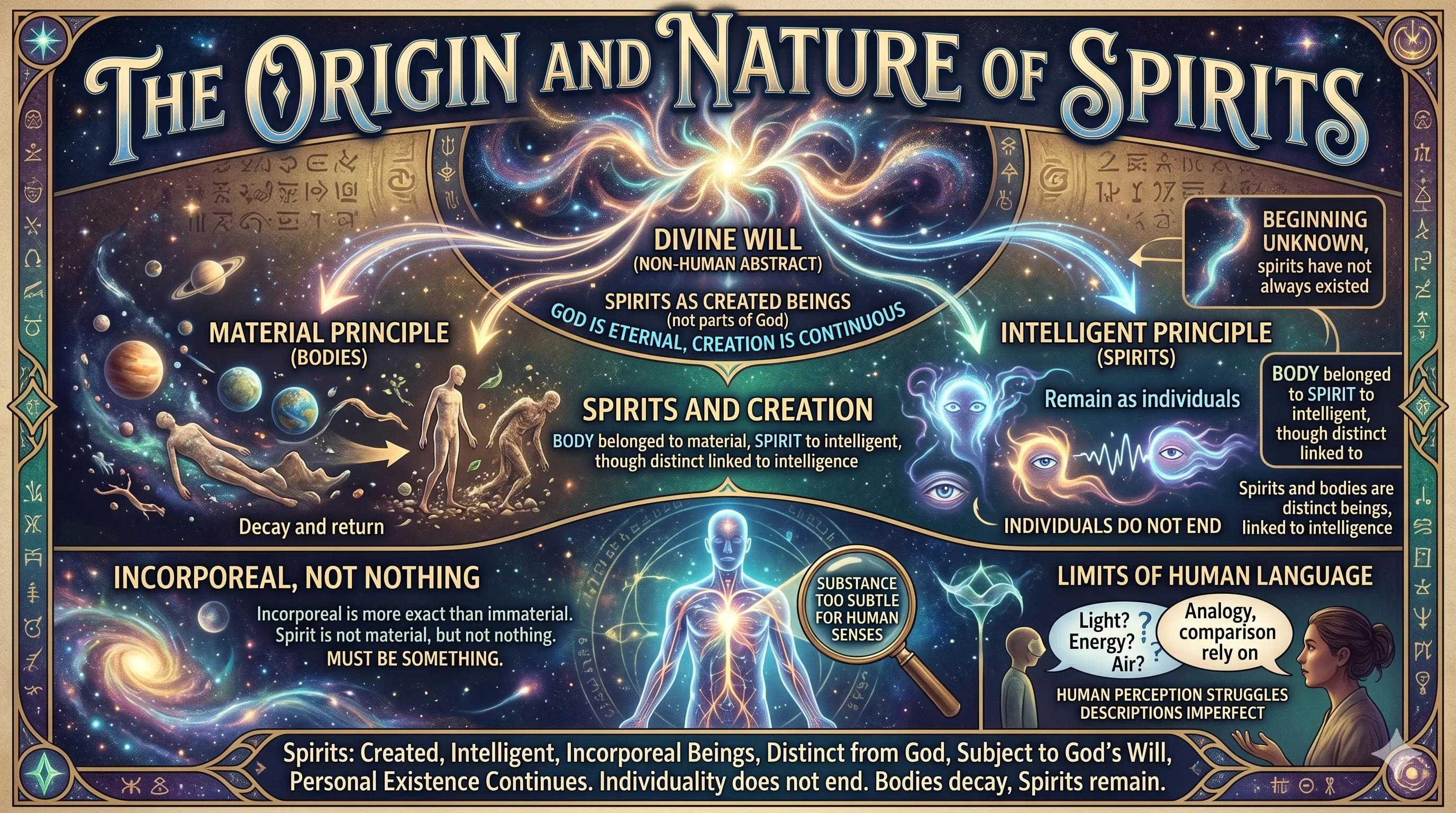
2.1.1 Spirits are the intelligent beings of creation.
2.1.2 They exist beyond the material world. They are not God, nor parts of God, but created beings brought into existence by the divine will. Because they are created, they are distinct from their Creator and subject to God’s will.
Spirits and Creation
2.1.3 Spirits have a beginning, though the time and manner of their creation are unknown.
2.1.4 God is eternal, and creation may be understood as continuous rather than confined to one moment. Spirits have not always existed by themselves. They do not produce one another or arise on their own, but come from the divine will.
The Intelligent Principle and the Material Principle
2.1.5 The universe can be viewed under two general elements: the intelligent principle and the material principle.
2.1.6 Bodies belong to the material principle, and spirits to the intelligent principle. They are therefore distinct beings linked to intelligence rather than matter, though the full mystery of their individualization remains unknown.
Incorporeal, Not Nothing
2.1.7 It is common to call spirits immaterial, but incorporeal is more exact.
2.1.8 A spirit is not a material body, but it is not nothing. As a creation, it must be something, though its substance is too subtle for ordinary human senses. The word immaterial helps only in showing that spirits are not like ordinary matter.
The Limits of Human Language
2.1.9 The difficulty of defining spirits comes from the limits of human perception.
2.1.10 Human beings struggle to grasp what lies beyond material perception, so descriptions of spirits are always imperfect and rely on comparison and analogy.
The Duration of Spirits
2.1.11 Although spirits had a beginning, their individuality does not end.
2.1.12 Bodies decay and return to their elements, but spirits do not. Once created as individual beings, they remain so. Though much remains beyond human understanding, spirits do not lose their individuality: they are created, intelligent, incorporeal beings, distinct from God, and their personal existence continues.
The Primitive, Normal World
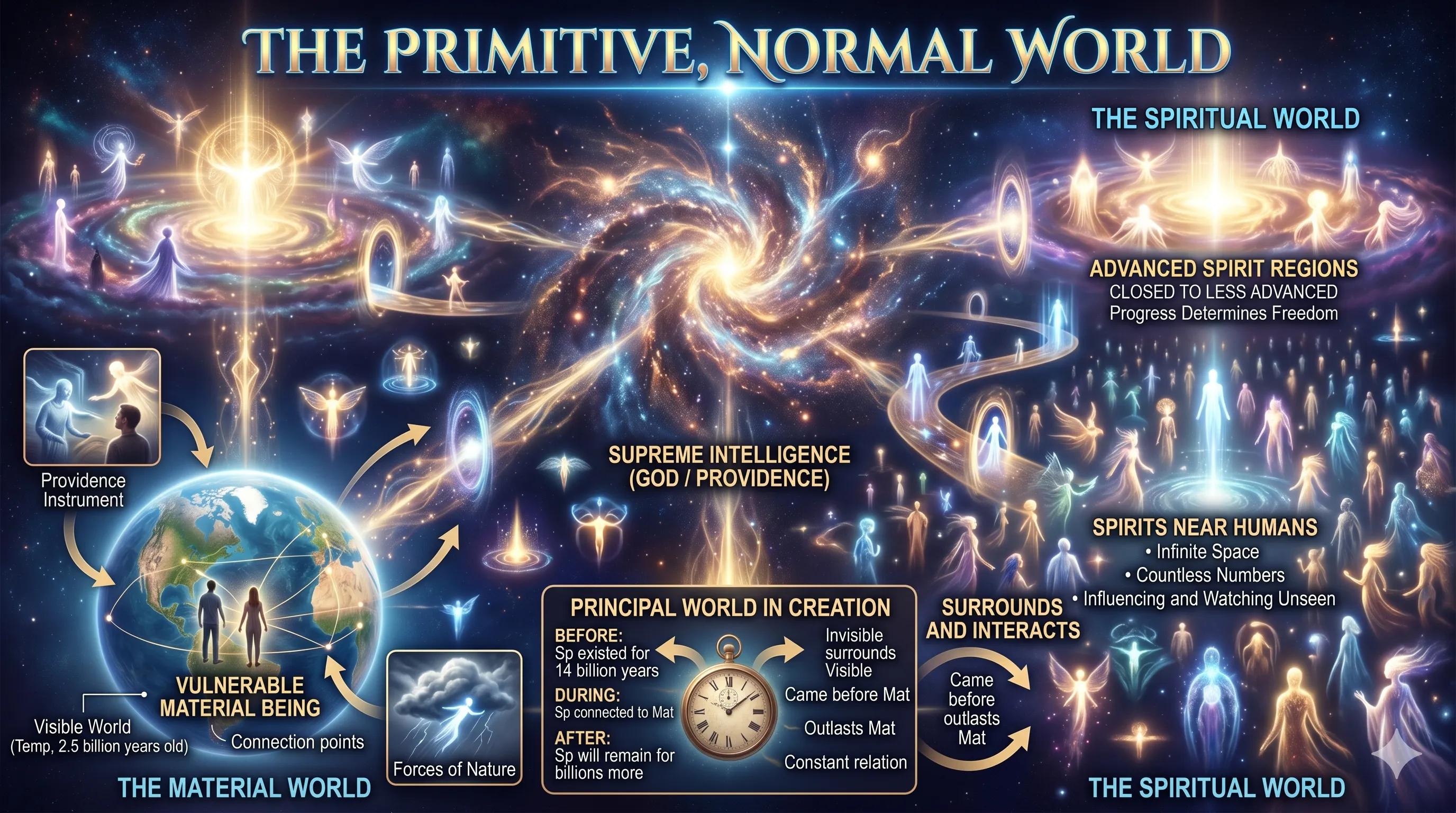
2.1.13 Beyond the visible world is the world of spirits, or incorporeal intelligences.
2.1.14 This spiritual world is the principal world in creation. It existed before the material world, will remain after it, and is always connected with it.
2.1.15 Spirits are not confined to one place. They fill infinite space in countless numbers. Some stay near human beings, watching and influencing them unseen. They are among the forces of nature and instruments of providence.
2.1.16 Yet not all spirits can go everywhere. Some regions are closed to less advanced spirits, and their freedom of movement depends on their progress.
2.1.17 So the unseen world surrounds the visible world, came before it, will outlast it, and remains in constant relation with it.
The Form and Ubiquity of Spirits
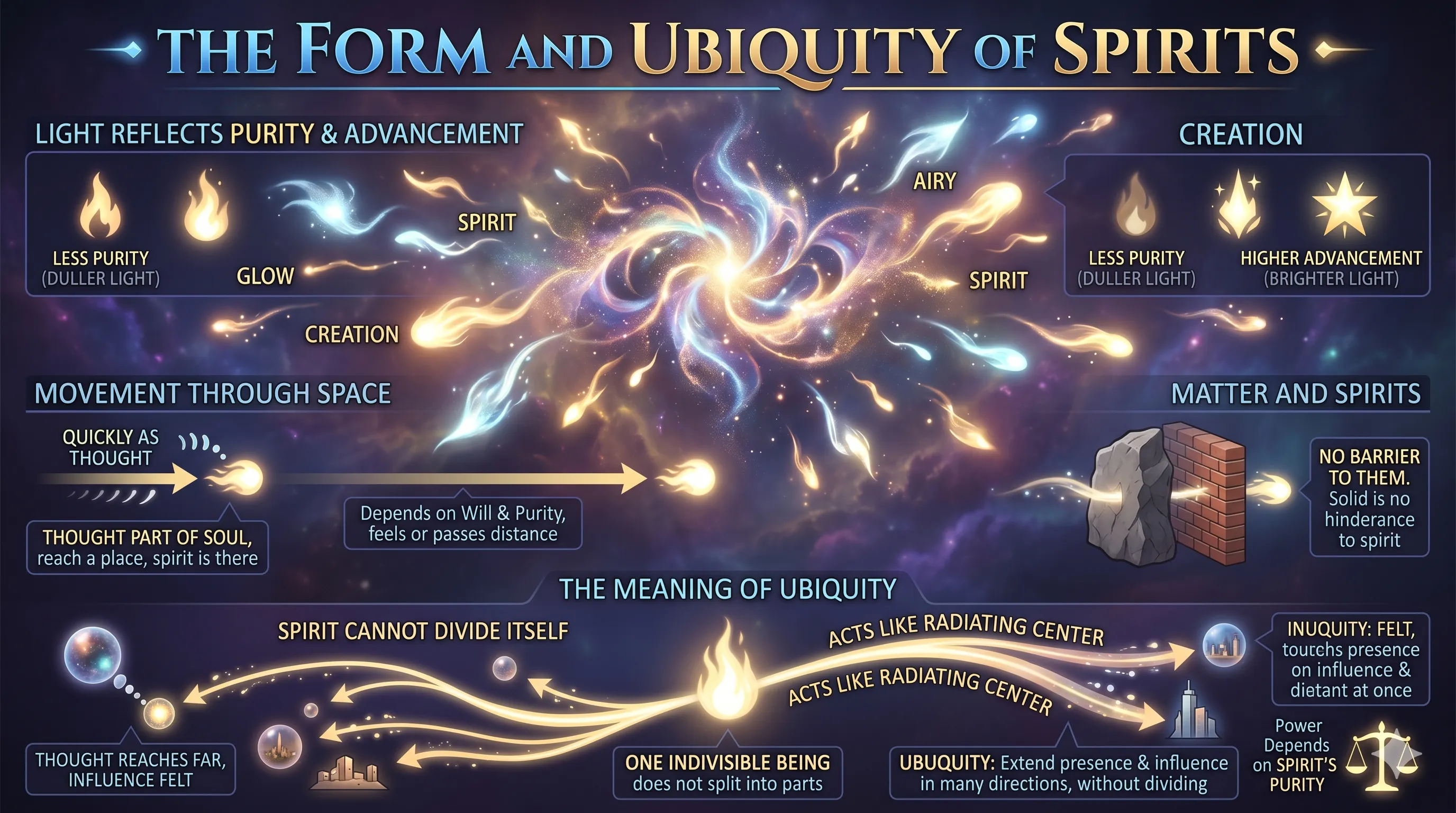
2.1.18 Spirits do not have a fixed form for our bodily senses. To us, they seem hard to define. But to other spirits, they do have a real form, often described as a flame, a glow, or an airy spark.
2.1.19 This light is not the same in all spirits. It reflects their purity and degree of advancement. The old image of a spirit marked by a flame or star carries a real meaning, because light is linked with intelligence.
Movement Through Space
2.1.20 Spirits move through space with great speed, as quickly as thought. Since thought is part of the soul, when thought reaches a place, the spirit is there as well.
2.1.21 A spirit may feel the distance it crosses, or may pass without noticing it. That depends on its will and on how purified it is.
Matter and Spirits
2.1.22 Matter does not stop spirits. They can pass through everything.
2.1.23 What seems solid and closed to a physical body is no barrier to them.
The Meaning of Ubiquity
2.1.24 A spirit cannot divide itself. The same being does not split into parts in order to be in many places.
2.1.25 Still, a spirit may appear to be present in several places at once. This is because it acts like a center that radiates outward. Its thought can reach far, and its influence can be felt at a distance without the spirit being divided.
2.1.26 This power depends on the spirit’s purity. The more elevated the spirit, the farther its thought and action can extend.
2.1.27 So ubiquity, when spoken of spirits, means that one indivisible being can extend its presence and influence in many directions at the same time, without becoming many beings.
The Perispirit
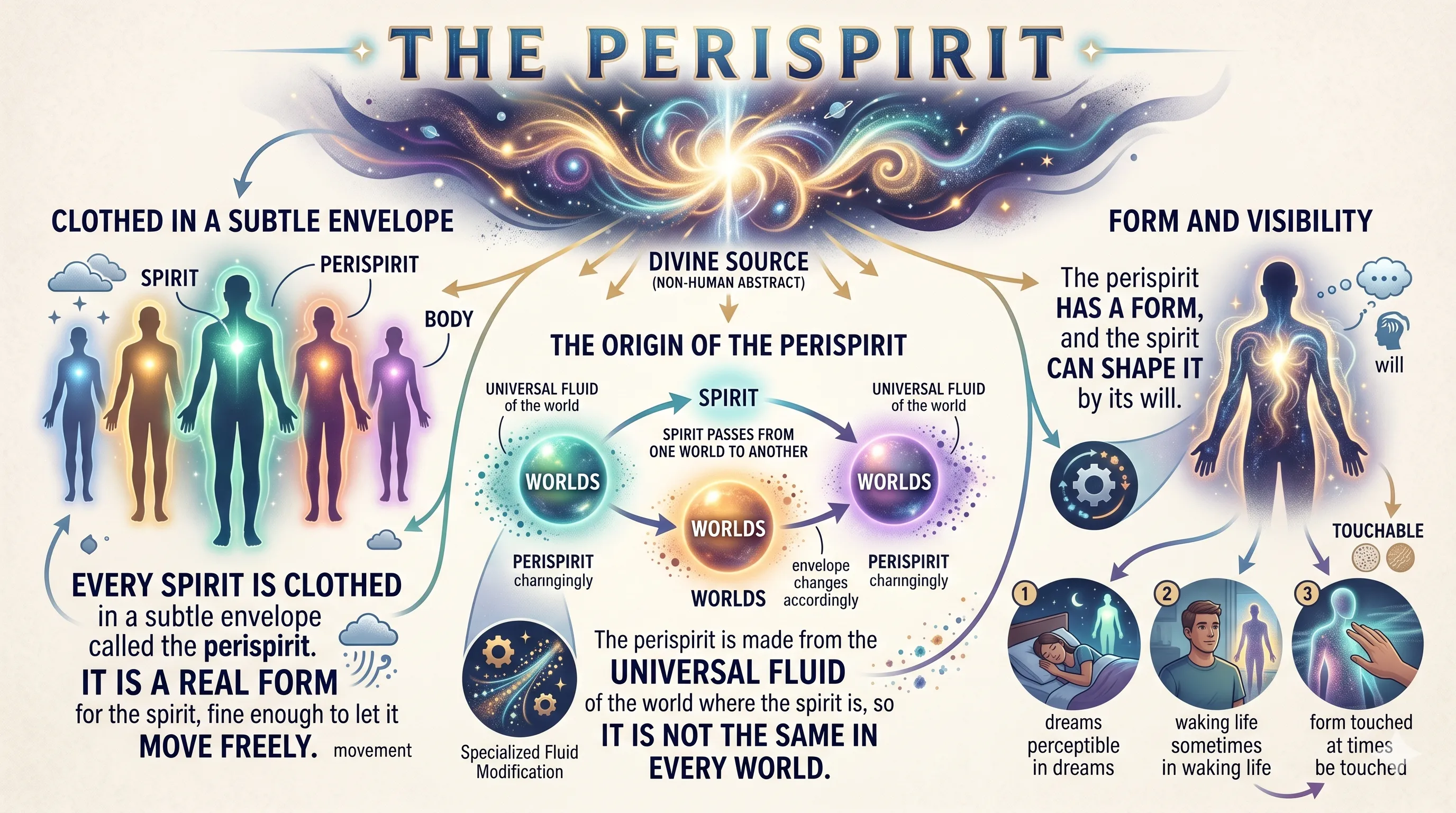
2.1.28 Every spirit is clothed in a subtle envelope called the perispirit. It is a real form for the spirit, though fine enough to let it move freely.
The Origin of the Perispirit
2.1.29 The perispirit is made from the universal fluid of the world where the spirit is, so it is not the same in every world. When a spirit passes from one world to another, its envelope changes accordingly.
Form and Visibility
2.1.30 The perispirit has a form, and the spirit can shape it by its will. Through it, the spirit can become perceptible in dreams and sometimes in waking life, even in a form that can at times be touched.
The Different Orders of Spirits
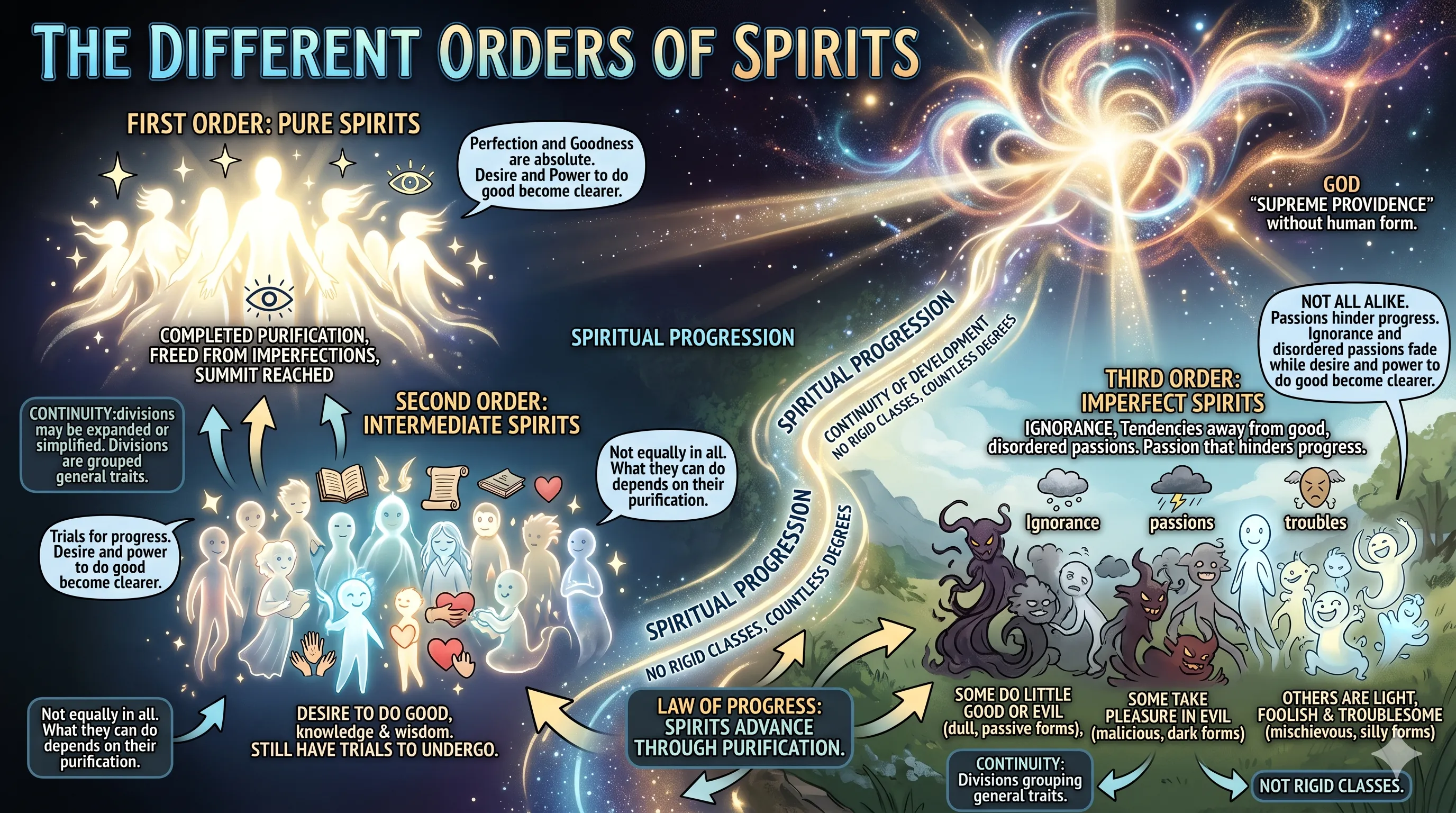
2.1.31 Spirits differ according to their degree of purification.
2.1.32 These orders are not rigid classes. There are countless degrees, with no exact boundary between them, so classification is only a practical way to group general traits.
2.1.33 Even so, spirits can be understood in three main orders.
Third Order
2.1.34 At the lower level are imperfect spirits. They are marked by ignorance, tendencies away from the good, and passions that hinder progress.
2.1.35 They are not all alike. Some do little good or evil. Some take pleasure in evil. Others are light, foolish, and troublesome rather than truly malicious.
Second Order
2.1.36 Above them are spirits at an intermediate stage. Their main concern is the desire to do good, though not equally in all, and what they can do depends on their purification.
2.1.37 Some stand out for knowledge; others for wisdom and goodness. But all still have trials to undergo.
First Order
2.1.38 At the highest level are pure spirits. They have reached perfection and completed the purification that frees them from the imperfections of the lower orders.
Continuity of Development
2.1.39 These three orders give a broad view of spiritual progress, but they are not closed groups. Since there is no barrier between degrees, the divisions may be expanded or simplified.
2.1.40 What remains constant is the law of progress. Spirits advance through purification, and as they rise, ignorance and disordered passions fade while the desire and power to do good become clearer. At the summit are the pure spirits, in whom perfection has been reached.
The Spirit Hierarchy
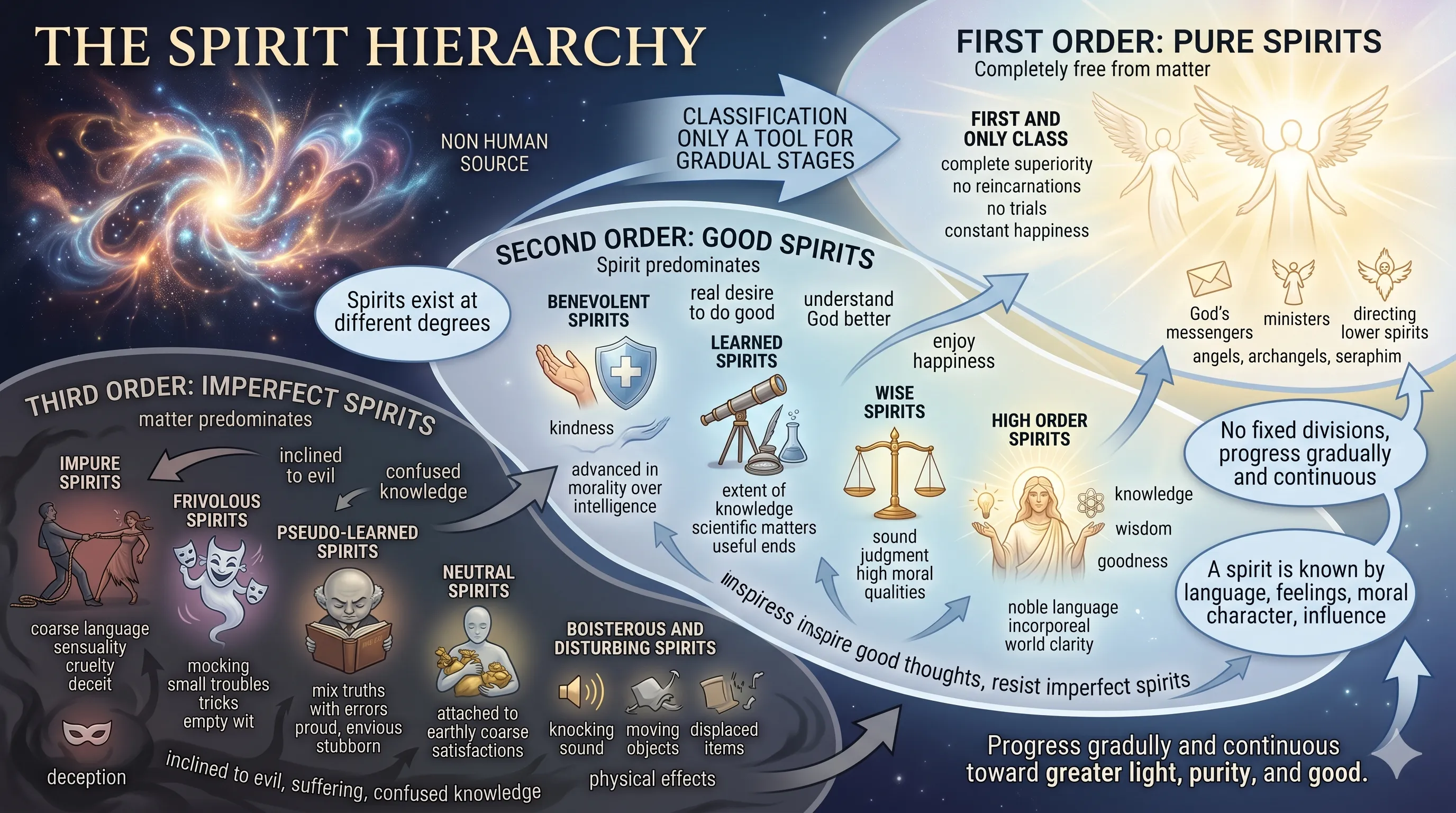
2.1.41 Spirits exist at different degrees of development.
2.1.42 These differences depend on the qualities they have gained, the faults they still carry, and whether spirit or matter has more influence in them. Any classification is only a tool for understanding gradual stages, not fixed divisions.
2.1.43 Still, three main orders can be recognized: imperfect spirits, good spirits, and pure spirits. These distinctions help explain why spiritual communications differ and why discernment is necessary. No spirit remains forever in one state, and progress may be uneven.
Third Order: Imperfect Spirits
2.1.44 In the Third Order, matter predominates over spirit. These spirits are inclined toward evil and marked by ignorance, pride, selfishness, and the passions that follow.
2.1.45 They understand little of God and the spirit world. Their knowledge is limited and confused, and even true things they say are mixed with error. They suffer through envy, jealousy, and the consequences of their faults.
2.1.46 Five principal classes may be distinguished within this order.
Tenth Class: IMPURE SPIRITS
2.1.47 These are bent on evil. They mislead, divide, deceive, and attach themselves to those who listen to them in order to hinder progress.
2.1.48 Their language is coarse and base. When incarnated, they tend toward sensuality, cruelty, deceit, hypocrisy, greed, and often do evil for its own sake.
Ninth Class: FRIVOLOUS SPIRITS
2.1.49 These spirits are ignorant, mocking, thoughtless, and mischievous. They answer without concern for truth and enjoy causing small troubles, fears, tricks, and confusion.
2.1.50 Their language may be lively and witty, but it lacks depth. They often take grand names out of mischief.
Eighth Class: PSEUDO-LEARNED SPIRITS
2.1.51 These spirits know something, but think they know far more. Their serious tone can make them seem wiser than they are.
2.1.52 Their messages mix some truths with many errors and still show pride, envy, and stubbornness.
Seventh Class: NEUTRAL SPIRITS
2.1.53 These are neither good enough to do good steadily nor bad enough to delight in evil. They remain attached to earthly things and coarse satisfactions.
Sixth Class: BOISTEROUS AND DISTURBING SPIRITS
2.1.54 These are recognized by physical effects such as knocks, movements, displaced objects, and other disturbances.
2.1.55 They seem more attached to matter than other imperfect spirits, though higher spirits may also produce such effects.
Second Order: Good Spirits
2.1.56 In the Second Order, spirit predominates over matter, and there is a real desire to do good.
2.1.57 Some stand out for knowledge, others for wisdom and kindness, and the highest unite knowledge with moral excellence. Though not yet fully freed from matter, they understand God and the infinite better and already enjoy the happiness of doing good.
2.1.58 They inspire good thoughts, turn people from evil, and help those open to their influence resist imperfect spirits.
2.1.59 Four principal groups may be distinguished.
Fifth Class: BENEVOLENT SPIRITS
2.1.60 Their main quality is kindness. They gladly help and protect human beings.
2.1.61 They have advanced more in morality than in intelligence.
Fourth Class: LEARNED SPIRITS
2.1.62 These are marked especially by the extent of their knowledge. They are more fitted for scientific matters than for moral teaching, but use knowledge for useful ends.
Third Class: WISE SPIRITS
2.1.63 These are distinguished above all by high moral qualities and by sound judgment.
Second Class: HIGH ORDER SPIRITS
2.1.64 These unite knowledge, wisdom, and goodness. Their language is noble, elevated, and benevolent.
2.1.65 They give the clearest ideas possible about the incorporeal world, communicate with sincere seekers of truth, and withdraw from the merely curious and material-minded.
First Order: Pure Spirits
2.1.66 Pure Spirits are no longer under the influence of matter. They possess complete intellectual and moral superiority over lower spirits.
First and only class
2.1.67 These spirits have passed through every degree of the hierarchy and freed themselves from all impurity. They have no more trials or expiations to undergo and no longer need reincarnation.
2.1.68 Their happiness is constant but not idle. They are God’s messengers and ministers in the harmony of the universe, directing lower spirits, helping them advance, and aiding human beings toward the good.
2.1.69 These are the beings sometimes called angels, archangels, or seraphim.
Progress and Discernment
2.1.70 No spirit remains forever in one class. Progress is gradual and continuous, and a spirit may show traits of more than one class.
2.1.71 So discernment is always necessary. A spirit is known by its language, its feelings, its moral character, and the influence it exerts. Classification is useful, but the reality is a living movement toward greater light, purity, and good.
The Progression of Spirits
First Order
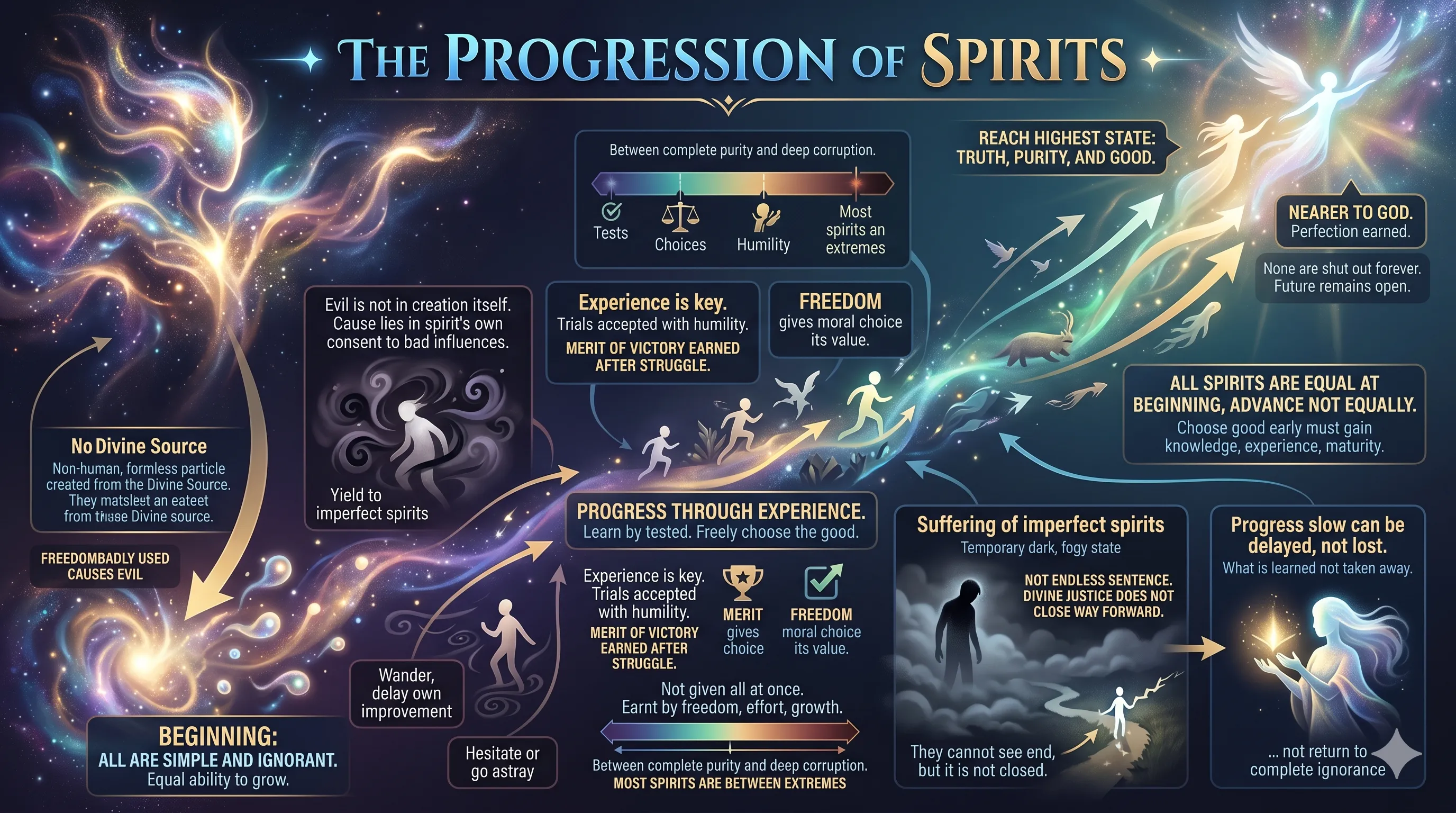
2.1.72 Spirits do not stay forever in the same condition. They move upward, from lower states to higher ones.
2.1.73 God does not create some spirits good and others evil. All are created simple and ignorant, with the same ability to grow. By learning, being tested, and freely choosing the good, they move little by little toward perfection and nearer to God.
2.1.74 This progress comes through experience. Some accept their trials with humility and advance sooner. Others resist, wander, and delay their own improvement. But none are shut out forever. However long the delay, the future remains open.
2.1.75 Progress can be slowed, but not truly lost. What a spirit has really learned is not taken away. It may hesitate or go astray, yet it does not return to complete ignorance.
2.1.76 Perfection is not given all at once. It must be earned. If spirits had been created perfect, they would not know the merit of victory after struggle. Their different degrees of advancement also allow different roles in the order of creation.
2.1.77 On earth, no one reaches everything in one life, because bodily life is short. In the spirit life, the future has no such limit. Spirits advance at different speeds, but all may finally reach the highest state.
2.1.78 A spirit is not made evil at its beginning. Evil appears when freedom is badly used. At first, the spirit is only ignorant, and from that ignorance it may turn either toward good or toward evil. Freedom is what gives moral choice its value.
2.1.79 The cause of evil is not in creation itself. It lies in the spirit's own consent to bad influences. Imperfect spirits may push others toward error, and they continue to do so as long as those others are weak enough to yield.
2.1.80 Between complete purity and deep corruption there are many degrees. Most spirits are found between these two extremes. Even those who have followed evil for a long time can still rise to the same height as the others, though by a harder and longer path.
2.1.81 The suffering of imperfect spirits is not an endless sentence. It may seem endless to them because they cannot see its end, but divine justice does not close the way forward.
2.1.82 All spirits are equal in their beginning, but they do not advance equally in intelligence or morality. Those who choose the good early are not perfect for that reason alone. They too must gain knowledge, experience, and maturity.
2.1.83 So, at its origin, a spirit is neither fully good nor fully evil. By freedom, effort, and growth, it rises step by step toward truth, purity, and the good.
Angels and Demons
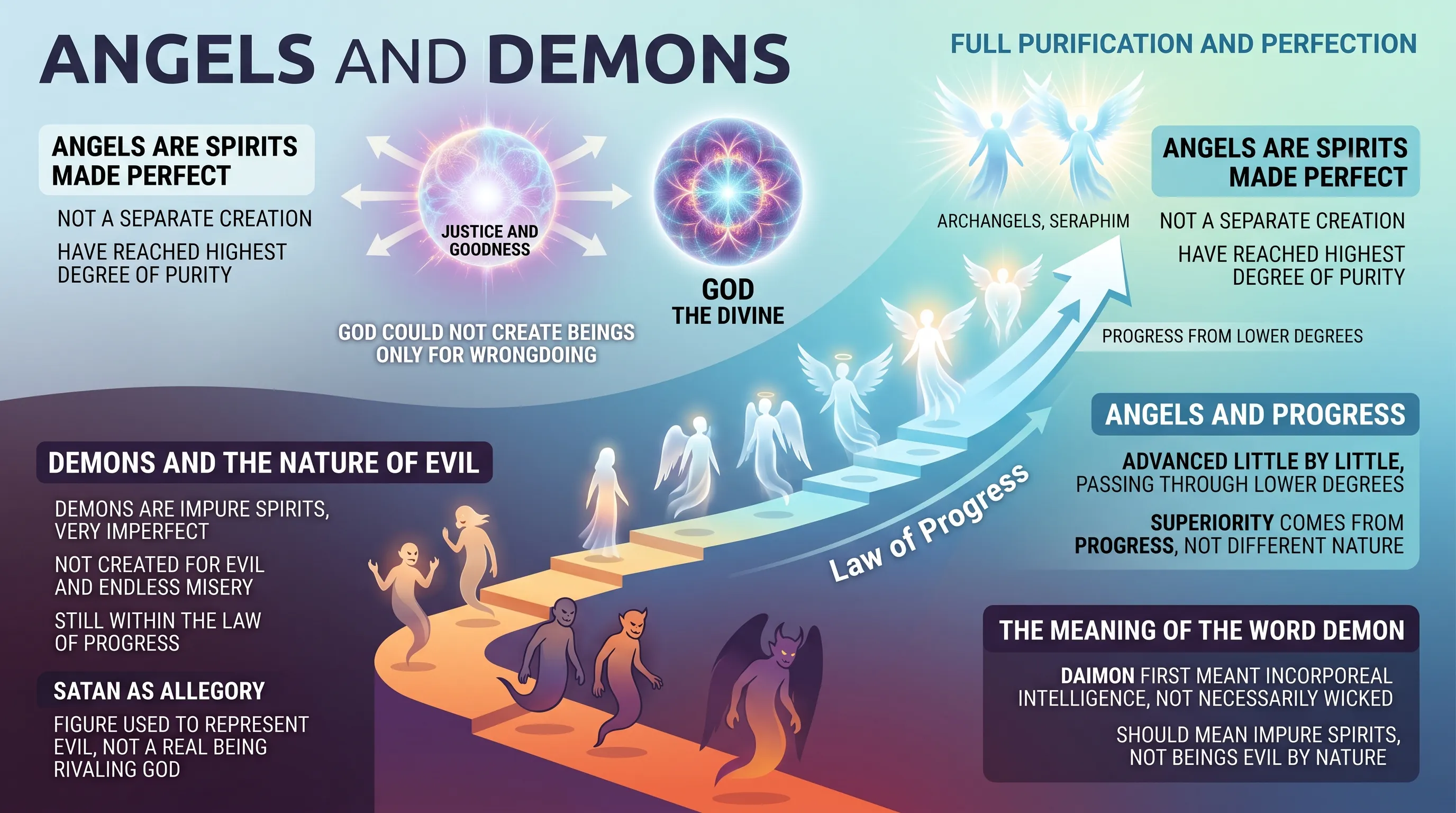
2.1.84 Angels, archangels, and seraphim are not a separate creation. They are spirits who have reached the highest degree of purity. The word angel is often used for any being above humanity, but in its fullest sense it means a spirit made perfect.
Angels and Progress
2.1.85 Angels were not created perfect. Like all spirits, they advanced little by little, passing through lower degrees before reaching full purification.
2.1.86 Some arrived sooner and others later, but their superiority comes from progress, not from a different nature. This is why people believed in higher beings long before they understood what those beings really were.
Demons and the Nature of Evil
2.1.87 Demons are often imagined as beings created for evil and condemned to remain evil forever. That cannot agree with the justice and goodness of God.
2.1.88 God could not create beings meant only for wrongdoing and endless misery. There cannot be an evil power forever equal to God and opposed to Him. What are called demons are spirits still very imperfect. They may be malicious, deceitful, and drawn to what is low, but they are not outside the law of progress.
The Meaning of the Word Demon
2.1.89 Today the word demon usually means an evil spirit. But the Greek word daimon first meant an incorporeal intelligence, not necessarily a wicked one.
2.1.90 Much confusion came from giving the word only its later meaning. If it is used, it should mean impure spirits, not beings evil by nature. Their suffering comes from their own imperfection, and by resisting improvement they make that suffering last longer.
Satan as Allegory
2.1.91 Satan is not a real being rivaling God. Satan is the figure used to represent evil.
Figurative Language and Religious Expression
2.1.92 Invisible things are often described by images taken from the visible world. So pure spirits are shown with signs of light and elevation, while evil is pictured in dark or animal forms. The error is to take the image as a literal being.
2.1.93 Religious language is often figurative, shaped for the understanding of its time. For that reason, descriptions of Satan and demons do not prove that evil has its own eternal kingdom set against God.
Moral Consequence
2.1.94 Evil does not come from creatures made wicked. It comes from spirits that are still imperfect and ruled by bad passions.
2.1.95 No spirit is created for evil, and none is condemned to remain evil forever. Angels and demons are the same order of beings at different stages: some have reached purity, and others are still on the way.