1.4 The Principle of Life
Organic and Inorganic Beings
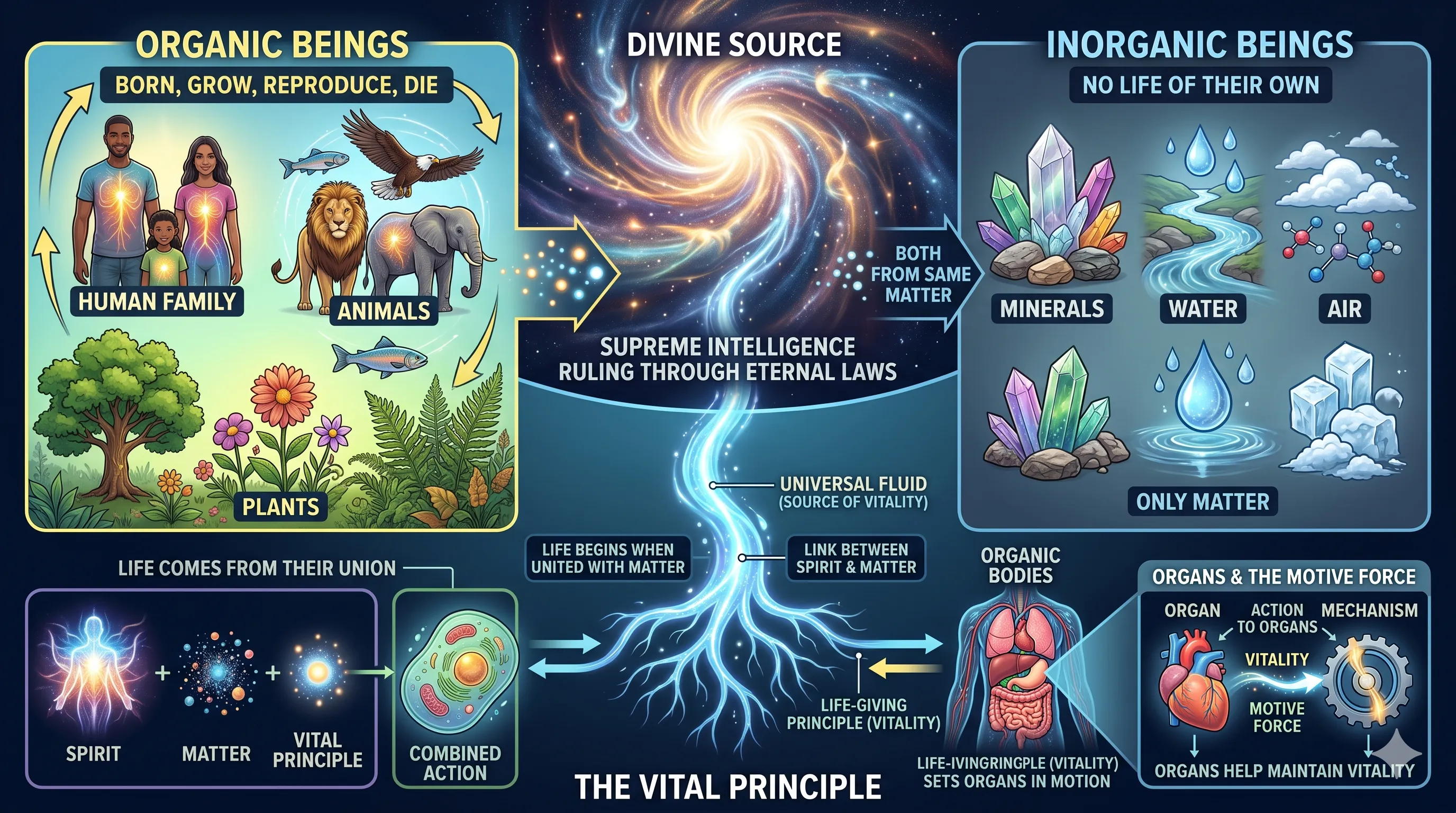
1.4.1 Organic beings are those that have life. They are born, grow, reproduce, and die. Human beings, animals, and plants belong to this class. Inorganic beings have no life of their own. They are only matter, such as minerals, water, and air.
1.4.2 Both are formed from the same matter. What makes them different is that organic bodies are joined to a life-giving principle.
The Vital Principle
1.4.3 This life-giving principle is called the vital principle. Life begins when it is united with matter. Matter by itself does not live, and the vital principle by itself is not life. Life comes from their union.
1.4.4 Spirit and matter are the two general elements of the universe. But in living beings there is also the vital principle. Even so, it is not a separate basic element. It comes from a special modification of universal matter.
The Source and Function of Vitality
1.4.5 The source of the vital principle is the universal fluid. It is related to what has been called magnetic fluid or animalized electric fluid, and it serves as a link between spirit and matter.
1.4.6 The vital principle exists in all organic beings, but it is shaped differently in each species. Because of this, each kind of being has the form of life and activity suited to its nature.
1.4.7 Vitality does not act separately from bodily organization. Life depends on organized matter joined with the vital agent. Without this union, vitality remains inactive.
Organs and the Motive Force of Life
1.4.8 The organs of a living being are like a mechanism set in motion by the vital principle. This principle is the motive force of organic bodies.
1.4.9 It gives action to the organs, and the organs help maintain and develop it. Life results from the combined action of the organized body and the vital principle.
Life and Death
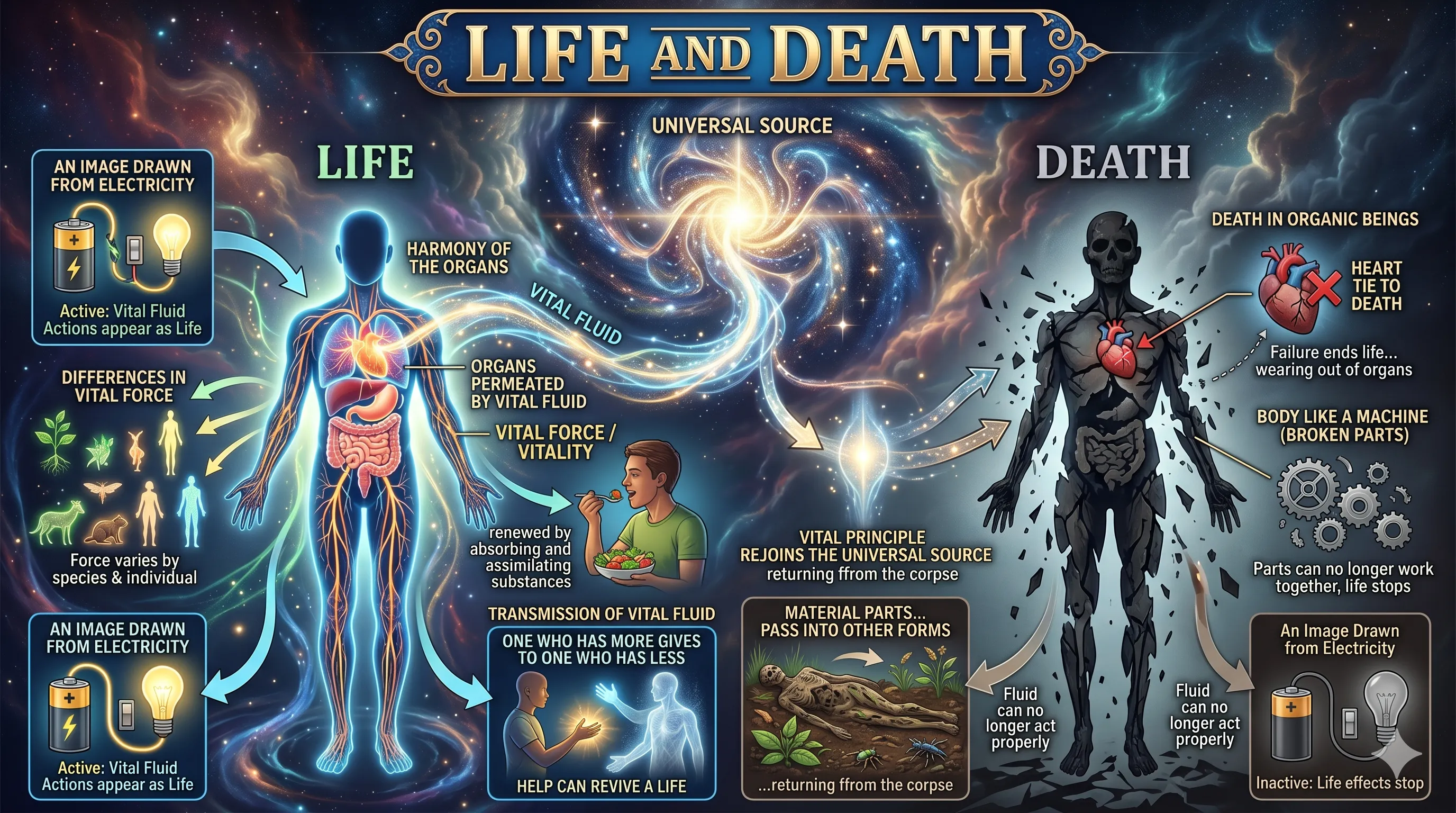
1.4.10 Death in organic beings comes from the wearing out of the organs. The body is like a machine: when its main parts can no longer work together, life stops. The heart is deeply tied to death, but it is not the only organ whose failure can end life.
1.4.11 After death, the material parts of the body remain and pass into other forms. But the vital principle does not stay in the corpse. It returns to the universal source from which living beings draw life.
The Action of the Vital Fluid
1.4.12 The organs are permeated by vital fluid, which makes all parts of the body act together. While the essential elements remain sound, this fluid keeps the organism alive.
1.4.13 When those elements are altered or destroyed, the fluid can no longer act properly. The harmony of the organs ends, and death follows.
An Image Drawn from Electricity
1.4.14 This can be compared to electricity. In a device, electricity may be present in a hidden state, but its effects appear only when it is active. In the same way, life appears only through the action of the vital fluid in the organism.
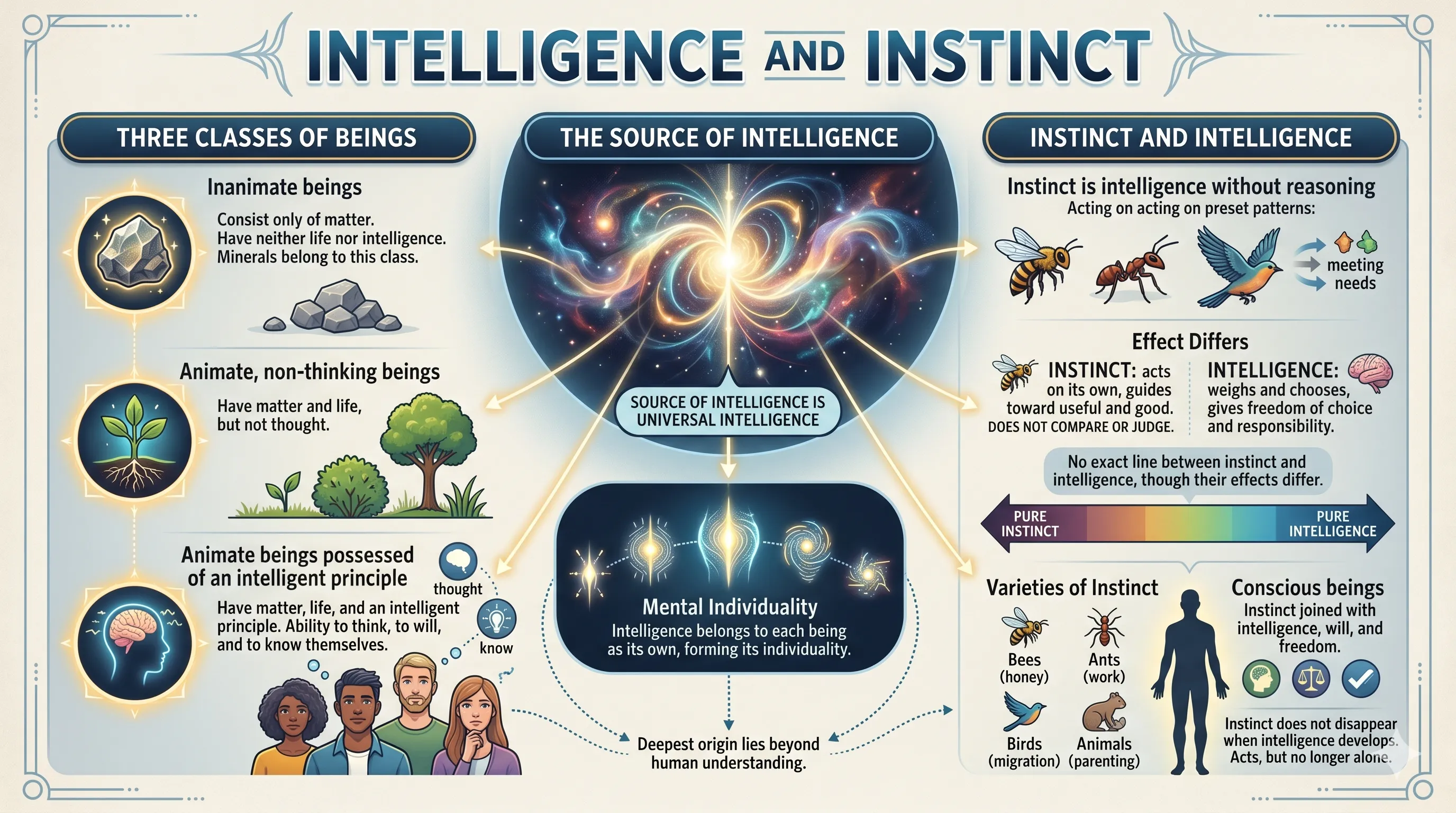
1.4.15 When that action stops, the visible effect also stops. Life is produced by this activity, and death comes when it ends.
Differences in Vital Force
1.4.16 Vital force is not the same in all beings. It varies from one species to another, and also from one individual to another.
1.4.17 Because of this, some have more vitality than others. This force can also be exhausted, and if it is not renewed by absorbing and assimilating the substances that contain it, it may become too weak to maintain life.
Transmission of Vital Fluid
1.4.18 Vital fluid can be transmitted from one individual to another. One who has more may give some to one who has less.
1.4.19 In certain cases, this help can revive a life that is close to being extinguished.
Intelligence and Instinct
1.4.20 Life, intelligence, and matter are distinct.
1.4.21 A being may live without thinking. Plants live but do not think. Intelligence appears through the body in living beings, but it does not come from matter.
1.4.22 Three main classes of beings can be distinguished.
1. Inanimate beings
1.4.23 These consist only of matter. They have neither life nor intelligence. Minerals belong to this class.
2. Animate, non-thinking beings
1.4.24 These have matter and life, but not thought.
3. Animate beings possessed of an intelligent principle
1.4.25 These have matter, life, and an intelligent principle that gives them the ability to think, to will, and to know themselves.
The Source of Intelligence
1.4.26 The source of intelligence is universal intelligence.
1.4.27 Yet intelligence belongs to each being as its own, forming its mental individuality. Its deepest origin still lies beyond human understanding.
Instinct and Intelligence
1.4.28 Instinct is a kind of intelligence without reasoning, by which living beings meet their needs.
1.4.29 There is no exact line between instinct and intelligence, though their effects differ. Instinct acts on its own, while intelligence weighs and chooses.
Instinct, Reason, and Freedom
1.4.30 Instinct does not disappear when intelligence develops.
1.4.31 It generally guides toward what is useful and good. Reason can do the same, but it is often led astray. Instinct does not compare or judge; reason does, and therefore gives human beings freedom of choice and responsibility.
The Varieties of Instinct
1.4.32 Instinct appears differently in each species according to its nature and needs.
1.4.33 In conscious beings aware of the outer world, instinct is joined with intelligence, will, and freedom. It still acts, but no longer alone.