2.2 Incarnation: Spirits in Human Bodies
Incarnation
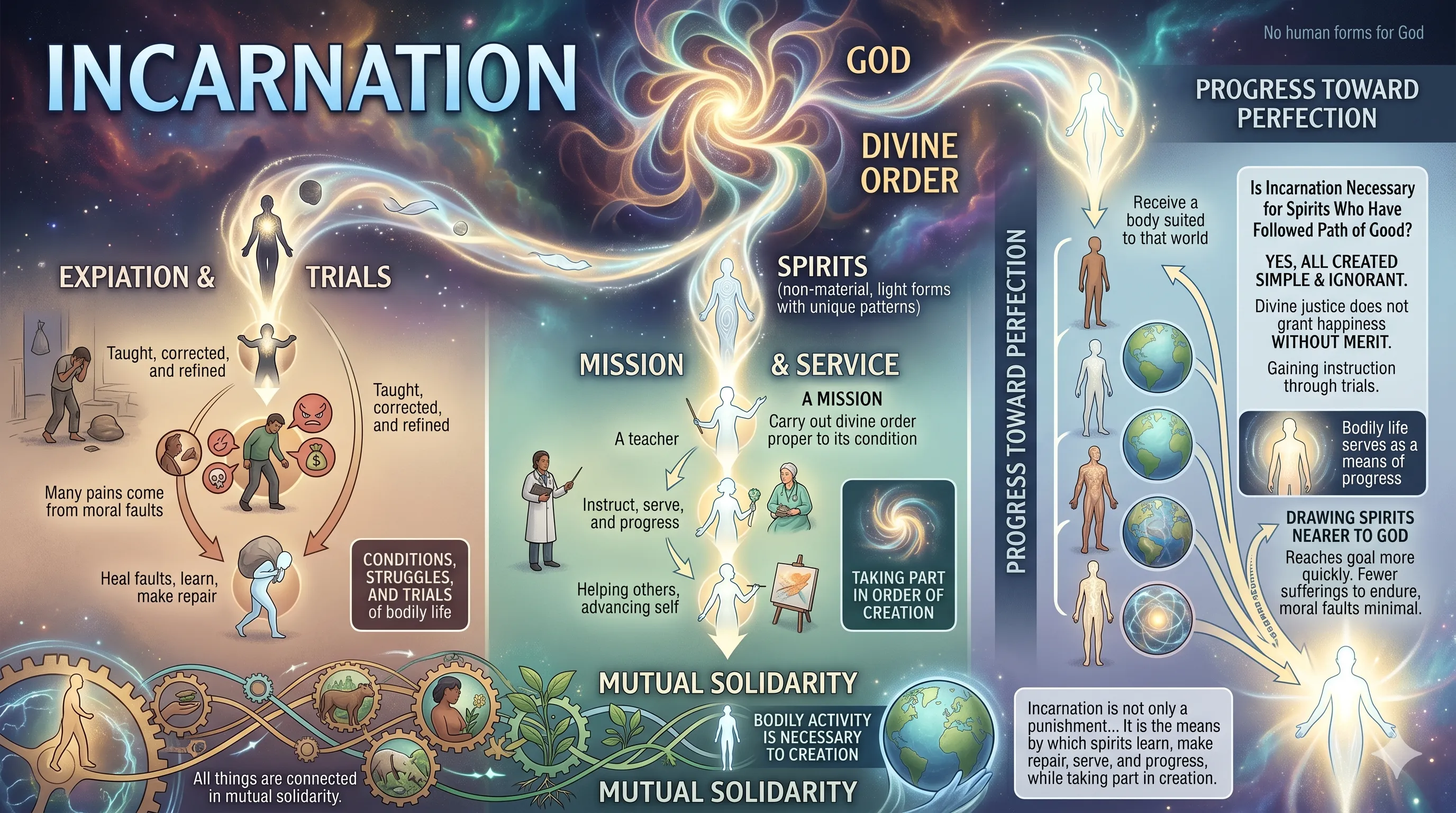
2.2.1 Incarnation is given to spirits so they can move toward perfection. For some it is expiation; for others, a mission. Through the conditions, struggles, and trials of bodily life, spirits are taught, corrected, and refined.
2.2.2 Embodied life also places spirits within the work of creation. On each world, a spirit receives a body suited to that world and helps carry out the divine order proper to its condition, while advancing itself.
2.2.3 Thus bodily activity is necessary to creation and also serves as a means of progress, drawing spirits nearer to God. By this law, all things are connected in mutual solidarity.
Is Incarnation Necessary for Spirits Who Have Followed the Path of Good from the Beginning?
2.2.4 Incarnation is necessary for all spirits. All are created simple and ignorant, and gain instruction through the trials of embodied life. Divine justice does not grant happiness without merit.
2.2.5 A spirit that follows the good is not freed from bodily life, but reaches the goal more quickly. As a spirit becomes purer, it has fewer sufferings to endure, since many pains come from moral faults.
2.2.6 Incarnation is therefore not only a punishment or burden. It is the means by which spirits learn, make repair, serve, and progress, while taking part in the order of creation.
The Soul
2.2.7 The soul is an incarnate spirit.
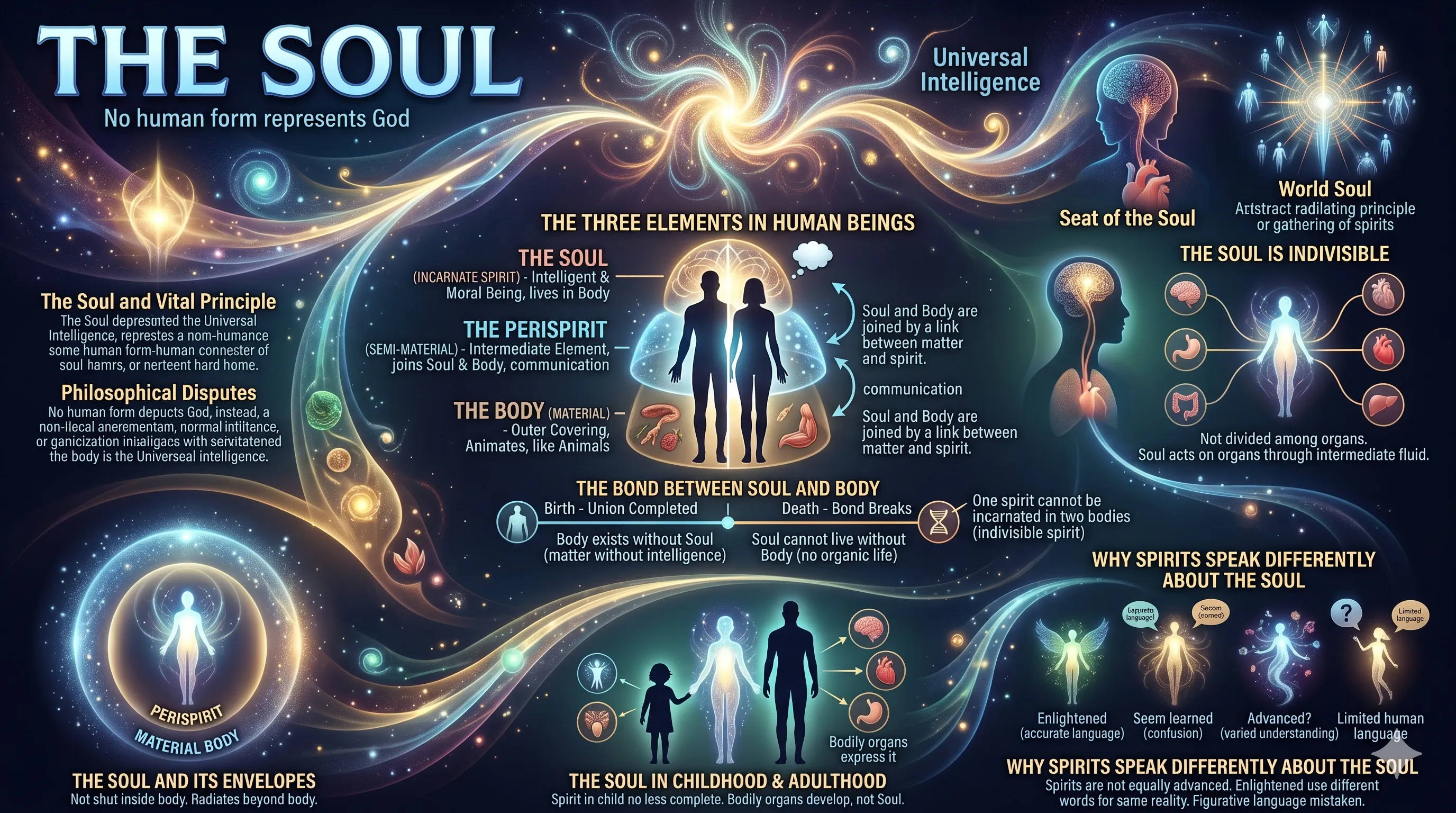
2.2.8 Before joining a body, it is called a spirit. During bodily life, it is called a soul. They are not two different beings, but the same being in two states.
The Three Elements in Human Beings
2.2.9 Human beings are made up of three essential parts.
1) The Body
2.2.10 The body is the material part. In its organic nature it is like that of animals and is animated by the same vital principle. By itself, it is only an outer covering.
2) The Soul
2.2.11 The soul is the incarnate spirit, the intelligent and moral being that lives in the body.
3) The Perispirit
2.2.12 The perispirit is the intermediate element joining soul and body. It is semi-material and makes communication between them possible.
The Bond Between Soul and Body
2.2.13 Soul and body are joined by a link between matter and spirit.
2.2.14 The body can exist without the soul, but only as living matter without intelligence. The soul cannot live in a body that has no organic life. The union is completed at birth and lasts until death breaks the bond.
2.2.15 One spirit cannot be incarnated in two bodies at the same time, because spirit is indivisible.
The Soul and the Vital Principle
2.2.16 The soul must not be confused with the principle of material life.
2.2.17 Some use the word soul to mean the force that animates living beings. But the soul, properly speaking, is a distinct moral being, independent of matter and keeping its individuality. Many disputes come from using the same word for different ideas.
The Soul Is Indivisible
2.2.18 The soul is not divided among the organs or muscles.
2.2.19 That idea only applies if soul means the vital fluid spread through the body. If it means the incarnate spirit, the soul is one and indivisible, acting on the organs through the intermediate fluid that animates them.
The Soul and Its Envelopes
2.2.20 The soul is not shut inside the body like a bird in a cage.
2.2.21 It radiates beyond the body. It is surrounded by two envelopes: first the perispirit, then the material body.
The Soul in Childhood and Adulthood
2.2.22 The spirit in a child is no less complete than in an adult.
2.2.23 What develops is not the soul itself, but the bodily organs through which it expresses itself.
Why Spirits Speak Differently About the Soul
2.2.24 Spirits do not all speak of the soul in the same way because they are not equally advanced.
2.2.25 Some understand little, some only seem learned, and even enlightened spirits may use different words for the same reality because human language is limited. Figurative language is often mistaken for literal teaching.
The World Soul
2.2.26 The expression world soul can mean the universal principle of life and intelligence from which individual beings come.
2.2.27 It is often vague. In a better sense, it can also mean the gathering of devoted spirits who help guide human actions toward the good.
On Philosophical Disputes About the Soul
2.2.28 Philosophical disagreements about the soul do not make the search useless.
2.2.29 Even mistaken systems helped prepare the way for clearer understanding, since truth and error were often mixed together.
The Seat of the Soul
2.2.30 The soul does not occupy one exact point in the body.
2.2.31 It may be said to reside especially where certain faculties are most active, such as the head for thought or the heart for feeling. But this is not anatomical. The soul remains the conscious, indivisible spirit, united to the body by the perispirit while remaining distinct from it.
Materialism
Materialism
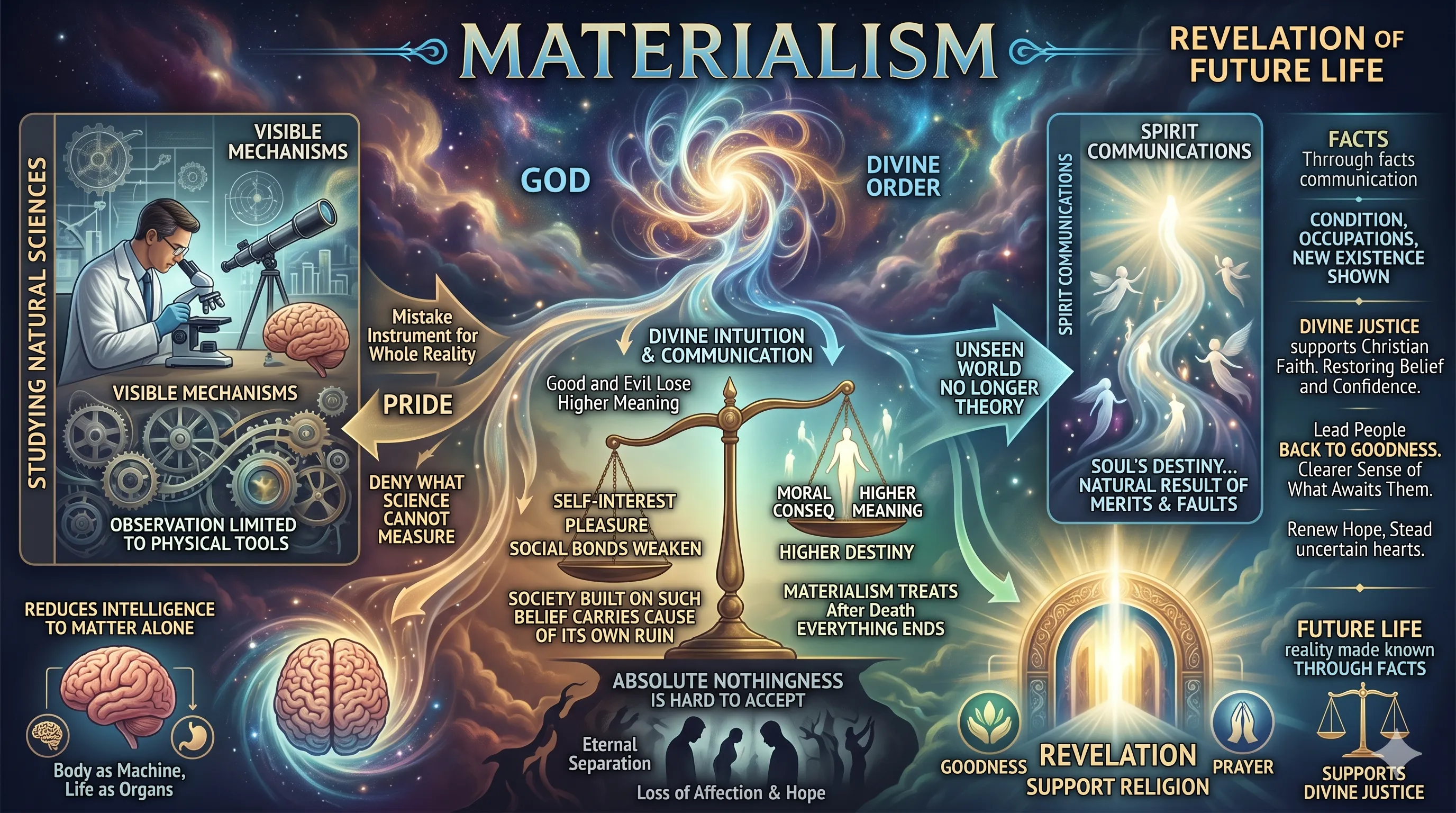
2.2.32 Those who study the natural sciences may be drawn toward materialism when they judge only by what they can see. If observation is limited to visible mechanisms, it is easy to mistake the instrument for the whole reality. Pride can reinforce this, leading people to deny what science cannot yet measure.
2.2.33 But materialism is not the natural result of science. It comes from misusing science. Some who claim to believe in nothingness are less certain than they appear, and often accept hope when it is offered.
2.2.34 Materialism reduces intelligence to matter alone. It treats the body as a machine and life as the work of organs. Because the soul cannot be grasped by physical tools, it concludes that thought depends only on matter and that after death everything ends.
2.2.35 If that were true, the moral consequences would be grave. Good and evil would lose higher meaning, people would live only for themselves and pleasure, and social bonds would weaken. A society built on such a belief would carry the cause of its own ruin.
2.2.36 Fortunately, this view is not general. The human heart resists it. Whatever people may argue, when death approaches most still ask what will become of them.
2.2.37 It is hard to accept absolute nothingness: the loss of every faculty, affection, and hope, and eternal separation from those we love. Religion denies this, and reason supports that denial. Still, many want more than a vague future.
2.2.38 It is one thing to say the soul exists and another to understand what that means. People ask whether it keeps its individuality, what future happiness or suffering is, and how that life is experienced. They want something that speaks to reason and to the heart.
2.2.39 It is false to say that no one has returned to speak of the life beyond. Through spirit communications, the future life is shown as a reality made known through facts. Spirits describe their condition, occupations, and new existence, so the unseen world is no longer only a theory.
2.2.40 Thus each soul’s destiny appears as the natural result of its merits and faults. This does not weaken Christian faith but supports it, restoring belief to doubters and confidence to the hesitant.
2.2.41 For that reason, the revelation of the future life strongly supports religion. It renews hope, steadies uncertain hearts, and helps lead people back to goodness by giving them a clearer sense of what awaits them.