3.5 The Instinct to Survive
The Self-Preservation Instinct
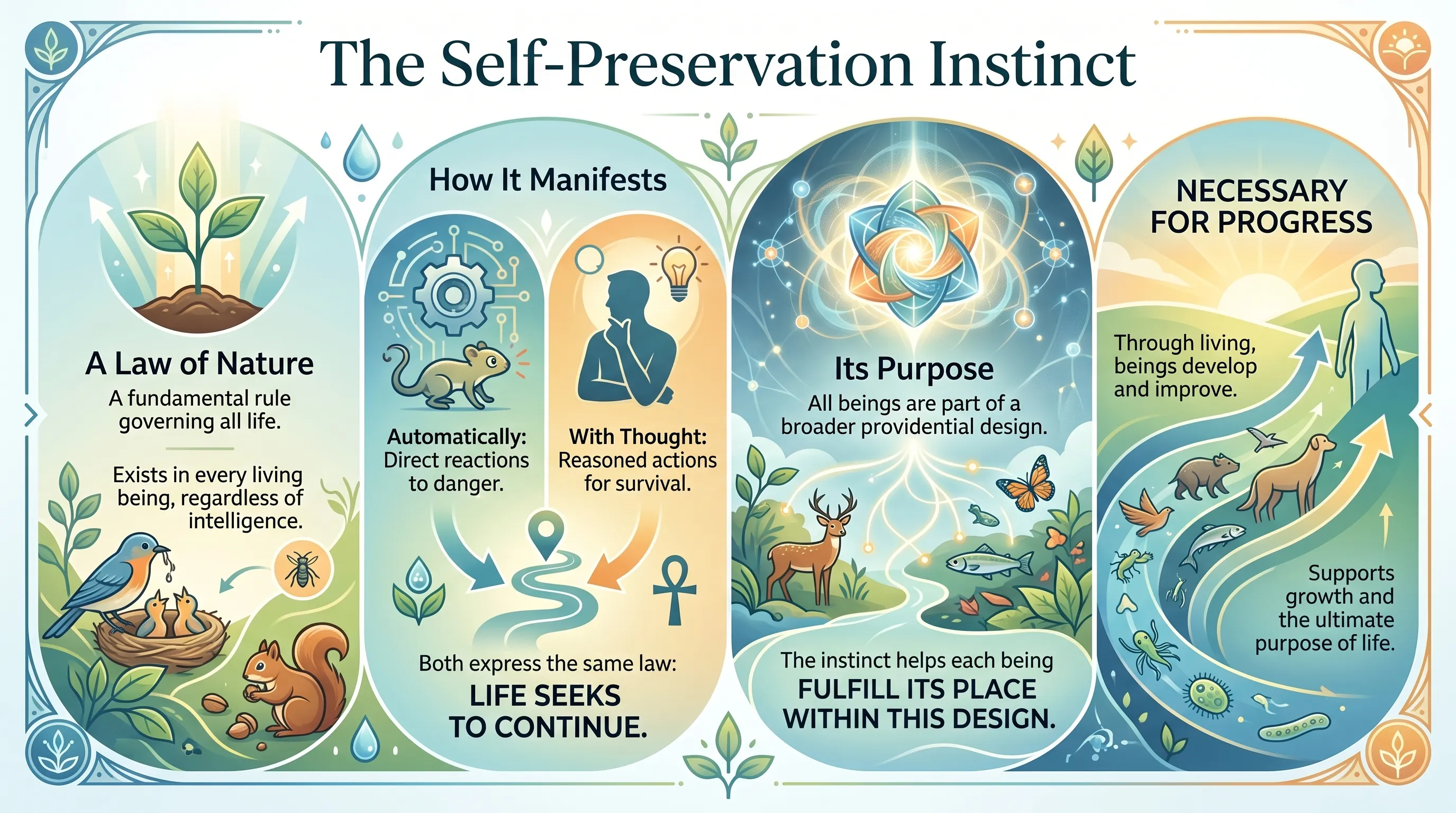
3.5.1 The instinct of self-preservation is a law of nature.
3.5.2 It exists in every living being, whatever its level of intelligence. In some, it acts automatically; in others, with thought and intention. But in all, it expresses the same law: life seeks to continue.
3.5.3 This instinct has a purpose in the order of creation. All beings are part of a providential design, and the need to preserve life helps each fulfill its place within it.
3.5.4 Life is also necessary for progress. Through living, beings develop and improve, even without clearly understanding this goal. The instinct of self-preservation is therefore not only a reaction to danger, but a natural force that supports growth and the purpose of life.
The Means of Self-Preservation
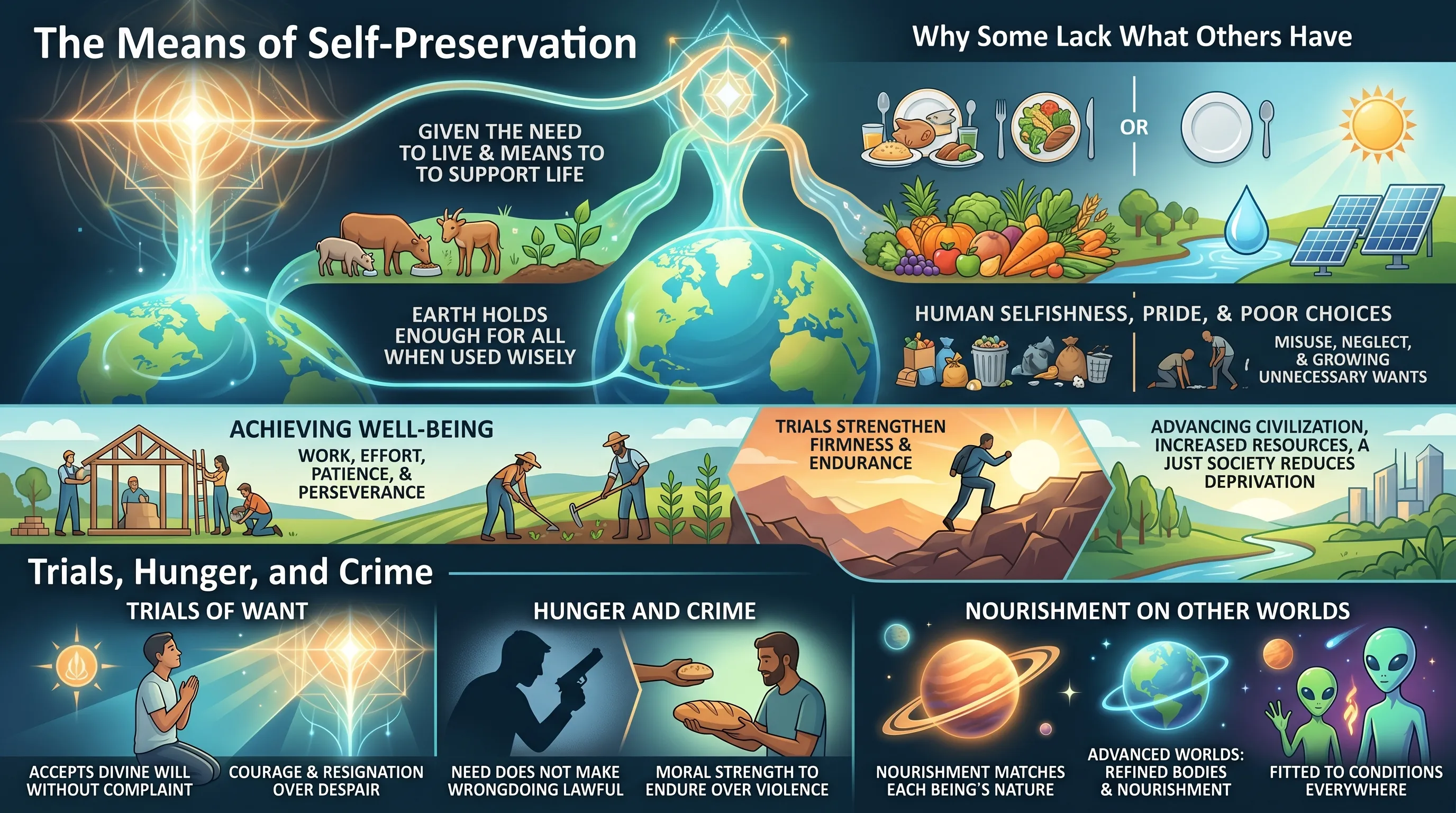
3.5.5 Every living being is given both the need to live and the means to support life. The earth holds enough to provide what is necessary for all, when its gifts are used wisely.
3.5.6 If many people still suffer want, the cause is not that nature failed. More often it comes from misuse, neglect, selfishness, and the endless growth of unnecessary wants. The earth offers not only food from the fields, but all the resources people can draw from it for use and well-being.
Why Some Lack What Others Have in Abundance
3.5.7 When some lack what others have in excess, the first cause is often human selfishness. People do not always help one another as they should, and many troubles are made worse by pride, ambition, vanity, or poor choices.
3.5.8 The means of living are usually found through work, effort, patience, and perseverance. Obstacles are not always punishments; they may be trials that strengthen firmness and endurance.
3.5.9 As civilization advances, needs increase, but work and resources also increase. When society becomes more just and better ordered, real deprivation will grow less common. Much suffering already comes less from nature than from human disorder.
Trials of Want and the Duty of Resignation
3.5.10 Sometimes a person lacks even the bare necessities through no fault of their own. This can be a hard trial.
3.5.11 One should still seek every honest way to preserve life. But if no way remains, there is merit in accepting the divine will without complaint. In such a trial, courage and resignation are worth more than despair or revolt.
Hunger and Crime
3.5.12 Need does not make wrongdoing lawful.
3.5.13 If someone kills in order to escape hunger, the act is still a crime against the natural law. Greater moral strength belongs to the one who endures suffering with self-control than to the one who saves life by violence.
Nourishment on Other Worlds
3.5.14 Beings on other worlds also need nourishment, but it matches their nature.
3.5.15 On more advanced worlds, bodies are less material, so their nourishment is also more refined. What sustains them would not be enough for earthly bodies, just as earthly food would not suit them. Everywhere, nourishment is fitted to the condition of the beings who receive it.
The Enjoyment of Material Things
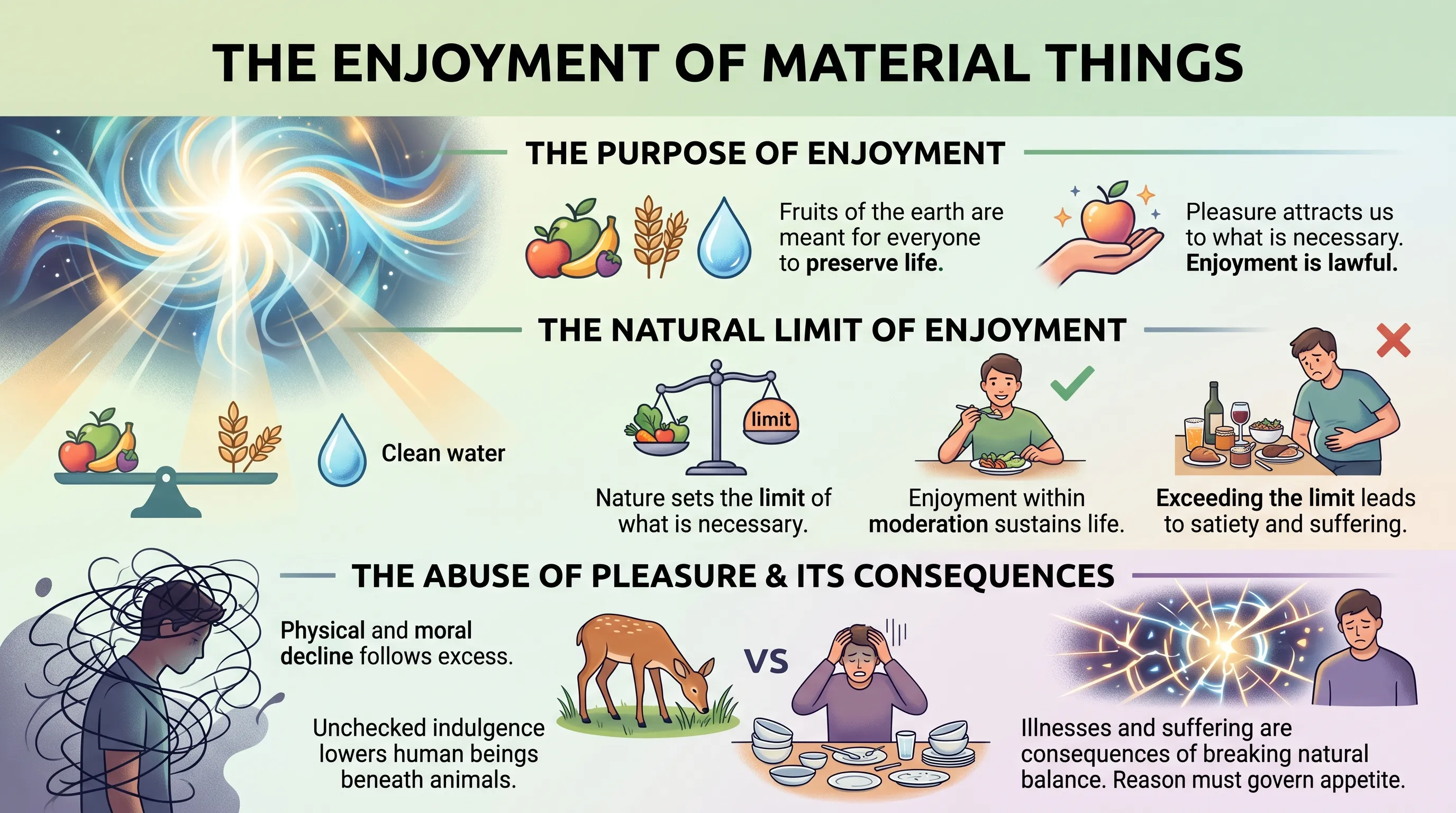
3.5.16 The fruits of the earth are meant for everyone, and human beings may use them because life must be preserved.
3.5.17 The pleasure connected with material things was given to attract people toward what is necessary for life. But it is also a test of self-control. Enjoyment is lawful, so long as appetite remains governed by reason.
The Natural Limit of Enjoyment
3.5.18 Nature itself sets the limit of what is necessary.
3.5.19 When that limit is crossed, satiety follows, and satiety is a punishment in itself. What should sustain life becomes a cause of suffering when used without moderation. The law of nature permits enjoyment, but not excess.
The Abuse of Pleasure
3.5.20 Those who give themselves to excess are to be pitied, not envied, because excess leads to physical and moral decline. The body is harmed, and the soul is harmed when reason yields to appetite.
3.5.21 Unchecked indulgence can lower human beings beneath animals, which stop when their need is satisfied. Human beings misuse reason when they serve craving instead of mastering it.
3.5.22 The illnesses and suffering caused by excess are consequences of breaking divine law. Material enjoyment is not evil in itself, but it must remain within necessity and under the guidance of reason.
Necessary and Superfluous Things
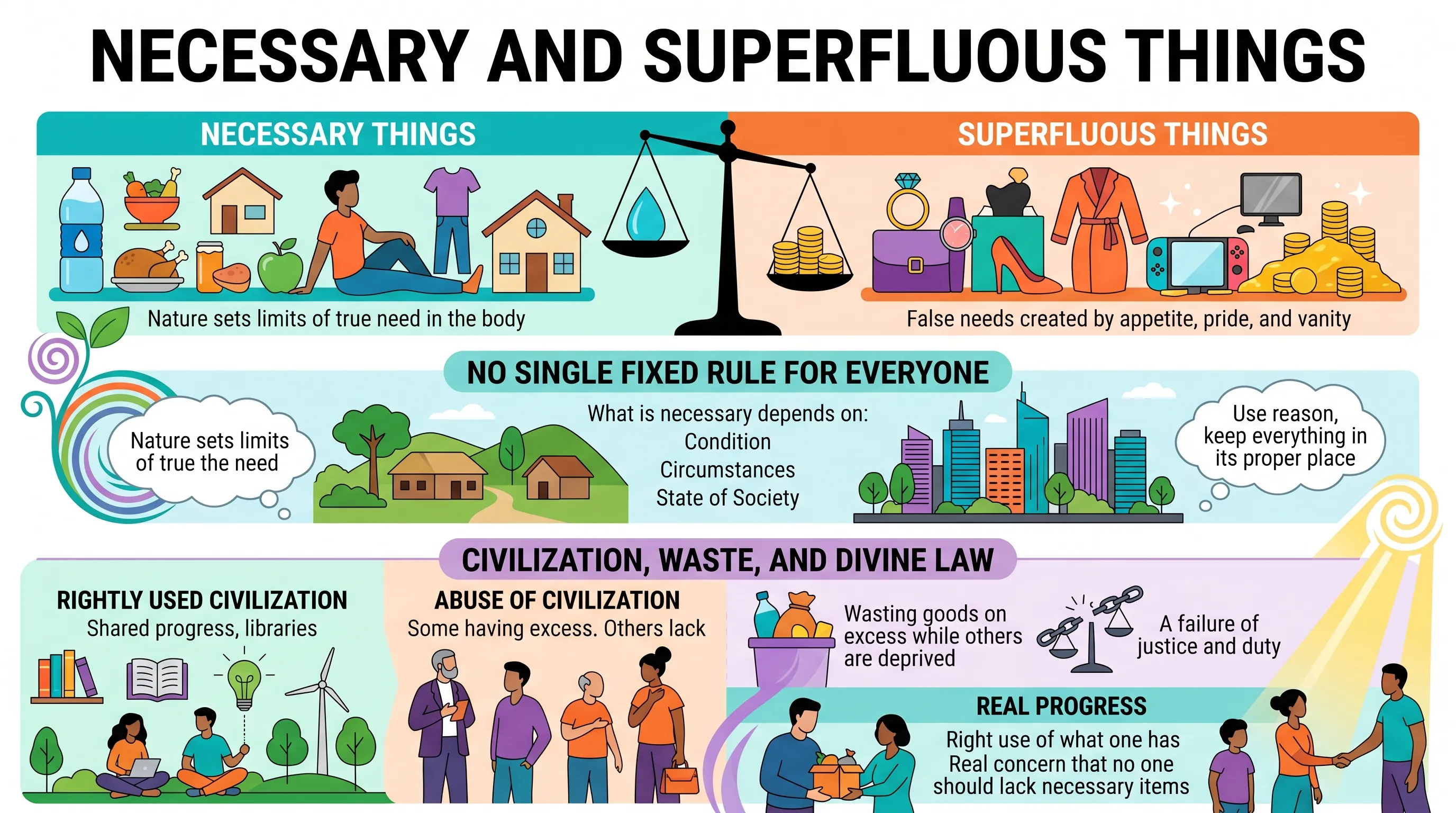
3.5.23 What is necessary and what is superfluous is not always easy to separate.
3.5.24 Nature sets the limit of true need in the body, but people create false needs through appetite, pride, and vanity.
3.5.25 So there is no single fixed rule for everyone. What is necessary depends on a person’s condition, circumstances, and the state of society. Civilization has introduced needs that simpler life did not know, but that is no reason to reject it. The important thing is to use reason and keep everything in its proper place.
3.5.26 Civilization, rightly used, helps moral and material progress. Its abuse begins when some keep its advantages for themselves while others lack what they need to live. To waste the goods of the earth on excess while others are deprived of essentials is against divine law. It is a failure of justice and duty.
3.5.27 Real progress is seen less in comfort and refinement than in the right use of what one has, and in real concern that no one should lack what is necessary.
Voluntary Privations. Mortifications
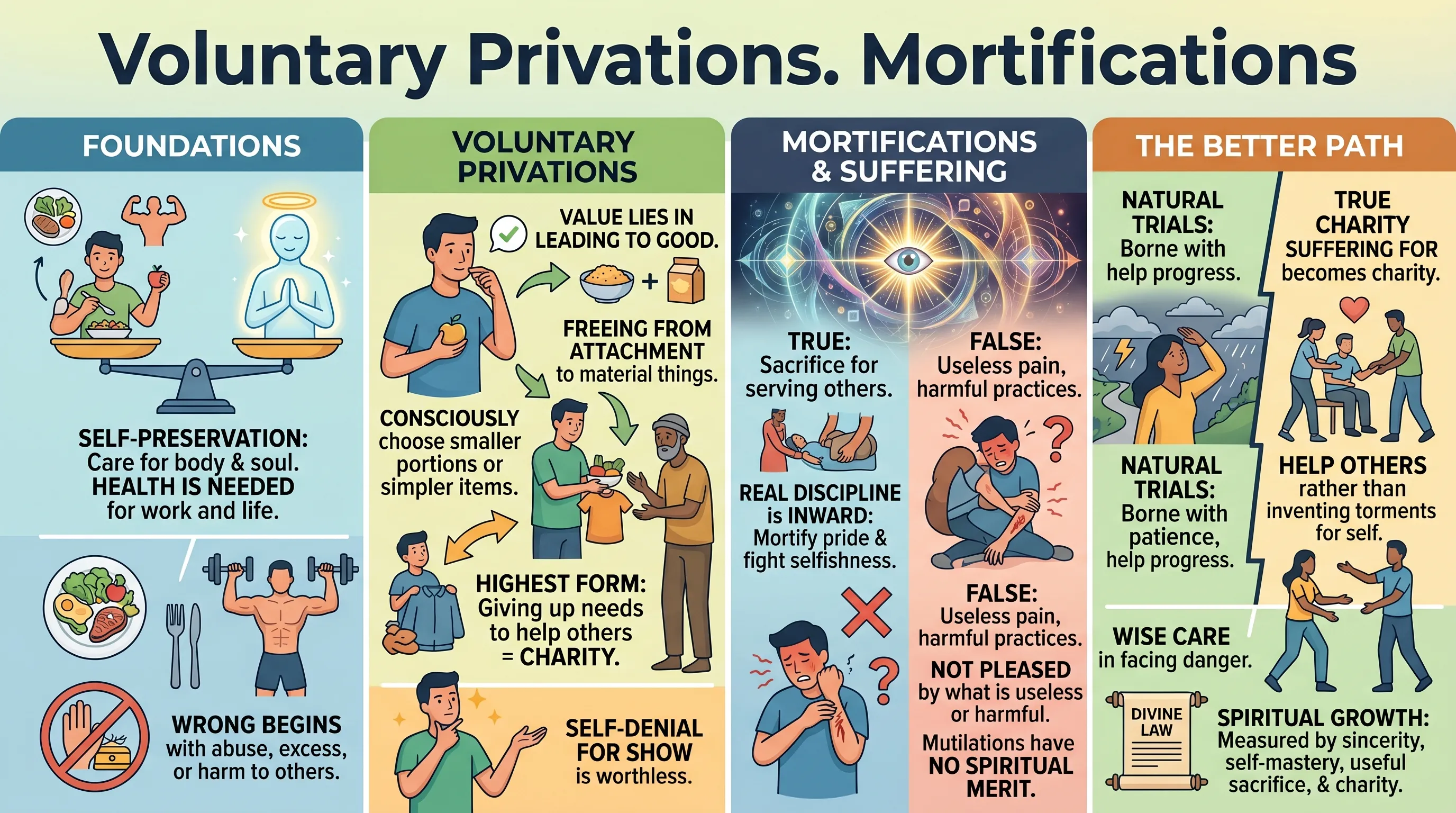
3.5.28 The law of self-preservation requires care for body and soul.
3.5.29 Physical needs do not oppose spiritual life. Health and strength are needed for work, and seeking well-being is natural. Wrong begins with abuse, when comfort harms others or weakens body or morals.
Voluntary Privations
3.5.30 Voluntary privation has value only when it leads to good.
3.5.31 Its merit is in freeing us from attachment to material things and restraining excess. Its highest form is giving up part of what one needs to help someone in greater need; then privation becomes charity.
3.5.32 If self-denial is only for show, it has no value.
Mortifications
3.5.33 Ascetic practices and bodily mortifications are worth only the good they do.
3.5.34 If they help no one but the one practicing them, or keep that person from doing good to others, they remain selfishness. Real mortification is not harsh treatment of the body, but sacrifice for serving others.
3.5.35 God is not pleased by what is useless or harmful. Progress comes from living by divine law, not from pain itself. Mutilations inflicted on people or animals have no spiritual merit.
Food and Abstinence
3.5.36 No food is forbidden in itself when it can be taken without harm to health.
3.5.37 Some laws forbidding foods had practical or hygienic reasons. The use of animals as food is not against the law of nature in present human conditions, since the body needs nourishment for life and work.
3.5.38 Abstinence has merit only when the privation is real, useful, and directed to the good of others. Otherwise it is empty or hypocritical.
Suffering and Progress
3.5.39 Not every kind of suffering helps spiritual growth.
3.5.40 The sufferings that help us advance are the natural trials of life, borne with patience and courage. But sufferings invented for no useful end do not have the same value. To shorten life by austerity or seek pain for itself does not lead upward.
3.5.41 The better path is to help others. Suffering accepted for others becomes charity; suffering sought only for oneself tends toward selfishness.
The Right Mortification
3.5.42 Human beings are not asked to invent torments for themselves, but to use wise care in facing danger.
3.5.43 The instinct of self-preservation was given so living beings would protect themselves from suffering and destruction. Foreseen dangers should be avoided when possible.
3.5.44 The truest discipline is inward. One must mortify pride rather than the flesh, and fight selfishness rather than wound the body. Spiritual growth is measured by sincerity, self-mastery, useful sacrifice, and charity.