3.9 Equality Among People
Natural Equality
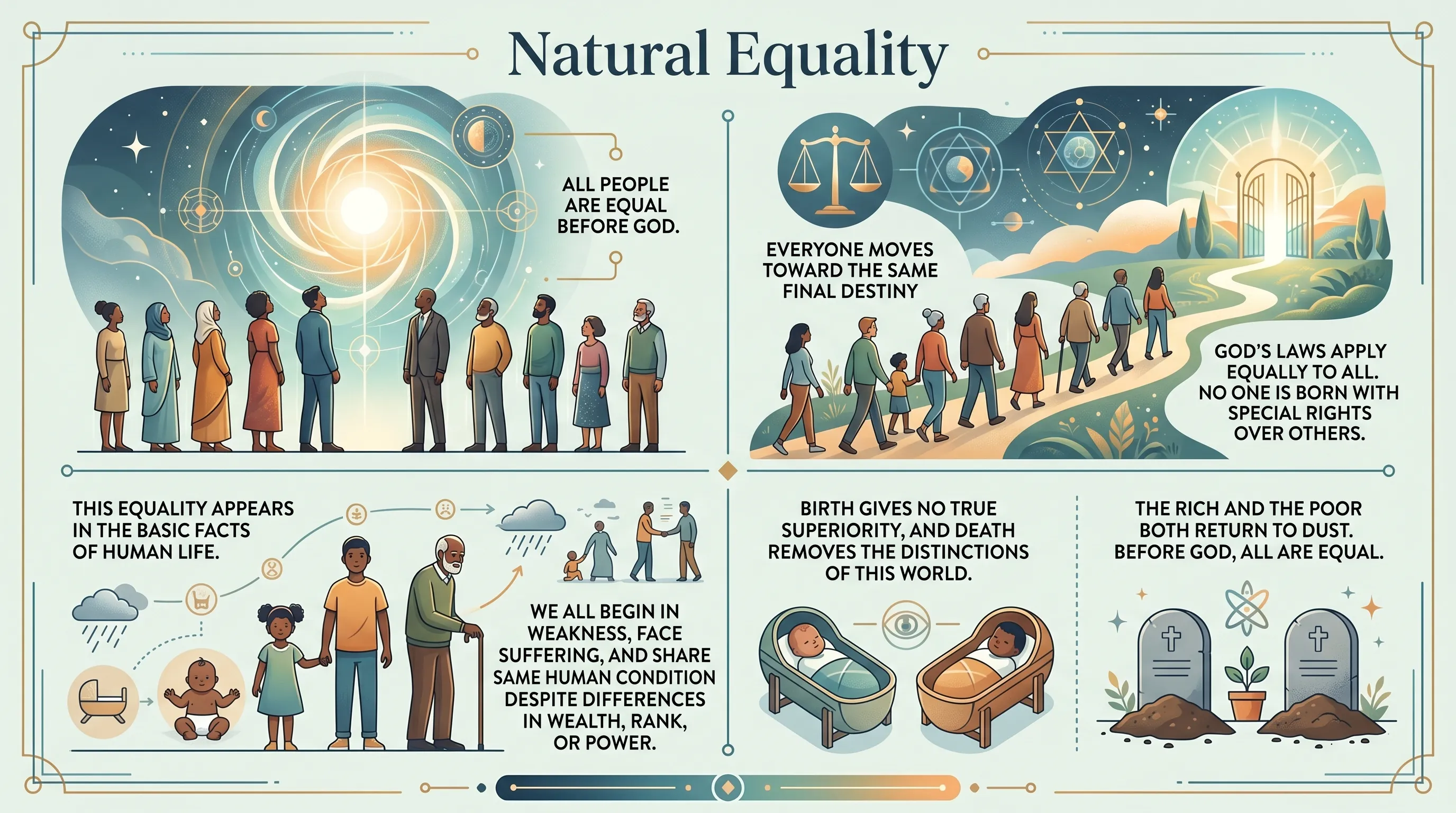
3.9.1 All people are equal before God.
3.9.2 Everyone moves toward the same final destiny, and God’s laws apply equally to all. No one is outside them, and no one is born with a special right over others.
3.9.3 This equality appears in the basic facts of human life. We all begin in weakness, face suffering, and share the same human condition despite differences in wealth, rank, or power.
3.9.4 Birth gives no true superiority, and death removes the distinctions of this world. The rich and the poor both return to dust. Before God, all are equal.
The Inequality of Aptitudes
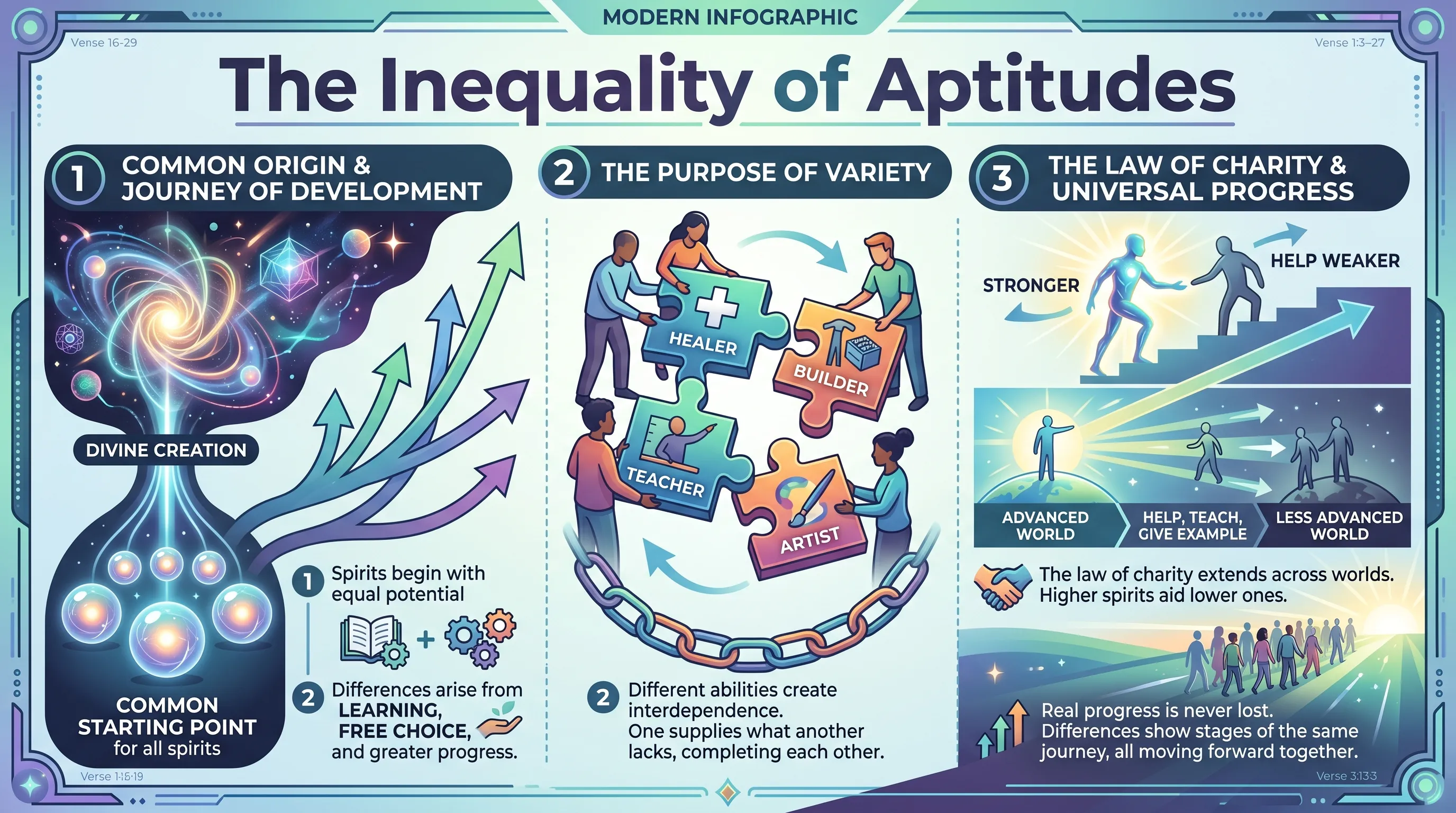
3.9.5 People do not all have the same abilities, but they were not created unequal.
3.9.6 Spirits begin from the same starting point. Differences in talent, intelligence, and moral strength come from different degrees of progress. What a spirit has gained through learning and free choice appears as greater ability.
3.9.7 So unequal aptitudes come not from a different original nature, but from greater or lesser development. As spirits advance, they become suited to different kinds of work.
3.9.8 This variety has a purpose. Since not everyone can do the same things, one supplies what another lacks. In this way, people depend on one another and complete one another.
3.9.9 This dependence is part of the law of charity. Those more advanced should help those less advanced. The same law extends beyond the earth, as spirits from more advanced worlds may come to a less advanced world to help, teach, and give example.
3.9.10 When a spirit comes from a higher world to a lower one, it does not lose what it has already gained. Real progress is never taken away, though outer conditions may be more limited.
3.9.11 The differences seen among people, then, are not signs of privilege or injustice in creation. They show spirits at different stages of the same journey, where the stronger help the weaker and all are meant to move forward together.
Social Inequalities
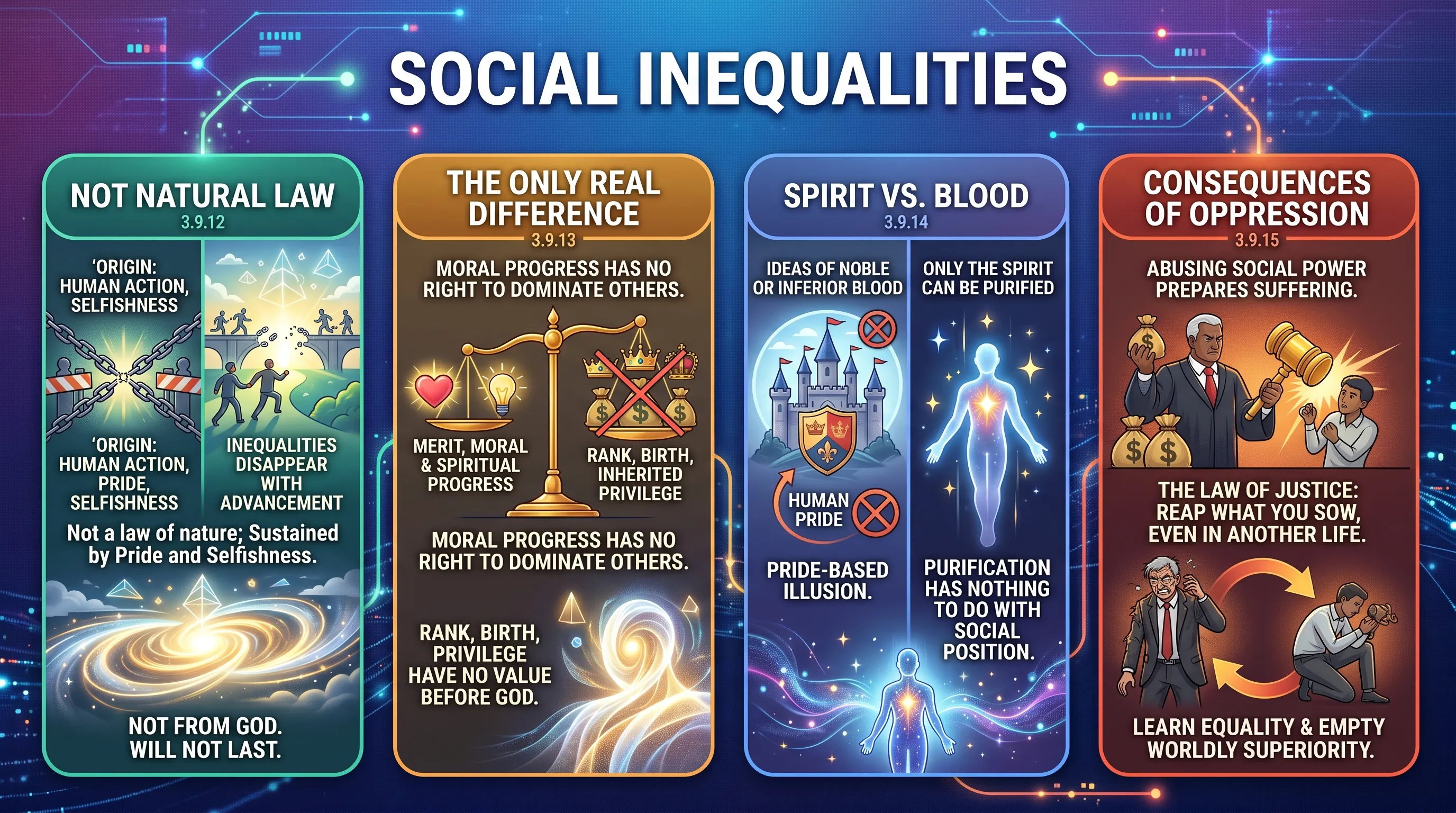
3.9.12 Social inequality is not a law of nature. It comes from human action, not from God, and so it is not meant to last. As humanity advances, these inequalities disappear, since they are sustained by pride and selfishness.
3.9.13 The only real difference between people is merit, or moral and spiritual progress. But this gives no one any right to dominate others. Rank, birth, and inherited privilege have no value before God.
3.9.14 Ideas of noble or inferior blood belong to human pride. Only the spirit can be more or less purified, and that has nothing to do with social position.
3.9.15 Whoever uses social power to oppress the weak abuses a temporary advantage and prepares suffering for themselves. By the law of justice, those who make others suffer will one day endure similar suffering, even in another life, to learn equality and the emptiness of worldly superiority.
The Inequality of Wealth
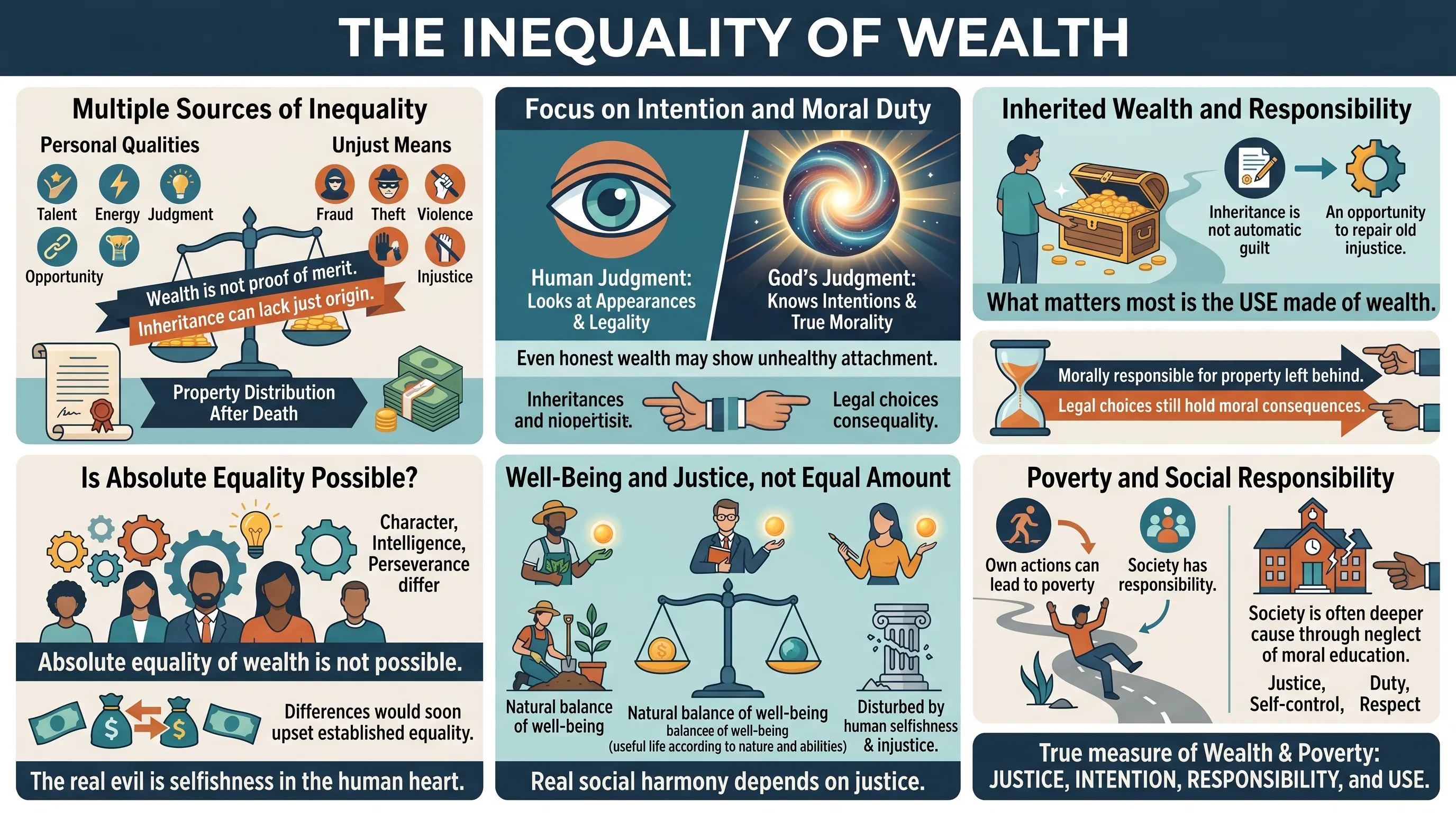
3.9.16 The inequality of wealth does not come from one cause alone.
3.9.17 Differences in talent, energy, judgment, and opportunity play a part, but wealth may also come from fraud, theft, violence, or injustice. So wealth is not proof of merit, and inheritance cannot always be assumed to have a just origin.
3.9.18 The moral issue is not only what is legal or outwardly successful. Even honestly gained wealth may show unhealthy attachment to riches. Human beings judge by appearances, but God judges intentions.
Inherited Wealth and Responsibility
3.9.19 Those who inherit a fortune are not automatically guilty of the wrongs by which it was first gathered, especially if they know nothing of them.
3.9.20 Still, inherited wealth may place a person under a serious duty. It can be a chance to repair an old injustice, and what matters most is the use made of it.
Wealth After Death
3.9.21 A person remains morally responsible for how property is left behind.
3.9.22 Even when the law allows a certain choice, that does not remove moral accountability. Property may be distributed with more justice or less justice, and each choice has consequences.
Is Absolute Equality of Wealth Possible?
3.9.23 Absolute equality of wealth is not possible.
3.9.24 People differ in character, intelligence, perseverance, and judgment, so outward conditions cannot remain exactly the same for all. Even if equal wealth were established for a time, human differences and changing circumstances would soon upset it.
3.9.25 The real social evil is not inequality itself, but selfishness. No system can cure society while selfishness remains in the human heart.
Well-Being and Justice
3.9.26 Although equal wealth is impossible, a fair sharing of well-being is possible.
3.9.27 Well-being does not mean everyone has the same amount. It means each person can live usefully according to their nature and abilities. A natural balance exists, but human selfishness and injustice disturb it. Real social harmony depends on justice.
Poverty, Fault, and Social Responsibility
3.9.28 Some fall into poverty through their own actions. Even then, society still has responsibility.
3.9.29 Society is often the deeper cause when it neglects the moral education of its members. If people are not taught justice, duty, self-control, and respect for others, their faults grow and later produce suffering.
3.9.30 Wealth, poverty, inheritance, and social order cannot be judged only by appearances or by law. Their true measure is justice, intention, responsibility, and the use made of what one has received.
The Trials of Wealth and Poverty
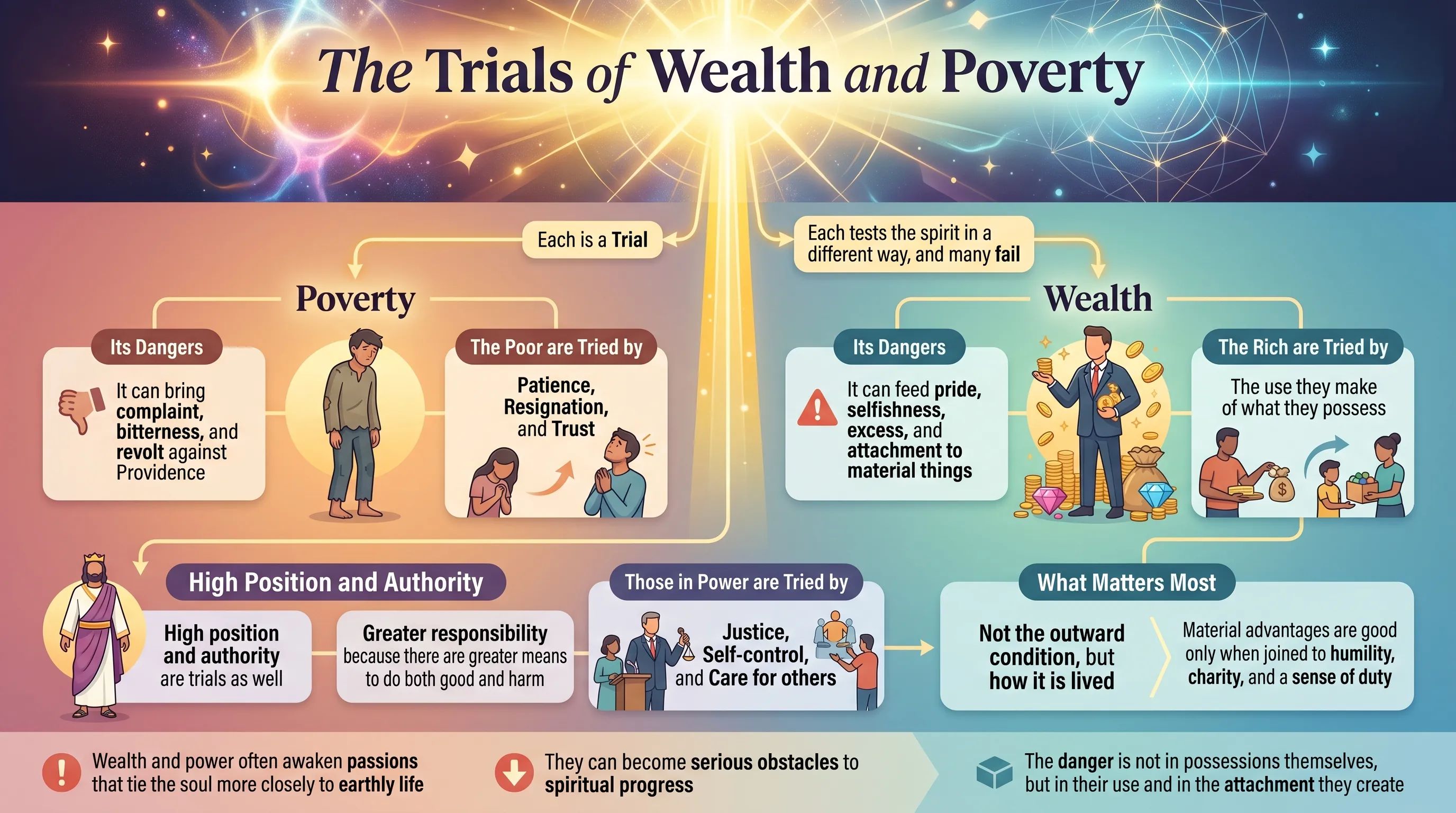
3.9.31 Wealth, poverty, rank, and power are not given without purpose. Each is a trial. Each tests the spirit in a different way, and many fail in the very trial they were to undergo.
3.9.32 Poverty has its dangers. It can bring complaint, bitterness, and revolt against Providence. Wealth also has its dangers. It can feed pride, selfishness, excess, and attachment to material things. Neither state makes a person virtuous by itself, and neither excuses wrongdoing.
3.9.33 High position and authority are trials as well. The more a person has, the more responsible that person becomes, because there are greater means to do both good and harm.
3.9.34 The poor are tried by patience, resignation, and trust. The rich are tried by the use they make of what they possess. Those in power are tried by justice, self-control, and care for others. What matters most is not the outward condition, but how it is lived.
3.9.35 Wealth and power often awaken passions that tie the soul more closely to earthly life. That is why they can become serious obstacles to spiritual progress.
3.9.36 The danger is not in possessions themselves, but in their use and in the attachment they create. Material advantages are good only when joined to humility, charity, and a sense of duty.
Equality of Rights between Men and Women
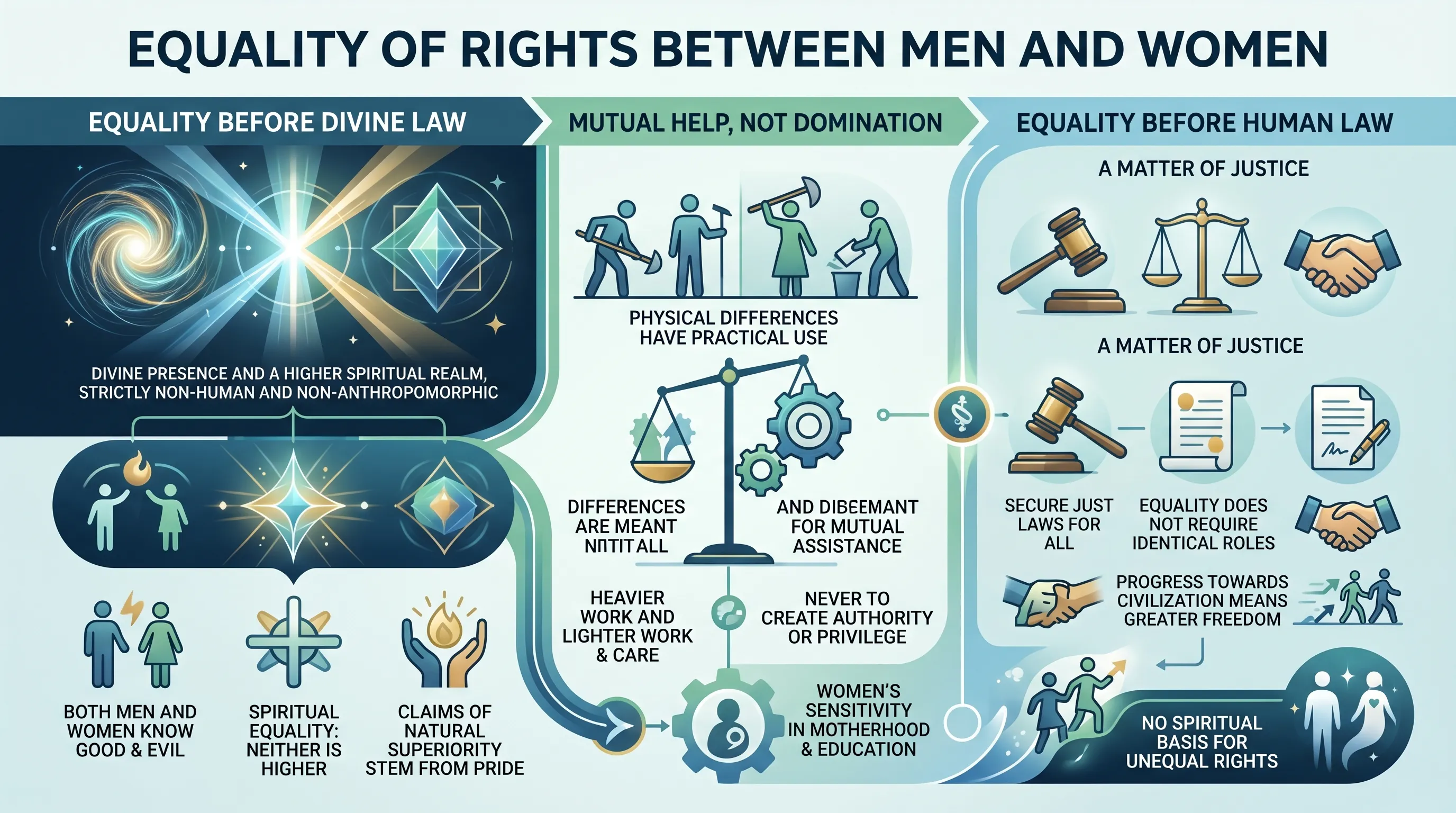
3.9.37 Men and women are equal before God. Both know good and evil, can improve, and in the spirit neither is higher than the other. The claim that one sex is naturally superior comes from pride, not divine law.
3.9.38 When women are treated as inferior, it is due to human domination, not nature. Physical differences have practical use, but they do not create moral inequality. Men may be stronger for heavier work, and women better fitted for lighter work and care, but these differences are meant for mutual help, not authority.
3.9.39 Strength should protect weakness, never enslave it. Though women may have less physical force, they often have special sensitivity, especially in motherhood, care, and early education.
Equality Before Human Law
3.9.40 Since men and women are equal before God’s law, they should also be equal before human law.
3.9.41 Equal rights are a matter of justice and should be secured by just laws. Equality does not require identical roles. Abilities and functions may differ, but difference never justifies privilege.
3.9.42 As society becomes more civilized, women gain freedom; their subjection belongs to more barbaric times. Since spirits can be born as either man or woman, there is no spiritual basis for unequal rights.
Equality in Death
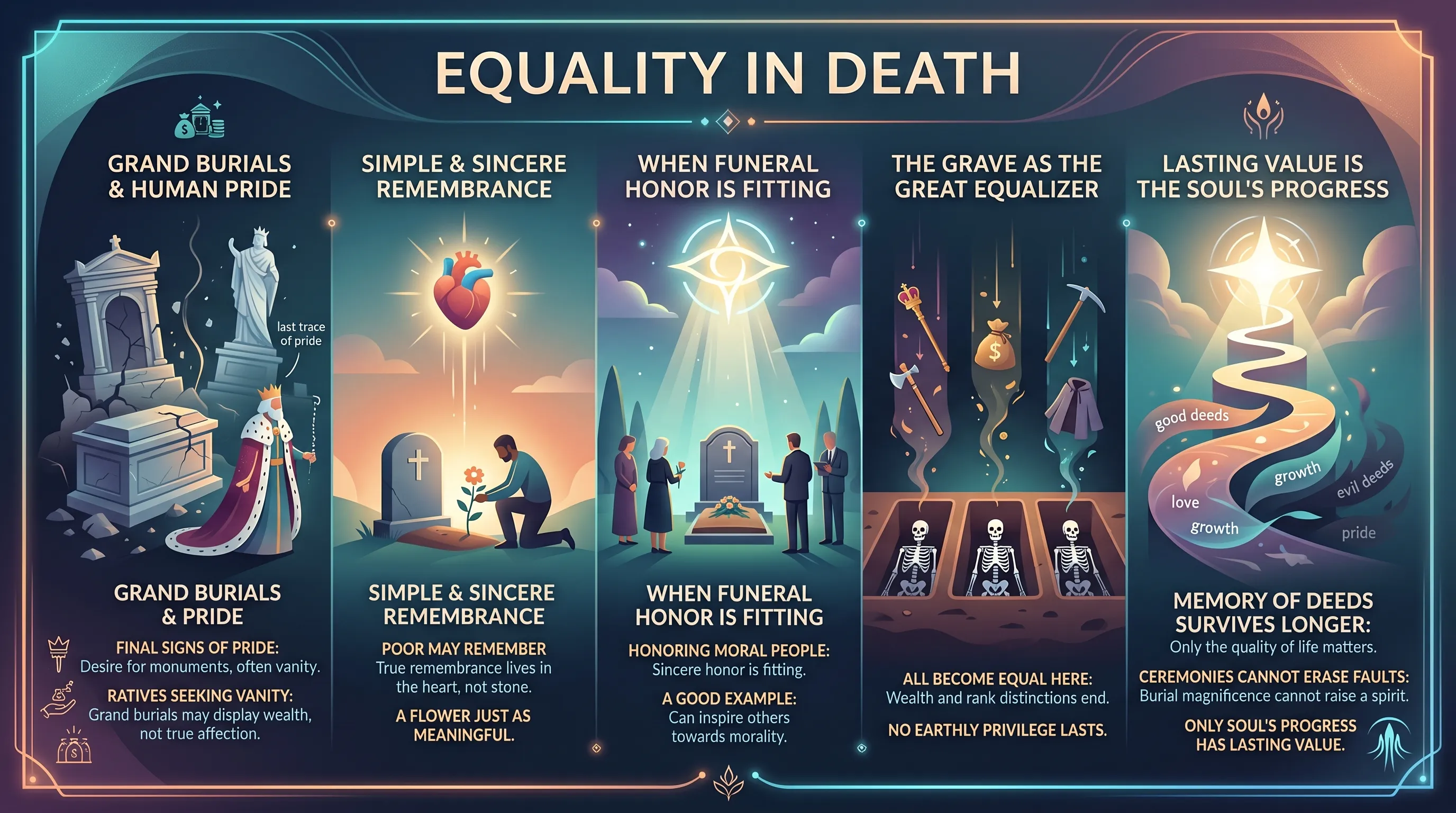
3.9.43 The desire for funeral monuments is often a final sign of pride. Even when the dead did not seek it, relatives may arrange grand burials from vanity or the wish to display wealth. Such display is not always true affection.
3.9.44 The poor, who leave only a flower on a grave, may remember just as faithfully as those who raise marble tombs. True remembrance lives in the heart, not in stone.
3.9.45 Still, funeral honor is not always wrong. When it sincerely honors a moral person, it is fitting and may offer a good example.
3.9.46 The grave is where all become equal. Distinctions of wealth and rank end there. Time destroys monuments as it destroys bodies, and no earthly privilege lasts.
3.9.47 What survives longer is the memory of a person’s good or evil deeds. Ceremonies cannot erase moral faults, and no magnificence in burial can raise a spirit in the hierarchy of spirits. Only the quality of life and the soul’s progress have lasting value.