2.7 Returning to Earthly Life
Preludes to the Return
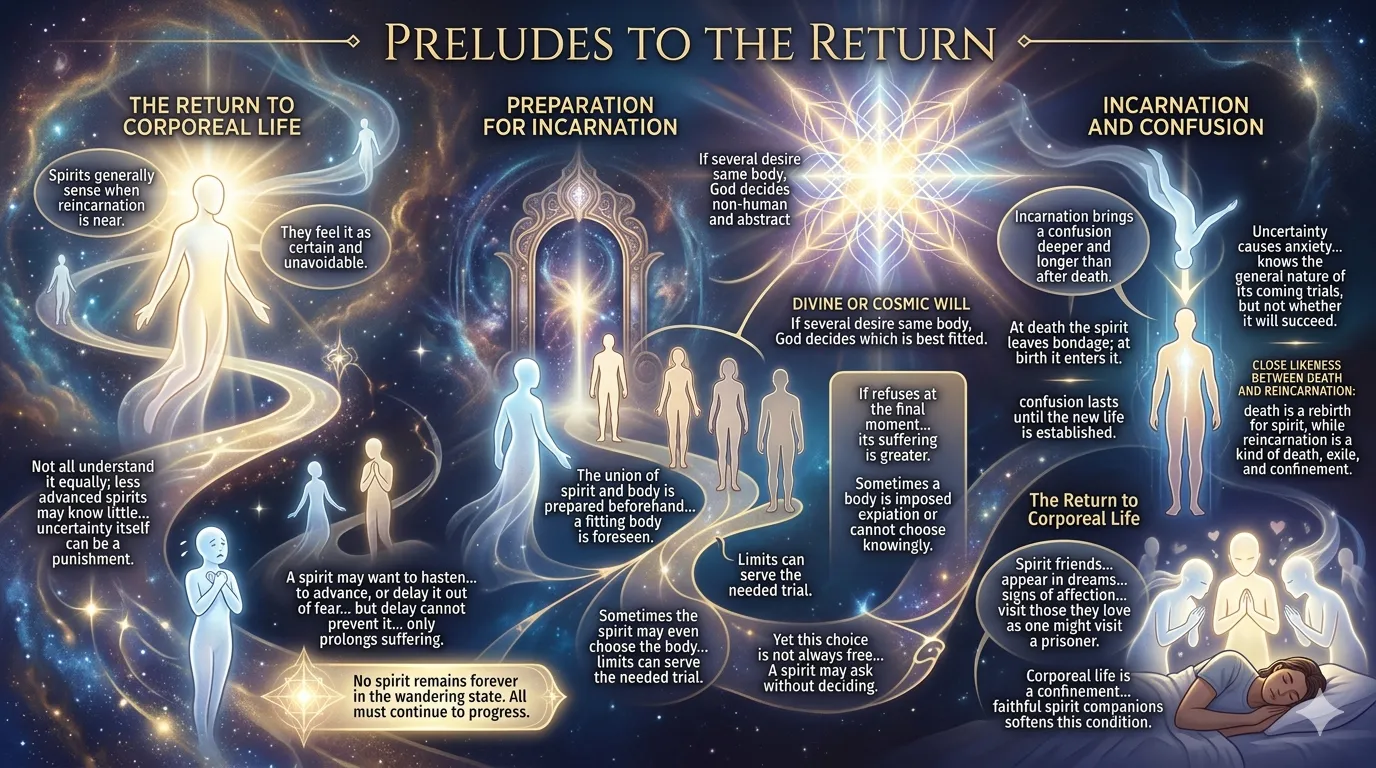
2.7.1 Spirits generally sense when reincarnation is near, though not always the exact moment. They feel it as certain and unavoidable. Not all understand it equally; less advanced spirits may know little about it, and uncertainty itself can be a punishment.
2.7.2 A spirit may want to hasten reincarnation to advance, or delay it out of fear, but delay cannot prevent it and only prolongs suffering. No spirit remains forever in the wandering state. All must continue to progress.
2.7.3 The union of spirit and body is prepared beforehand. When a spirit chooses the kind of trial it seeks, it asks for reincarnation, and a fitting body is foreseen. Sometimes the spirit may even choose the body, since its limits can serve the needed trial.
2.7.4 Yet this choice is not always free. A spirit may ask without deciding. If it refuses at the final moment to enter a body it had accepted, its suffering is greater. No child born alive is without a soul; if none offers willingly, divine providence assigns one. Sometimes a body is imposed for expiation or because the spirit cannot choose knowingly. If several desire the same body, God decides which is best fitted.
2.7.5 Incarnation brings a confusion deeper and longer than that after death. At death the spirit leaves bondage; at birth it enters it. A spirit knows the general nature of its coming trials, but not whether it will succeed, and this uncertainty causes anxiety.
2.7.6 There is a close likeness between death and reincarnation: death is a rebirth for the spirit, while reincarnation is for it a kind of death, exile, and confinement. When the time comes, confusion lasts until the new life is established. For more advanced spirits, this departure is often softened by the affection of loving spirits who accompany and encourage them.
The Return to Corporeal Life
2.7.7 The spirit friends who accompany a person in life are often the same ones who appear in dreams with signs of affection, even if not recognized. They visit those they love as one might visit a prisoner.
2.7.8 Corporeal life is a confinement for the incarnate spirit. Though necessary for progress, it places the spirit under limits it does not have in freedom. The presence of faithful spirit companions softens this condition, especially during sleep, when the soul is less tightly bound to the body.
The Joining of the Soul with the Body.
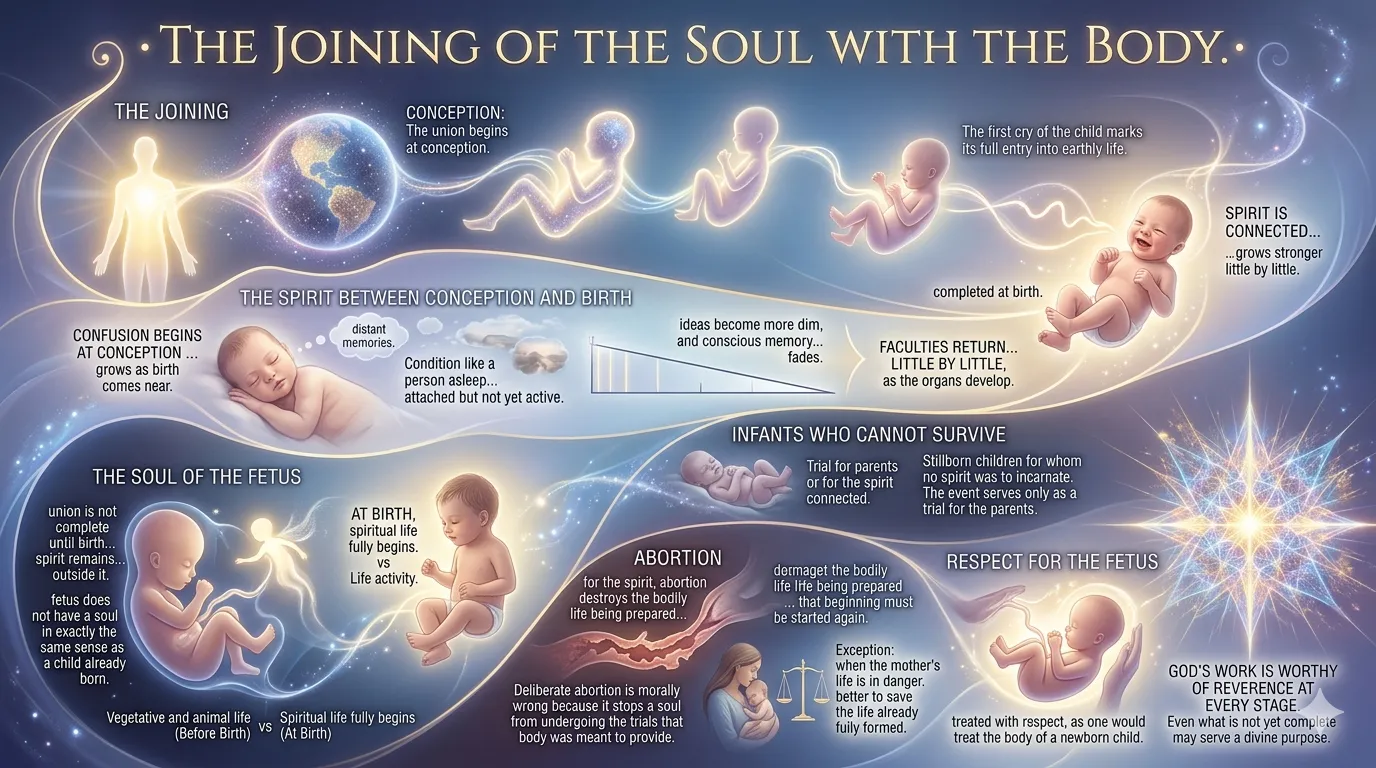
2.7.9 The soul joins the body at conception, and this union is completed at birth. From the beginning, the spirit chosen for that body is connected to it by a bond that grows stronger little by little. The first cry of the child marks its full entry into earthly life.
2.7.10 No other spirit can take the place of the one meant for that body. Still, at first the bond is weak. If it breaks, the child does not live. If the body dies before birth, the spirit takes another body. Such early deaths may come from the weakness of matter, and they may also be a trial for the parents.
The Spirit Between Conception and Birth
2.7.11 Between conception and birth, the spirit does not fully use its faculties. A kind of confusion begins at conception and grows as birth comes near.
2.7.12 Its condition is like that of a person asleep: the spirit is attached to the body, but not yet active in earthly life. As birth approaches, its ideas become more dim, and conscious memory of the past fades. After birth, its faculties return only little by little, as the organs develop.
The Soul of the Fetus
2.7.13 Because the union is not complete until birth, the fetus does not have a soul in exactly the same sense as a child already born. The spirit that will animate it still remains, in some way, outside it while incarnation is being completed.
2.7.14 Yet the fetus is already linked to the spirit that is to belong to it. Before birth, human life is mainly vegetative and animal. At birth, spiritual life fully begins.
Infants Who Cannot Survive
2.7.15 Some children are not meant to live, even before birth. This may happen as a trial for the parents or for the spirit connected with the child.
2.7.16 There are also stillborn children for whom no spirit was to incarnate. In such cases, the event serves only as a trial for the parents. But every child that lives has an incarnated spirit.
Abortion
2.7.17 For the spirit, abortion destroys the bodily life being prepared for it, and that beginning must be started again.
2.7.18 Deliberate abortion is morally wrong because it stops a soul from undergoing the trials that body was meant to provide. One exception is when the mother’s life is in danger. Then it is better to save the life already fully formed than the one not yet fully established.
Respect for the Fetus
2.7.19 The fetus should be treated with respect, as one would treat the body of a newborn child.
2.7.20 God’s work is worthy of reverence at every stage. Even what is not yet complete may serve a divine purpose.
The Moral and Intellectual Faculties of Humankind
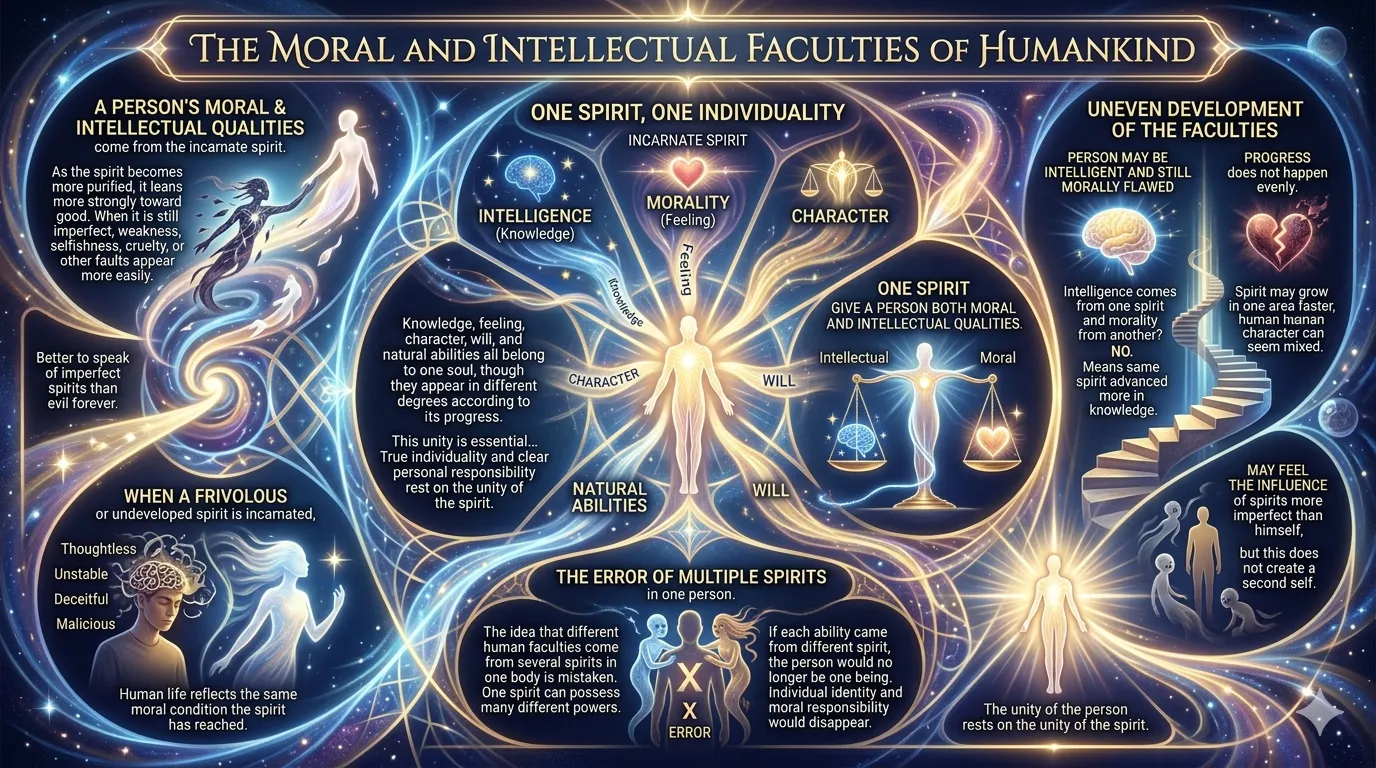
2.7.21 A person’s moral and intellectual qualities come from the incarnate spirit. As the spirit becomes more purified, it leans more strongly toward good. When it is still imperfect, weakness, selfishness, cruelty, or other faults appear more easily. So it is better to speak of imperfect spirits than of spirits that are evil forever.
2.7.22 When a frivolous or undeveloped spirit is incarnated, the person may be thoughtless, unstable, deceitful, or even malicious. Human life reflects the same moral condition the spirit has reached.
One Spirit, One Individuality
2.7.23 The same spirit gives a person both moral and intellectual qualities. Knowledge, feeling, character, will, and natural abilities all belong to one soul, or incarnate spirit, though they appear in different degrees according to its progress.
2.7.24 This unity is essential. If several spirits shared one person, there would be no true individuality and no clear personal responsibility.
Uneven Development of the Faculties
2.7.25 A person may be very intelligent and still morally flawed. This does not mean that intelligence comes from one spirit and morality from another. It means the same spirit has advanced more in knowledge than in moral purification.
2.7.26 Progress does not happen evenly. A spirit may grow in one area faster than in another, which is why human character can seem mixed or contradictory. A person may also feel the influence of spirits more imperfect than himself, but this does not create a second self.
The Error of Multiple Spirits in One Person
2.7.27 The idea that different human faculties come from several spirits in one body is mistaken. One spirit can possess many different powers and express them in different ways.
2.7.28 If each ability came from a different spirit, the person would no longer be one being. Individual identity and moral responsibility would disappear. The unity of the person rests on the unity of the spirit.
The Influence of the Organism
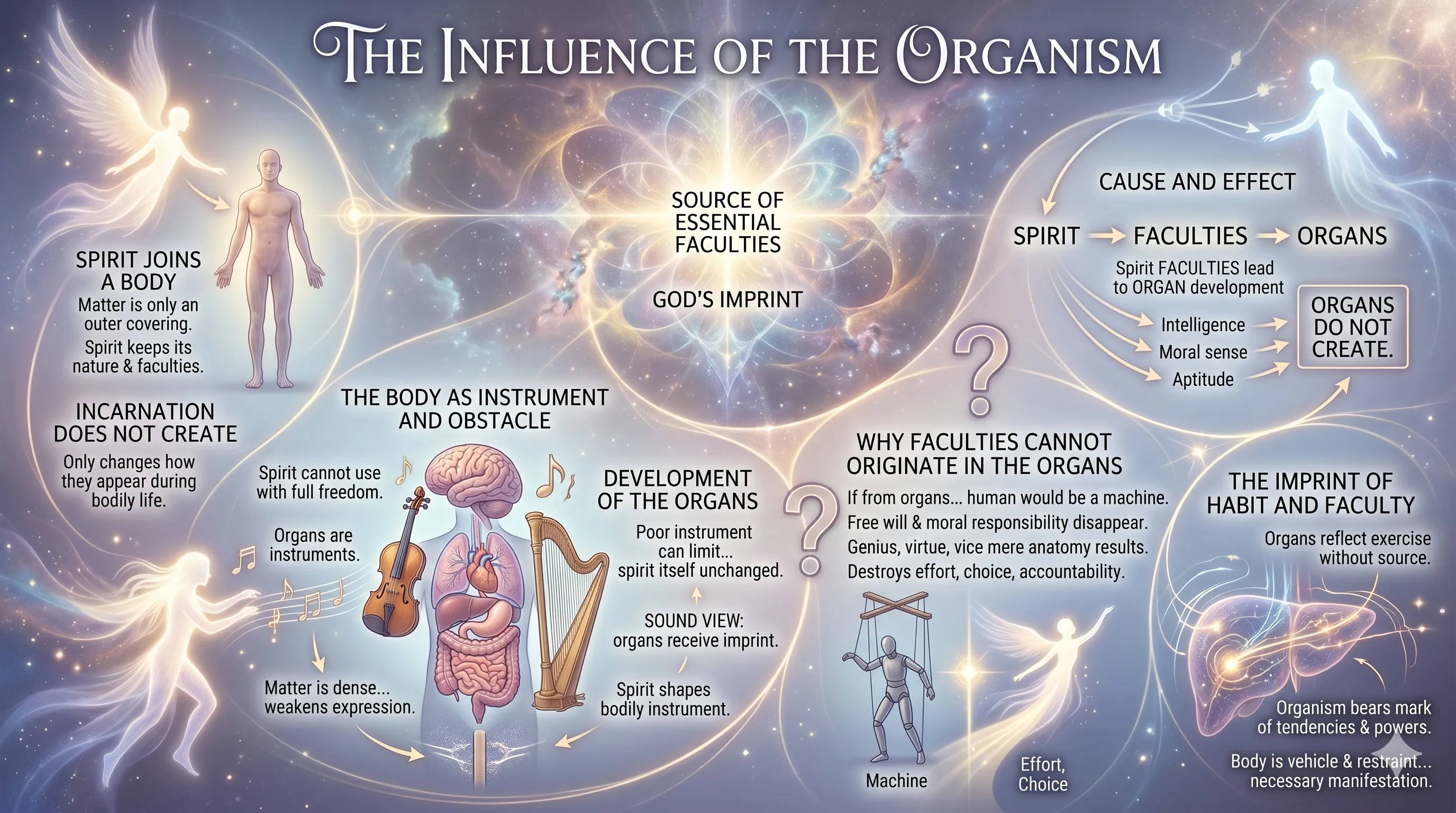
2.7.29 When a spirit joins a body, it does not become matter. Matter is only an outer covering. The spirit keeps its spiritual nature and its essential faculties.
2.7.30 Incarnation does not create these faculties. It only changes how they appear during bodily life.
The Body as Instrument and Obstacle
2.7.31 Once united with a body, the spirit cannot use its faculties with full freedom. The organs are the instruments through which those faculties are expressed.
2.7.32 Because matter is dense, it weakens their expression. A spirit may contain much more than the body can show. What appears outwardly depends partly on the condition and development of the organs.
The Development of the Organs
2.7.33 The soul’s faculties act through bodily organs because those organs are tools of expression. A poor instrument can limit what appears without changing the spirit itself.
2.7.34 The organs do not create the faculties. They only allow them to appear during earthly life.
Cause and Effect
2.7.35 Cause must not be confused with effect. The spirit already possesses the faculties that belong to its advancement. The organs do not produce intelligence, moral sense, or aptitude.
2.7.36 On the contrary, the spirit’s faculties lead to the development of the organs needed to express them. Differences in human ability come mainly from the spirit, though matter can help or hinder expression.
Why Faculties Cannot Originate in the Organs
2.7.37 If faculties came only from the organs, the human being would be only a machine. Free will and moral responsibility would disappear.
2.7.38 Genius, virtue, and vice would become mere results of anatomy. That would destroy the meaning of effort, choice, and accountability.
2.7.39 A sounder view is that the organs receive the imprint of the faculties they serve. The spirit shapes the bodily instrument through its activity.
The Imprint of Habit and Faculty
2.7.40 Bodily organs may reflect the exercise of the spirit’s faculties without being their source.
2.7.41 The organism bears the mark of the spirit’s tendencies and powers. It is made for expression, not origination.
2.7.42 The body is therefore both a vehicle and a restraint: necessary for manifestation in earthly life, yet never the true source of intelligence, character, or moral worth.
Mental Impairment and Insanity
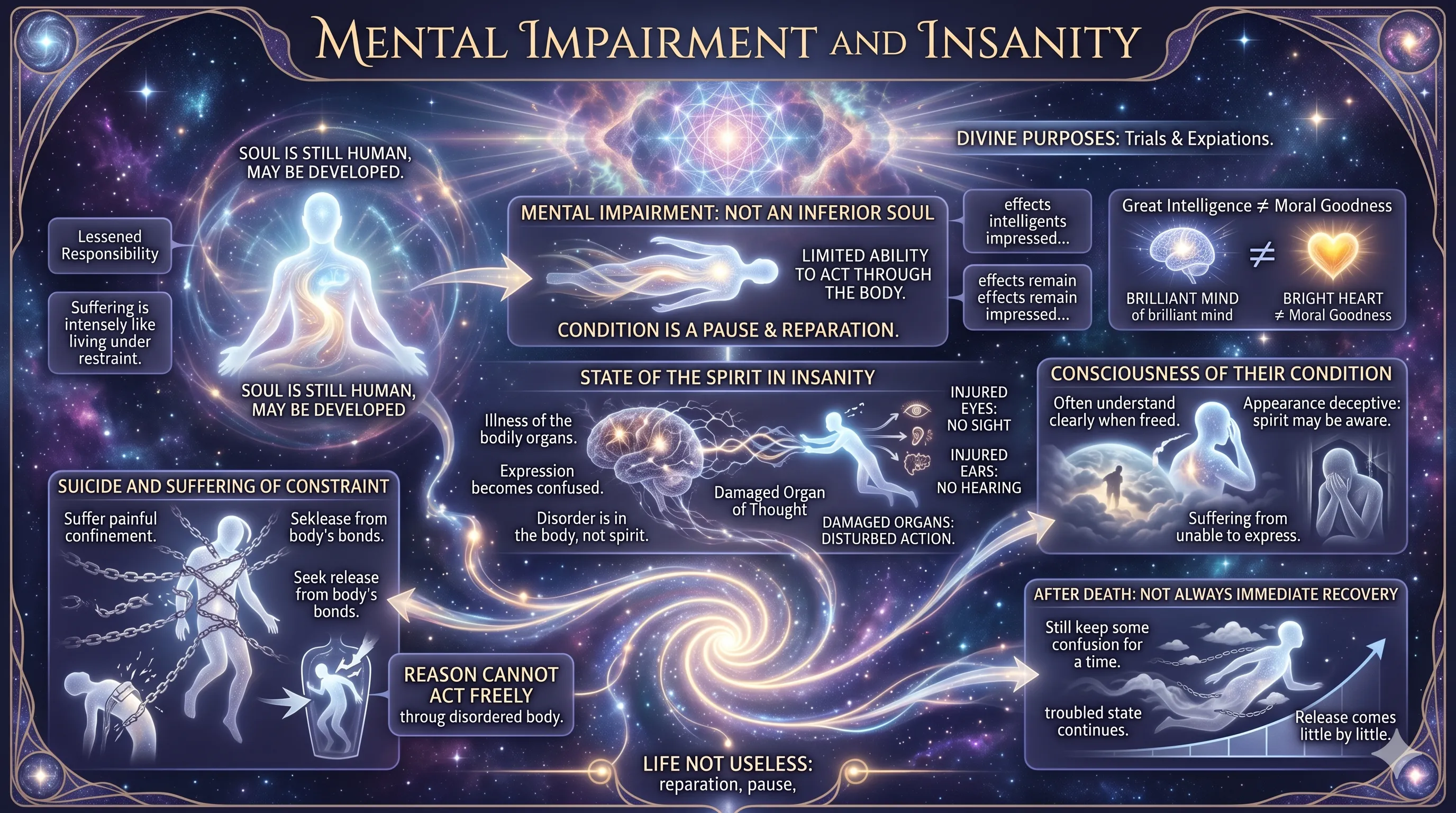
2.7.43 Mental impairment does not mean an inferior soul. The soul is still human and may be far more developed than the person seems to be on earth. What is limited is not the spirit itself, but its ability to act through the body.
2.7.44 The soul’s powers belong to the spirit, not to the organs. But during earthly life, those powers can appear blocked by an undeveloped or damaged brain. So a person may seem to have little intelligence while the inner being remains much more capable.
2.7.45 Such conditions are trials and expiations. They may be linked to past misuse of important faculties. They also help explain why the responsibility of those in these states is lessened, since reason cannot act freely through a disordered body.
2.7.46 This kind of life is not useless. It may be both a reparation and a needed pause. Great intelligence is not the same as moral goodness, and brilliant abilities can be abused. The suffering in these conditions may be intense, like living under restraint.
Consciousness of Their Condition
2.7.47 When freed from the body, spirits who lived in mental impairment often understand their condition clearly. They see that this limitation was part of a trial or expiation.
2.7.48 So the appearance of mental weakness can be deceptive. Behind a body that could not express much, the spirit may have remained aware and may even have suffered keenly from that inability.
The State of the Spirit in Insanity
2.7.49 Insanity is mainly an illness of the bodily organs through which the spirit works. On earth, the spirit depends on these organs to think and act outwardly. If they are damaged, expression becomes confused.
2.7.50 Just as injured eyes prevent sight and injured ears prevent hearing, damaged organs of thought disturb the spirit’s action. The disorder is therefore in the body more than in the spirit. Still, if the condition lasts a long time, its effects may remain impressed on the spirit for a while.
Suicide and the Suffering of Constraint
2.7.51 Insanity may sometimes lead to suicide because the spirit suffers under this painful confinement. Feeling trapped and unable to act freely, it may seek death as a release from the body’s bonds.
After Death
2.7.52 After death, recovery is not always immediate. The spirit may still keep some confusion from its earthly condition and continue to feel its effects for a time.
2.7.53 The longer the insanity lasted during life, the longer this troubled state may continue. Release comes little by little as the spirit loosens from matter and becomes more clearly aware of its new condition.
Childhood
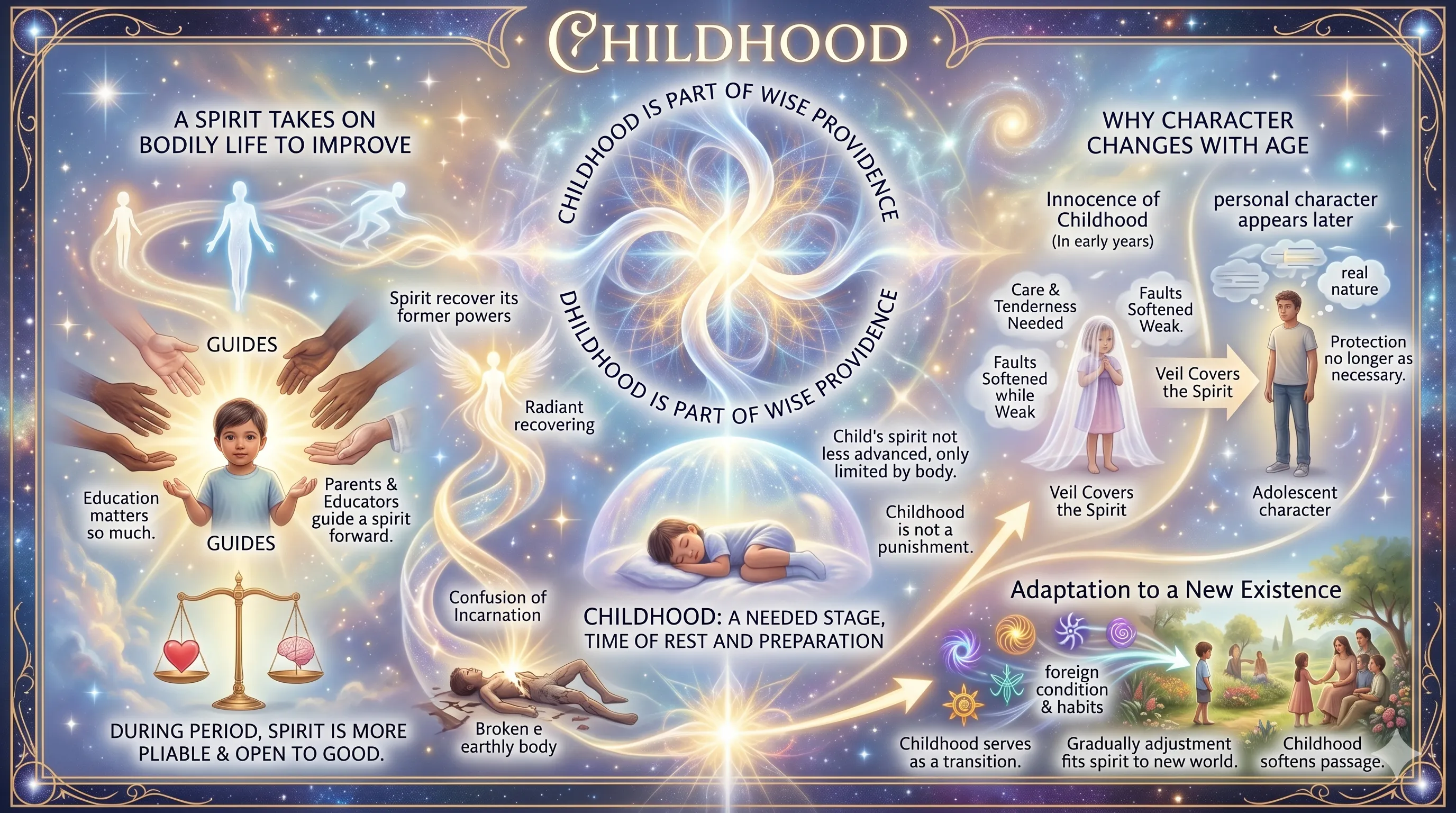
2.7.54 A child’s spirit is not less advanced simply because the child is young. What limits it is the body, whose organs are still developing, so the spirit cannot yet show itself fully.
2.7.55 At the start of life, the confusion of incarnation is not completely gone. The spirit thinks and expresses itself only little by little as the body grows. If the child dies, the spirit recovers its former powers after leaving the body.
2.7.56 Childhood is not a punishment. It is a needed stage, a time of rest and preparation, in keeping with divine order.
The Usefulness of Childhood
2.7.57 A spirit takes on bodily life in order to improve, and childhood helps that work. During this period, the spirit is more pliable and more open to the influences that can guide it toward good.
2.7.58 That is why education matters so much. Those who guide a child are helping a spirit move forward.
Why Character Changes with Age
2.7.59 The change often seen after adolescence does not mean the child had one spirit and the adult another. It is the same spirit, now showing more clearly its real nature.
2.7.60 The innocence of childhood is not always the true sign of moral advancement. A veil covers the spirit in early years, softening the appearance of even its faults while its judgment is still weak.
2.7.61 This also helps draw out the care and tenderness a weak child needs. Later, when this protection is no longer as necessary, the spirit’s personal character appears more openly.
Childhood as Adaptation to a New Existence
2.7.62 A spirit may come from a very different condition and with habits unlike those of earthly life. Childhood serves as a transition. It helps the spirit gradually adapt to its new world.
2.7.63 Without this gradual adjustment, the incarnated being might show instincts and tendencies too foreign for the family and society around it. Childhood softens this passage and fits the spirit to its new circumstances.
The Duty of Parents and Educators
2.7.64 One of the great purposes of childhood is moral improvement. In its early weakness, the spirit is more open to guidance, correction, and the forming of good habits.
2.7.65 So parents and educators have a serious duty. They are not entrusted only with the child’s body, but also with helping the spirit advance. They are accountable for the way they fulfill that task.
2.7.66 Childhood is useful, necessary, and part of wise providence.
Earthly Sympathies and Antipathies
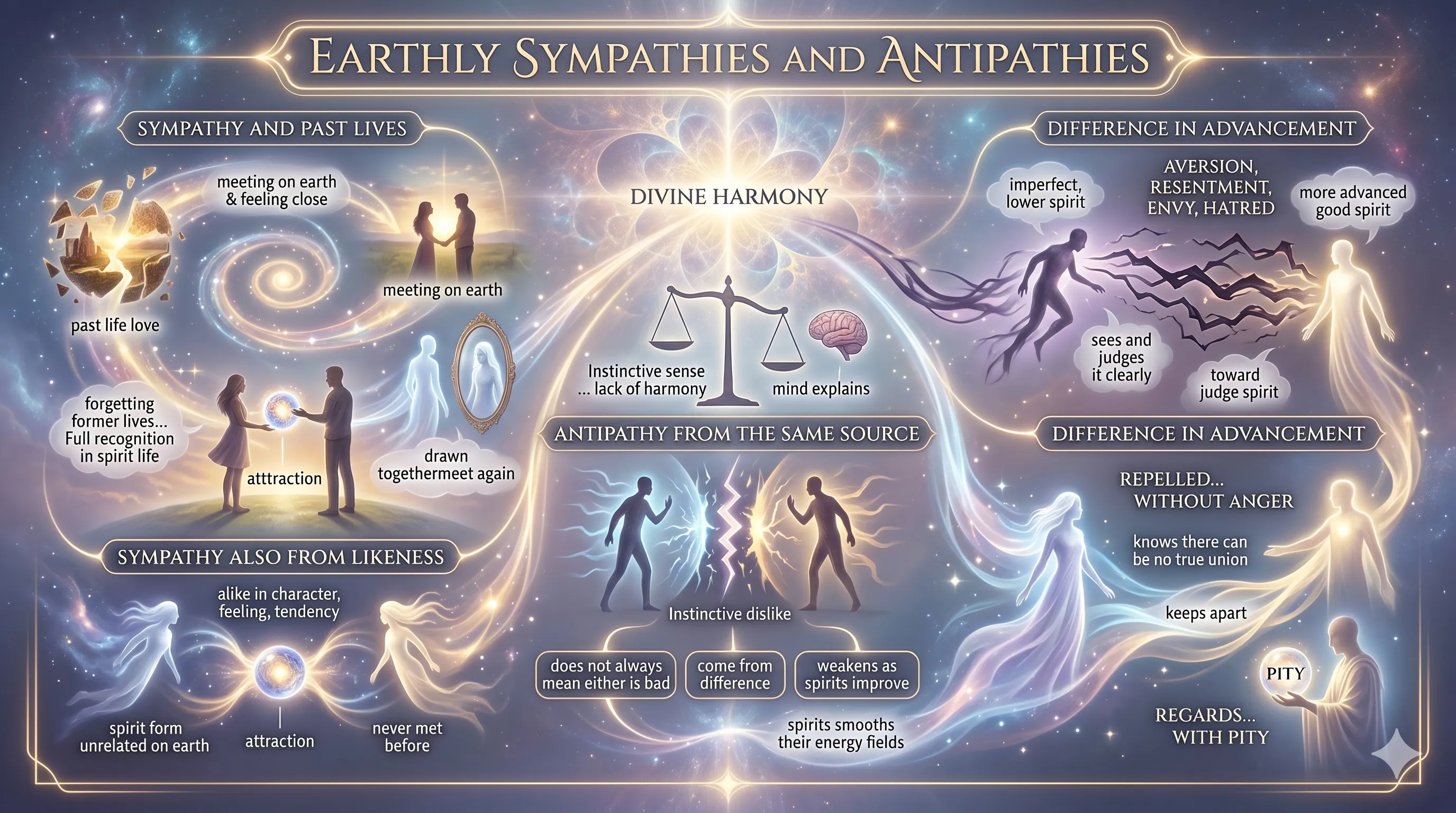
2.7.67 People who loved one another in a past life may meet again on earth and feel close without knowing why. Exact recognition is rare, but the attraction remains, since spirits long drawn together meet again.
2.7.68 This forgetting is not necessarily harmful. Clear memory of former lives could create confusion in earthly life. Full recognition belongs more naturally to the life of spirits, where they meet and remember the past.
2.7.69 Sympathy does not always come from a former earthly relationship. Two spirits may be drawn to each other because they are alike in character, feeling, and tendency, even if they have never met before.
2.7.70 Antipathy comes from the same source. Some feel an instinctive dislike at first sight because their spirits sense a lack of harmony before the mind explains it. This does not always mean either is bad; it may come from difference in nature or feeling, and it weakens as spirits improve.
2.7.71 When one spirit is lower and the other more advanced, the feeling differs. The imperfect spirit feels aversion toward the one who sees and judges it clearly, which may become resentment, envy, or hatred. The good spirit also feels repelled by the evil one, but without anger. It knows there can be no true union, keeps apart, and regards the other with pity.
Forgetfulness of the Past
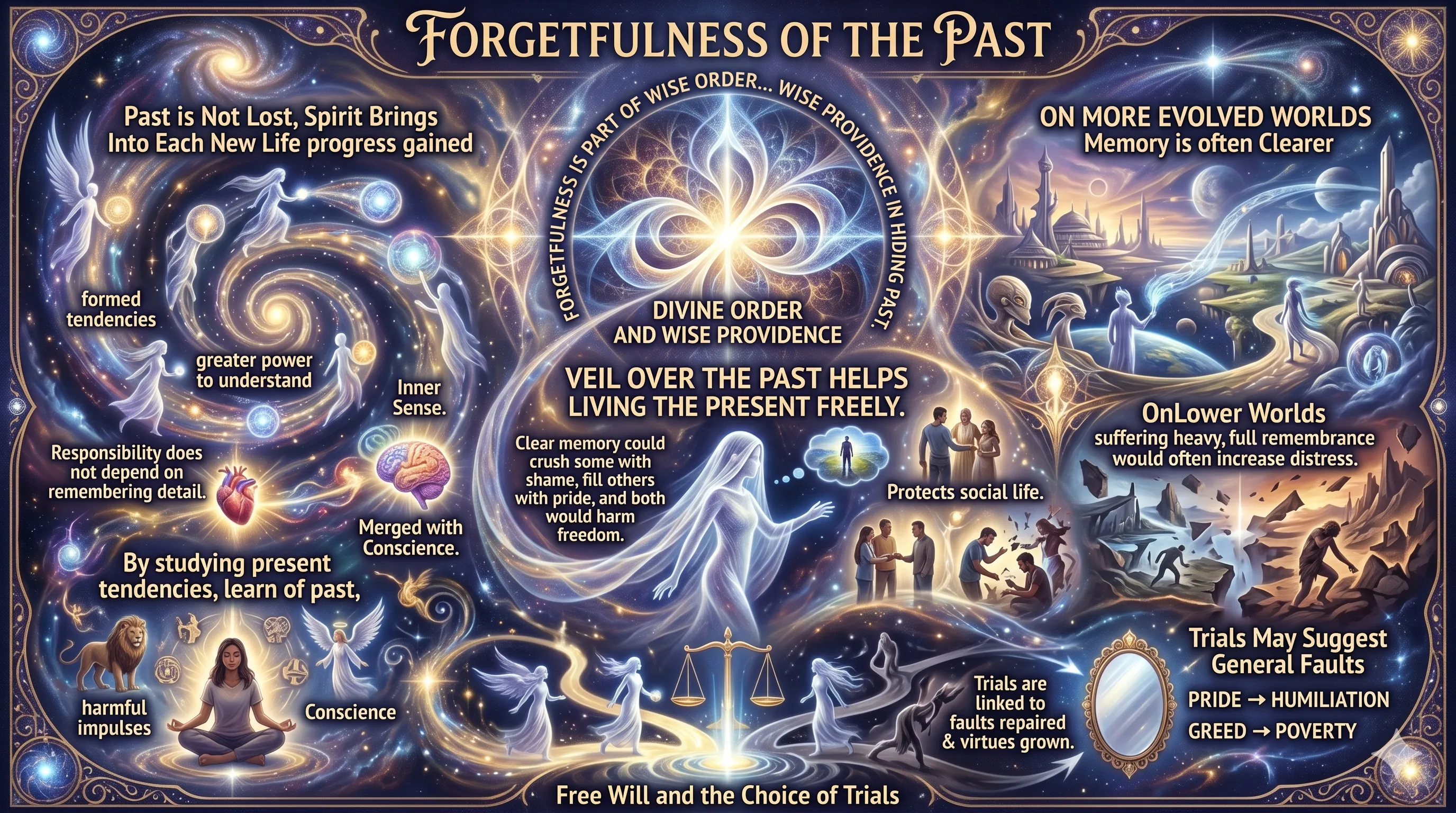
2.7.72 Spirits in bodily life usually do not clearly remember former lives. This forgetfulness is part of a wise order. Full memory would often confuse or overwhelm, while the veil over the past helps a person live the present life freely.
2.7.73 But the past is not lost. The spirit brings into each new life the progress already gained, its formed tendencies, and a greater power to understand. In the spirit state it sees its past more clearly, recognizes its faults, and accepts a new life to repair and improve.
2.7.74 Thus the past remains present in moral form. Harmful impulses may be linked to former faults, while conscience resists them. If a spirit endures its trials well and resists evil tendencies, it rises on returning to spirit life.
Why Forgetfulness Does Not Cancel Responsibility
2.7.75 Responsibility does not depend on remembering past acts in detail. What matters is the spirit’s present moral condition, the tendencies it still carries, and the use it makes of its freedom now.
2.7.76 Each life is not a new beginning from nothing. The spirit returns with lessons already learned and an inner sense of what it must overcome. Full memory would also lessen merit, since a person might do good only because past punishments were plainly remembered.
Intuition, Instinct, and Conscience
2.7.77 Even without clear memory, there is often an intuition of the past. Instinctive tendencies are a kind of remembrance, showing inclinations already formed.
2.7.78 Conscience stands against these tendencies when they lead to wrong. It may reflect the resolution made in the spirit state not to repeat former faults. By studying present tendencies, a person may learn something of the past, though only imperfectly.
2.7.79 A present life may also include new faults if the spirit has not yet learned to resist certain trials. But spirits do not lose the progress already gained. They advance or remain delayed; they do not truly go backward.
More Evolved Worlds and the Memory of the Past
2.7.80 On worlds more advanced than Earth, memory of former lives is often clearer, because the body is less material.
2.7.81 On some higher worlds, people remember past lives clearly and better appreciate their present happiness. On others, life is improved but still troubled, and the inhabitants may not clearly recall a worse past while incarnate, though they understand it later in spirit life.
2.7.82 On lower worlds, where suffering is still heavy, full remembrance would often increase distress instead of helping.
The Providence in Forgetfulness
2.7.83 The hiding of former lives is an act of mercy. Clear memory could crush some with shame and fill others with pride, and both would harm freedom.
2.7.84 It also protects social life. If people remembered what others had done in former lives, relationships could be poisoned by resentment, humiliation, distrust, or superiority.
2.7.85 So the veil over the past is usually a blessing. What is needed for improvement remains through conscience and the tendencies that must be corrected, while what would feed vanity, despair, or conflict is hidden.
Partial Memories and Exceptional Revelations
2.7.86 Sometimes a person receives a faint glimpse of a former life, but such impressions are often imaginary, so caution is necessary.
2.7.87 There are also rare cases in which a person truly knows something of a past life. Such revelations are not given for curiosity, but only for a useful purpose and by permission of higher spirits.
2.7.88 Future lives cannot be revealed, because they depend on how the present life is lived and on later choices of the spirit.
Free Will and the Choice of Trials
2.7.89 Spirits always keep free will.
2.7.90 Before a new bodily life, in the spirit state, they choose the trials suited to their progress and expiation. During earthly life, they remain free to choose between good and evil. Without freedom, a person would be only a machine.
2.7.91 These trials are linked to faults that must be repaired and virtues that must grow. If the spirit overcomes them, it advances; if it fails, the same work must be faced again.
What Present Trials Can Reveal About the Past
2.7.92 A person’s trials may suggest the general kind of faults that came before, though no fixed rule can be made. Instinctive tendencies are usually safer signs than outward suffering alone, since trials concern both past repair and future growth.
2.7.93 Still, there is often a moral correspondence between fault and consequence: pride may be corrected by humiliation, greed by poverty, harshness by harsh treatment, tyranny by slavery, and laziness by forced labor.
2.7.94 These correspondences should not be used to judge others with certainty, but for self-examination.
How to Read the Past in the Present
2.7.95 Even without knowing exact acts from former lives, people can learn much about what they have been by studying themselves carefully.
2.7.96 Dominant tendencies, repeated weaknesses, natural attractions, and constant inner struggles often show the direction from which the spirit has come. But improvement may already have happened, so present character does not reveal the past in a simple way.
2.7.97 What matters is not recovering old names, places, and events, but seeing what must be corrected now. Forgetfulness is therefore not a loss of guidance but a safeguard: the spirit remembers what matters most through conscience, inclination, trial, and the freedom to choose differently.