2.3 Life After Death
The Soul after Death
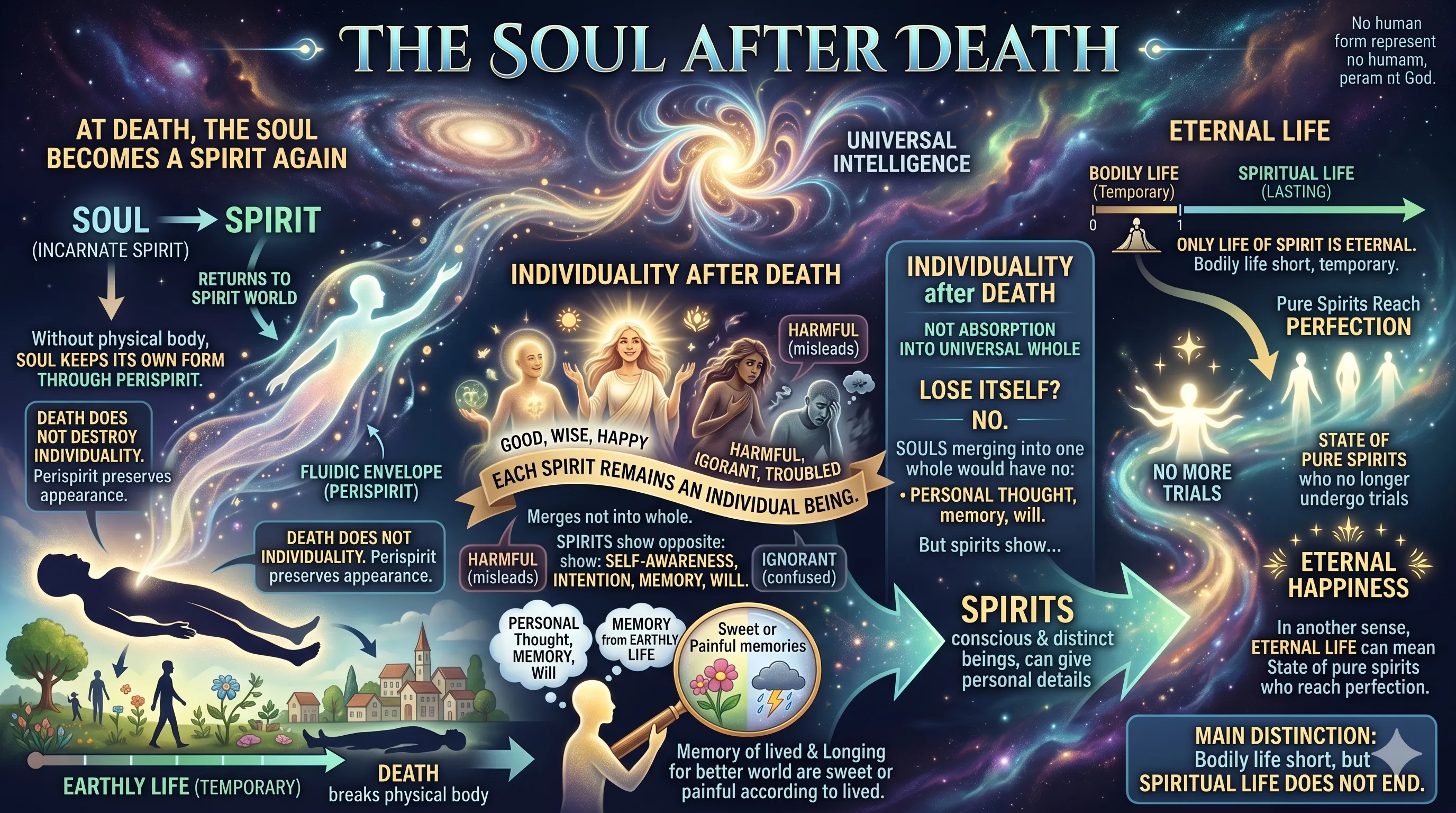
2.3.1 At death, the soul becomes a spirit again and returns to the spirit world it had temporarily left during earthly life.
2.3.2 Death does not destroy individuality. Without the physical body, the soul still keeps its own form through a fluidic envelope called the perispirit, which preserves the appearance of its last incarnation.
2.3.3 What it carries from earthly life is not material wealth, but memory and desire. It keeps the memory of what it lived and the longing for a better world. These memories are sweet or painful according to how it lived.
Individuality after Death
2.3.4 It is mistaken to say that the soul returns to the universal whole if this means it loses its individuality. It is correct only if by universal whole one means the entire assemblage of incorporeal beings, of which each spirit is a member.
2.3.5 Each spirit remains an individual being. If souls truly merged into one whole, they would have no personal thought, memory, or will. But spirits show the opposite: self-awareness, intention, memory, and character.
2.3.6 Their differences make this clear. Some are good, others harmful; some wise, others ignorant; some happy, others troubled. They can also give personal details from earthly life, showing themselves to be conscious and distinct beings.
Eternal Life
2.3.7 Only the life of the spirit is eternal. The life of the body is temporary. When the body dies, the soul returns to the lasting life proper to spirit.
2.3.8 In another sense, eternal life can also mean the state of pure spirits who no longer undergo trials because they have reached perfection. In that state, eternal life means eternal happiness.
2.3.9 The main distinction is simple: bodily life is short, but spiritual life does not end.
The Separation of the Soul from the Body
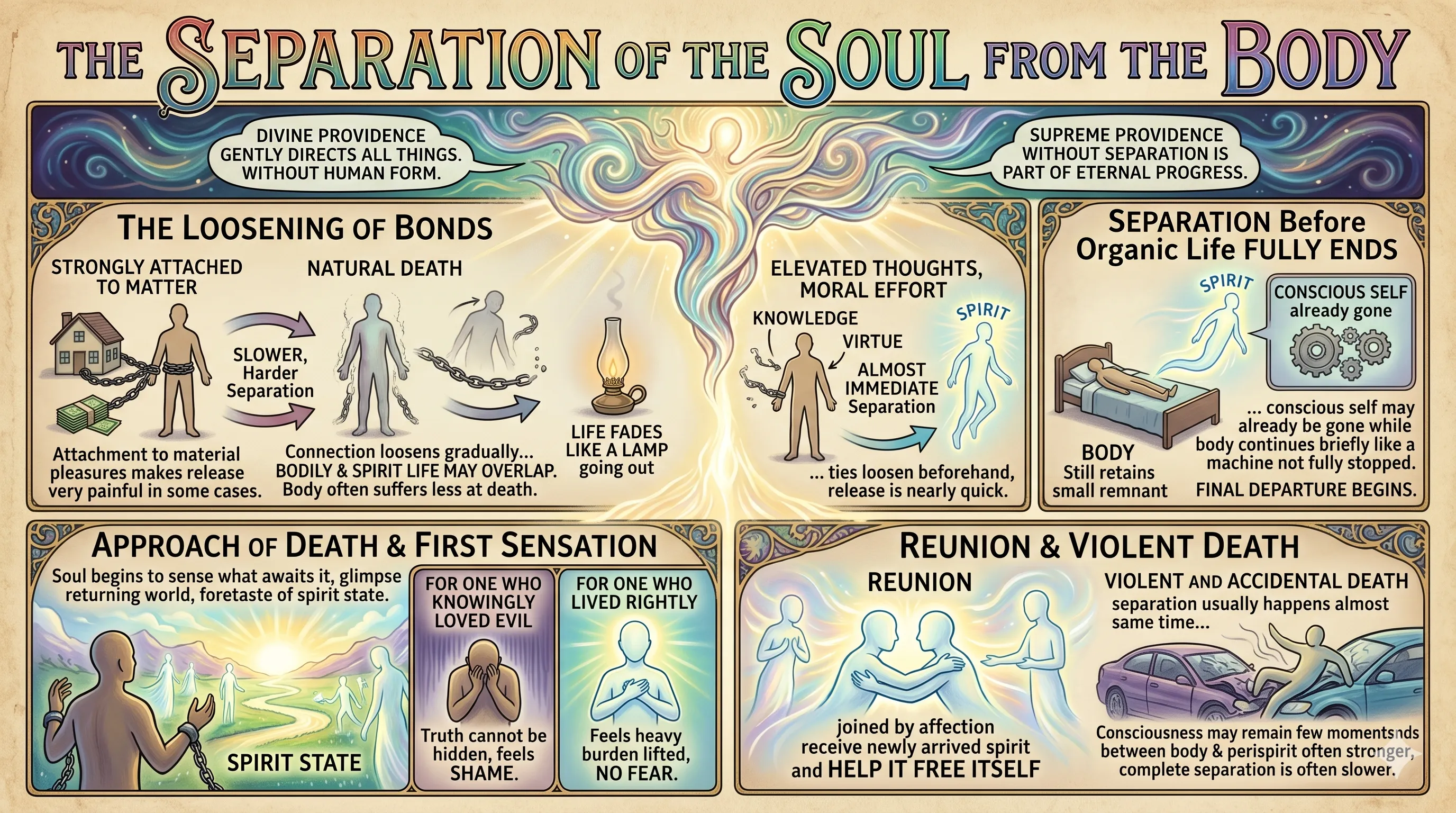
2.3.10 The separation of the soul from the body is not usually painful.
2.3.11 The body often suffers more during life than at death. For the soul, death is often a release, and in natural death life may fade almost unnoticed, like a lamp going out when the oil is spent.
The Gradual Loosening of the Bonds
2.3.12 The soul does not usually leave the body all at once. Its connection with the body loosens gradually, so bodily life and spirit life may seem to overlap for a time.
2.3.13 The spirit is joined to the body by the perispirit. Death destroys the body, but not this envelope, which separates when organic life ends.
2.3.14 This release varies. For some it is quick; for others, especially those attached to material pleasures, it is much slower and may last a long time. The stronger the attachment to matter, the harder and more painful the separation may be.
2.3.15 By contrast, moral effort, intellectual activity, and elevated thoughts loosen these ties beforehand, making separation almost immediate. In rare cases, the lingering bond can be very painful, and the spirit may feel horror at the body’s decomposition.
Separation Before Organic Life Fully Ends
2.3.16 The soul’s final departure may begin before all organic life has ended.
2.3.17 In the last moments, the conscious self may already be gone while the body still retains a small remnant of life, continuing briefly like a machine not yet fully stopped.
The Soul’s Awareness at the Approach of Death
2.3.18 As the bonds loosen, the soul often begins to sense what awaits it.
2.3.19 Partly freed from matter, it may glimpse the world it is returning to and feel a longing or foretaste of the spirit state.
The First Sensation in the Spirit World
2.3.20 The first feeling in the spirit world depends on the soul’s moral condition.
2.3.21 For one who knowingly loved evil, it is shame, because the truth can no longer be hidden. For one who lived rightly, it is like a heavy burden being lifted, without fear.
Reunion with Those Known on Earth
2.3.22 Spirits commonly meet again after death.
2.3.23 Those joined by affection often come to receive the newly arrived spirit and help it free itself from its last ties to matter. The spirit may also meet others it knew and even visit those still living on earth.
Violent and Accidental Death
2.3.24 In violent or accidental death, separation usually happens almost at the same time because the organs were not worn out gradually.
2.3.25 Still, it is not always completed in one indivisible instant. Consciousness may remain for a few moments until organic life is fully extinguished. Because life was cut off suddenly, the bonds between body and perispirit are often stronger, so complete separation is often slower.
The Spirit’s State of Confusion after Death
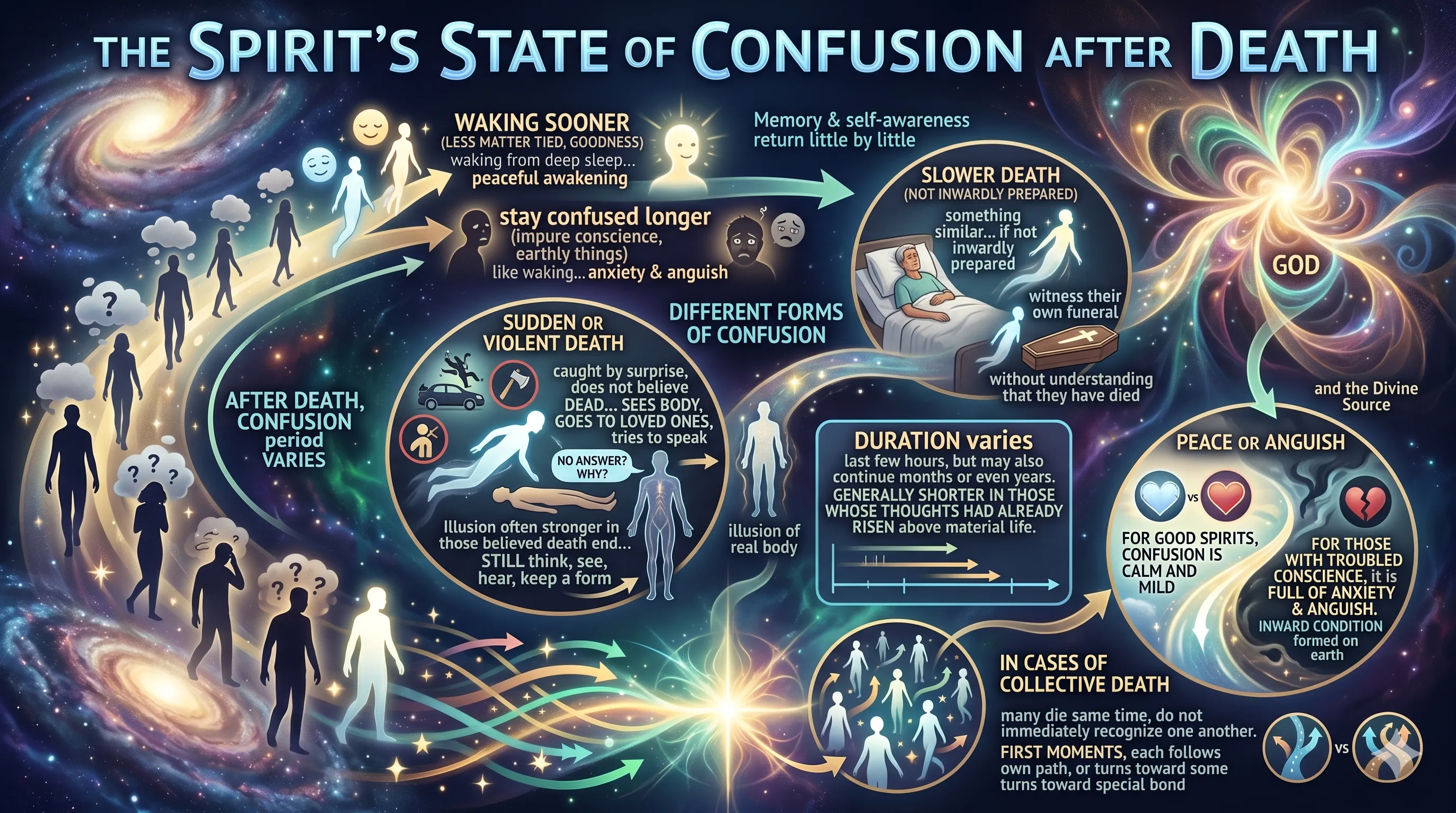
2.3.26 After death, the spirit does not always understand its new state right away. There is usually a period of confusion.
2.3.27 This confusion varies from one spirit to another. It depends mainly on moral progress and on how strongly the spirit was attached to bodily life. Spirits who were less tied to matter awaken sooner. Those who lived absorbed in earthly things, or who carry the weight of an impure conscience, stay confused longer.
2.3.28 Knowing something about spiritual life can help, because the change seems less strange. But goodness and a peaceful conscience help even more. At first, the spirit is like a person waking from deep sleep. As the body’s hold disappears, memory and self-awareness return little by little.
2.3.29 This state may last only a few hours, but it may also continue for months or even years. It is generally shorter in those whose thoughts had already risen above material life.
Different Forms of Posthumous Confusion
2.3.30 Posthumous confusion does not look the same in every case. In sudden or violent death, such as in an accident, execution, suicide, or fatal injury, the spirit is often caught by surprise. It may not believe it is dead. It sees its body, goes to loved ones, tries to speak, and cannot understand why no one answers.
2.3.31 This can continue until the separation from bodily life is complete. The illusion is often stronger in those who believed death was the end of everything. Since they still think, see, and hear, they do not understand what has happened. They also keep a form like the body they just left and may take it, at first, for a real material body.
2.3.32 Something similar may happen after a slower death if the person was not inwardly prepared. Some even witness their own funeral without understanding that they are the one who has died.
Peace or Anguish
2.3.33 For good spirits, this confusion is calm and mild, like a peaceful awakening.
2.3.34 For those with a troubled conscience, it is full of anxiety and anguish. The spirit carries into the next life the inner condition it formed on earth.
In Cases of Collective Death
2.3.35 When many people die at the same time, they do not immediately recognize one another. In the first moments of confusion, each spirit usually follows its own path, or turns only toward those to whom it feels a special bond.