2.11 Matter, Life, and Spirit
Minerals and Plants
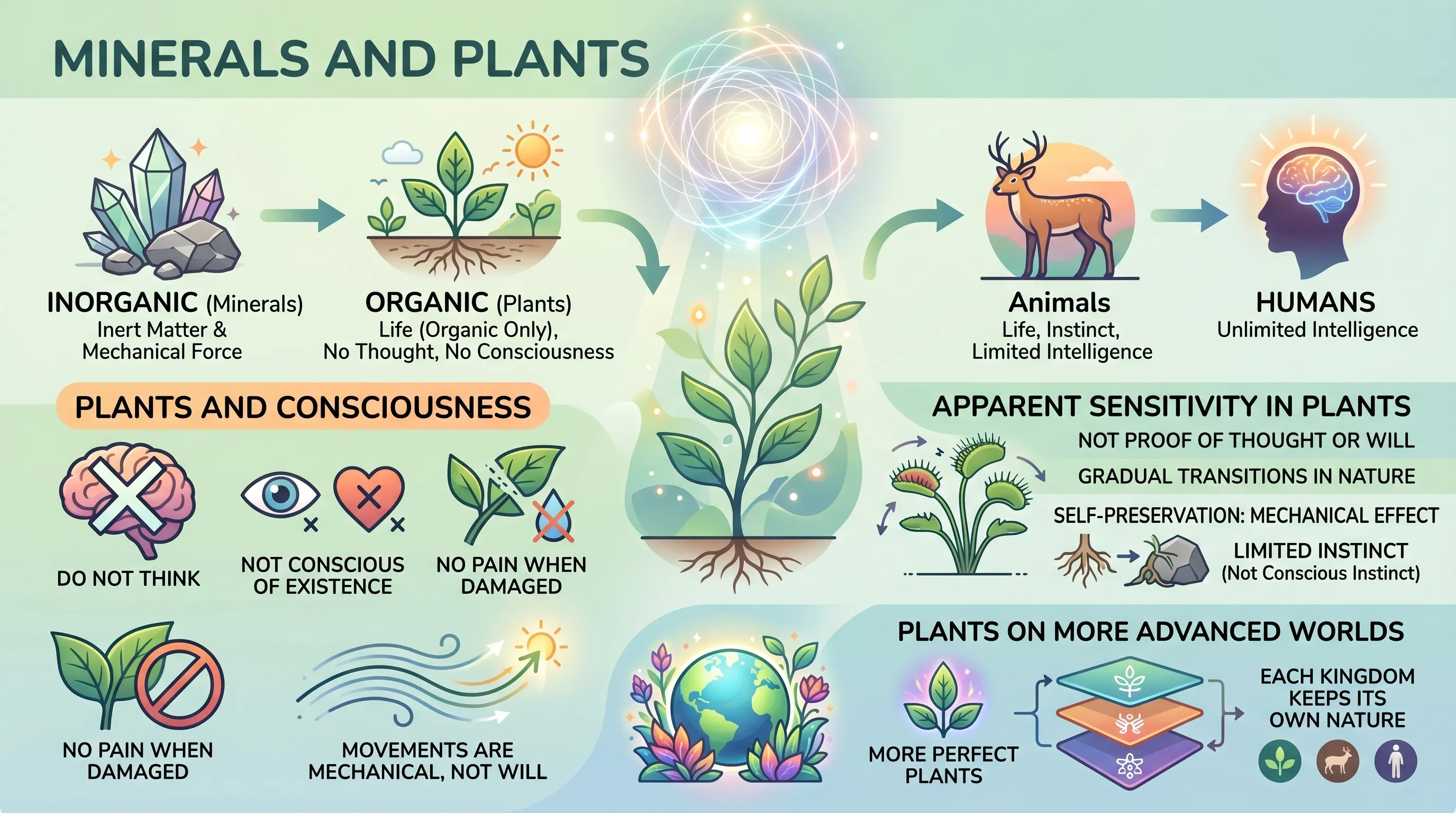
2.11.1 Nature can be viewed materially or morally. Materially, beings are organic or inorganic. Minerals are inert matter with only mechanical force. Plants are formed from inert matter but possess life. Animals also have life, with instinct and limited intelligence. Human beings contain what is found in plants and animals, but rise above both through a special, unlimited intelligence.
Plants and Consciousness
2.11.2 Plants do not think and are not conscious of their existence. They have only organic life.
2.11.3 They receive physical impressions, but do not feel them consciously. When cut or damaged, they do not suffer pain as animals do. Their movements come from mechanical causes, not will.
Apparent Sensitivity in Certain Plants
2.11.4 Some plants seem sensitive, such as the mimosa or dionea, but this does not prove thought or will.
2.11.5 Nature has gradual transitions, yet plants still do not think. Their movements no more show intention than digestion or circulation show conscious choice.
Self-Preservation in Plants
2.11.6 Plants may seem to seek what helps them and avoid what harms them, but this is only a mechanical effect.
2.11.7 If instinct is used here, it must be understood in a very limited sense, not as true conscious instinct.
Plants on More Advanced Worlds
2.11.8 On more advanced worlds, plants are more perfect, as all beings there are more perfect.
2.11.9 Still, each kingdom keeps its own nature. Plants remain plants, animals remain animals, and human beings remain human beings.
Animals and Human Beings
Instinct and Intelligence in Animals
2.11.10 Animals are not guided by instinct alone.
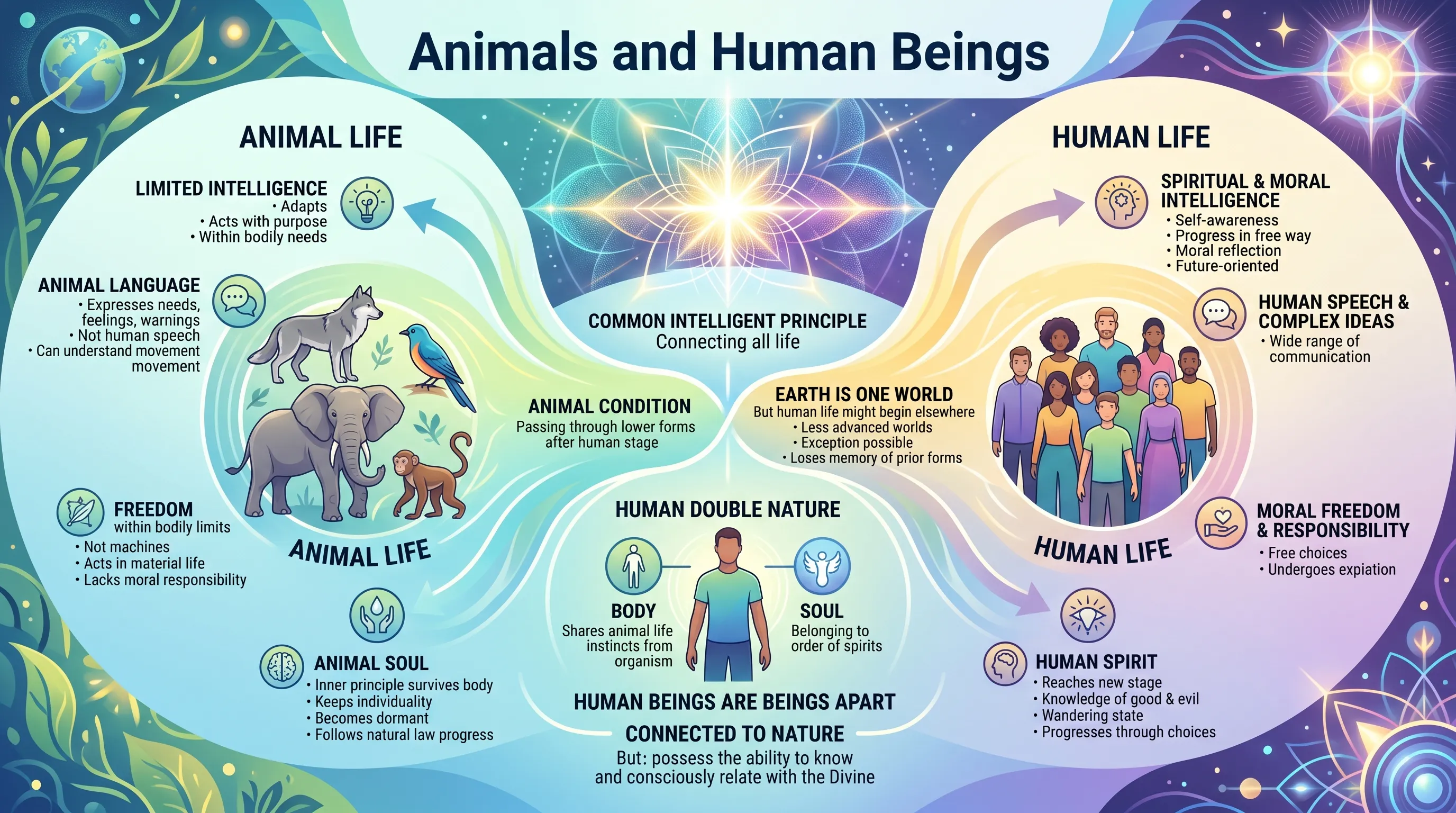
2.11.11 They also have a limited kind of intelligence. They can adapt, learn certain things, and act with purpose. But this intelligence stays within the needs of bodily life and does not rise to moral reflection.
2.11.12 So animals do not progress in the same free way as human beings. Their activity follows lines that remain mostly fixed, even if training can develop some abilities.
Animal Language
2.11.13 Animals do have a kind of language.
2.11.14 They do not have human speech, but they can express needs, feelings, warning, and intention. Their communication matches the range of their ideas, which is narrow compared with ours.
2.11.15 Even when they have no voice, they can still understand one another by movement, signs, and other means suited to their nature.
Freedom of Action in Animals
2.11.16 Animals are not machines.
2.11.17 They have some freedom to act, but only within the limits of material life. This is very different from human freedom, because it does not involve the same moral responsibility.
2.11.18 Some can also imitate sounds or gestures, as far as their organs allow.
The Soul of Animals
2.11.19 Animals have an inner principle distinct from matter, and it survives the body.
2.11.20 In a broad sense, this can be called a soul. But the animal soul is not the human spirit. It has intelligence, yet not the same self-awareness or moral life.
2.11.21 After death, the animal soul keeps its individuality, but its intelligent activity becomes dormant. It does not freely choose its condition, and it does not remain in the wandering state proper to the human spirit.
The Progress of Animals
2.11.22 Animals do progress, but not as human beings do.
2.11.23 On more advanced worlds, animals are also more advanced. Still, they remain below humanity. Their progress follows natural law, not free moral choice, so they do not undergo expiation as human spirits do.
Intelligence as a Common Principle
2.11.24 There is a real link between animal life and human life.
2.11.25 In both, intelligence comes from one common intelligent principle. In animals, it remains tied to material life. In human beings, it opens into moral and spiritual life.
Human Nature and Animal Nature
2.11.26 Human beings do not have two souls.
2.11.27 A person has one soul and a double nature. Through the body, the person shares in animal life and instinct. Through the soul, the person belongs to the order of spirits.
2.11.28 The instincts of the body come from the organism and its needs, not from a second soul. The body alone is not intelligent; the incarnated spirit gives human life its intellectual and moral character.
The Origin of the Human Spirit
2.11.29 The intelligent principle in animals and in human beings emanates from a single principle. But the point of departure of the human spirit belongs to the secrets of God.
2.11.30 One view says the intelligent principle is prepared and individualized in lower degrees of creation before becoming spirit. Another says the human spirit has always belonged to the human race. Human beings have not been given certainty on this point.
2.11.31 What is certain is that in the human state the spirit possesses self-awareness, sense of the future, knowledge of good and evil, and responsibility.
The Beginning of Humanity
2.11.32 Earth is not necessarily where human life begins.
2.11.33 The first human incarnations generally begin on worlds less advanced than ours, though there may be exceptions. Once the spirit enters the human state, it no longer remembers the existences that came before.
Human Beings as Beings Apart
2.11.34 Human beings are beings apart in creation.
2.11.35 Yet they are not cut off from the rest of nature. Humanity is connected with what comes before it, while remaining distinct through moral freedom, self-awareness, responsibility, and the ability to know God.
2.11.36 That is why the human race is the order of embodied life chosen for the incarnation of spirits capable of conscious relation with the divine.
Metempsychosis
2.11.37 The common source of living beings in the intelligent principle does not prove metempsychosis in the usual sense.
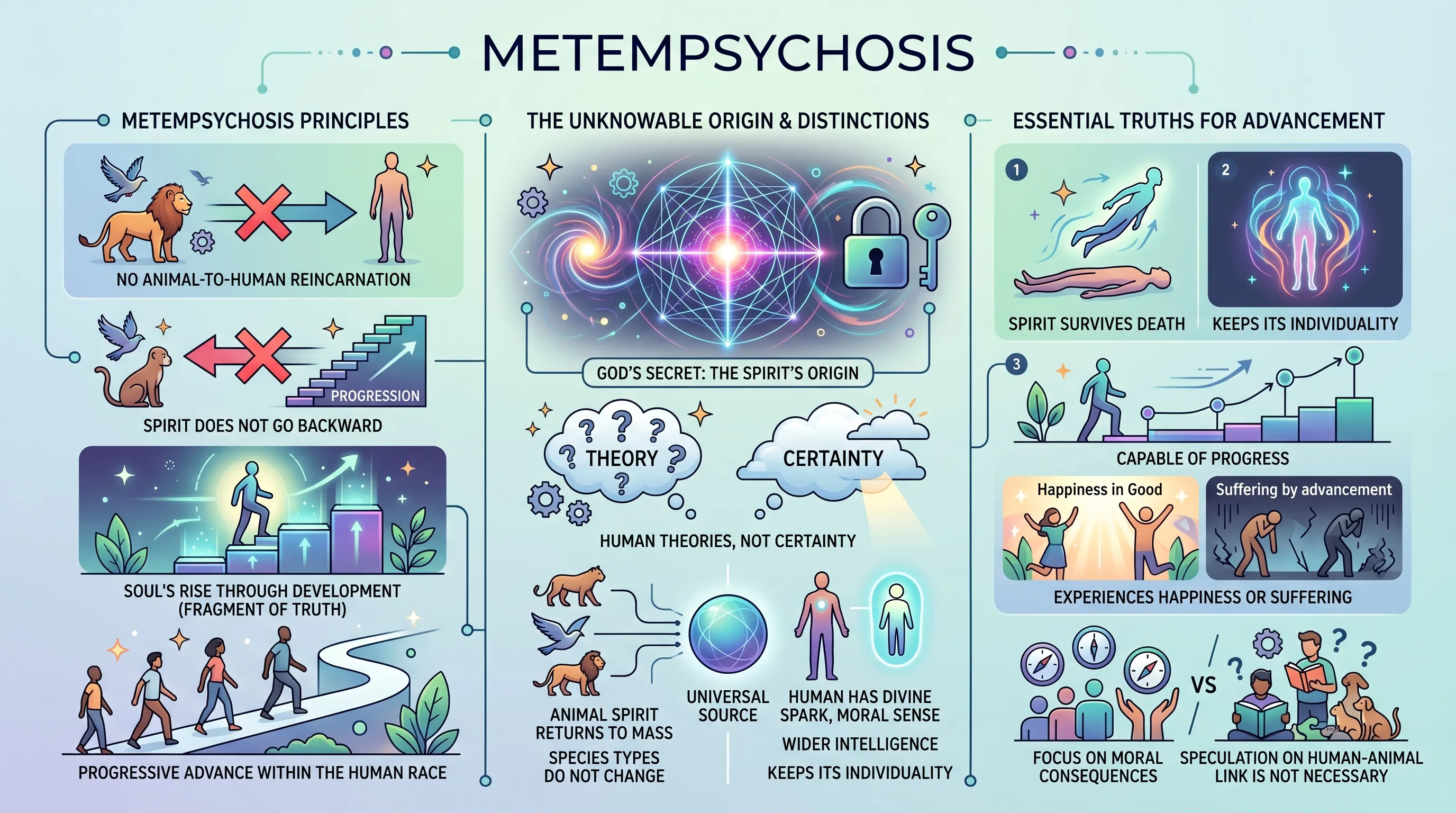
2.11.38 Once the intelligent principle has become a spirit and entered the human stage, it is no longer the soul of an animal. In human beings, what still relates to the animal state belongs to the body, through passions and instinct. So a human being is not the reincarnation of an animal.
2.11.39 A spirit that has lived in a human body cannot incarnate in an animal body, since spirit does not go backward.
2.11.40 Still, the widespread belief contains a fragment of truth. If metempsychosis means the soul’s rise from a lower condition to a higher one through development, there is something true in it. What is false is the idea of direct passage from animal to human, or from human back to animal.
2.11.41 Reincarnation rests instead on progressive advance within the human race. The persistence of metempsychosis at least shows that successive lives answer to a deep human intuition.
What Can and Cannot Be Known
2.11.42 The starting point of the spirit belongs to the origin of things, and remains one of God’s secrets. Human beings can form theories, but they have not been given certainty.
2.11.43 Spirits do not know everything either, and on matters beyond their reach they may give opinions rather than knowledge. That is why there is disagreement about the relation between humans and animals.
2.11.44 One view says the spirit reaches the human stage after preparation through lower degrees of creation. Another says the human spirit has always belonged to the human race and never passed through animal life.
Humans and Animals
2.11.45 According to the second view, animal species do not develop spiritually from one into another. The spirit of one species does not become that of another. Each species is a type of its own.
2.11.46 In that view, each individual draws from the universal source the intelligent principle needed for its organs and role in nature. At death, that principle returns to the general mass.
2.11.47 In that same view, the matter is different with human beings. Physically, the human being is one link in living creatures, but morally there is a break between human and animal. The human being alone has a soul or spirit, a divine spark that gives moral sense and wider intelligence. This spirit exists before the body, survives it, and keeps its individuality.
2.11.48 Its exact origin remains hidden. Theories are possible, but certainty is not.
What Matters for Human Advancement
2.11.49 What is solid, and supported by reason and experience, is this: the spirit survives death, keeps its individuality, can progress, and experiences happiness or suffering according to its advancement in the good.
2.11.50 These truths have the essential moral consequences.
2.11.51 By contrast, the hidden relation between humans and animals is not necessary for moral progress. It is enough to know that the spirit survives, advances, and receives the results of its own development. Speculation about what God has not yet revealed does not.