2.8 The Soul Beyond the Body
Sleep and Dreams
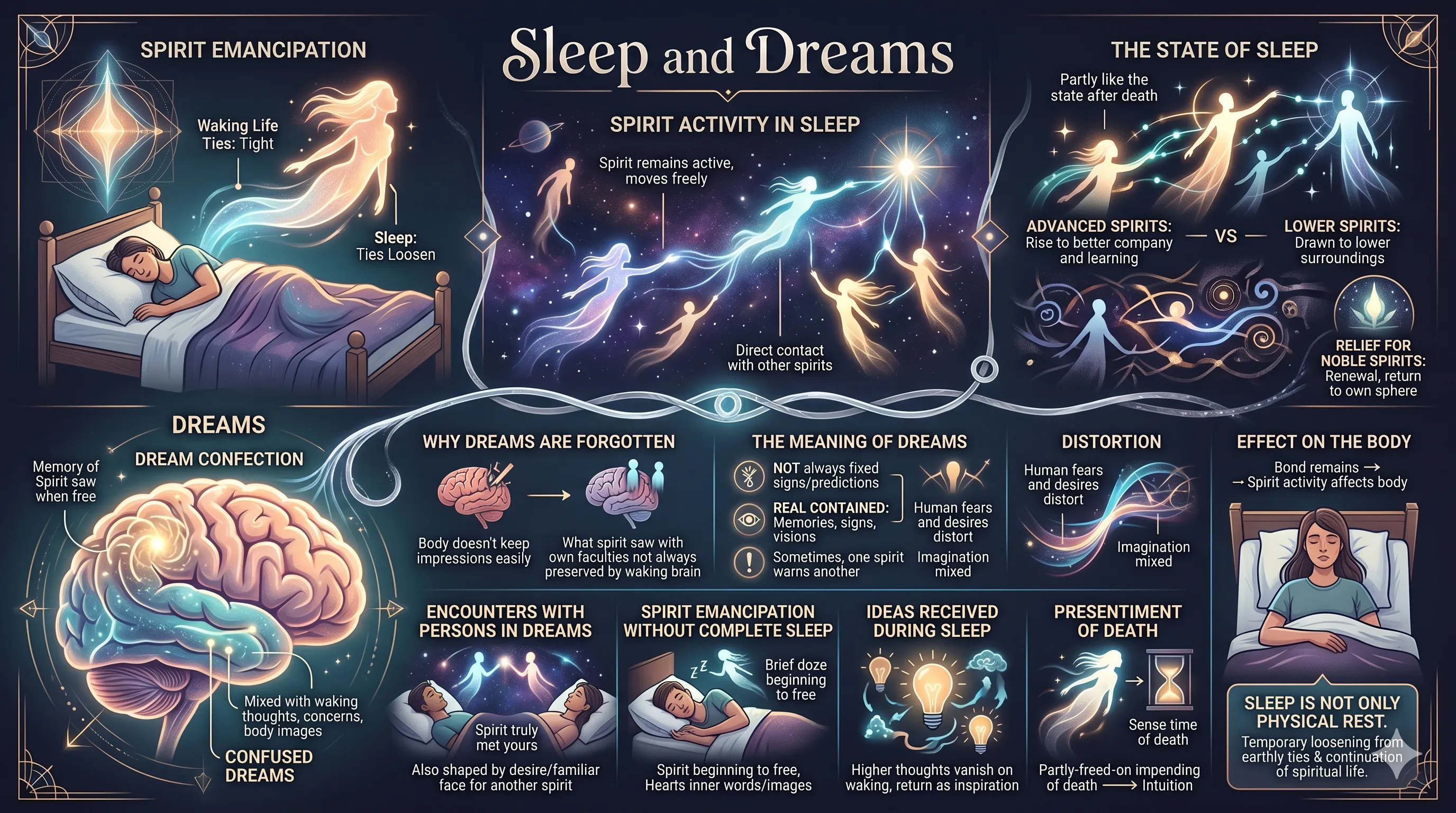
2.8.1 The spirit is not held in the body by its own free choice. During waking life it is tied to the body, but in sleep those ties loosen. While the body rests, the spirit remains active, moves more freely, and enters more direct contact with other spirits.
2.8.2 Dreams come from this greater freedom. In sleep, the spirit may recall the past, sometimes have a glimpse of the future, or meet spirits from this world and others. Sleep places the soul for a few hours in a state partly like the one after death. More advanced spirits rise toward better company and learning, while lower spirits are drawn to lower surroundings.
2.8.3 For noble spirits living in hard earthly conditions, sleep is also a relief. It lets them renew themselves and return for a time to beings of their own sphere.
Dreams as the Memory of Spiritual Activity
2.8.4 A dream is the memory of what the spirit saw while free during sleep. But that memory is rarely clear. It is mixed with waking thoughts, present concerns, and images from the body.
2.8.5 That is why dreams are often confused. Things far away, past events, unknown worlds, and even memories from former lives may blend with ordinary scenes from present life.
Why Dreams Are Forgotten
2.8.6 Sleep is rest for the body, not for the spirit. The spirit continues to act and communicate.
2.8.7 Dreams are often forgotten because the body does not easily keep impressions received by the spirit alone. What the spirit saw with its own faculties is not always preserved by the waking brain.
The Meaning of Dreams
2.8.8 Dreams are not fixed signs that always predict events. Yet they may still contain something real.
2.8.9 They can be memories of the past, signs of what may come if such knowledge is allowed, or visions of something happening elsewhere at that moment. Sometimes one spirit warns another through a dream. But human fears and desires often distort what is seen, and imagination becomes mixed with the spirit’s perceptions.
Encounters with Other Persons in Dreams
2.8.10 When people appear in dreams and act unlike themselves, it is not always pure imagination. Their spirit may truly have met yours, even if neither person remembers it on waking.
2.8.11 Still, dreams can also be shaped by personal desire. A familiar face may stand for another spirit, another situation, or even a scene from another existence.
The Emancipation of the Spirit Without Complete Sleep
2.8.12 The spirit does not need full sleep to begin freeing itself. Whenever the senses grow dull, it regains some liberty. The less active the body is, the freer the spirit becomes.
2.8.13 That is why drowsiness can bring dreamlike experiences. Before full sleep, a person may hear inner words or see clear images because the spirit is already acting more independently.
Ideas Received During Sleep
2.8.14 During sleep, or even a brief doze, higher thoughts may come and then vanish on waking.
2.8.15 These ideas arise from the spirit’s greater freedom and may also come from the guidance of other spirits. Even when the body forgets them, the spirit keeps their mark, and they may return later as sudden inspiration.
Presentiment of Death
2.8.16 When partly freed from matter, the incarnate spirit may sometimes sense the time of its death. This may appear as a vague presentiment or as a clearer inner knowledge. When it reaches waking life, it becomes intuition.
The Effect of Spiritual Activity on the Body
2.8.17 The spirit’s activity during sleep can affect the body, because the bond between them still remains. If the spirit has been very active, the body may wake tired even after resting.
2.8.18 So sleep is not only physical rest. It is also a temporary loosening of the soul from earthly ties and a continuation of spiritual life.
Visits between the Spirits of Living Persons
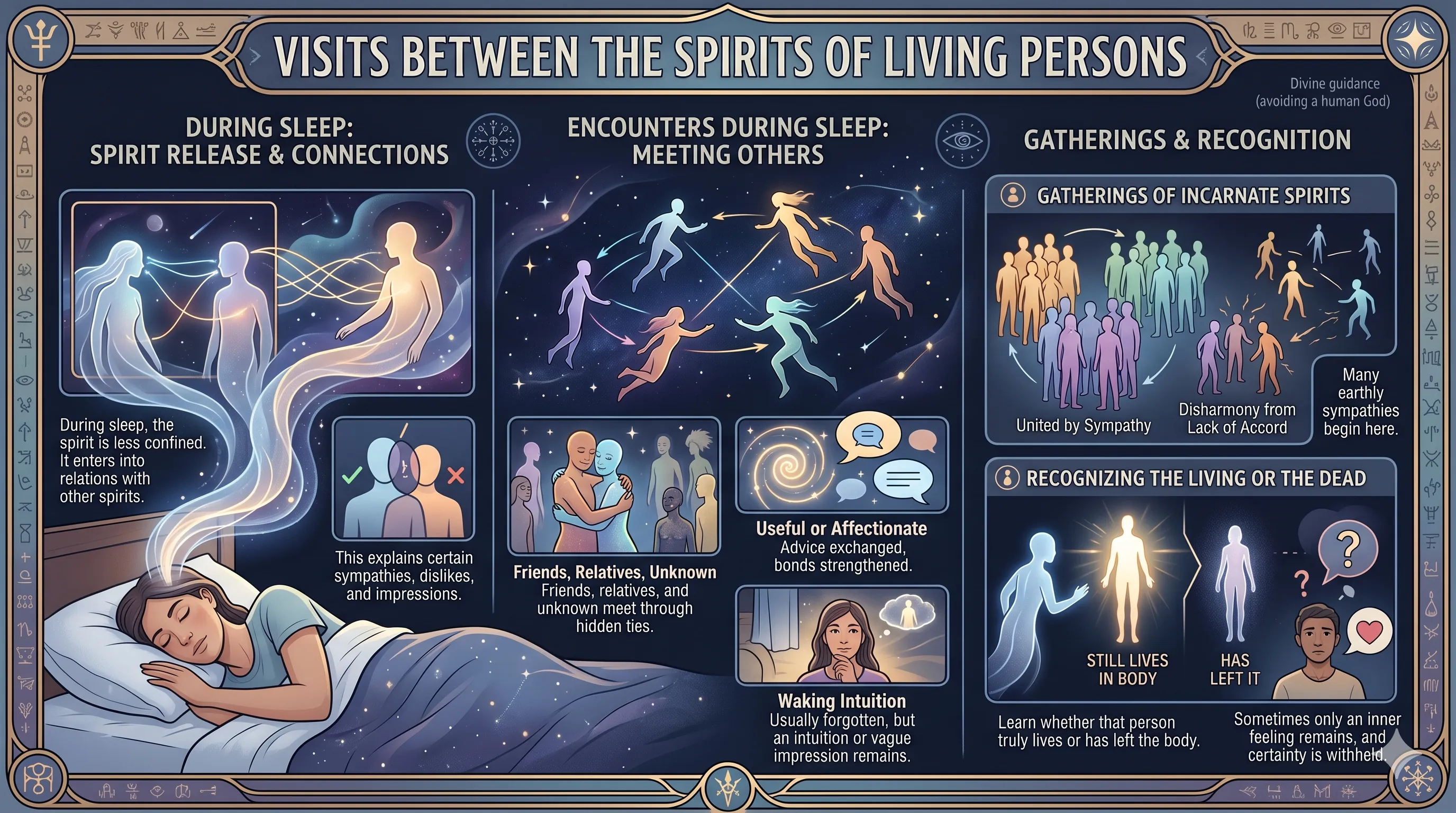
2.8.19 During sleep, the spirit is less confined than in waking life and can enter into relations with other spirits. This helps explain certain sympathies, dislikes, and impressions that remain after sleep without clear memory.
Encounters During Sleep
2.8.20 Living persons can meet one another in spirit during sleep. Friends, relatives, and even those unknown on earth may come together through hidden ties.
2.8.21 These meetings may be useful or affectionate. Advice may be exchanged and bonds strengthened. On waking, the meeting is usually forgotten, but an intuition or vague impression may remain.
Gatherings of Incarnate Spirits
2.8.22 The spirits of living persons may also gather in groups. Those united by sympathy seek each other, and these gatherings vary according to the nature of the spirits present.
2.8.23 Many earthly sympathies begin there, while disharmony may also come from a lack of spiritual accord.
Recognizing the Living or the Dead
2.8.24 In these meetings, a spirit may encounter someone thought dead, or fail to find someone expected. From this, it may learn whether that person still lives in the body or has truly left it.
2.8.25 But this knowledge is not always clear after waking. Sometimes only an inner feeling remains, and sometimes certainty is withheld because it would not be useful.
The Concealed Transmission of Thought
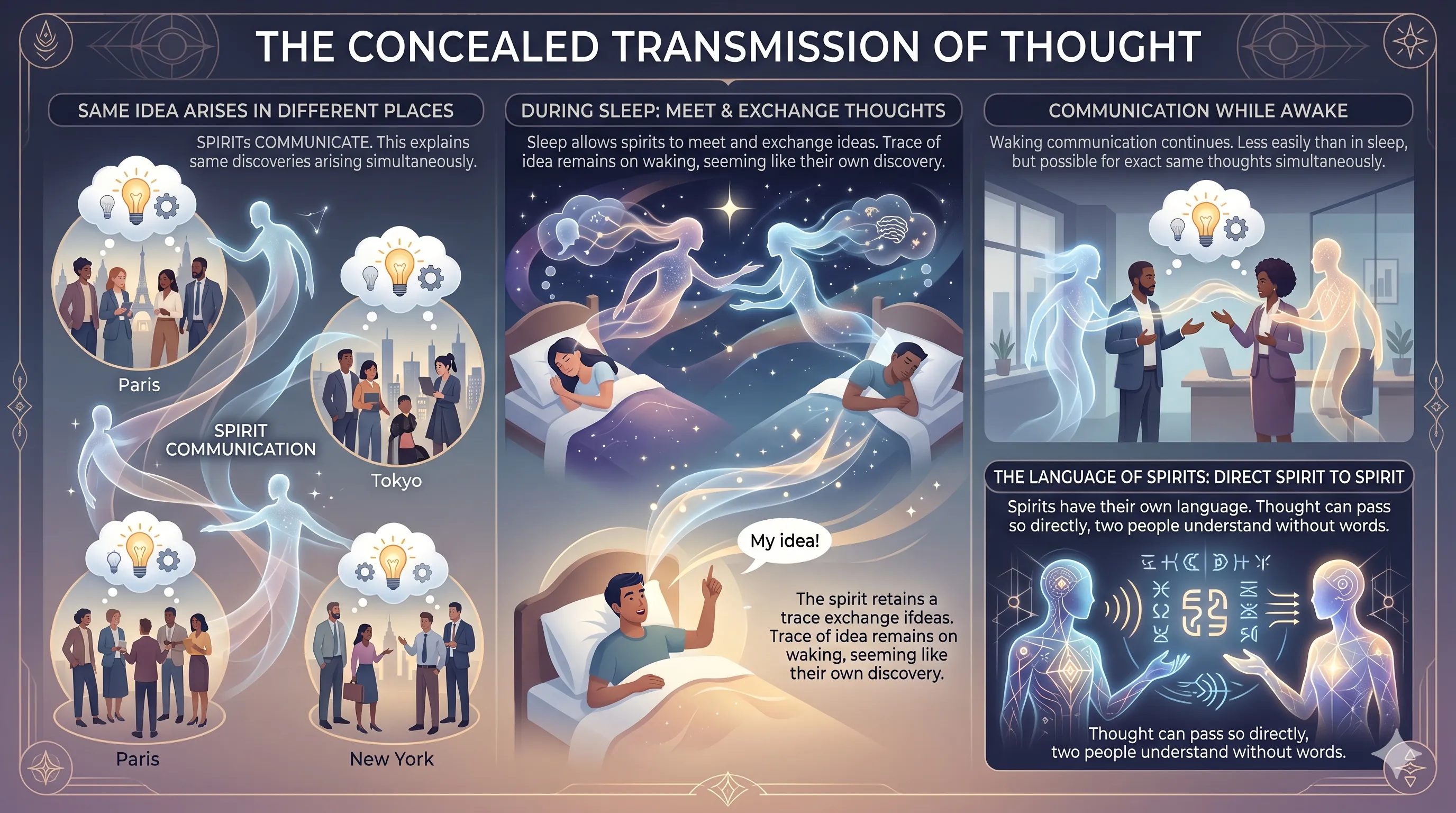
2.8.26 The same idea can arise in different places at nearly the same time because spirits communicate with one another.
2.8.27 During sleep, spirits meet and exchange thoughts. When the body wakes, the spirit retains some trace of what it received, and the person may think the idea came only from his or her own mind. This helps explain why several people may seem to make the same discovery at once.
Communication While Awake
2.8.28 This communication does not stop when we are awake.
2.8.29 The spirit is not imprisoned in the body and can still communicate with other spirits during waking life, though less easily than during sleep. This can explain why two people, fully awake, may have exactly the same thought at the same moment.
The Language of Spirits
2.8.30 When spirits are in contact, thought can pass so directly that two people understand each other without spoken words.
2.8.31 In this sense, spirits have a language of their own: the direct language of spirit to spirit.
Lethargy, Catalepsy, Apparent Death
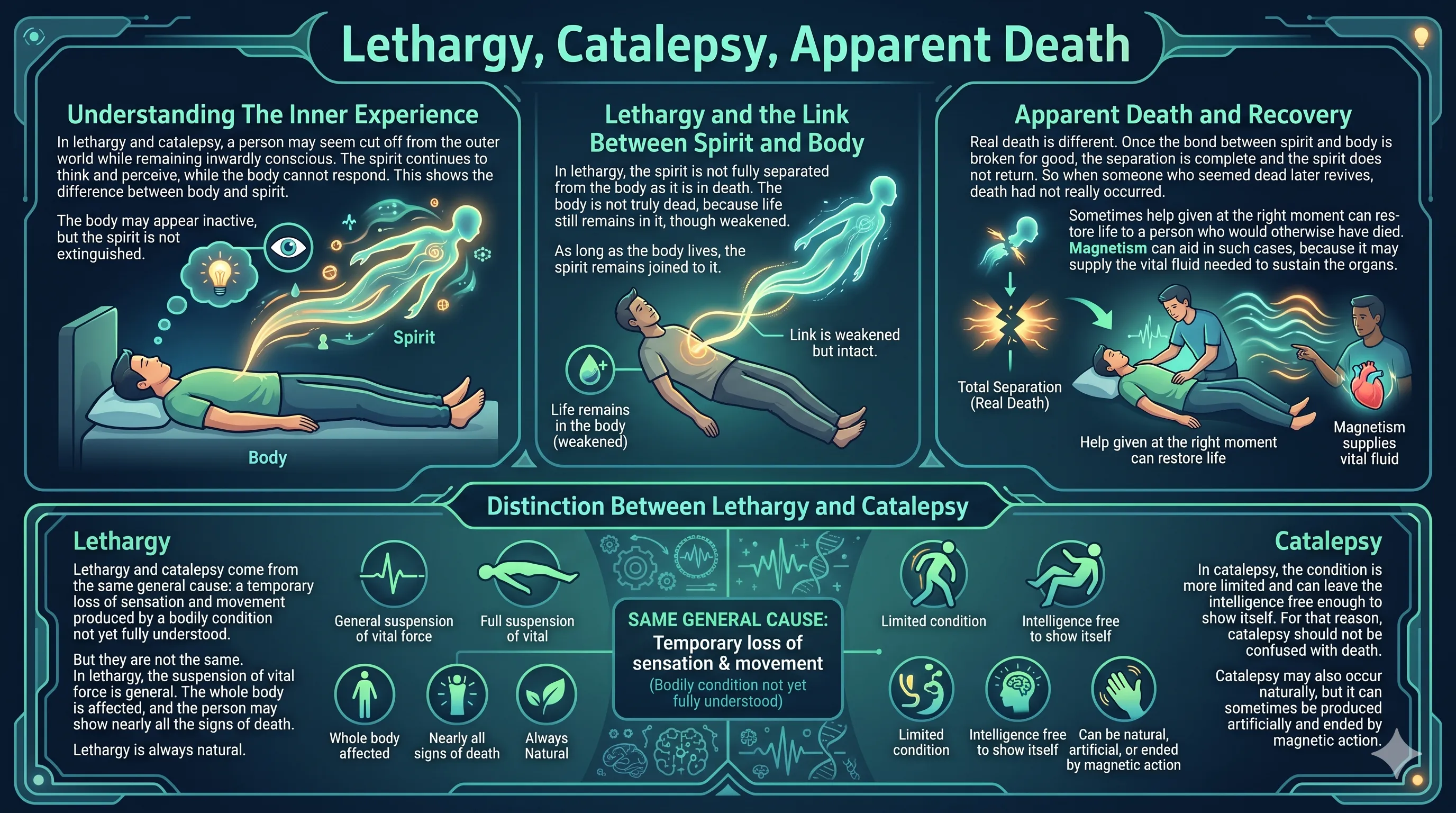
2.8.32 In lethargy and catalepsy, a person may seem cut off from the outer world while remaining inwardly conscious. The spirit continues to think and perceive, while the body cannot respond.
2.8.33 This shows the difference between body and spirit. The body may appear inactive, but the spirit is not extinguished.
Lethargy and the Link Between Spirit and Body
2.8.34 In lethargy, the spirit is not fully separated from the body as it is in death. The body is not truly dead, because life still remains in it, though weakened. As long as the body lives, the spirit remains joined to it.
2.8.35 Real death is different. Once the bond between spirit and body is broken for good, the separation is complete and the spirit does not return. So when someone who seemed dead later revives, death had not really occurred.
Apparent Death and Recovery
2.8.36 Sometimes help given at the right moment can restore life to a person who would otherwise have died.
2.8.37 Magnetism can aid in such cases, because it may supply the vital fluid needed to sustain the organs.
Distinction Between Lethargy and Catalepsy
2.8.38 Lethargy and catalepsy come from the same general cause: a temporary loss of sensation and movement produced by a bodily condition not yet fully understood. But they are not the same.
2.8.39 In lethargy, the suspension of vital force is general. The whole body is affected, and the person may show nearly all the signs of death. In catalepsy, the condition is more limited and can leave the intelligence free enough to show itself. For that reason, catalepsy should not be confused with death.
2.8.40 Lethargy is always natural. Catalepsy may also occur naturally, but it can sometimes be produced artificially and ended by magnetic action.
Somnambulism
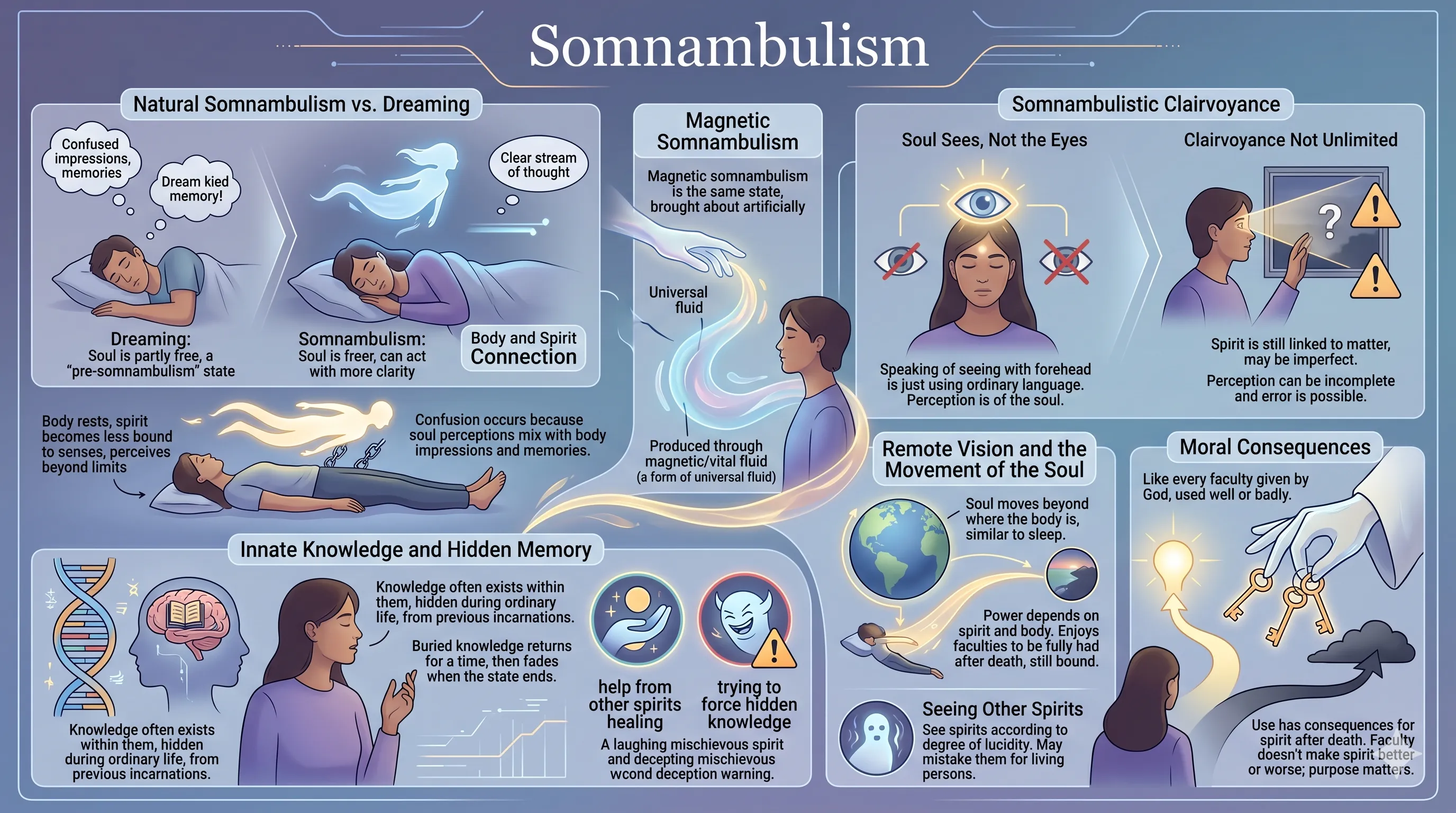
2.8.41 Natural somnambulism is connected with dreaming, but it is not the same. In dreams, the soul is partly free. In somnambulism, it is freer and can act with more clarity. In that sense, dreaming can be seen as an imperfect kind of somnambulism.
2.8.42 While the body rests, the spirit becomes less bound to the senses and can perceive beyond the usual limits. This is why dreams are often confused when remembered after waking. What the soul perceived is mixed with impressions from the body and with memories that are hard to sort out.
Magnetic Somnambulism
2.8.43 Magnetic somnambulism is the same state in its nature, but brought about artificially.
2.8.44 It is produced through the action of the magnetic or vital fluid, a form of the universal fluid.
Somnambulistic Clairvoyance
2.8.45 The clairvoyance of the somnambulist belongs to the soul, not to the body. It is the soul that sees, not the eyes.
2.8.46 So when a somnambulist says they see through the forehead or another part of the body, this should not be taken literally. They usually speak that way because ordinary language expects a bodily organ.
2.8.47 Still, this sight is not unlimited. Somnambulists do not see everything and are not free from error. Since the spirit is still linked to matter and may still be imperfect, its perception can remain incomplete.
Innate Knowledge and Hidden Memory
2.8.48 When somnambulists speak of things they never learned while awake, that knowledge is not always newly acquired. Much of it may already exist within them, hidden during ordinary life.
2.8.49 As incarnate spirits, they have lived before. In the somnambulistic state, some of this buried knowledge can return for a time, though never fully. When the state ends, the memory usually fades again.
2.8.50 They may also receive help from other spirits, especially in matters like healing. But when one tries to force hidden knowledge to appear, deception becomes possible, because frivolous spirits may answer carelessly.
Remote Vision and the Movement of the Soul
2.8.51 Some somnambulists can see distant places because the soul can move beyond where the body is, much as it does in sleep.
2.8.52 How far this power reaches depends on both the spirit and the body. In this state, the spirit partly enjoys faculties it will have more fully after death, though it is still bound to the body.
Seeing Other Spirits
2.8.53 Many somnambulists can also see spirits, according to the degree of their lucidity.
2.8.54 At first they may not understand what they are seeing and may take spirits for living persons, since spirits often appear in human form.
Where the Somnambulist Sees From
2.8.55 When a somnambulist sees at a distance, the perception comes from where the soul is, not from where the body lies. The soul sees directly.
2.8.56 But the link with the body remains. Because of that, sensations may return to the body, and the somnambulist may feel the heat or cold of the place where the soul is present.
Moral Consequences
2.8.57 Like every faculty given by God, somnambulism may be used well or badly.
2.8.58 Its use during earthly life has consequences for the spirit after death. The faculty itself does not make the spirit better or worse; what matters is the purpose for which it is used.
Ecstasy
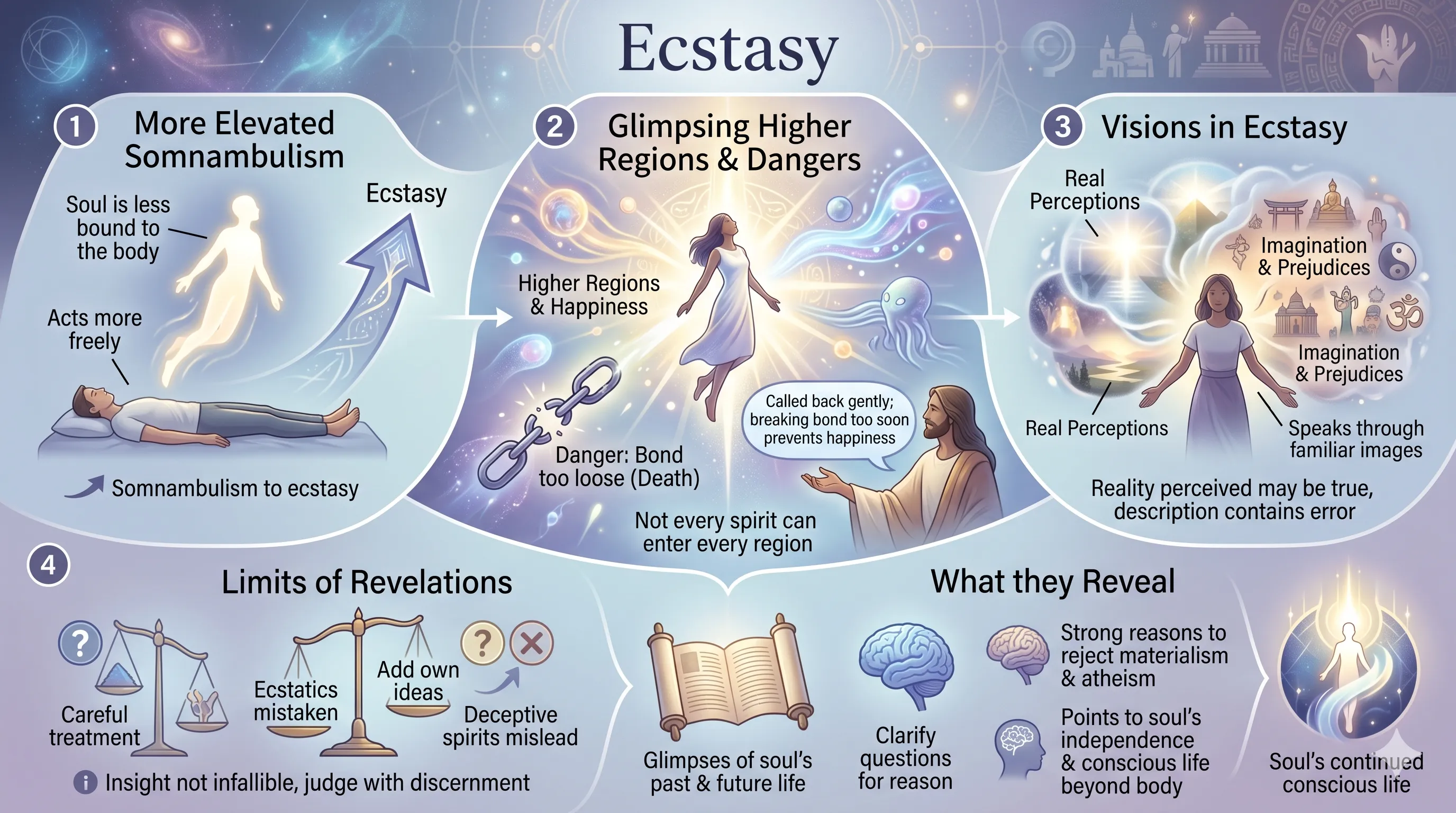
2.8.59 Ecstasy is a more elevated form of somnambulism, in which the soul is less bound to the body and acts more freely.
2.8.60 It may glimpse higher regions and feel something of the happiness there, which can create a desire to remain in that state. But not every spirit can enter every region, and ecstasy can be dangerous. If the bond to the body loosens too much, death could follow. So the person should be gently called back to earthly life and made to understand that breaking the bond too soon would prevent the happiness hoped for.
Visions in Ecstasy
2.8.61 Those in ecstasy often describe real perceptions mixed with imagination, old beliefs, and personal prejudice. Their spirit still uses ideas formed during earthly life, so they speak through familiar religious, cultural, or symbolic images.
2.8.62 Because of this, the reality perceived may be true while the description contains error.
The Limits of Ecstatic Revelations
2.8.63 Revelations received in ecstasy must be treated with care. Ecstatics can be mistaken, especially when they try to know what should remain hidden. They may add their own ideas or be misled by deceptive spirits.
2.8.64 So ecstasy can offer real insight, but it is not infallible and must be judged with discernment.
What Somnambulism and Ecstasy Reveal
2.8.65 Somnambulism and ecstasy offer glimpses of the soul’s past and future life. Studied carefully, they help clarify questions that reason alone struggles to answer.
2.8.66 Whoever examines these facts honestly can find in them strong reasons to reject materialism and atheism. They point to the soul’s independence and the continuation of conscious life beyond the body.
Second Sight
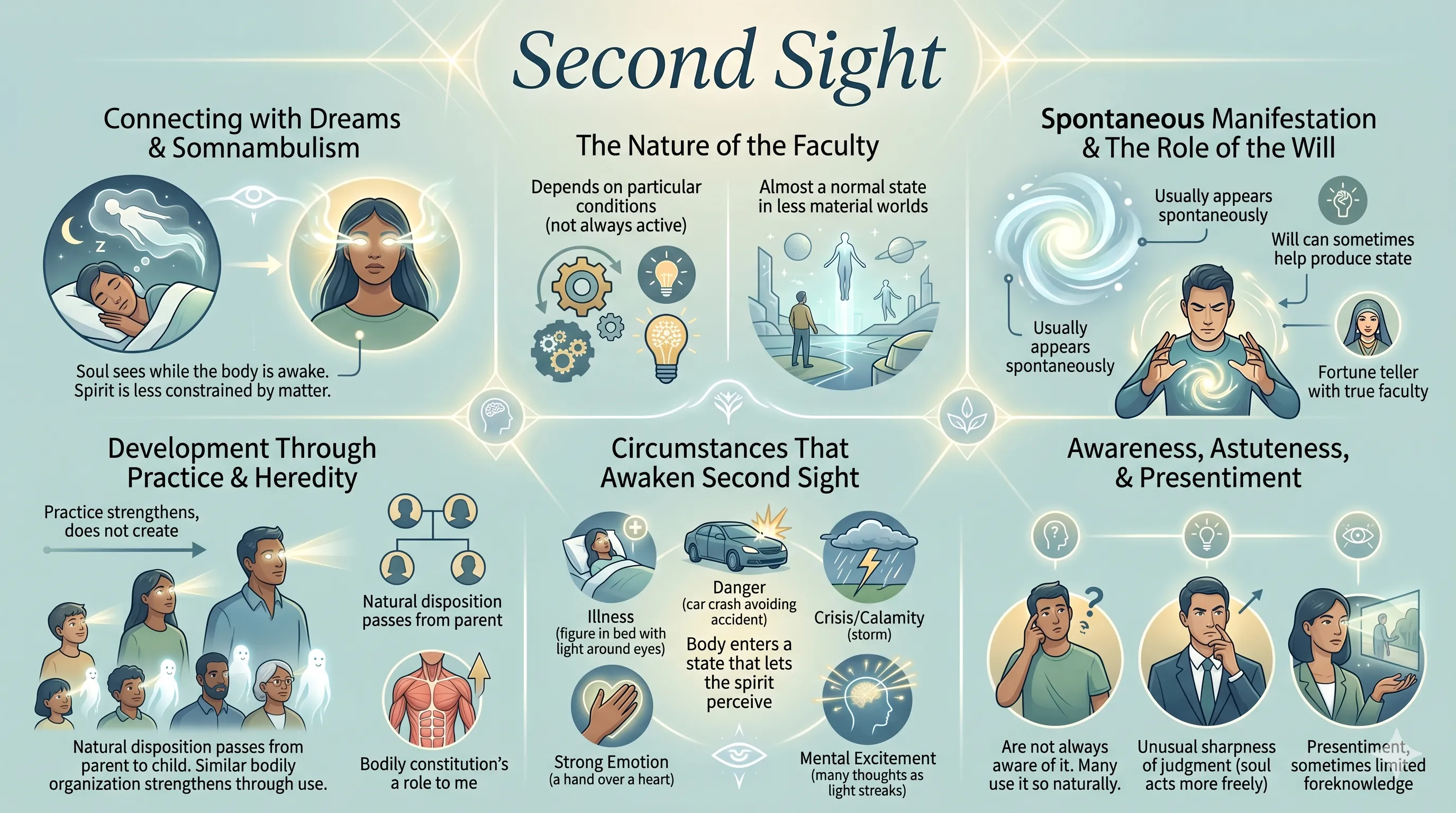
2.8.67 Second sight is related to dreams and somnambulism. In it, the soul sees while the body is awake, because the spirit is less constrained by matter and can perceive beyond ordinary sight.
The Nature of the Faculty
2.8.68 This faculty may exist without being constantly active. A person may possess it without being able to use it at will, since it depends on particular conditions.
2.8.69 In worlds less material, where spirits free themselves more easily from the body, second sight is almost a normal and permanent state.
Spontaneous Manifestation and the Role of the Will
2.8.70 Second sight usually appears spontaneously, though the will can sometimes help produce the state in which visions occur.
2.8.71 Some people can, by intention, place themselves in the needed condition. Among those who claim to tell fortunes, a few truly have this faculty.
Development Through Practice
2.8.72 Second sight may be strengthened by practice, but practice does not create it.
2.8.73 The body plays an important role, and some constitutions are more fitted for it than others.
Heredity and Transmission
2.8.74 When it appears in several family members, it comes from similarity in bodily organization.
2.8.75 This natural disposition may pass from parent to child and be strengthened by use.
Circumstances That Awaken Second Sight
2.8.76 Second sight may be temporarily awakened by illness, danger, crisis, calamity, strong emotion, or mental excitement, when the body enters a state that lets the spirit perceive what the eyes cannot.
Awareness of the Faculty
2.8.77 Those who possess this faculty are not always aware of it. Many use it so naturally that they think nothing unusual is happening and may suppose others perceive the same way.
Second Sight, Astuteness, and Presentiment
2.8.78 In some people, unusual sharpness of judgment may come from this cause, as the soul acts more freely and sees more clearly.
2.8.79 It may also include presentiment and sometimes a limited foreknowledge of future events.
A Theoretical Summary of Somnambulism, Ecstasy and Second Sight
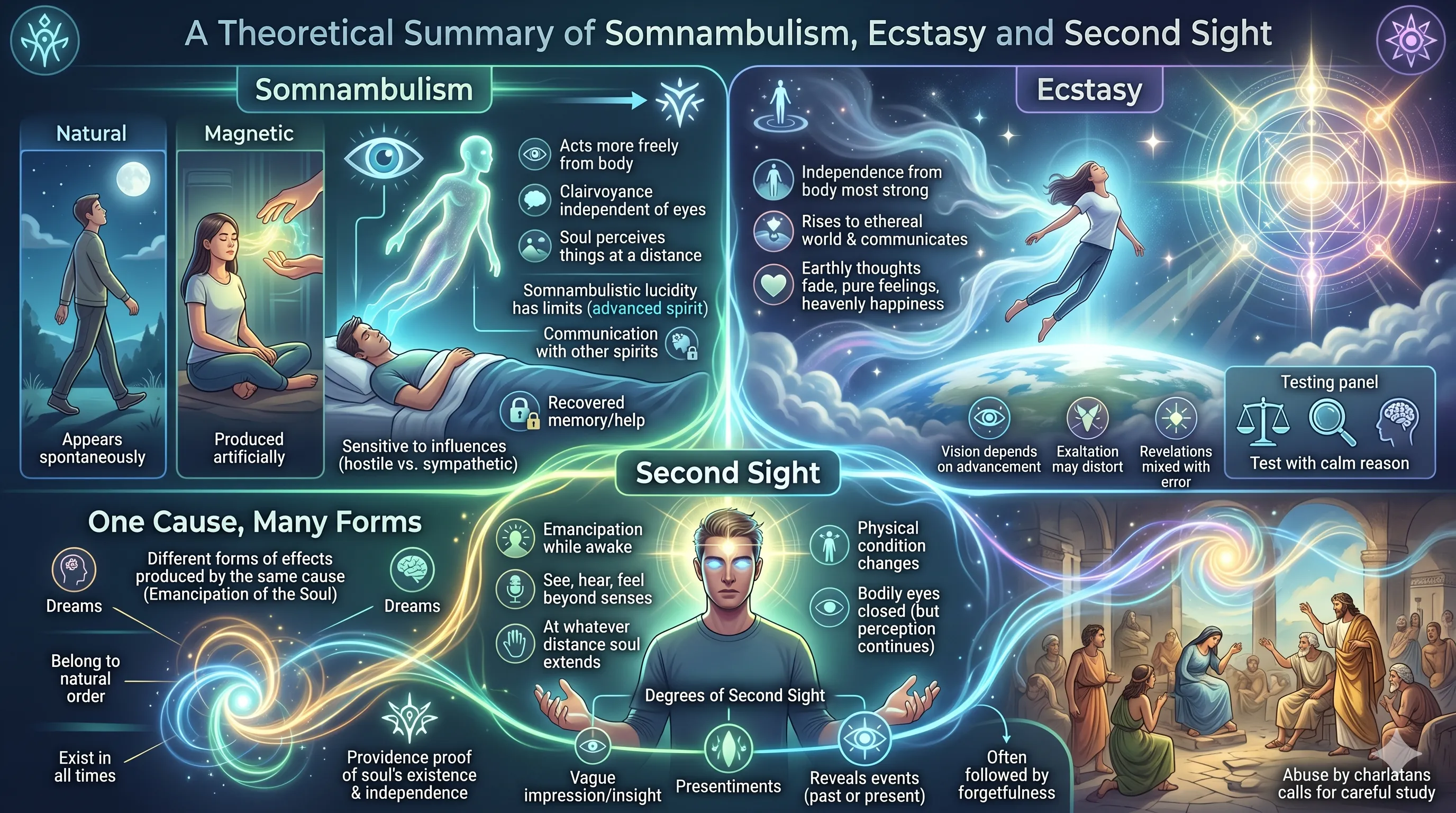
2.8.80 Natural somnambulism appears without an outward cause; magnetic somnambulism is the same phenomenon produced artificially. Abuse by charlatans does not disprove it, but calls for careful study.
2.8.81 For Spiritism, somnambulism shows the soul acting more freely from the body. Its clearest sign is clairvoyance independent of the physical eyes. This comes from the soul itself, whose perception reaches as far as it can extend.
2.8.82 In this state, the soul perceives things as if present where they are, while the body remains nearly without sensation. This partial separation cannot last long, because the body grows tired. The sight involved does not belong to any special bodily organ.
2.8.83 Somnambulistic lucidity has limits. It depends on the spirit's advancement and is therefore neither universal nor infallible, especially when used for curiosity or display.
2.8.84 As the spirit becomes freer, communication with other spirits becomes easier through perispiritual contact, so ideas may be received by impression or intuition. Because of this sensitivity, hostile or skeptical influences can disturb the faculty, while calm and sympathetic surroundings help it.
2.8.85 Somnambulists perceive both spirit and body and may seem to live a double life at once. Some show knowledge beyond their education because the spirit recovers memories, perceives directly, or receives help from other spirits. Still, what they say is worth only what their spirit is worth.
2.8.86 Through somnambulism, natural or induced, Providence gives proof of the soul's existence and independence. When distant things are described, it is the soul, not the body, that perceives.
Ecstasy
2.8.87 Ecstasy is the state in which the soul's independence from the body appears most strongly.
2.8.88 In dreams and somnambulism the soul remains nearer the earthly sphere; in ecstasy it rises into the world of ethereal spirits and communicates with them, but only to a certain limit. The body is then reduced almost to organic life alone, and the soul seems attached only by a thread.
2.8.89 In this state, earthly thoughts fade, replaced by pure feelings and a foretaste of heavenly happiness. Earthly pleasures and troubles seem small beside what the ecstatic feels approaching.
2.8.90 But ecstatics are not all equally lucid. Their vision depends on the advancement of their spirit, and exaltation may distort what is seen. Their revelations are often mixed with truth and error, and imperfect spirits may strengthen their prejudices. For this reason, such revelations must be tested by calm reason.
Second Sight
2.8.91 The soul's emancipation can also appear while awake. This is called second sight. By it, a person may see, hear, and feel beyond the usual limits of the senses, at whatever distance the soul extends.
2.8.92 When it appears, the physical condition changes: the eyes become vague and fixed, and the whole expression takes on exaltation. The bodily eyes are not the true source, since perception may continue even when they are closed.
2.8.93 For those who possess it, this faculty may seem natural, though it is often followed by forgetfulness like that of a dream.
2.8.94 Second sight has degrees. At its weakest, it gives a vague impression or instinctive insight; in a stronger form, it produces presentiments; in a higher one, it reveals events that have happened or are happening.
One Cause, Many Forms
2.8.95 Natural and induced somnambulism, ecstasy, and second sight are different forms of effects produced by the same cause. Like dreams, they belong to the natural order. They have existed in all times, and explain many events once treated as supernatural.