1.3 Creation
The Formation of Worlds
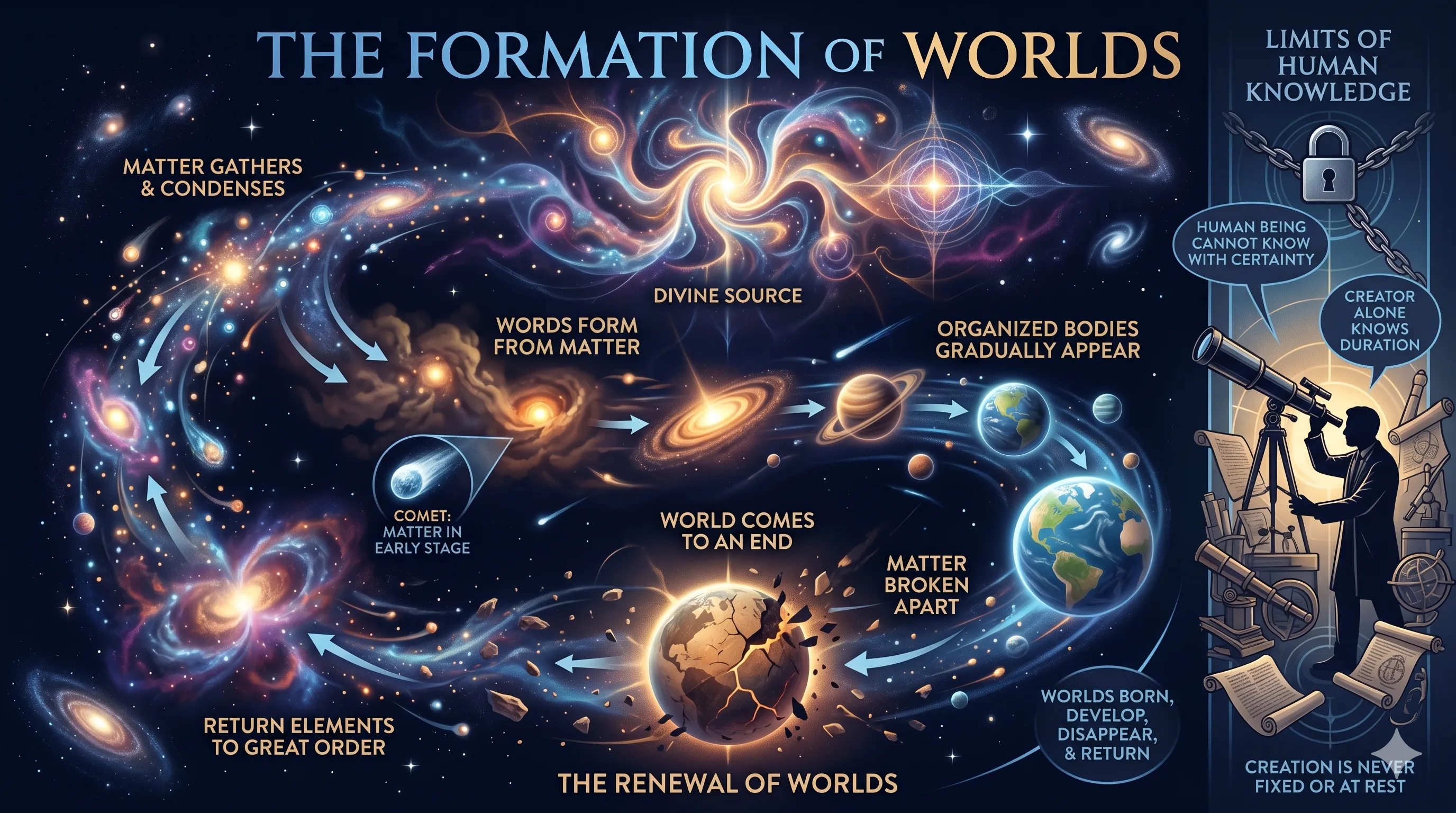
1.3.1 The universe includes countless worlds, along with all living beings, stars, and the fine matter spread through space. It did not make itself, and it is not the result of chance. It is the work of God.
1.3.2 As far as human understanding can reach, worlds are formed when matter scattered through space gathers together and becomes denser. From this, organized bodies gradually appear. Comets may be seen as matter in an early stage of formation, but they do not have the mysterious influence that superstition has often given them.
The Renewal of Worlds
1.3.3 A world that has been formed can also come to an end. Its matter may be broken apart and scattered again through space. In this way, worlds are renewed just as living beings are renewed.
1.3.4 Creation is never fixed or at rest. Worlds are born, develop, disappear, and return their elements to the great order of the universe.
The Limits of Human Knowledge
1.3.5 Human beings cannot know with certainty how long the formation of worlds takes, including that of the earth. Such knowledge belongs to the Creator alone. Claims that try to fix the exact number of ages go beyond what people can truly know.
The Formation of Living Beings
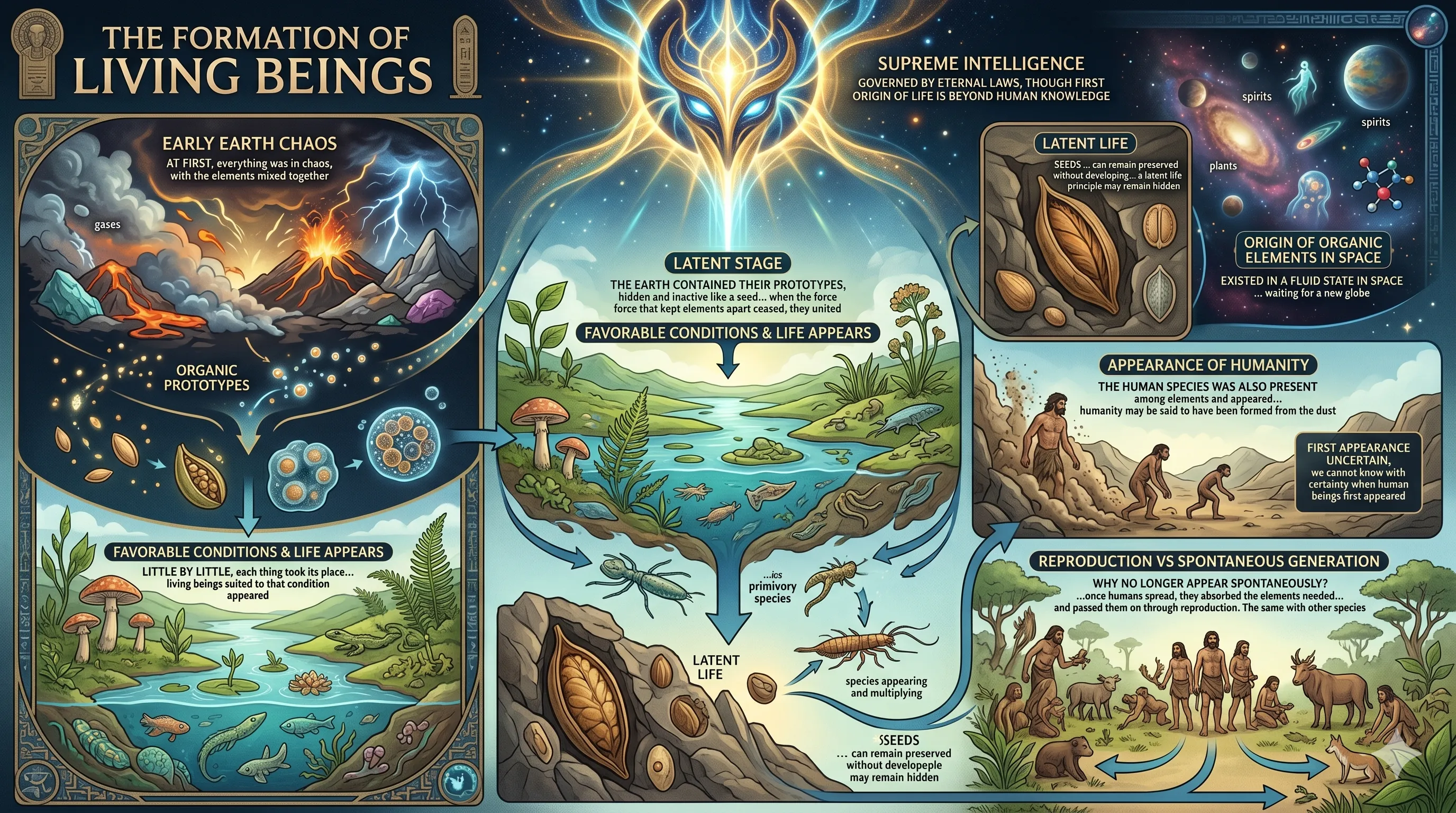
1.3.6 Living beings did not appear on the earth all at once in a finished world.
1.3.7 At first, everything was in chaos, with the elements mixed together. Little by little, each thing took its place, and when the earth became fit for them, the living beings suited to that condition appeared.
1.3.8 The earth already contained their prototypes, waiting for the right moment to develop. When the force that kept the organic elements apart ceased, those elements united. The first forms of living beings were then prepared, remaining hidden and inactive like a seed until the time came for each species to appear and multiply.
1.3.9 Before the earth was formed, these organic elements existed in a fluid state in space, among spirits or on other worlds, waiting for a new globe where a new cycle of life could begin.
1.3.10 Seeds of plants and animals can remain preserved without developing until conditions are favorable. In the same way, a latent life principle may remain hidden until the proper time. This does not lessen divine power, but agrees with the idea of a supreme intelligence ruling through eternal laws, though the first origin of the elements of life remains beyond human knowledge.
1.3.11 The human species was also present among the organic elements of the earth and appeared at the proper time. In this sense, humanity may be said to have been formed from the dust of the earth.
1.3.12 We cannot know with certainty when human beings and other living creatures first appeared.
1.3.13 As for why human beings no longer appear spontaneously as they did at the beginning, one explanation is that once the first humans spread over the earth, they absorbed the elements needed for their formation and then passed them on through reproduction. The same happened with the other living species.
The Peopling of the Earth: Adam
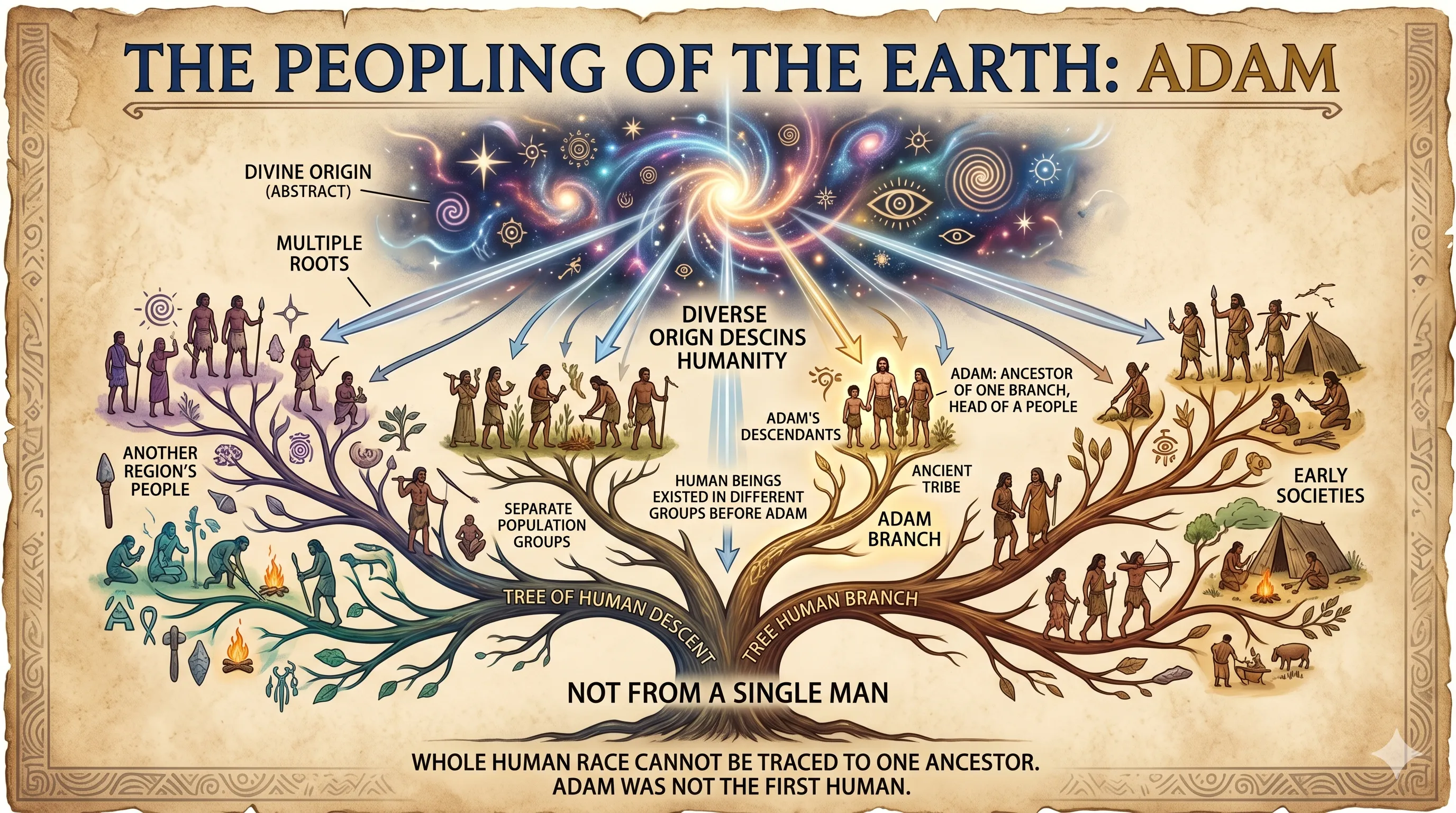
1.3.14 Humanity did not begin with a single man.
1.3.15 Adam was not the first human on earth, and all peoples did not come from him alone. Human beings already existed in different groups, so the whole human race cannot be traced to one ancestor.
1.3.16 Adam may be understood as the ancestor of one branch of humanity, or as a figure personifying one of the world’s earliest ages, rather than the sole father of the entire human race.
The Diversity of Human Races
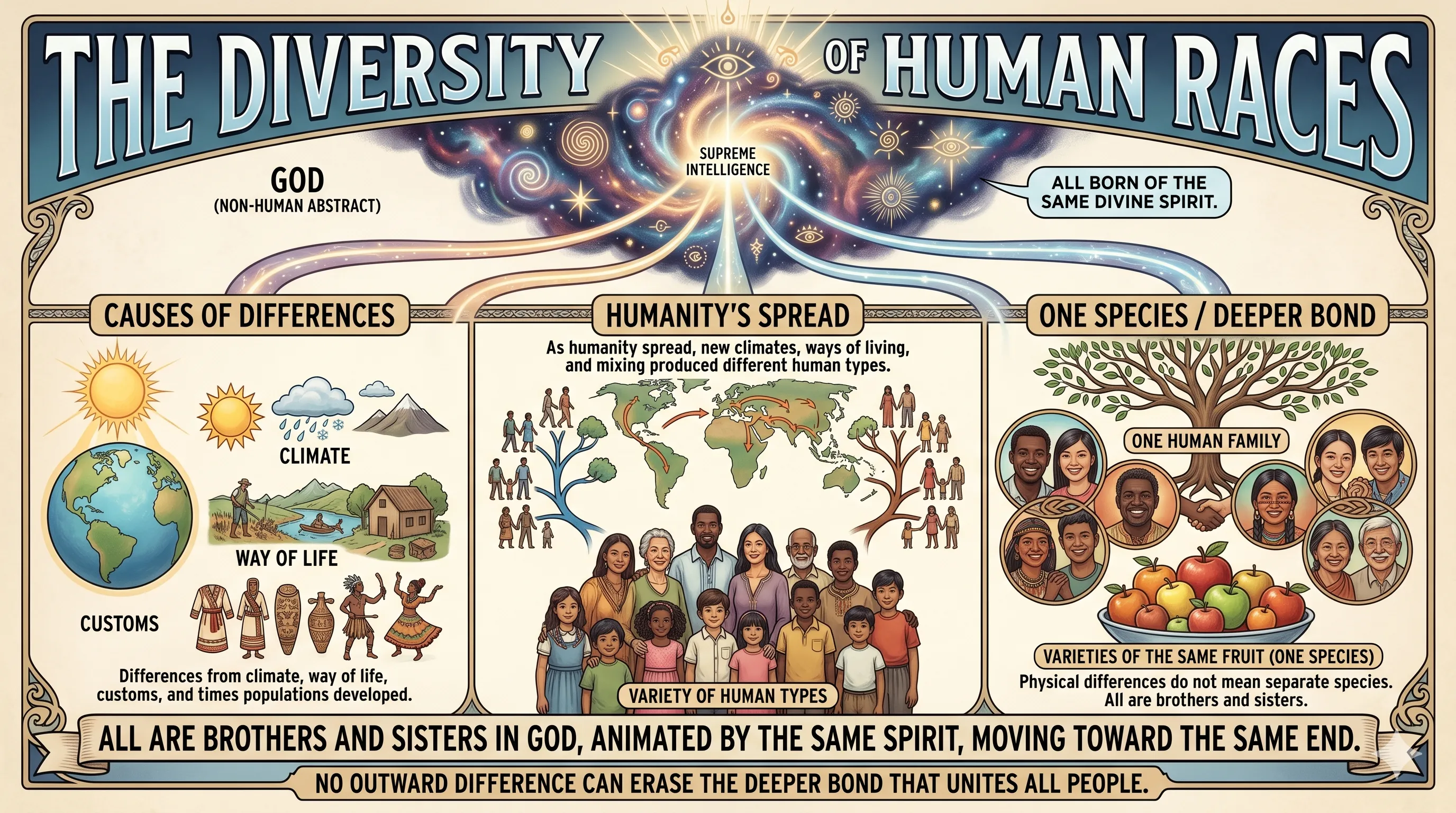
1.3.17 The physical and moral differences seen among human races come from causes such as climate, way of life, customs, and the times and places in which populations developed.
1.3.18 People formed in different environments do not develop in exactly the same way. As humanity spread across the earth, new climates, ways of living, and mixing between groups produced different human types.
1.3.19 But these differences do not mean there are separate human species. All human beings belong to one family, just as varieties of the same fruit remain of one species.
1.3.20 So no outward difference can erase the deeper bond that unites all people. All are brothers and sisters in God, animated by the same spirit, and moving toward the same end.
The Plurality of Worlds
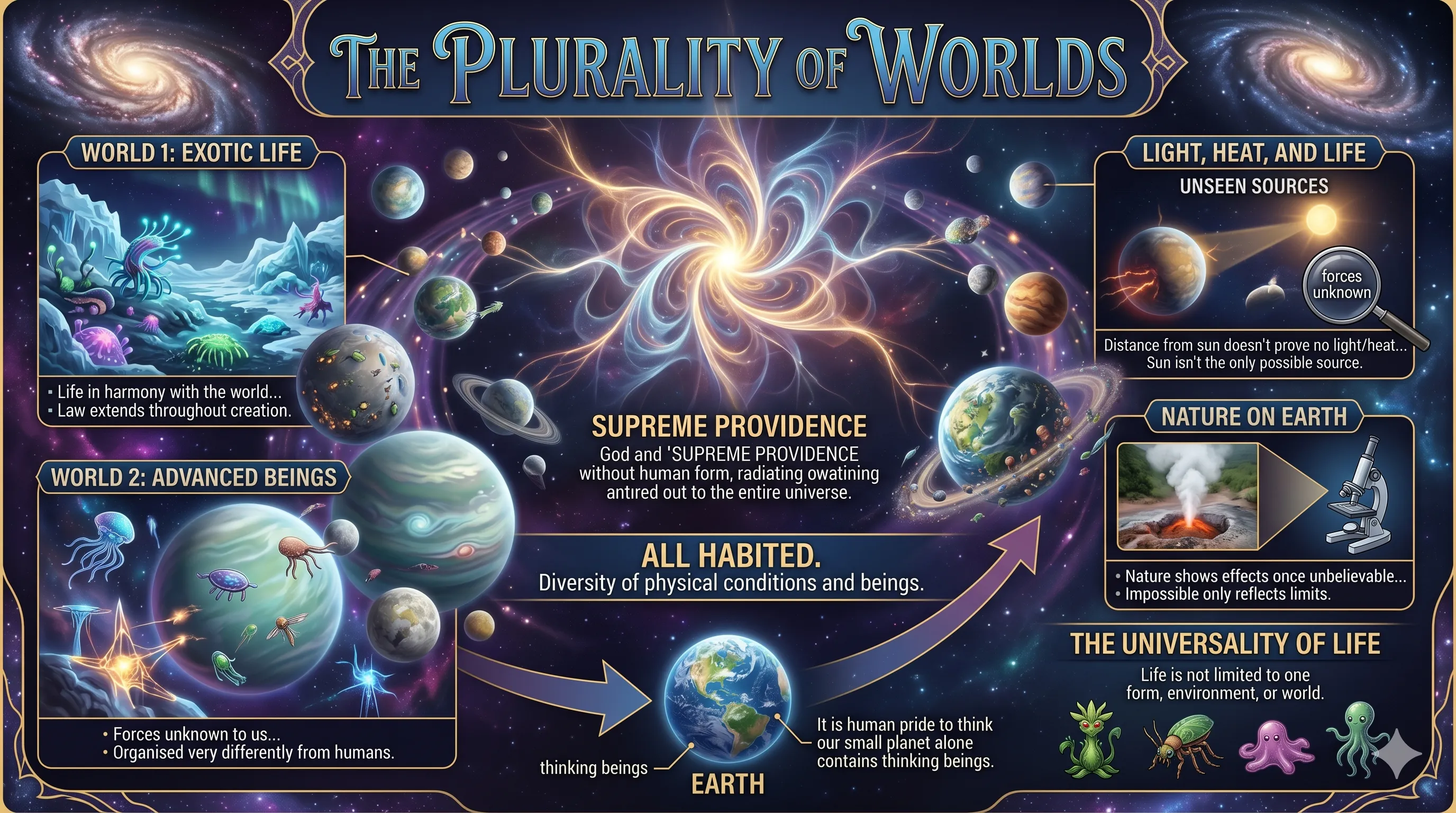
1.3.21 The worlds that move through space are not empty. They are inhabited, and Earth is not the highest world in intelligence, goodness, or perfection. It is human pride to think that our small planet alone contains thinking beings.
1.3.22 God did not create countless worlds for no purpose. All have life suited to the plan of Providence.
Diversity of Worlds
1.3.23 Worlds are not all alike. Their physical conditions differ greatly, and the beings who live on them differ as well.
1.3.24 Living creatures are formed in harmony with the world where they dwell. Just as life on Earth varies with different conditions, the same law extends throughout creation.
Light, Heat, and Conditions of Life
1.3.25 A world’s distance from the sun does not prove that it has no light or heat. It is a mistake to think the sun is the only possible source of warmth and brightness.
1.3.26 There may be forces and kinds of matter unknown to us. The beings on other worlds may also be organized very differently from human beings. Life exists wherever conditions are prepared for it.
1.3.27 What seems impossible to us often only reflects the limits of our own experience. Even on Earth, nature shows effects that once would have seemed unbelievable. So there is no reason to deny that other worlds may contain what their inhabitants need.
The Universality of Life
1.3.28 Life is not limited to one form, one environment, or one world. Throughout the universe, beings exist in conditions suited to their nature and their purpose.
1.3.29 Each world has its place, each order of beings its role, and all are directed by Providence.
Biblical Considerations and Account concerning the Creation
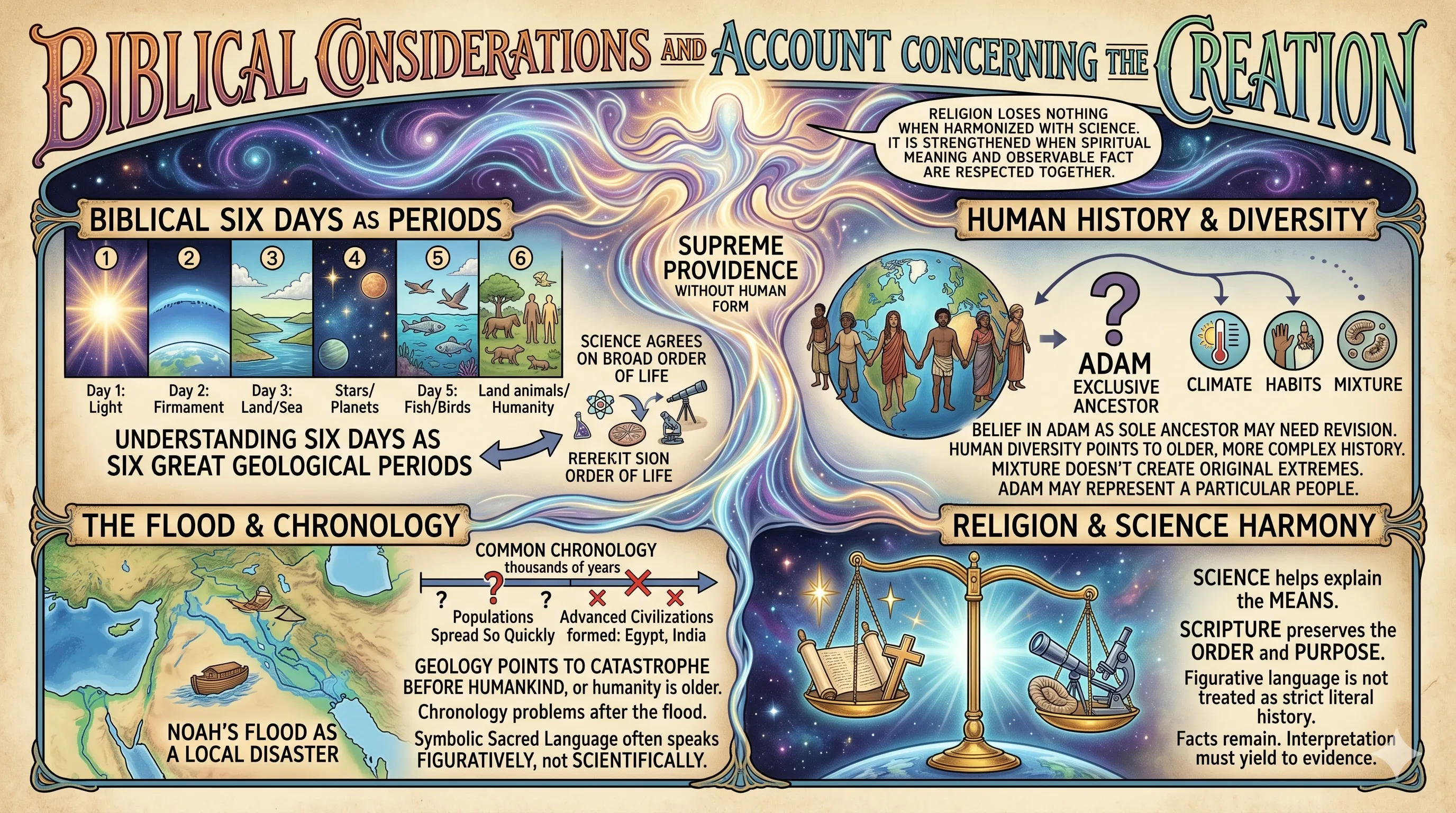
1.3.30 Ideas about creation have differed as human understanding has changed. Reason and science show that some ancient explanations cannot be kept as strict literal history. Many conflicts between spiritual teaching and scripture disappear when figurative language is not treated as exact science.
1.3.31 The belief that Adam was the one exclusive ancestor of all humanity may need revision, just as interpretations once changed when it became clear that the earth moves around the sun. Facts remain what they are, and interpretation must yield to evidence.
1.3.32 The Bible speaks of creation in six days and places it only a few thousand years before the Christian era. Taken literally, this conflicts with science, which shows the earth has a far longer history. The six days can be understood as six great periods.
1.3.33 This does not lessen God. A creation unfolding through the laws of nature over immense periods shows divine power, order, and wisdom. In broad outline, science also agrees with Genesis on the general order in which living beings appeared.
1.3.34 The same need for interpretation appears in the account of the flood. Geology points to a great catastrophe from a time before humankind, according to present findings. If traces of humans before that event were found, either Adam was not the first man or his origin belongs to a much older past.
1.3.35 A narrow chronology also creates problems after the flood. If all humanity came from one family, it is difficult to explain how populations spread so quickly and formed advanced civilizations already seen at an early date in places like Egypt and India.
1.3.36 Human diversity raises another difficulty. Climate and habits can modify physical traits, but not enough to explain the strongest differences among human groups. Mixture can combine existing types, but it does not create the original extremes. This points to a longer and more complex human history.
1.3.37 These difficulties become easier to understand if it is admitted that humanity may be older than common chronology says; that its origin may not have been limited to one single source in the usual sense; that Adam may have represented a particular people rather than all humankind; that Noah's flood may have been a local disaster; and that ancient sacred language often speaks symbolically rather than scientifically.
1.3.38 Religion loses nothing when brought into harmony with science. It is strengthened when spiritual meaning and observable fact are respected together.