3.8 Human Progress
The State of Nature
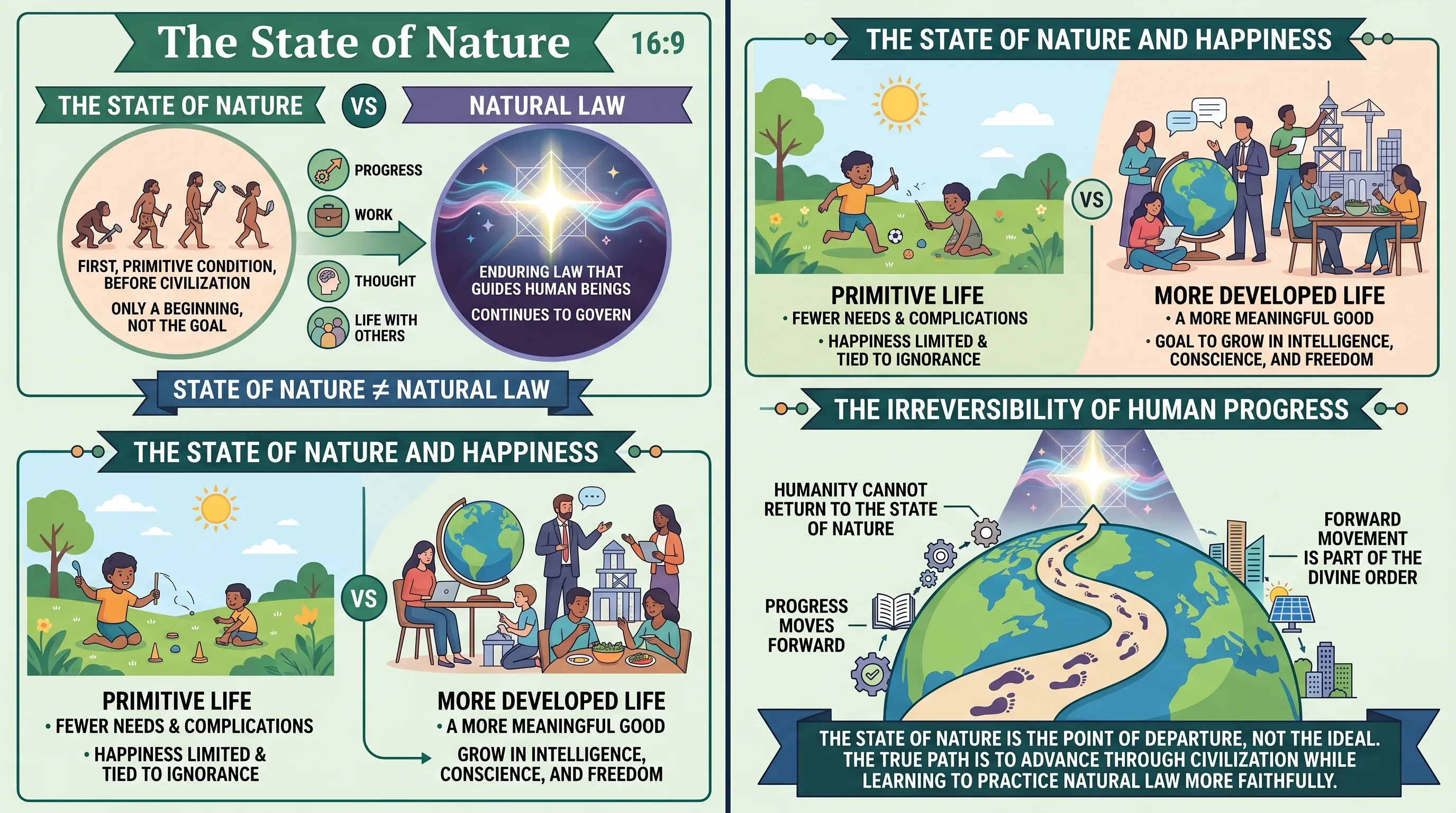
3.8.1 The state of nature is not the same as natural law.
3.8.2 It is humanity’s first, primitive condition, before civilization. Natural law is the enduring law that guides human beings and leads them forward.
3.8.3 Human beings are not meant to remain in that early state. The state of nature is only a beginning, not the goal. Through progress, work, thought, and life with others, humanity leaves it behind while natural law continues to govern.
The State of Nature and Happiness
3.8.4 A primitive life may seem to have fewer troubles because it has fewer needs and fewer complications.
3.8.5 But this does not make the state of nature the highest earthly happiness. Its happiness is limited and tied to ignorance, like the ease of children before the duties of maturity.
3.8.6 A more developed life may bring more trials, but it also allows a fuller and more meaningful good. Human beings are meant to grow in intelligence, conscience, and freedom.
The Irreversibility of Human Progress
3.8.7 Humanity cannot return to the state of nature.
3.8.8 Once progress begins, it moves forward. There may be errors, troubles, and delays, but humanity does not truly return to its infancy.
3.8.9 This forward movement is part of the divine order. The state of nature is the point of departure, not the ideal to which humanity should return. The true path is to advance through civilization while learning to practice natural law more faithfully.
The March of Progress
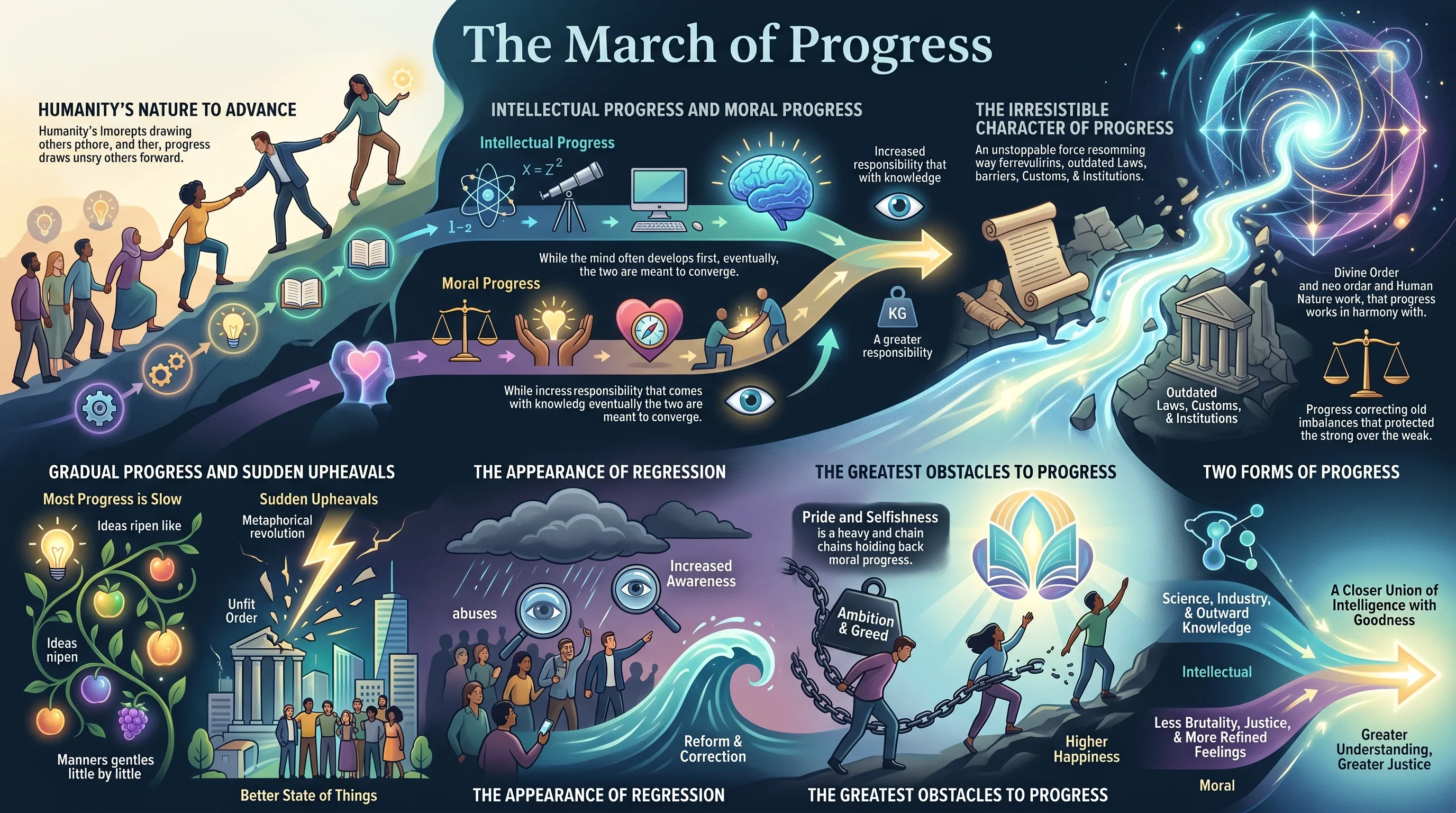
3.8.10 Human beings are made to advance. Progress is part of our nature, even though it does not happen at the same pace for everyone. Some move ahead sooner, and through life in society they help draw others forward.
Intellectual Progress and Moral Progress
3.8.11 Intellectual progress does not always bring moral progress at once. Very often the mind develops first, and the heart follows later.
3.8.12 As intelligence grows, people see more clearly what is good and what is evil, and responsibility becomes greater. But a people may be highly educated and still morally corrupt. Intelligence, in its early stages, can be used for selfish or harmful ends. In time, however, intellectual and moral progress are meant to come together.
The Irresistible Character of Progress
3.8.13 Progress cannot be stopped. It may be delayed, but never prevented.
3.8.14 Those who try to resist it struggle against both human nature and the divine order. Laws, customs, and institutions can hold it back for a while, but when they no longer match humanity’s growth, they fall. Human laws have often protected the strong at the expense of the weak, yet progress works little by little to correct this.
Gradual Progress and Sudden Upheavals
3.8.15 Most progress is slow. Ideas ripen over time, and manners become gentler little by little.
3.8.16 But when needed change has been delayed too long, sudden upheavals come. Revolutions, whether moral or social, are often prepared in silence for many years. Then they burst forth and sweep away what has become unfit. These troubled times may look like disorder, but they often prepare a better state of things.
The Appearance of Regression
3.8.17 There are times when evil seems so widespread that humanity appears to be going backward.
3.8.18 Yet this is often only an appearance. As people become more aware of abuses, they speak of them more openly and feel them more sharply. Evil may seem greater because it is seen more clearly. That very awareness helps bring correction, and excess itself may awaken the desire for reform.
The Greatest Obstacles to Progress
3.8.19 The chief obstacles to moral progress are pride and selfishness.
3.8.20 Intellectual progress goes on, but moral progress is slowed by these faults. Growing intelligence may even feed ambition, greed, and the love of power. Still, this state does not last forever. People eventually learn that earthly satisfactions are not enough, and that a higher and more lasting happiness exists.
Two Forms of Progress
3.8.21 There are two forms of progress: intellectual progress and moral progress. They support one another, but they do not move in step.
3.8.22 A society may advance in science, industry, and outward knowledge while remaining morally behind. Even so, moral progress is real. Human life has become less brutal, justice has gained ground, and feelings have grown more refined. The work is unfinished, but humanity continues to move toward greater understanding, greater justice, and a closer union of intelligence with goodness.
Relapsed Cultures
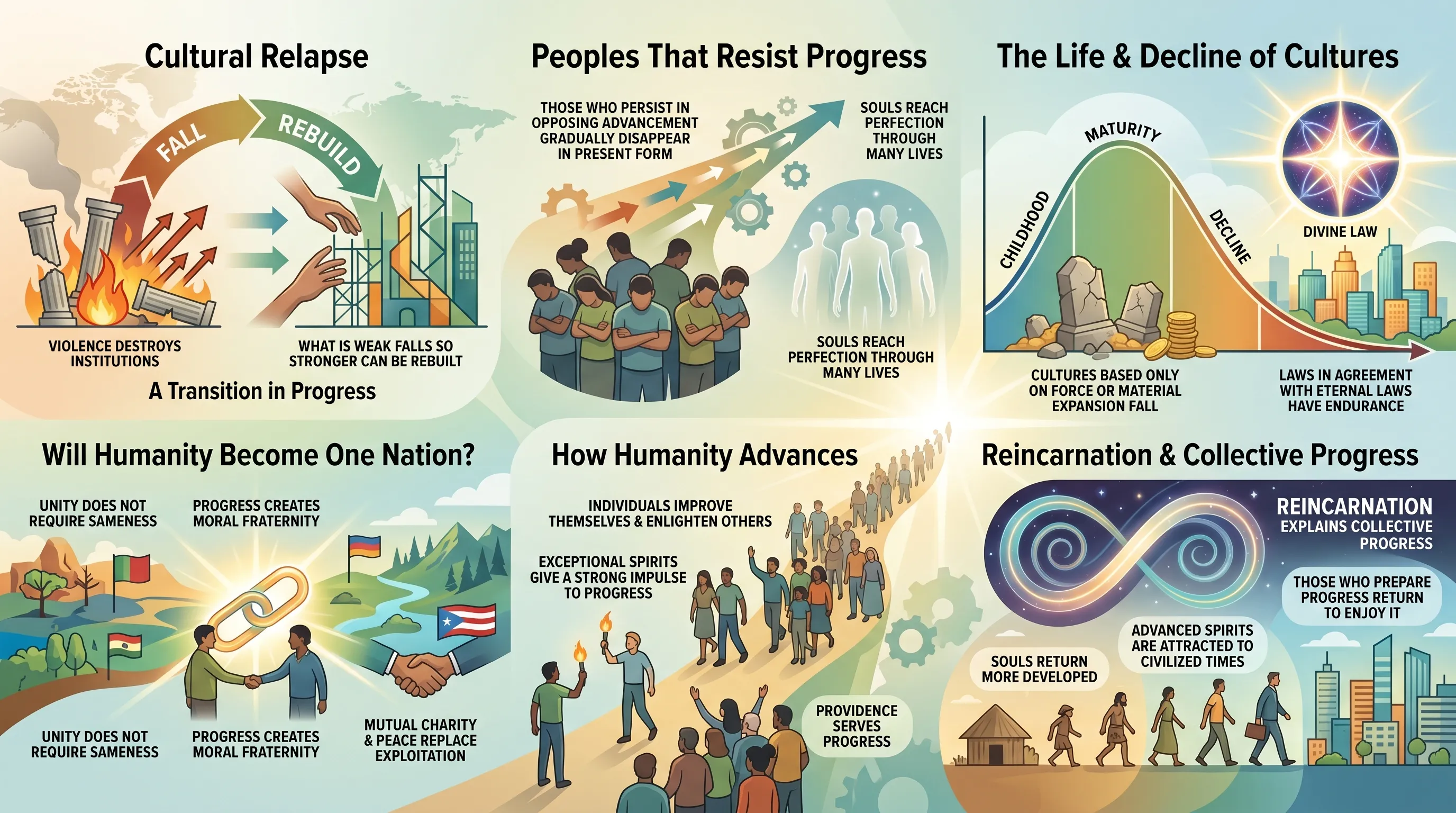
3.8.23 Some cultures seem to fall back into barbarism when violence destroys their institutions, but this does not cancel the law of progress. Such decline is a transition: what is weak falls so something stronger can be rebuilt.
3.8.24 The spirits in a declining culture are not always the same ones who made it great. More advanced spirits may have moved on, while less advanced ones take their place for a time. What looks like relapse may be a change in the spirits incarnated there.
Peoples That Resist Progress
3.8.25 Some peoples seem to resist progress, but this cannot last forever. Those who persist in opposing advancement gradually disappear in their present bodily form.
3.8.26 Their souls are not lost. Like all souls, they are destined to reach perfection through many lives. The most civilized people of today may once have lived in very primitive conditions.
The Life and Decline of Cultures
3.8.27 Like individuals, cultures have childhood, maturity, and decline. Peoples whose greatness rests only on force, conquest, or material expansion rise and fall because material power wears out.
3.8.28 The same is true of societies ruled by selfish laws opposed to enlightenment and charity. But a people whose laws agree with the Creator’s eternal laws has a deeper source of endurance and can become a moral light to others.
Will Humanity Become One Nation?
3.8.29 Progress will not make all peoples into one nation. Nationalities arise from differences in climate, customs, needs, and laws.
3.8.30 Unity does not require sameness. Progress can create moral fraternity. When divine law becomes the basis of human law, peoples will practice mutual charity, live in peace, and stop exploiting one another.
How Humanity Advances
3.8.31 Humanity advances through individuals who improve themselves and enlighten others. As they multiply, they lead the rest forward. At certain times, exceptional spirits give a strong impulse to progress, and those in authority may also serve as instruments of Providence.
3.8.32 This shows the justice of reincarnation. Those who help prepare progress are not forever deprived of enjoying it; through many existences, they may return in more civilized ages and benefit from the better conditions they helped produce.
Why Reincarnation Explains Collective Progress
3.8.33 Without reincarnation, the progress of cultures is hard to understand. If each soul lived only once, the more advanced would seem to have been created better than others, which would deny justice.
3.8.34 Reincarnation explains that souls in civilized times have passed through less advanced stages. They return more developed and are drawn to environments suited to their advancement. In this way, the work of civilizing a people attracts spirits who have progressed.
The Moral Transformation of the Earth
3.8.35 As peoples rise morally, the earth becomes fit for better spirits. When humanity reaches a common moral level, the earth will be inhabited only by good spirits living in fraternal unity.
3.8.36 Spirits attached to evil will find no place suited to them here and will go to less advanced worlds until they are worthy to return. Thus humanity’s upward movement is real, even when history seems interrupted. Cultures may weaken and institutions fall, but the souls involved continue to advance.
Civilization
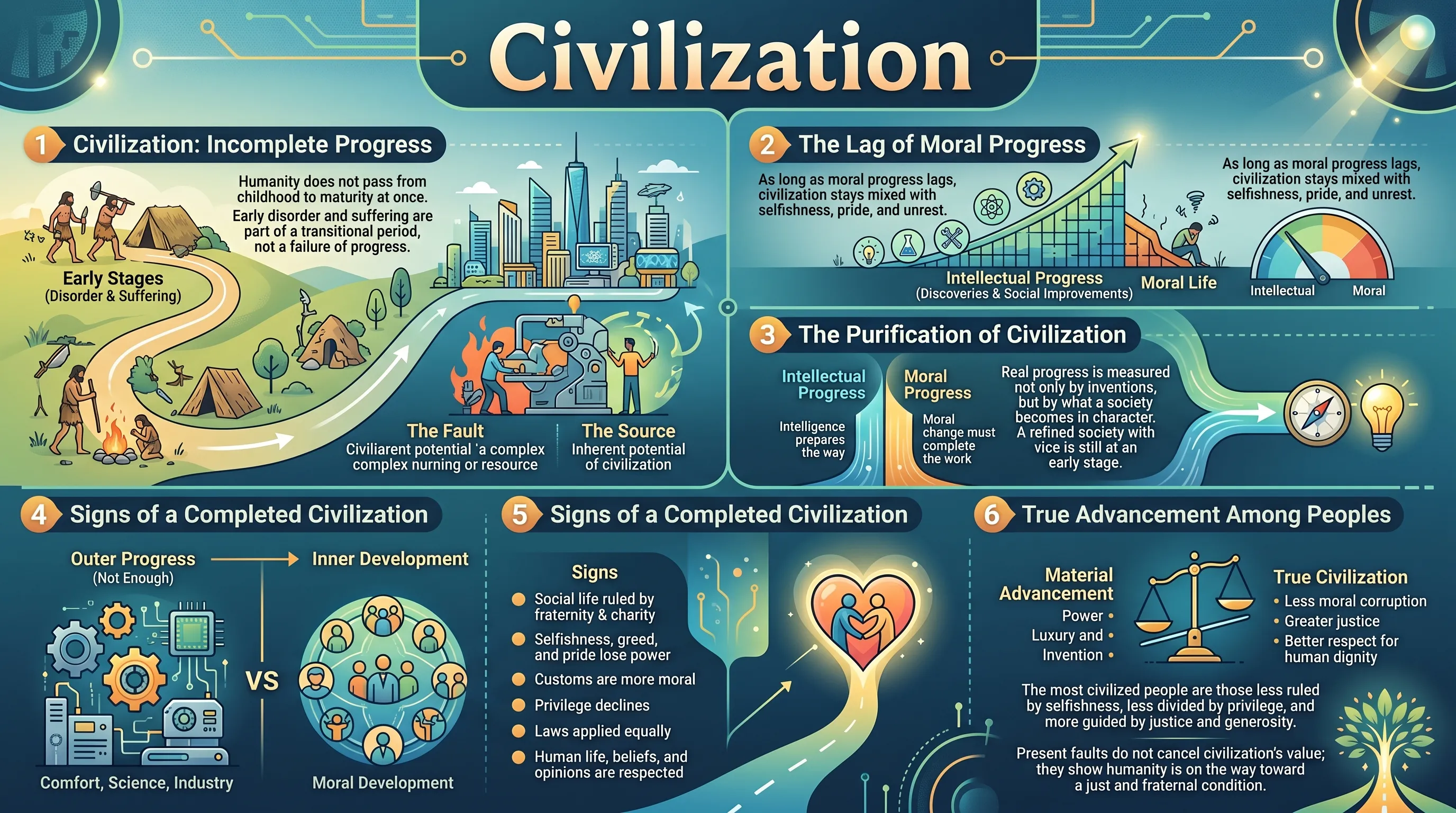
3.8.37 Civilization is progress, but not complete progress. Humanity does not pass from childhood to full maturity at once. So civilization should not be condemned because, in its early stages, it brings disorder and suffering. The fault lies not in civilization itself, but in the wrong use people make of it.
Incomplete Progress
3.8.38 As long as moral progress lags behind intellectual progress, civilization cannot produce all the good it should. Intelligence brings discoveries and social improvements, while moral life may remain weak. Then progress stays mixed with selfishness, pride, and unrest.
3.8.39 This is a passing state. The evils seen in growing societies do not prove that progress is false, but belong to a time of transition.
The Purification of Civilization
3.8.40 Civilization will be purified when moral progress reaches the same level as intellectual progress. Intelligence prepares the way, but moral change must complete the work.
3.8.41 Real progress is measured not only by what a society invents, but by what it becomes in character. A people may be skilled and refined, yet still remain at an early stage if vice continues to stain social life.
The Signs of a Completed Civilization
3.8.42 A completed civilization is recognized by moral development. Outer progress is not enough. Comfort, science, and industry do not by themselves prove true civilization.
3.8.43 Civilization reaches maturity when social life is ruled by fraternity and charity is truly practiced. Then selfishness, greed, and pride lose their power. Customs become more moral, privilege declines, laws are applied more equally, and human life, beliefs, and opinions are more respected.
True Advancement Among Peoples
3.8.44 When two peoples seem equally advanced, the higher one is not the one with more power, luxury, or invention. It is the one in which moral corruption is less, justice is greater, and human dignity is better respected.
3.8.45 The most civilized people are those less ruled by selfishness, less divided by privilege, and more guided by justice and generosity. Present faults do not cancel civilization's value; they show that humanity is still on the way toward a more just and fraternal condition.
The Progress of Human Legislation
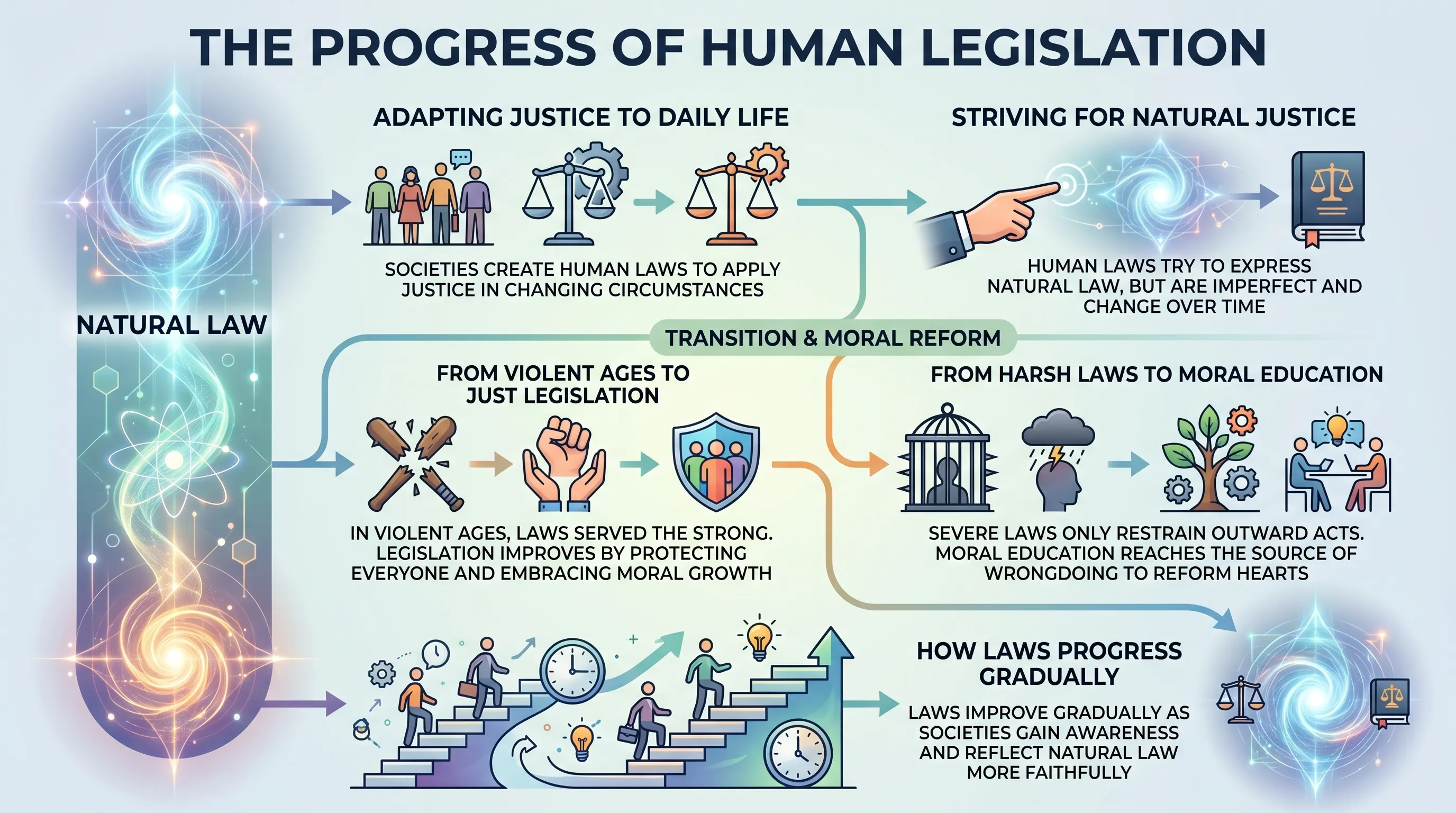
3.8.46 If people understood and lived by natural law, it would be enough. But societies have changing needs, so they make human laws to apply justice in daily life.
3.8.47 These laws do not replace natural law. They try to express it under imperfect conditions, so they are also imperfect and change over time.
3.8.48 In violent ages, laws are often made by the strong for their own benefit. As moral sense grows, such laws are rejected. Legislation improves when it protects everyone and comes closer to natural justice.
3.8.49 Natural law remains the same. Human law changes as humanity advances.
Harsh Laws and Moral Reform
3.8.50 Very severe laws may seem necessary in a corrupt society, but they show that the society is still unhealthy.
3.8.51 Such laws punish evil after it is done, but they do not remove its cause. Fear may restrain some people, but it does not reform the heart. The deeper remedy is moral education, because it reaches the source of wrongdoing.
3.8.52 As people improve, crimes become less common, and harsh punishments are needed less.
How Laws Progress
3.8.53 Laws do not change all at once. They improve gradually.
3.8.54 Events may reveal old injustices, and more advanced people may help society recognize what is better. In this way, legislation slowly becomes more just by reflecting natural law more faithfully.
Spiritism’s Influence on Progress
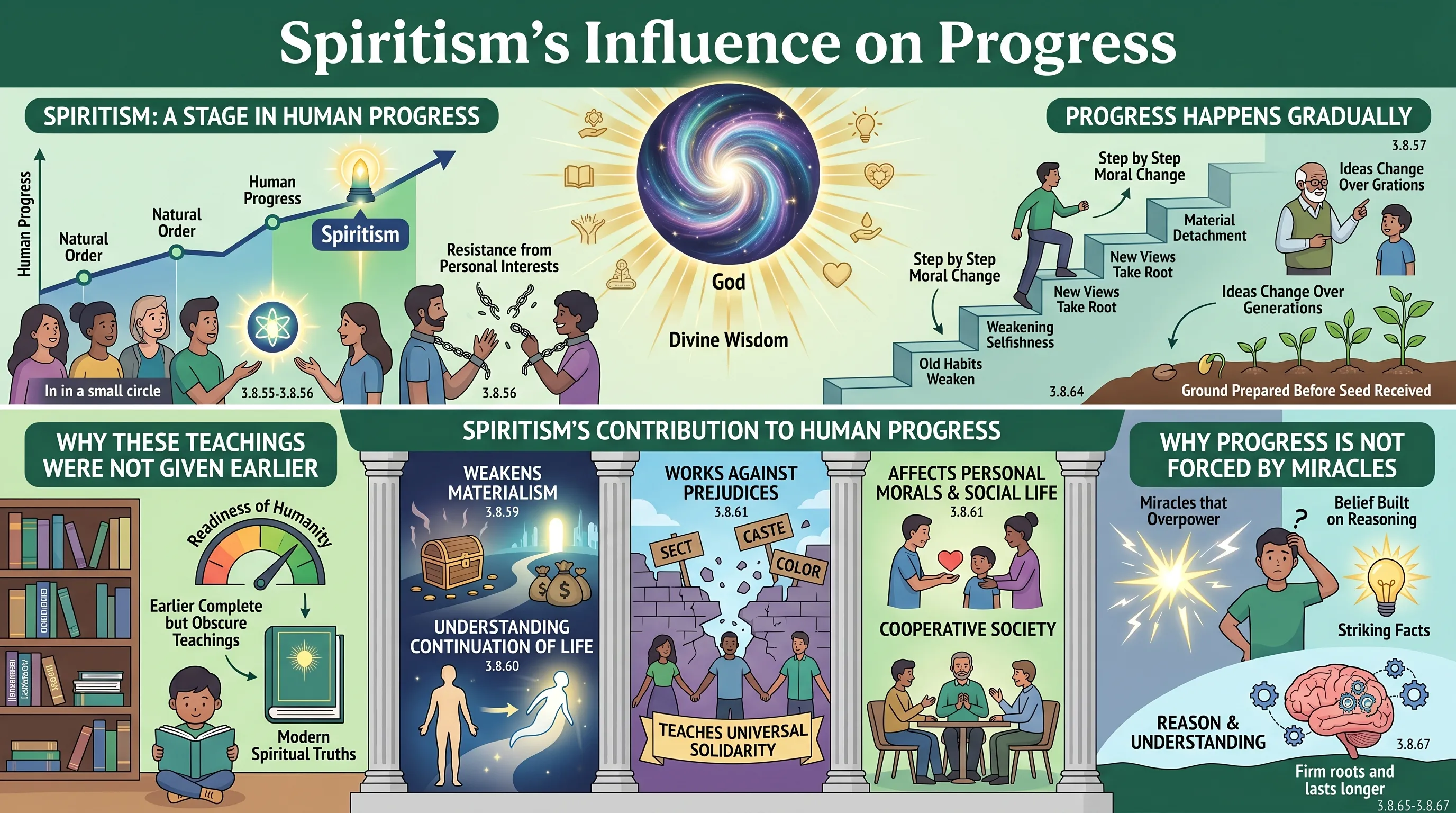
3.8.55 Spiritism is meant to take its place in human life as part of the natural order, not as the belief of a small circle. Because of that, it marks a stage in human progress.
3.8.56 It does not spread without resistance. Much of that resistance comes from personal interests that feel threatened. But as the teaching advances, that opposition tends to shrink and stand more alone.
Progress Happens Gradually
3.8.57 Human ideas do not change in a moment. They change little by little, often from one generation to the next, as old habits weaken and new views slowly take root.
3.8.58 The same is true here. Even when a teaching is true, it does not instantly cure selfishness or attachment to material things. Moral change comes step by step, and each step helps prepare the next.
Spiritism’s Contribution to Human Progress
3.8.59 Spiritism helps progress especially by weakening materialism, which is one of the great causes of moral disorder.
3.8.60 When people understand that life continues after death, they see their real interests more clearly. They better understand that the future depends on how the present is used.
3.8.61 It also works against the prejudices that separate people. By weakening divisions of sect, caste, and color, it teaches the solidarity that should unite all human beings. In this way, it affects both personal morals and social life.
Why These Teachings Were Not Given Earlier
3.8.62 Truth is given according to humanity’s readiness to receive it.
3.8.63 A child is not taught in the same way as an adult. In the same way, spiritual truths appear as people become able to understand them. Earlier teachings, even when incomplete or obscure, still helped prepare the way.
3.8.64 The ground had to be made ready before the seed could be received and bear fruit.
Why Progress Is Not Forced by Miracles
3.8.65 One might think great extraordinary events would quickly force belief and speed progress. But that is not usually how divine wisdom leads humanity.
3.8.66 Even the most striking facts do not convince everyone. Some deny what is before them, and others remain unmoved even by what they see themselves.
3.8.67 So progress is not meant to rest on miracles that overpower the mind. God leaves people the freedom and merit of being convinced by reason. Belief built on understanding is firmer and lasts longer than belief produced only by amazement.