3.6 Destruction and Renewal
Necessary Destruction and Abusive Destruction
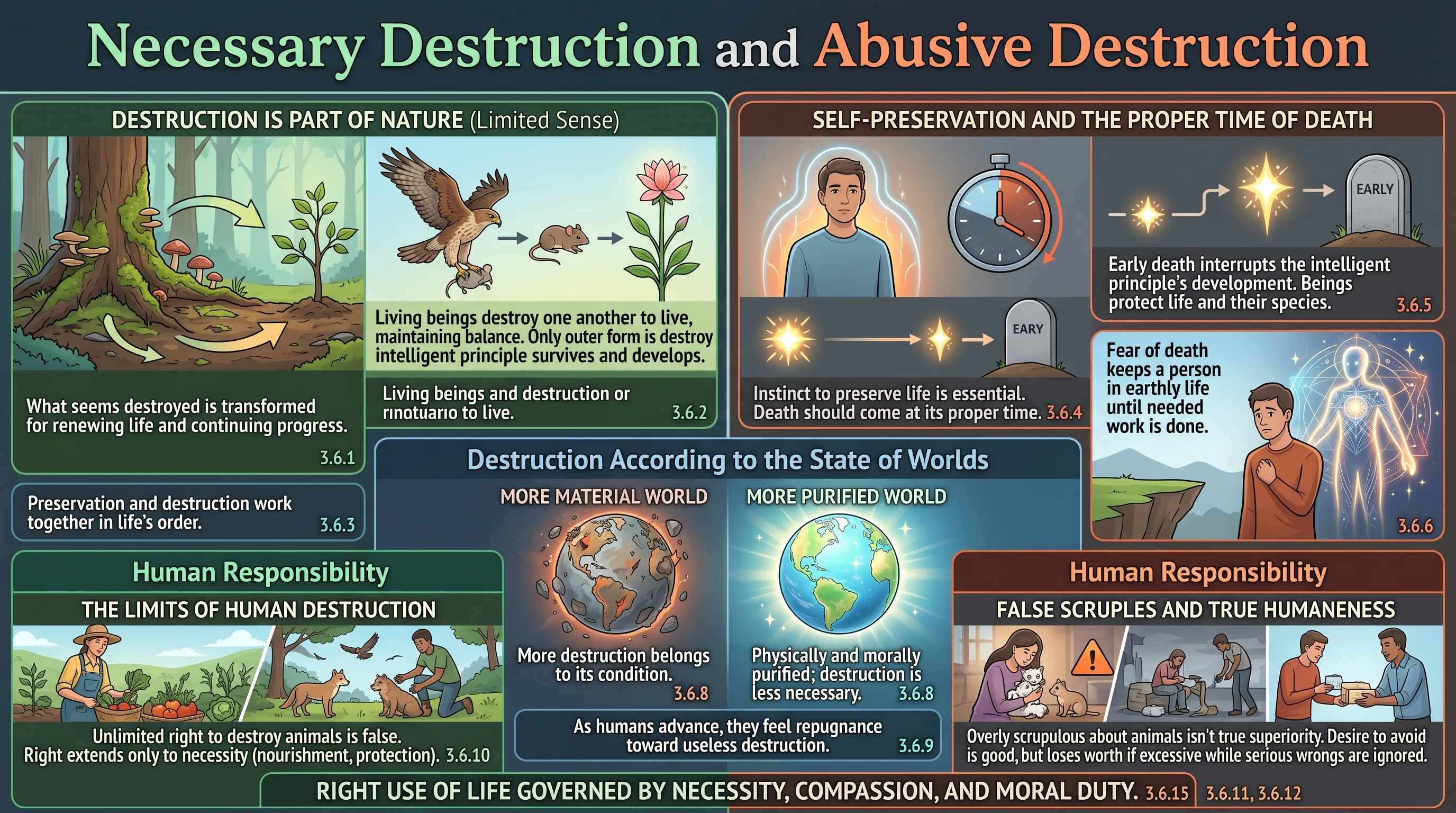
3.6.1 Destruction is part of nature, but only in a limited sense. What seems destroyed is often only transformed, so life can be renewed and progress continue.
3.6.2 Living beings destroy one another in order to live, helping maintain balance in nature. Only the outer form is destroyed; the intelligent principle is not. It survives these changes and continues developing.
3.6.3 So preservation and destruction work together in the order of life.
Self-Preservation and the Proper Time of Death
3.6.4 Even though destruction is necessary, every being has the instinct to preserve itself. Death should come at its proper time, not before.
3.6.5 If life ends too soon, the development of the intelligent principle is interrupted. For this reason, beings are driven to protect life and continue their species.
3.6.6 Fear of death serves the same purpose. Though death may free the soul, that fear helps keep a person in earthly life until the needed work is done.
Destruction According to the State of Worlds
3.6.7 The need for destruction is not the same in every world. It depends on how material the world is.
3.6.8 The more material a world is, the more destruction belongs to its condition. As worlds become more purified, physically and morally, destruction becomes less necessary.
3.6.9 The same is true on earth. As human beings advance, they feel more repugnance toward useless destruction.
The Limits of Human Destruction
3.6.10 In humanity’s present state, people do not have an unlimited right to destroy animals. That right extends only as far as necessity, such as nourishment and protection.
3.6.11 Beyond necessity, destruction becomes abuse. To kill only for the pleasure of killing shows moral inferiority.
3.6.12 Animals destroy from need. Human beings can go beyond need, and are responsible for that.
False Scruples and True Humaneness
3.6.13 Being overly scrupulous about killing animals is not, by itself, a sign of real superiority.
3.6.14 The desire to avoid causing suffering is good. But if it becomes excessive while more serious wrongs are ignored, it loses much of its worth.
3.6.15 What matters is a right use of life, governed by necessity, compassion, and moral duty.
Destructive Calamities
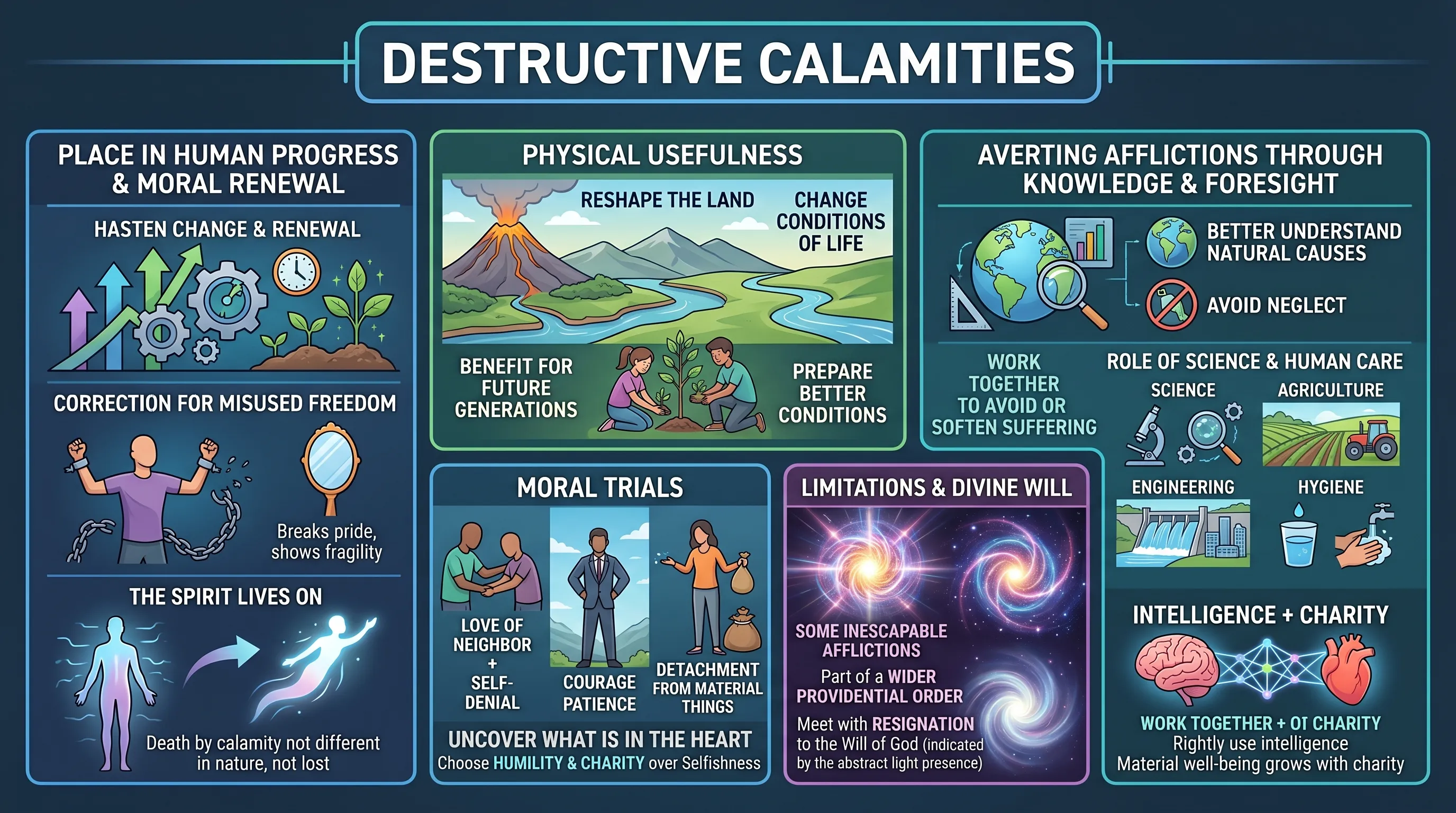
3.6.16 Destructive calamities have a place in human progress.
3.6.17 They can hasten change and help bring moral renewal. This does not mean people must suffer in order to improve. Human beings already know enough to choose between good and evil. But when they misuse their freedom, suffering can become a correction. It breaks pride and reminds people how fragile they are.
3.6.18 A painful question remains: why do good people suffer along with the guilty? If we look only at earthly life, this seems unjust. But the body is temporary, while the spirit lives on. Those who die in great disasters are not lost. In the end, death by calamity is not different in nature from death by any other cause, though it may come more suddenly.
Physical Usefulness
3.6.19 Calamities also have physical usefulness.
3.6.20 They can reshape the land and change the conditions of life. Often the benefit is not for those who suffer through them, but for those who come afterward. What seems only destructive now may prepare the way for better conditions later.
Moral Trials
3.6.21 Calamities are also moral trials.
3.6.22 In times of hardship, people may show courage, patience, resignation, self-denial, detachment from material things, and love of neighbor. If they bear these sufferings without complaint, they receive compensation for them.
May We Avert the Calamities That Afflict Us?
3.6.23 Many calamities can be prevented, at least in part.
3.6.24 This is done not by superstition, but by knowledge and foresight. Much suffering comes from human neglect. As people better understand natural causes, they can avoid many dangers or lessen their effects.
3.6.25 Still, not every affliction can be escaped. Some belong to a wider providential order and must be met with resignation to the will of God. Even so, human carelessness often makes disasters worse. Science, agriculture, engineering, and hygiene can prevent much suffering or reduce its force.
3.6.26 Material well-being grows when intelligence is rightly used, but intelligence alone is not enough. Charity is also needed. When knowledge and charity work together, much suffering can be avoided or softened.
War
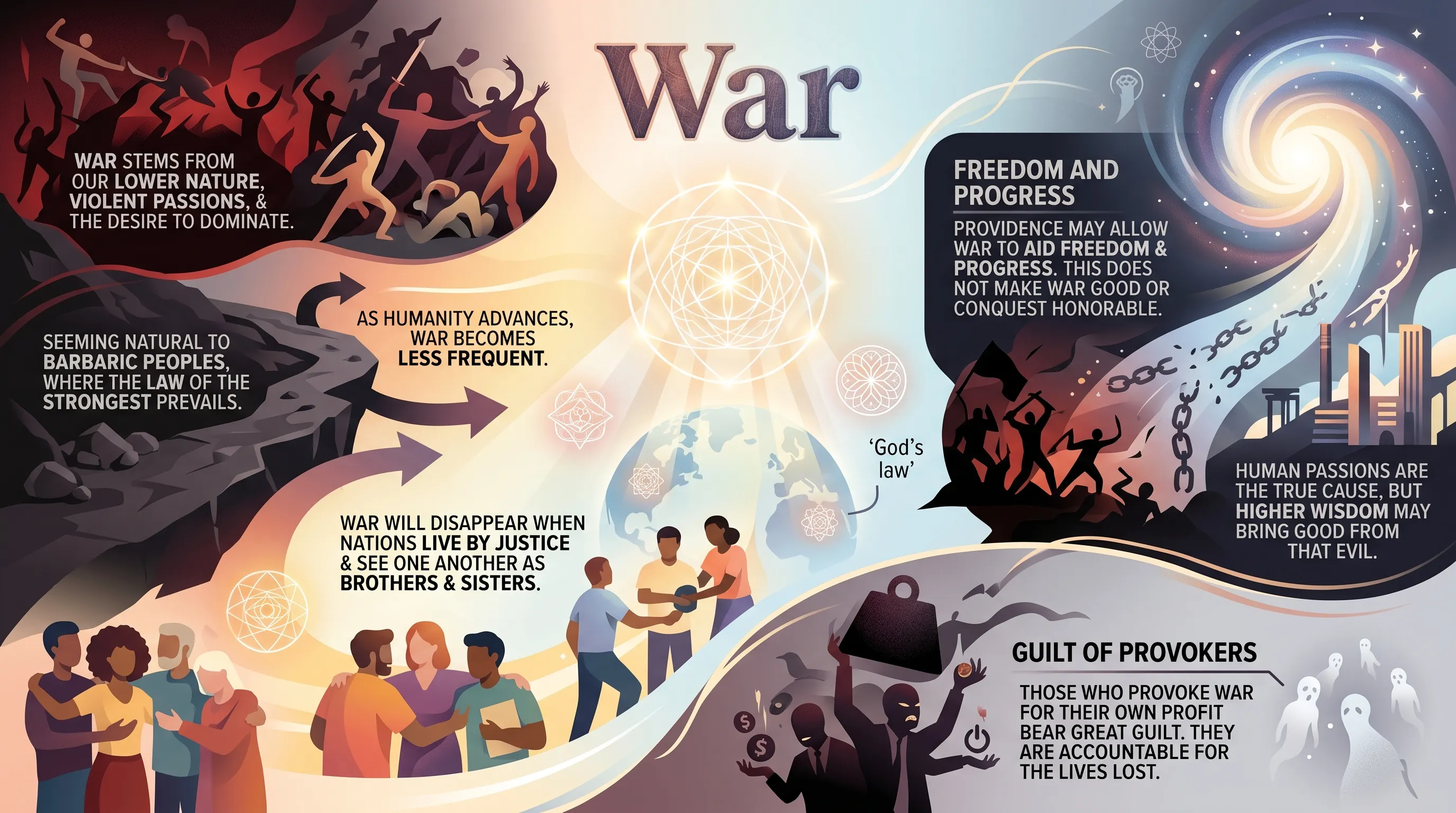
3.6.27 War comes from the dominance of our lower, animal nature over our spiritual nature. It is born from violent passions and the desire to dominate.
3.6.28 Among barbaric peoples, where the law of the strongest prevails, war seems natural. As humanity advances, it becomes less frequent, because its causes are better understood and more often prevented. It will disappear when people live by justice and God's law, and nations see one another as brothers and sisters.
Freedom and Progress
3.6.29 Providence may allow war to produce results that aid freedom and progress.
3.6.30 This does not make war good or conquest honorable. Human passions are still its true cause, but a higher wisdom may bring some good from that evil.
The Guilt of Those Who Provoke War
3.6.31 Those who provoke war for their own profit bear great guilt.
3.6.32 Their fault is grave, because they seek bloodshed through ambition, pride, or self-interest. They are accountable for the lives lost and must repair the moral harm caused by the deaths for which they are responsible.
Murder
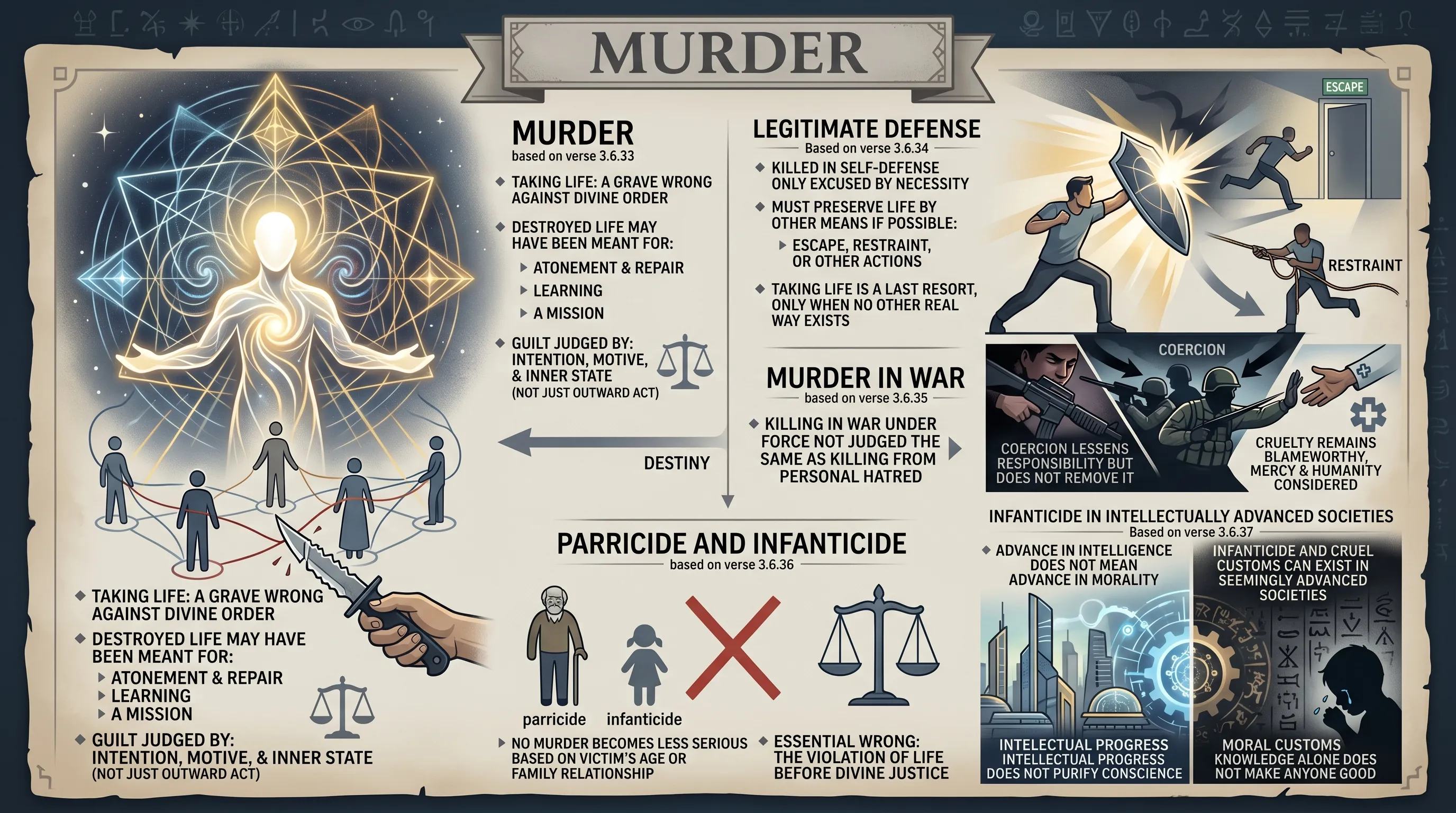
3.6.33 Taking another person’s life is a grave wrong against divine order. The life destroyed may have been meant for atonement, repair, learning, or a mission. Yet guilt is not judged by the outward act alone: intention, motive, and inner state are also considered.
Legitimate Defense
3.6.34 Only necessity can excuse killing in self-defense. If a person can preserve their own life by escape, restraint, or some other means without taking the aggressor’s life, that should be done. Taking life is excused only when no other real way exists.
Murder in War
3.6.35 Those who kill in war under force are not judged the same as those who kill from personal hatred. Coercion lessens responsibility but does not remove it. Cruelty remains blameworthy, while mercy and humanity are taken into account.
Parricide and Infanticide
3.6.36 No murder becomes less serious because of the victim’s age or family relationship. Parricide and infanticide are equally guilty. Before divine justice, the essential wrong is the violation of life.
Infanticide in Intellectually Advanced Societies
3.6.37 A people may advance in intelligence without advancing in morality. That is why infanticide and other cruel customs can exist in societies that seem advanced. Intellectual progress does not purify the conscience, and knowledge alone does not make anyone good.
Cruelty
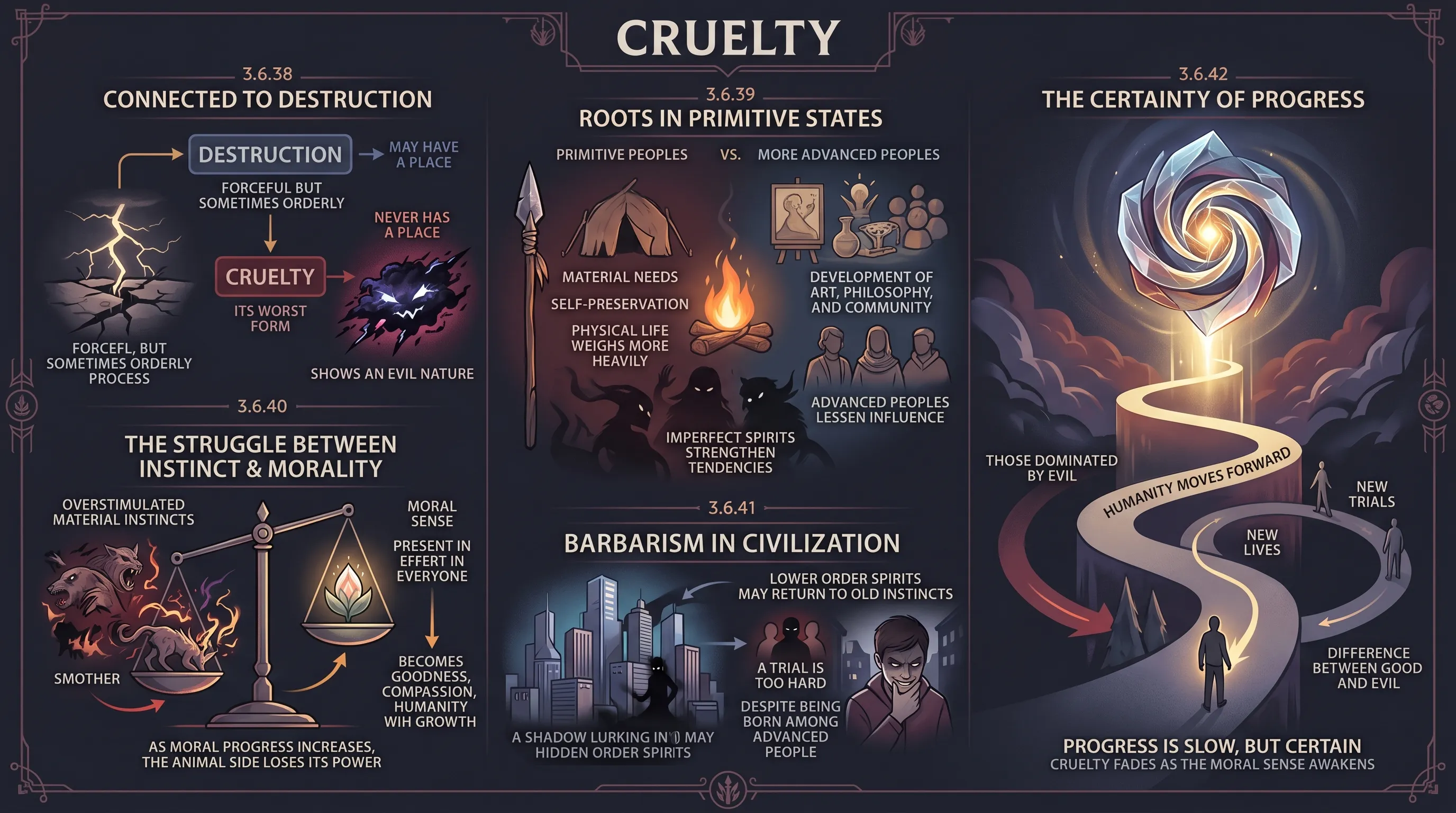
3.6.38 Cruelty is connected to the instinct of destruction, but it is its worst form. Destruction may sometimes have a place in the order of things; cruelty never does. It always shows an evil nature.
3.6.39 Among primitive peoples, physical life weighs more heavily than spiritual life. Because they are focused on material needs and self-preservation, they are more open to cruelty. Imperfect spirits also strengthen these tendencies until more advanced peoples lessen their influence.
3.6.40 Cruelty does not come from a total lack of moral sense, because moral sense exists in everyone, though in different degrees. In primitive people it may lie dormant, but with growth it becomes goodness, compassion, and humanity. When material instincts are overstimulated, they smother the moral sense. As moral progress increases, the animal side loses its power.
3.6.41 So even in civilized societies, some people can still be as cruel as barbarians. Spirits of a lower order may be born among more advanced peoples in order to progress, but if the trial is too hard, their old instincts can return.
3.6.42 Still, humanity moves forward. Those dominated by evil, and unfit for more moral societies, will little by little disappear from them. In new lives and through new trials, they will learn the difference between good and evil. Progress is slow, but certain, and cruelty fades as the moral sense awakens.
Dueling
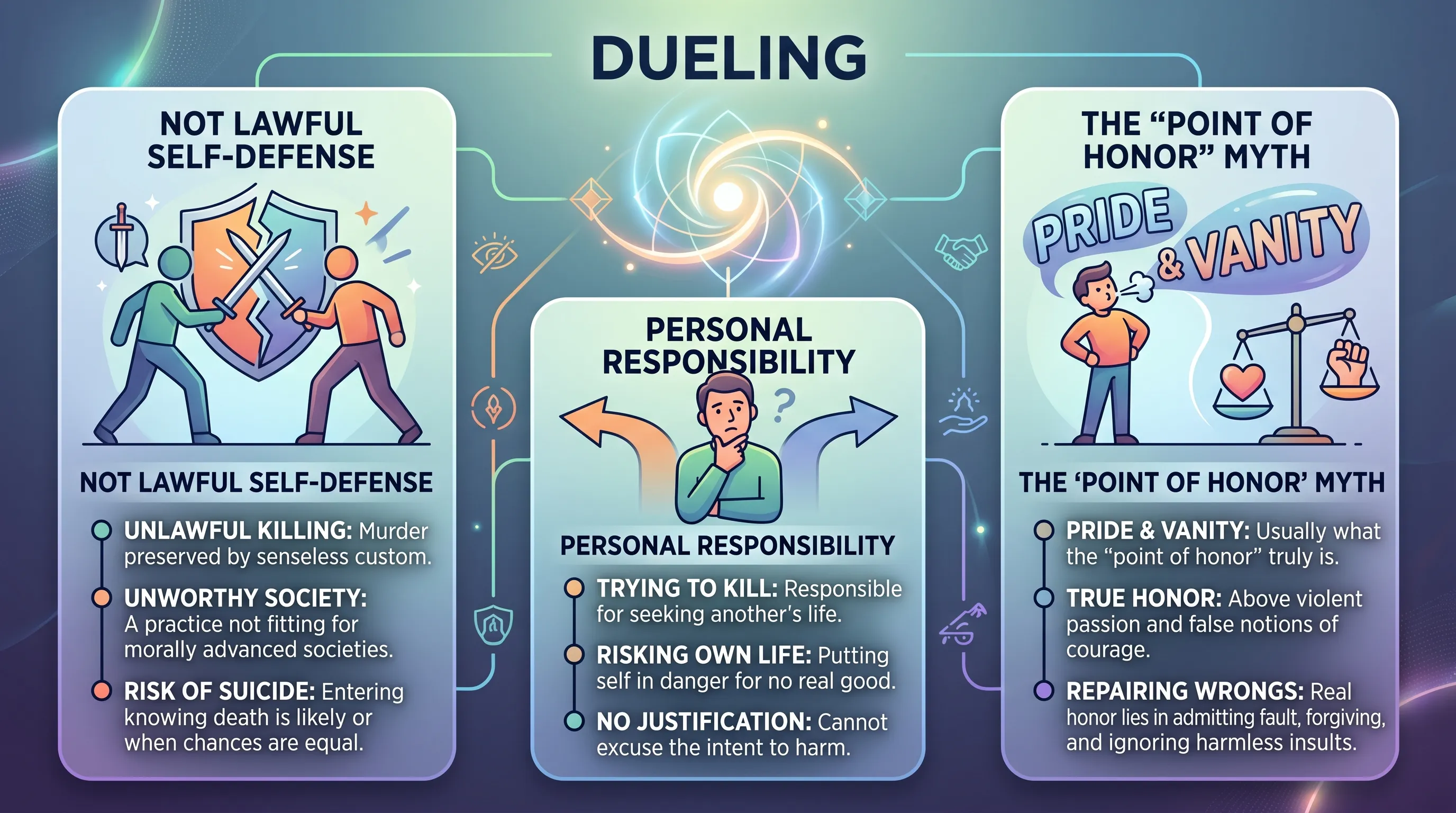
3.6.43 Dueling is not lawful self-defense. It is murder preserved by a senseless custom, unworthy of a morally advanced society. If a person enters a duel knowing they are likely to die, it is also suicide. If the chances are equal, it remains both murder and suicide.
3.6.44 In every case, the dueler is responsible for trying to kill another and for risking their own life for no real good.
The So-Called Point of Honor
3.6.45 What is called the “point of honor” is usually pride and vanity. People may imagine that honor requires a duel or that refusing one is cowardice, but true honor is above violent passion.
3.6.46 A wrong is not repaired by killing someone or by being killed. Real honor lies in admitting a fault when one is wrong, forgiving when one is right, and refusing to treat harmless insults as important.
The Death Penalty
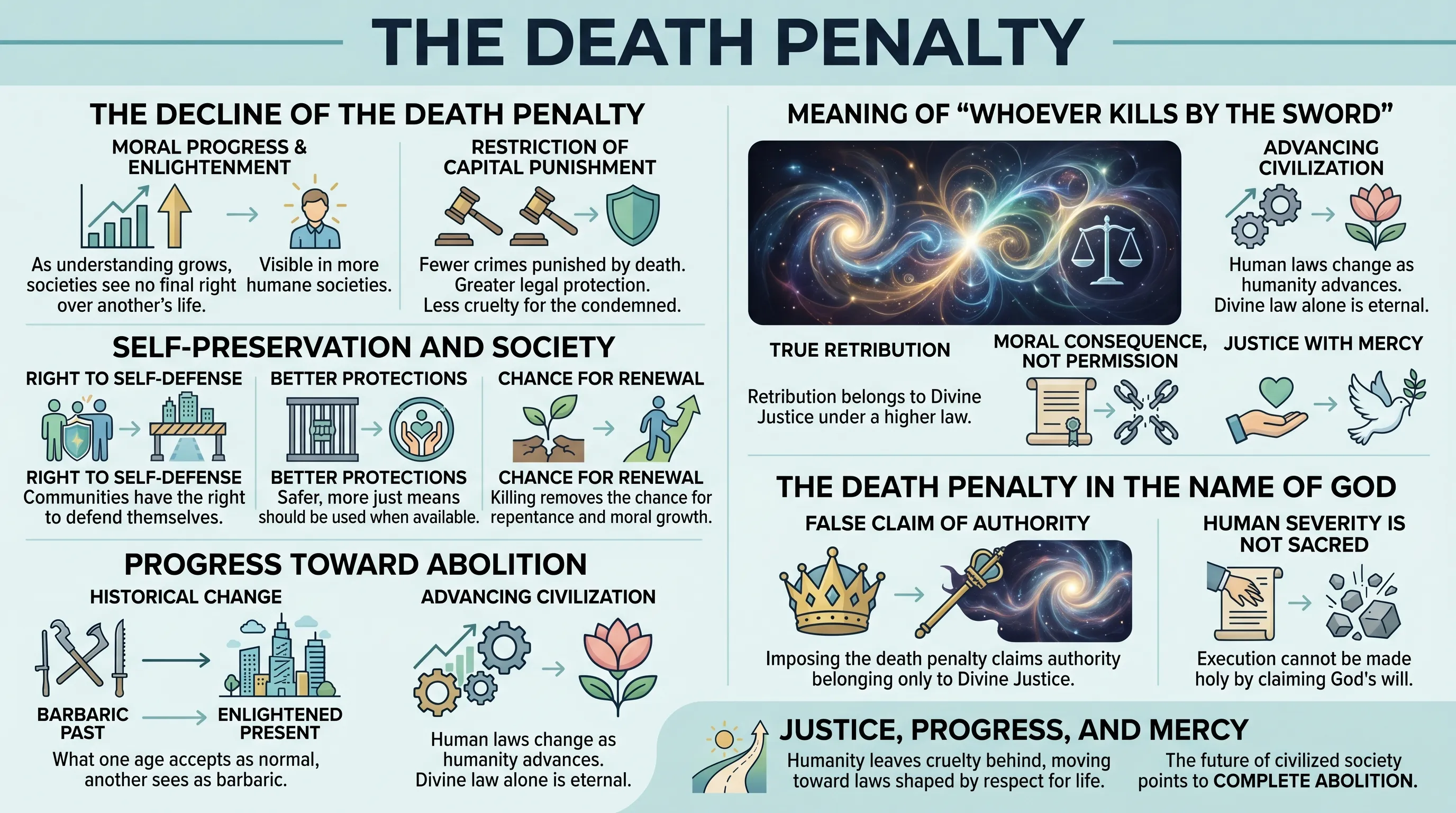
3.6.47 The death penalty will disappear from human law.
3.6.48 Its decline marks moral progress. As people become more enlightened, they see more clearly that no one should claim the final right over another’s life. This is already visible where society has become more humane.
3.6.49 Even now, progress appears in the restriction of capital punishment. Fewer crimes are punished by death, the accused receive greater legal protection, and the condemned are treated less cruelly than in earlier times.
Self-Preservation and Society
3.6.50 The right of self-preservation does not justify killing a dangerous member of society when society can be protected in other ways.
3.6.51 A community has the right to defend itself, but if safer and more just means exist, they should be used. To kill the offender is also to remove the chance for repentance and moral renewal.
Was It Ever Necessary?
3.6.52 What people call necessary is often only what they have not yet learned to replace.
3.6.53 In less developed times, harsh practices seemed unavoidable because no better remedy was known. As societies become more enlightened, they reject acts once committed in the name of justice during ignorance.
Civilization and the Restriction of Capital Punishment
3.6.54 The shrinking number of cases in which the death penalty is used is a sign of civilization’s progress.
3.6.55 History contains many judicial killings once treated as righteous. What one age accepts as normal, another later sees as barbaric. This shows that human laws change as humanity advances, while divine law alone is eternal.
The Meaning of “Whoever Kills by the Sword”
3.6.56 The words, “Whoever kills by the sword shall perish by the sword,” do not give human beings the right to take revenge or claim an absolute right over a murderer’s life.
3.6.57 True retribution belongs to divine justice. Wrongdoing brings consequences under a higher law. This saying means moral consequence, not permission for human killing.
3.6.58 It must also be understood with the command to forgive one’s enemies. Justice without mercy distorts that teaching.
The Death Penalty in the Name of God
3.6.59 To impose the death penalty in the name of God is to claim an authority that belongs only to divine justice.
3.6.60 It falsely turns human severity into something sacred. The death penalty imposed in the name of God is a crime, and those who do so are responsible for such killings.
Justice, Progress, and Mercy
3.6.61 Humanity advances by leaving cruelty behind and moving toward laws shaped by respect for life and the possibility of repentance.
3.6.62 The death penalty belongs to a less enlightened stage of society. As understanding grows, justice becomes less violent and more in harmony with divine law. The future of civilized society points to its complete abolition.