4.2 Joys and Sorrows in the Life to Come
Nothingness. The Future Life
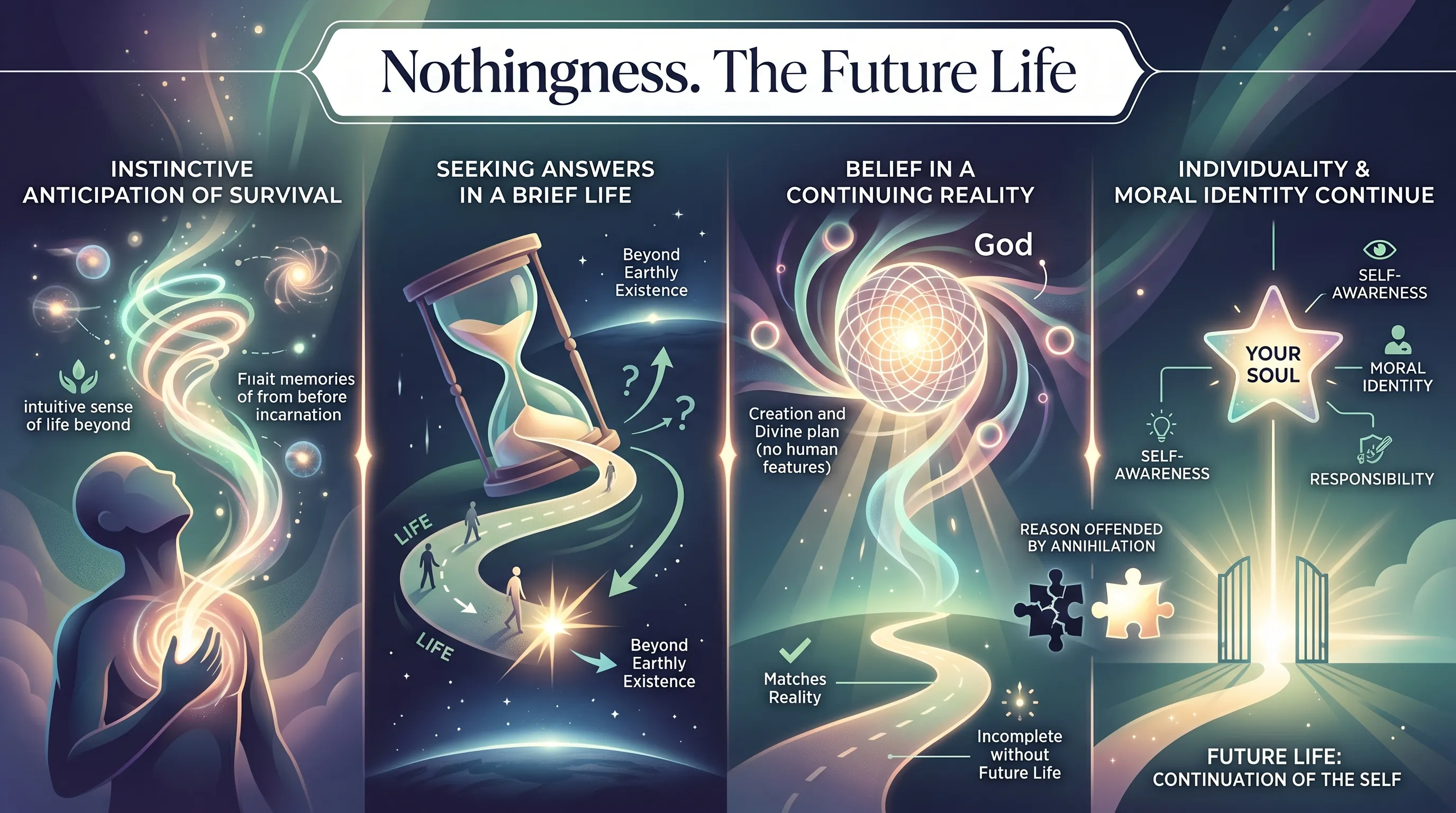
4.2.1 Human beings naturally recoil from the idea of nothingness, because it is not our destiny. Within us is a sense that life does not end at the grave. Before incarnation, the spirit knows realities that bodily life partly hides, and the soul keeps a faint memory of that spiritual state. This remains as an intuition that we survive.
4.2.2 In every age, people have looked beyond death. Earthly life is brief and uncertain, so it is natural to ask what becomes of us after death. This concerns not a few more years, but our lasting future.
4.2.3 The idea of total annihilation offends reason. Even those who think little about spiritual matters often ask, when death comes near, what will become of them. Belief in God without belief in a future life is incomplete. The sense of life beyond the present one is planted in the human heart because it matches reality.
4.2.4 A future life also means that individuality continues after death. Survival would mean little if the moral self were lost in a vague whole. The soul’s future therefore includes the continuation of the self: its awareness, moral identity, and responsibility.
The Intuition of Future Joys and Sorrows
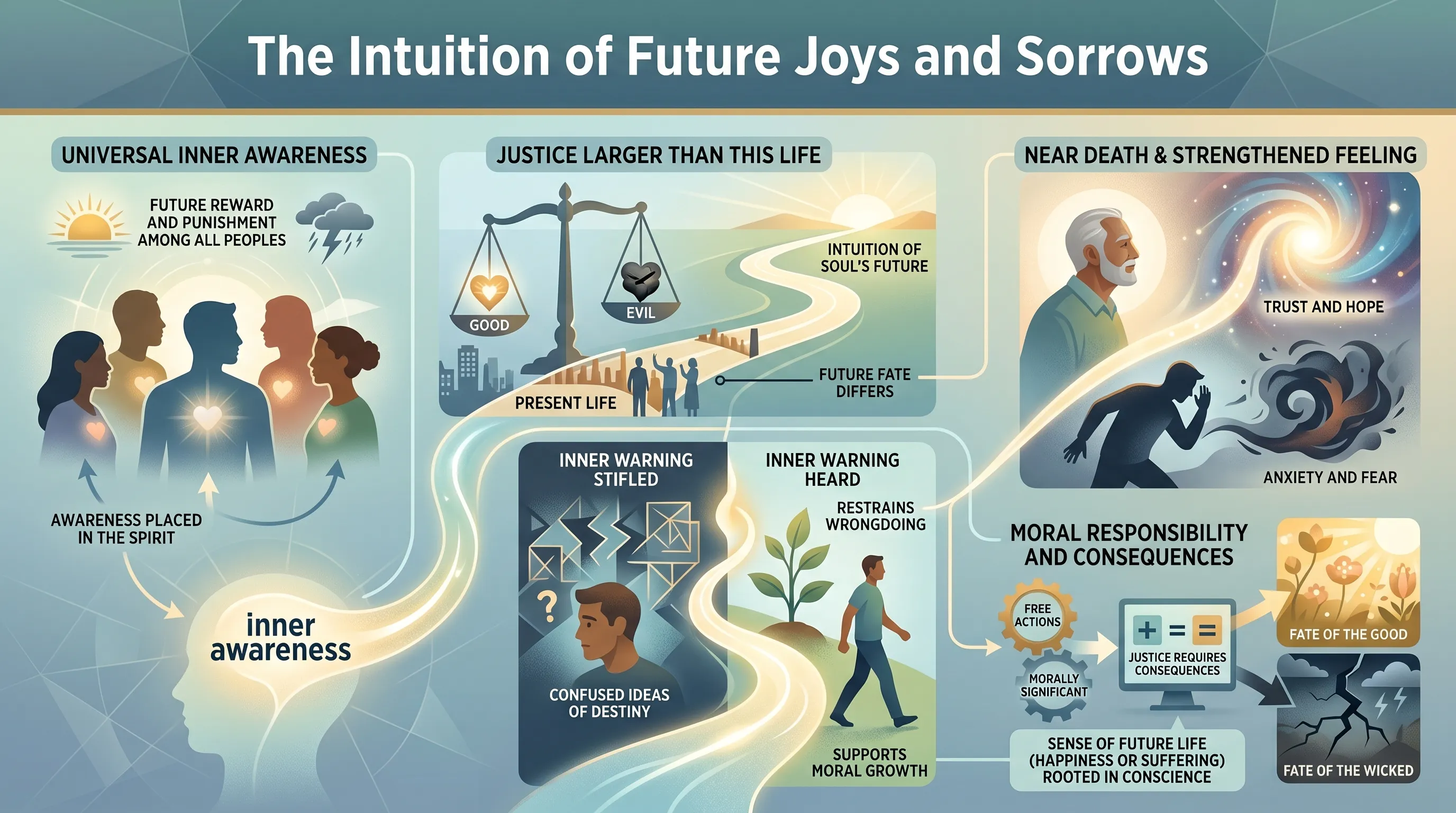
4.2.5 The expectation of future reward and punishment is found among all peoples. It comes from an inner awareness placed in the spirit itself.
4.2.6 People feel that good and evil cannot end in the same result, and that justice is larger than this present life. This is a natural intuition of the soul’s future.
4.2.7 When this inner warning is stifled, ideas about destiny become confused. When it is heard, it restrains wrongdoing and supports moral growth.
4.2.8 Near death, this feeling often becomes stronger. The guilty tend toward anxiety and fear, while the upright more often feel trust and hope.
4.2.9 Future joys and sorrows are tied to responsibility. If human actions are free and morally significant, they must have consequences. Justice requires a difference between the fate of the good and that of the wicked.
4.2.10 So the sense of a future life, with happiness or suffering according to one’s conduct, is rooted in conscience itself.
God’s Intervention in Punishments and Rewards
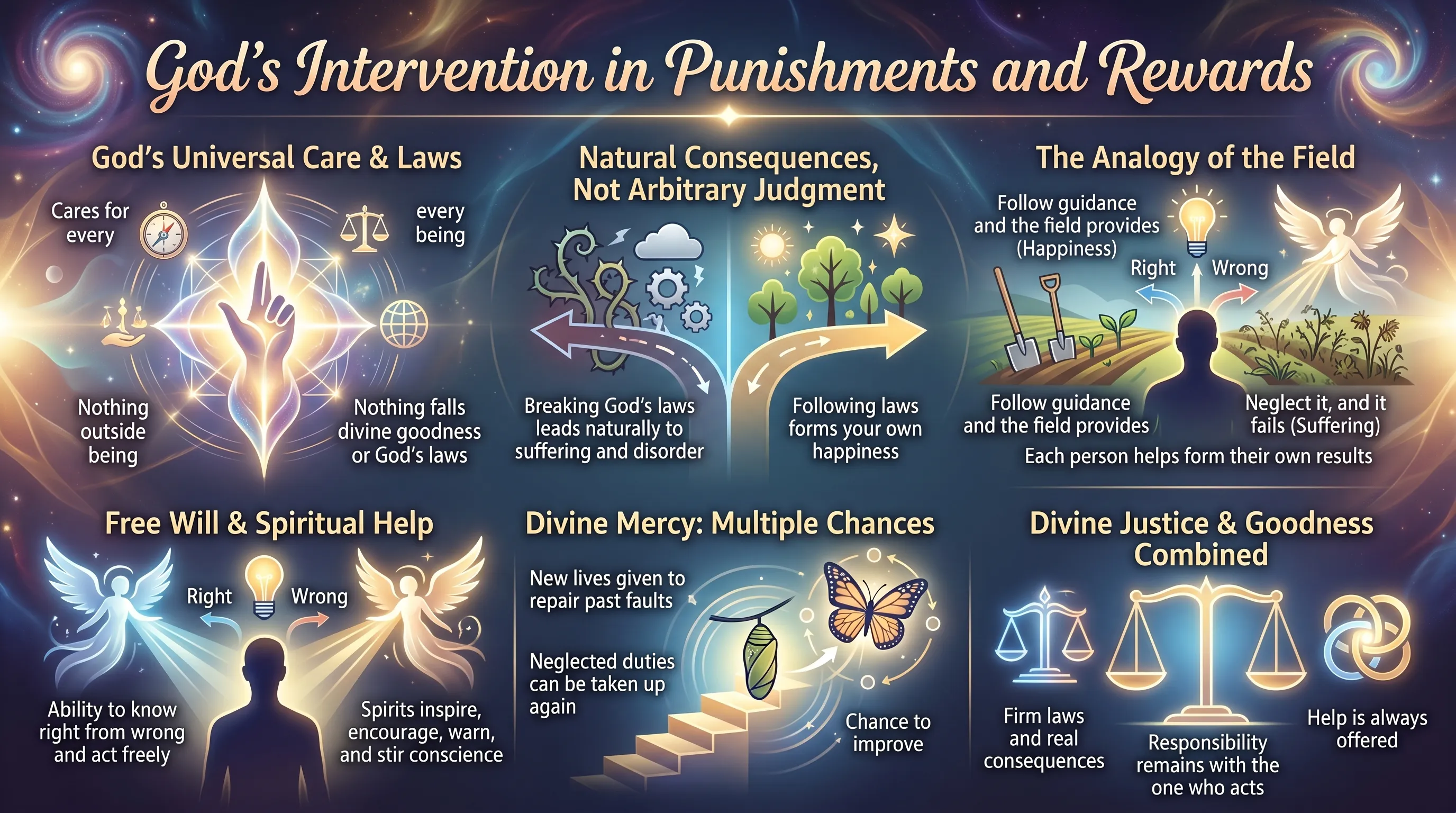
4.2.11 God cares for every being, and nothing falls outside divine goodness or God’s laws.
4.2.12 This does not mean God gives an arbitrary judgment for each act. God has established laws for human conduct, and suffering follows naturally when those laws are broken. Disorder brings pain, and each person helps form his or her own happiness or unhappiness.
4.2.13 A comparison helps. A father teaches his son, gives him tools, and entrusts him with a field. If the son follows the guidance, the field provides for him. If he neglects it, it fails, and he suffers the result.
4.2.14 So it is in the divine order. God has given human beings the ability to know right from wrong and to act freely. God also helps through spirits who inspire, encourage, warn, and stir the conscience, though people often refuse them.
4.2.15 There is also mercy: life is not limited to one chance. New lives are given so past faults may be repaired and neglected duties taken up again. Freedom remains, consequences remain, and so does the chance to improve.
4.2.16 So divine justice and divine goodness work together. The laws are firm, the consequences are real, responsibility stays with the one who acts, and help is always offered.
The Nature of Future Joys and Sorrows
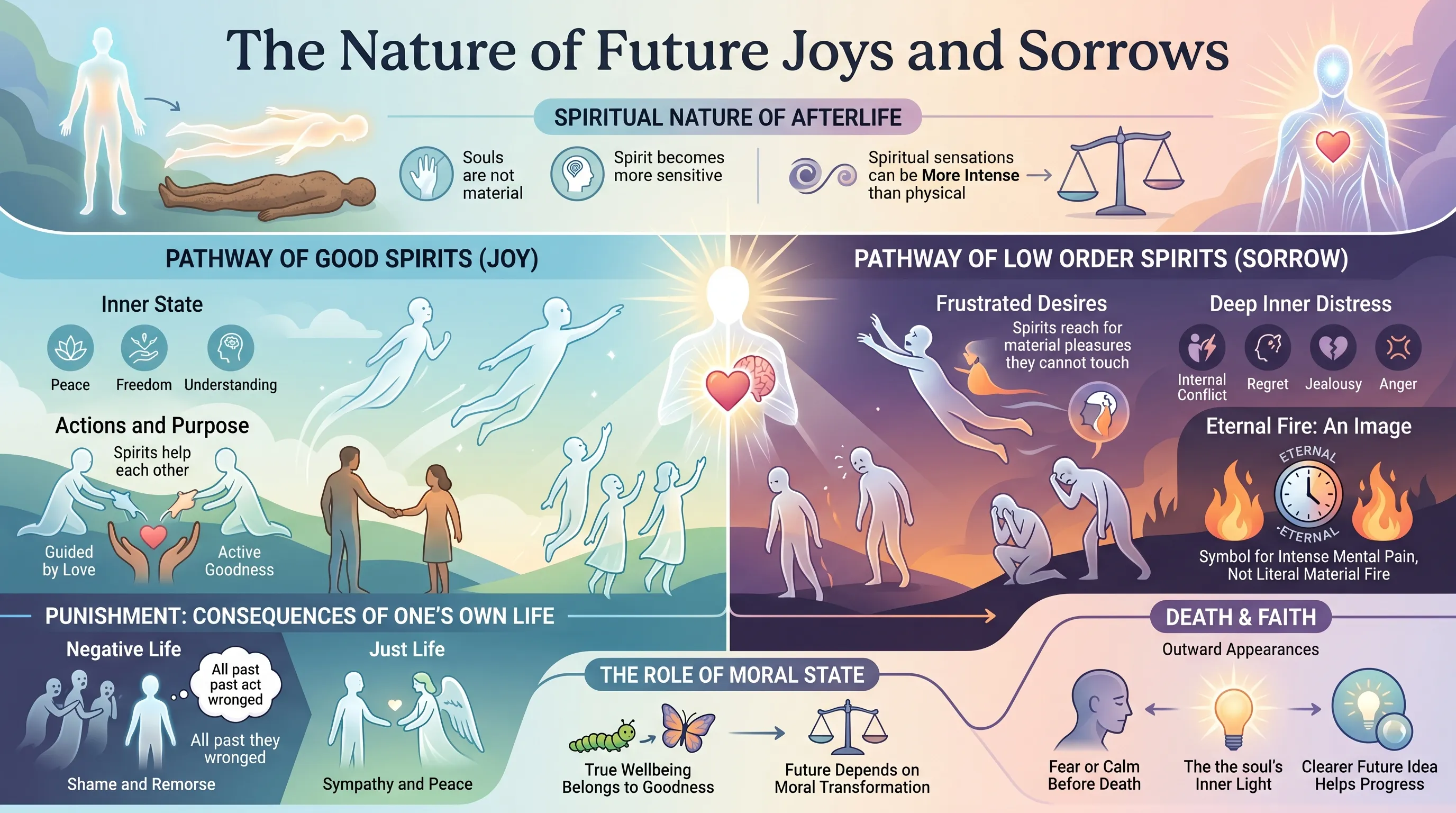
4.2.17 The soul’s future joys and sorrows are not material.
4.2.18 Because the soul is not made of matter, it does not feel pleasure and pain as the body does. Yet once freed from the body, the spirit becomes more sensitive, since matter no longer blunts its impressions. For that reason, the joys and sufferings of the future life are a thousand times more vivid than those experienced on earth.
4.2.19 People often picture the next life in material forms. Spiritual truths were often taught by images, and error begins when those images are taken literally.
The Happiness of Good Spirits
4.2.20 The happiness of good spirits is an inner state of peace, freedom, and clear understanding. They are no longer troubled by hatred, envy, jealousy, ambition, or the anxieties of bodily life. Their joy is in the good they do and in the love that joins them to one another.
4.2.21 This happiness matches their progress. Only pure spirits have perfect happiness, but there are many degrees below that. The more advanced spirits look upward without jealousy.
4.2.22 The images of spirits before God, singing praises, should be understood as figures. Their happiness is not idleness. They help guide other spirits, and in that work they find both purpose and joy.
The Sufferings of Low Order Spirits
4.2.23 The sufferings of low order spirits are as varied as their faults. Their greatest pain is wanting happiness and not being able to reach it. They see it, understand it, and know what keeps them from it. From this come regret, jealousy, anger, remorse, and deep inner distress.
4.2.24 After death, evil tendencies may remain. Spirits are still drawn toward what fed their passions on earth, but they can no longer satisfy them. Some also suffer from believing themselves condemned forever, and that despair itself becomes part of their punishment.
4.2.25 Some of these sufferings are beyond human language, but they must not be imagined as literal flames.
Eternal Fire as an Image
4.2.26 Eternal fire is an image, not a material reality.
4.2.27 Fire has long been used to represent intense suffering. Since spiritual pain cannot be described directly, people used the image of burning. Trouble begins when the symbol is treated as fact.
Punishment as the Consequence of One’s Own Life
4.2.28 The future state of the soul follows naturally from the life it has lived.
4.2.29 Punishment is not arbitrary. Each spirit suffers through its own faults—through regret, fear, shame, uncertainty, isolation, and separation from what it loves. It bears not only the result of the evil it did, but also of the good it failed to do.
4.2.30 Low order spirits understand the happiness of the good, and this makes their pain sharper. Once freed from matter, they see more clearly what stands between them and peace. That is why they desire a new earthly life: they know that a life well used can shorten their suffering.
The Sight of Victims and the Exposure of the Past
4.2.31 In the spiritual world, thoughts are not hidden, and the acts of one’s life are known.
4.2.32 For the guilty, this is a punishment. They may be faced with those they have wronged, and secret actions can no longer be concealed. This brings shame, regret, and remorse until the wrong has been repaired. For the just, the opposite is true: they meet sympathy and peace.
4.2.33 When a spirit has truly purified itself, the memory of past faults no longer disturbs its happiness.
Affection, Sympathy, and Spiritual Union
4.2.34 One of the great joys of spirits is reunion with those bound to them by love and goodness.
4.2.35 In the spiritual world, spirits of the same order form true families through shared feeling. Their affection is sincere and free from selfishness, betrayal, and hypocrisy. This harmony is itself a source of happiness.
The Good and the Suffering of Others
4.2.36 The sight of suffering spirits does not destroy the happiness of good spirits.
4.2.37 They know that such suffering is not eternal, and they work to help others improve. Helping the unhappy is one of their joys. If they suffer for those they loved on earth, it is less because of temporary pain than because of the weakness that delays that person’s progress.
Death, Fear, and Moral State
4.2.38 Fear of death, calm before death, or even joy at the thought of death does not by itself show a soul’s future condition.
4.2.39 Everything depends on the reason for that feeling. What matters is the moral state of the soul, not the outward appearance of courage or indifference.
Faith and Future Well-Being
4.2.40 Future happiness does not depend on outwardly professing Spiritism or on having believed in spirit manifestations.
4.2.41 True well-being belongs to goodness. A person’s future depends on moral transformation, not on a label. Still, a clearer idea of the future life can help people become better, bear suffering with more patience, and avoid what would delay their progress.
Temporary Punishments
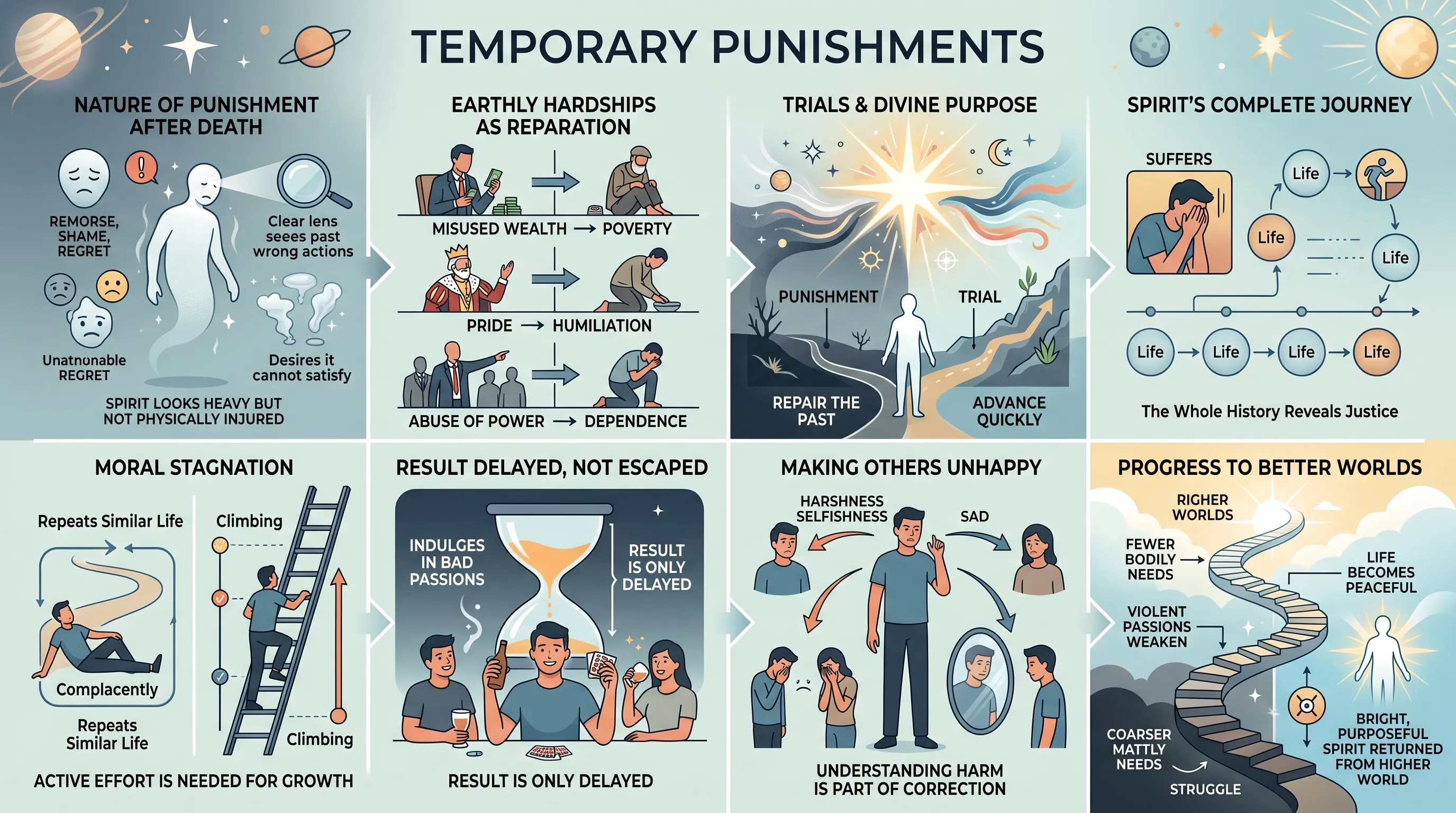
4.2.42 Punishment after death is not endless. Once free from the body, spirits no longer suffer physical pain, but they do suffer in other ways. They feel remorse, shame, regret, and the pain of seeing clearly the wrong they have done. They may also suffer from desires they can no longer satisfy.
4.2.43 Many hardships on Earth are also forms of reparation. Misused wealth may be followed by poverty. Pride may be corrected by humiliation. Abuse of power may be followed by dependence. So the trials of life may come from faults in the present life or from faults of an earlier one.
4.2.44 A person may seem happy while giving way to bad passions, but the result is only delayed, not escaped.
Punishment, Trial, and Responsibility
4.2.45 Not every suffering in life is a direct punishment for present faults. Some are trials allowed by God, or even chosen by the spirit before rebirth, to expiate wrongs committed in a former life.
4.2.46 What seems undeserved in one life may be just when the whole history of the spirit is taken into account.
Progress to Better Worlds
4.2.47 As spirits improve, they pass into better worlds suited to their progress. There matter is less coarse, bodily needs are fewer, and physical suffering is lighter.
4.2.48 Violent passions weaken there. Hatred, jealousy, pride, and selfishness lose much of their power, and life becomes more peaceful.
4.2.49 A spirit that has progressed on Earth may sometimes return here. If it comes back to complete a useful task, that return is no longer an expiation, but a mission.
The Consequences of Moral Stagnation
4.2.50 It is not only active evil that holds back progress. Those who do not seriously try to improve, even if they are not openly wicked, remain almost where they are. Since they have gained little, they must often begin again in a life much like the one they have just left.
4.2.51 An easy life is not always a sign of advancement. Without struggle, there may be little growth.
4.2.52 Happiness is always in keeping with the good one has done, just as suffering is in keeping with the evil done and the pain caused to others.
Making Others Unhappy
4.2.53 Some people are not truly bad, yet by selfishness, harshness, bad temper, or lack of care, they make those around them unhappy. They are responsible for that suffering.
4.2.54 Part of their punishment is to see the pain they caused and understand it. Later they may endure similar conditions themselves. This is not revenge, but correction. These punishments are temporary and last only until the imperfection that caused them is overcome.
Expiation and Repentance
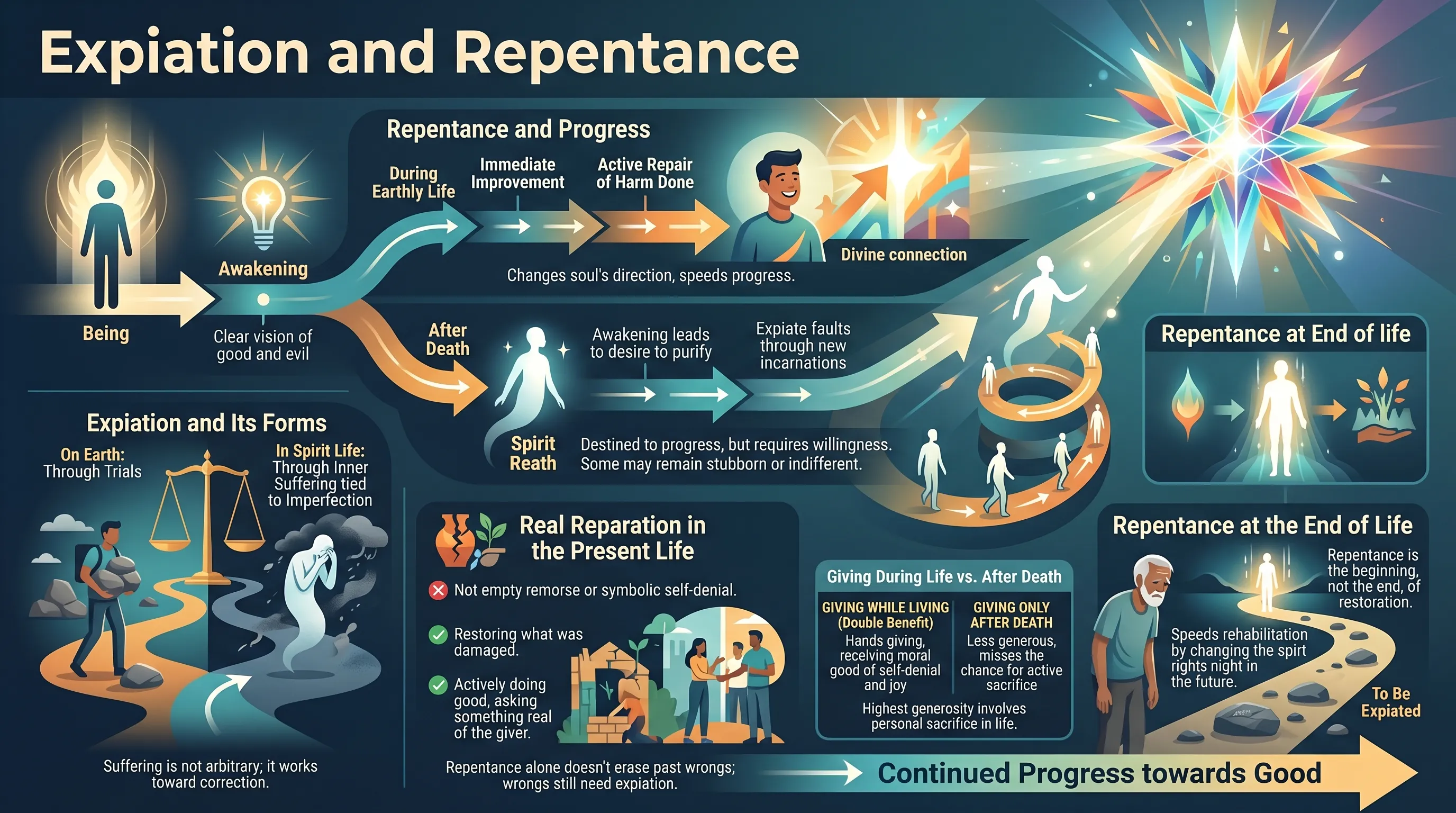
4.2.55 Repentance can happen during earthly life or after death. It begins when a being clearly sees good and evil and understands what has kept it from happiness. After death, this awakening leads the spirit to desire a new incarnation to purify itself, expiate faults, and overcome the imperfections that caused its suffering. During life, repentance can act at once by helping a person improve and repair the harm done.
4.2.56 No spirit is shut out from repentance forever. All are destined to progress through successive lives, more quickly or slowly according to their willingness. Even the wicked usually recognize their wrongs after death, and this regret adds to their suffering. But repentance is not always immediate. Some remain stubborn, indifferent, or continue doing evil. Prayer helps repentant spirits by consoling them, but those hardened by pride remain closed to it. Death does not instantly perfect an imperfect spirit; faults and prejudices are corrected only little by little.
Expiation and Its Forms
4.2.57 Expiation exists both in bodily life and in spirit life. On earth, it comes through trials; in the spirit state, through inner suffering tied to imperfection itself. This suffering is not arbitrary. It fits the spirit’s condition and works toward correction and progress.
4.2.58 Sincere repentance during life improves the spirit, but it does not erase the past. Wrongs still need expiation. Repentance changes the soul’s direction, but it does not cancel moral law.
Reparation in the Present Life
4.2.59 Wrongs may be redeemed in the present life through real reparation. This is not empty remorse, symbolic self-denial, or gifts that cost nothing. Good repairs evil only when it truly answers the harm done and asks something real of the one making amends. What matters is restoring what was damaged and actively doing good.
4.2.60 Property gained unjustly is not truly repaired simply by being returned after death, when the chance for sacrifice has passed. Reparation must reach the very place where the wrong was done.
Giving During Life and After Death
4.2.61 To arrange after death for one’s property to be used for good is better than doing nothing, but it is not the highest generosity. Many who give only after death want the credit of charity without the sacrifice of practicing it in life. The one who gives while living receives a double benefit: the moral good of self-denial and the joy of seeing others helped.
4.2.62 Wealth is a difficult trial because selfishness makes giving seem like loss. Yet those who never learn to give deprive themselves of one of life’s purest joys. Generosity is itself a blessing, and the chance to practice it is one reason material abundance is allowed.
Repentance at the End of Life
4.2.63 When people see their wrongs only at the end of life and no longer have time to repair them, repentance still has value. It speeds rehabilitation because it changes the spirit inwardly and opens it to progress. But it does not by itself remove the wrong. What has not been repaired will still need to be expiated and set right in the future.
4.2.64 No sincere return to the good is ever lost. Repentance is the beginning of restoration, not the end. Expiation, reparation, and progress continue until the spirit has overcome the causes of its suffering and is truly aligned with the good.
The Duration of Future Punishments
4.2.65 Future suffering is not arbitrary.
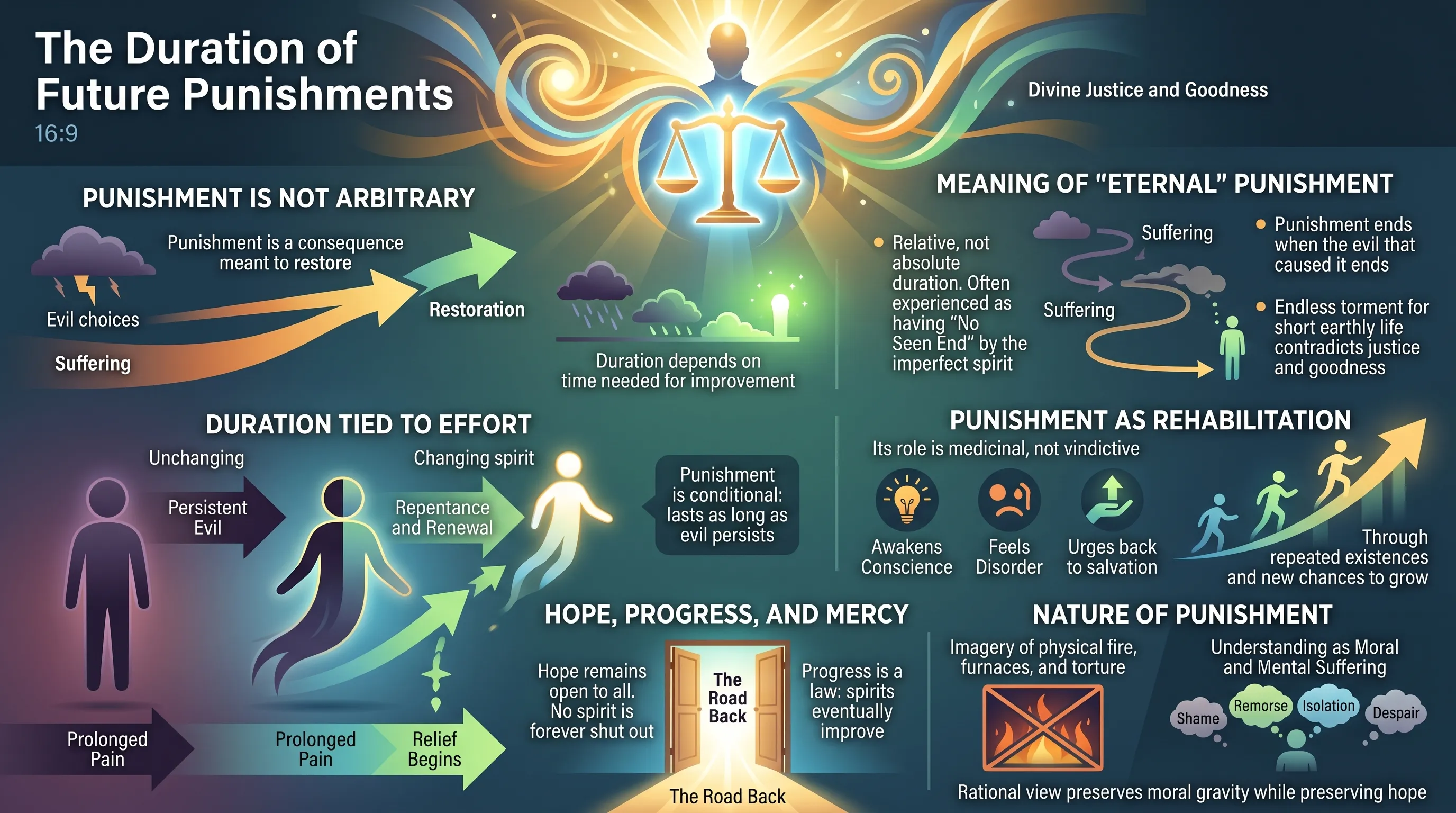
4.2.66 The destiny of spirits is governed by divine justice and goodness. Punishment is not vengeance, but a consequence meant to restore. Its duration depends on how long the spirit needs to improve. As the spirit becomes better, suffering lessens and changes. When the will turns sincerely toward the good, pain gradually gives way to peace.
4.2.67 For suffering spirits, time seems longer than on earth because nothing interrupts awareness.
The Law Governing the Duration of Punishment
4.2.68 Punishment can be called eternal only conditionally: if a spirit remained evil forever, it would suffer forever. But spirits are created with the power to progress, even if free will can delay that progress.
4.2.69 So the length of suffering is tied to the spirit’s own efforts. If it persists in evil, it prolongs its pain. If it turns toward repentance and renewal, relief begins.
4.2.70 To condemn a being to endless torment for the faults of a short earthly life would contradict justice and goodness. Punishment lasts according to the effort made to reform.
Repentance, Progress, and Hope
4.2.71 Some spirits delay repentance for a very long time. But to say a spirit will never improve is to deny the law of progress.
4.2.72 Hope remains open to all. No spirit is forever shut out from return. The road back may be long and painful, but it is never closed.
4.2.73 Exile lasts only while the spirit clings to it. Reconciliation begins as soon as it turns back.
The Meaning of “Eternal” Punishment
4.2.74 Much confusion comes from the word eternal.
4.2.75 It often means not absolute infinity, but a duration whose end is not seen. Suffering spirits may call their pain eternal because, in their imperfect state, they cannot see when it will end.
4.2.76 Punishment lasts as long as the evil that caused it lasts. When evil is overcome, punishment no longer has a reason to continue.
4.2.77 So eternal punishment, rightly understood, is relative, not absolute. Evil is not eternal. God alone is eternal.
Punishment as Rehabilitation
4.2.78 The purpose of punishment is not revenge, but rehabilitation.
4.2.79 When a spirit turns away from goodness, it suffers the natural results of that choice. Punishment awakens conscience, makes the soul feel its disorder, and urges it back to the path of salvation.
4.2.80 Its role is medicinal, not vindictive. If punishment were eternal for a fault that is not eternal, it would lose its purpose.
4.2.81 Through repeated existences and new chances to grow, penalties lessen as the spirit rises.
Against the Idea of Absolute Eternal Damnation
4.2.82 The belief in absolute eternal punishment has often led to disbelief, indifference, and materialism.
4.2.83 When people are asked to accept a future life that offends reason and moral sense, many reject religion itself. Endless, hopeless, and disproportionate punishment appears monstrous to conscience.
4.2.84 Such a doctrine makes the Supreme Being seem harsh and implacable. It is more coherent to say that beings were created able to fail, but also given the means to learn, repair their faults, and rise again by their own efforts.
4.2.85 Under this law, no one is without hope. Freedom may delay or hasten liberation, but mercy is never absent.
Fire and Torment
4.2.86 The images of physical fire, furnaces, and torture belong to an earlier way of religious expression. Taken literally, they no longer satisfy a thoughtful mind.
4.2.87 The fire of punishment is better understood as moral and mental suffering. Shame, remorse, isolation, despair, and the painful sight of one’s own baseness can wound the spirit more deeply than material flames.
4.2.88 These sufferings are real though not physical. Punishment belongs to moral law, but it lasts only as long as its cause lasts.
Moral Influence of a Rational Future Life
4.2.89 People are drawn toward morality by hope of happiness and restrained from evil by fear of suffering. But if punishment is presented in a way that violates reason, it loses its power.
4.2.90 A rational view of the future life preserves moral seriousness and trust in divine justice. Wrongdoing has consequences, and every fault requires expiation. Yet no soul is locked forever in evil or denied the chance to return.
4.2.91 This view gives punishment real gravity while preserving hope. Suffering lasts as long as it is needed for transformation. Once the spirit is healed, punishment has done its work.
4.2.92 Hope remains because progress remains possible, and where progress is possible, absolute eternal condemnation has no place.
The Resurrection of the Flesh
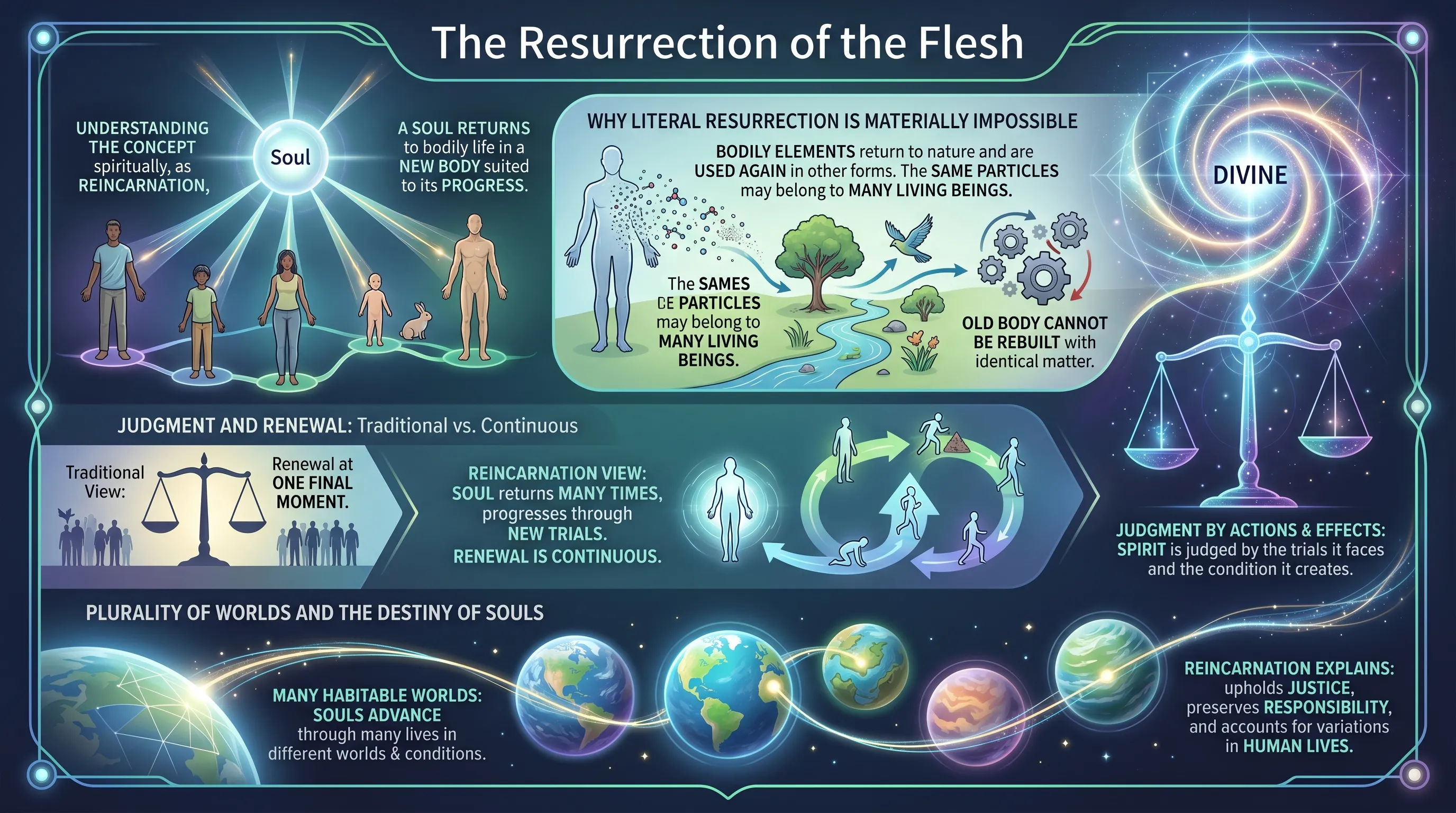
4.2.93 The resurrection of the flesh is best understood in a spiritual sense, as reincarnation.
4.2.94 If taken literally, it is hard to accept and seems to conflict with reason. But understood as the soul returning to bodily life in a new body, it becomes clear and agrees with divine justice. The soul does not take back the same body. It enters a new bodily life suited to its progress.
Why Literal Resurrection Is Materially Impossible
4.2.95 A literal return of the same physical body is materially impossible.
4.2.96 After death, the body breaks down. Its elements return to nature and are used again in other forms and other bodies. The same particles may have belonged, over time, to many living beings.
4.2.97 So the old body cannot be rebuilt with exactly the same matter. In that sense, the resurrection of the flesh cannot mean the return of the identical body to life. It must refer to something else.
Judgment and Renewal
4.2.98 There is still a difference between the usual idea of resurrection at the end of time and reincarnation.
4.2.99 In reincarnation, the soul returns many times and progresses little by little through new trials. Renewal is continuous, not reserved for one final moment.
4.2.100 Judgment is also real, but not only as a single event at the end of history. Each spirit is judged by the effects of its actions, by the trials it faces, and by the condition it creates for itself. In this way, judgment is part of the moral order that governs progress.
Plurality of Worlds and the Destiny of Souls
4.2.101 This fits with the plurality of worlds.
4.2.102 If many worlds are inhabited, the soul's destiny cannot be limited to one earthly life followed by one collective resurrection. Souls advance through many lives, in different worlds and different conditions.
4.2.103 Reincarnation makes that destiny understandable. It preserves responsibility, upholds justice, and helps explain the differences in human lives, sufferings, and opportunities.
Heaven, Hell and Purgatory
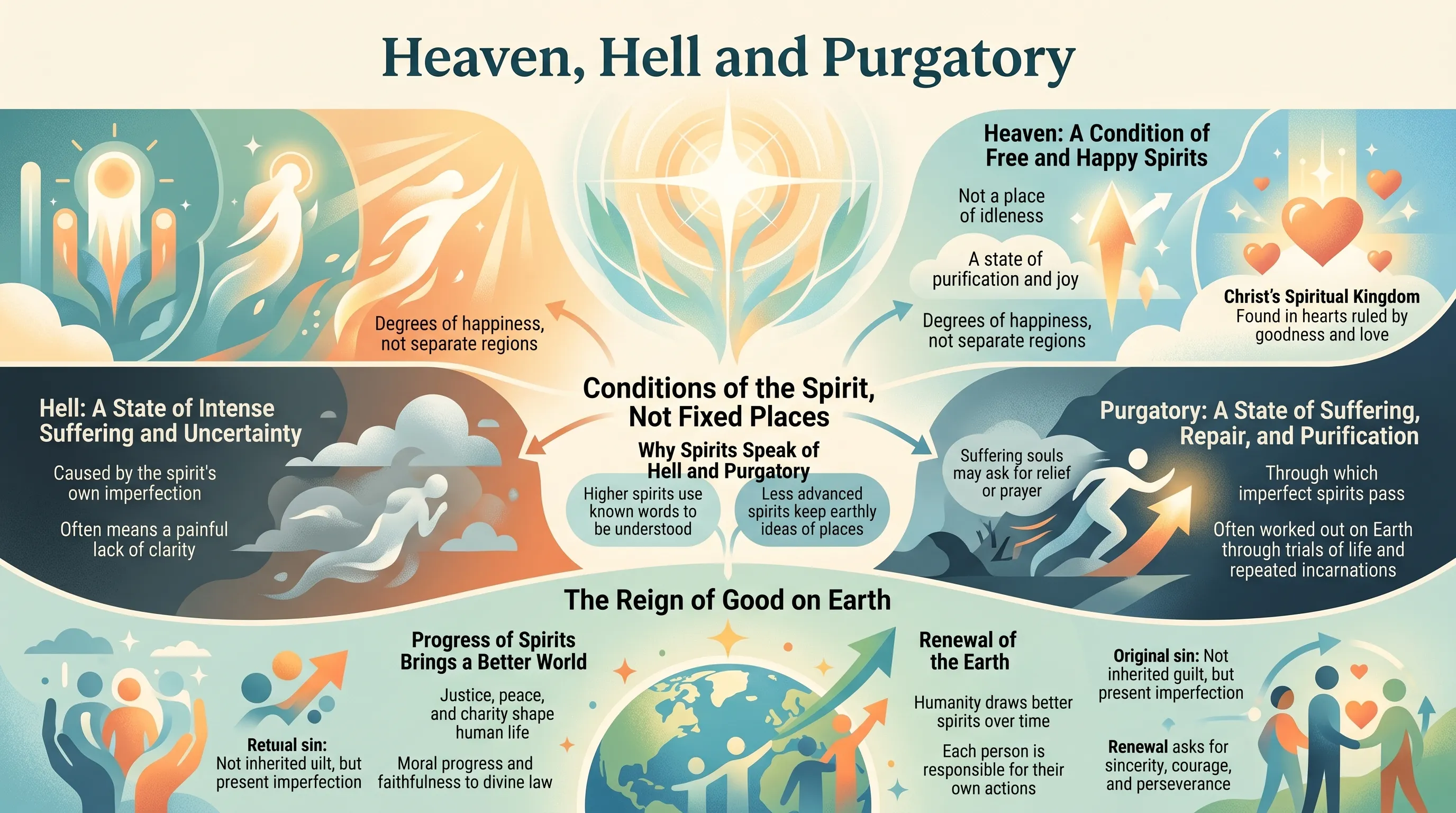
4.2.104 Heaven, hell, and purgatory are not separate places prepared for souls. They are conditions of the spirit.
4.2.105 A spirit’s happiness or suffering depends on its own purity or imperfection. Spirits of the same kind are naturally drawn together, but joy and pain do not belong to fixed locations. The common images of places of reward and punishment come from giving a material form to spiritual realities.
Purgatory
4.2.106 Purgatory is the state of suffering, repair, and purification through which imperfect spirits pass.
4.2.107 It is often worked out on earth, through the trials of bodily life and through repeated incarnations. In that sense, purgatory is found in the struggles of earthly existence, where past faults are corrected and the spirit slowly becomes fit for happier conditions.
4.2.108 A suffering soul is often restless and unsettled. When it can communicate, it may ask for relief, prayer, or support.
Why Spirits Speak of Hell and Purgatory
4.2.109 Spirits often use words that people already understand.
4.2.110 Higher spirits may speak in this way so they can be understood. Less advanced spirits also use these terms because they still keep many earthly ideas. So when they speak of hell, they may mean intense suffering and uncertainty. When they speak of purgatory, they may mean a painful but hopeful state of trial and cleansing.
Heaven
4.2.111 Heaven is not a place of idleness.
4.2.112 It is the condition of free and happy spirits, no longer burdened by the troubles of material life or the anguish of inferior states. When spirits speak of different heavens, they usually mean different degrees of purification and happiness, not separate physical regions.
4.2.113 In this sense, each spirit carries within itself the source of its heaven or its hell, while purgatory is most often met in incarnation and its moral consequences.
“My Kingdom Is Not of This World”
4.2.114 Christ’s kingdom is spiritual, not earthly.
4.2.115 It is found in hearts ruled by goodness, love, and selflessness. Those who live only for worldly interests turn themselves away from it.
The Reign of Good on Earth
4.2.116 The reign of good on earth will come when the majority of the spirits incarnated here are more inclined to good than to evil.
4.2.117 Then justice, peace, and charity will shape human life more deeply. This change comes through moral progress and faithfulness to divine law. As humanity improves, it draws better spirits and gradually pushes away those who remain attached to evil.
4.2.118 A renewed generation will arise through the coming of more advanced spirits. Those who resist progress will leave for younger, less advanced worlds, where they will continue their own education and help the growth of others.
4.2.119 In this view, original sin is not inherited guilt from another’s fault, but the imperfection still present in human nature. Each person is responsible for his or her own actions.
4.2.120 The renewal of the earth asks for sincerity, courage, and perseverance. Those who reject the light prolong their own darkness and suffering.