3.3 Work and Effort
The Necessity of Labor
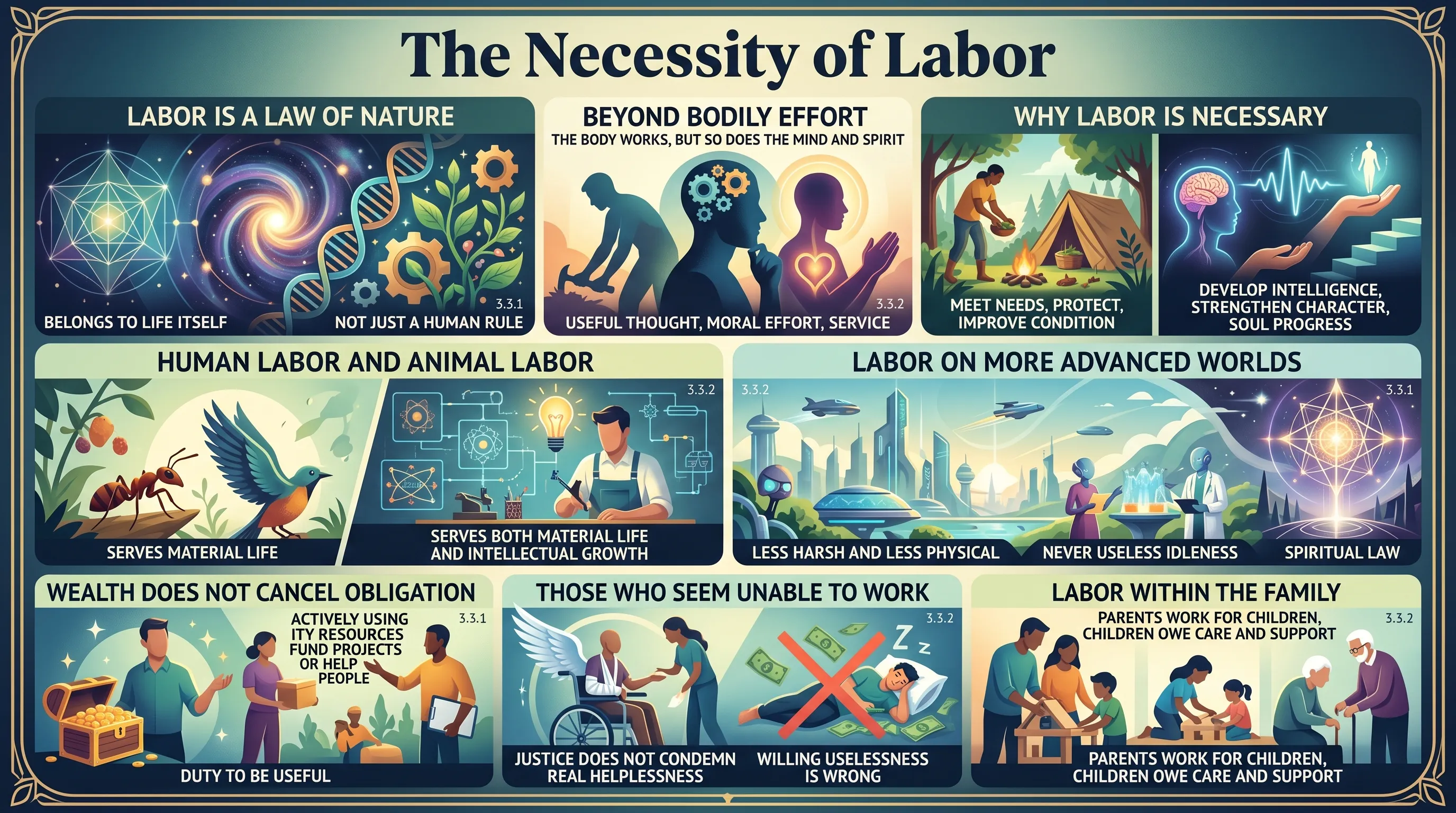
3.3.1 Labor is a law of nature. It is not just a human rule or a result of need. It belongs to life itself.
3.3.2 This law includes more than bodily effort. The body works, but so does the mind and spirit. Useful thought, moral effort, and service to others are also kinds of labor.
Why Labor Is Necessary
3.3.3 Because civilization increases needs and enjoyments, it also obliges human beings to work more.
3.3.4 Labor is a means of expiation and, at the same time, a means of perfecting intelligence. Through effort, struggle, and activity, intelligence develops and character is strengthened.
Human Labor and Animal Labor
3.3.5 Animals also labor, since they must act to preserve life. In this sense, nature does not leave them in complete idleness.
3.3.6 But human labor has a wider purpose. It not only supports the body, but also develops thought. That is what raises human beings above mere instinct. Animal labor serves material life; human labor serves both material life and intellectual growth.
Labor on More Advanced Worlds
3.3.7 On more advanced worlds, labor still exists. The law does not change, but its form does.
3.3.8 Where life is less burdened by material needs, labor becomes less harsh and less physical. Yet there is never useless idleness. A life with no worthy activity would not be happiness.
Wealth Does Not Cancel the Obligation to Work
3.3.9 Wealth does not free anyone from the duty to labor. It may remove the need to work for food, but it does not remove the duty to be useful.
3.3.10 Those who have more freedom and resources should use them well. Caring for others, improving the mind, and doing good are also forms of labor.
Those Who Seem Unable to Work
3.3.11 Those who truly cannot work are not blamed. Justice does not condemn real helplessness.
3.3.12 What is wrong is willing uselessness—when someone chooses to live from the labor of others and refuses any useful effort. Each person should contribute according to ability.
Labor Within the Family
3.3.13 The law of labor also governs family life. Parents work for their children, and children in turn owe care, respect, and support to their parents.
3.3.14 So labor is not only for survival. It is also part of love, duty, and mutual service within the family.
The Limit of Labor. Rest
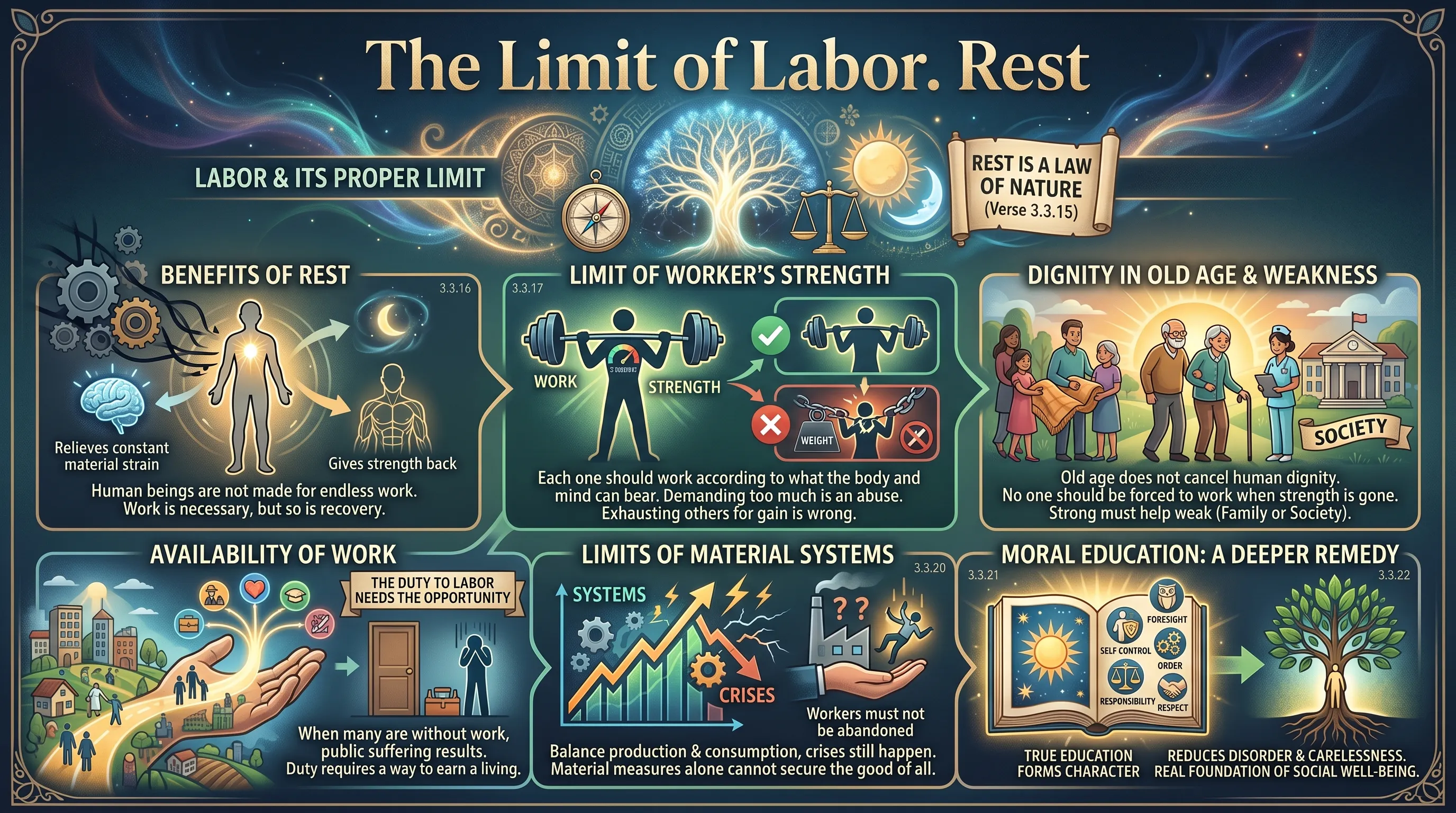
3.3.15 Labor has its limit, and rest is a law of nature.
3.3.16 Rest gives strength back to the body and relieves the mind from constant material strain. Human beings are not made for endless work. Work is necessary, but so is recovery.
3.3.17 The true limit of labor is the limit of a person’s strength. Each one should work according to what the body and mind can bear. To demand too much from workers is an abuse of power. No one has the right to exhaust others for gain or ambition.
3.3.18 Old age does not cancel human dignity. No one should be forced to work when strength is gone. When age or weakness makes work impossible, the strong must help the weak. If the family cannot do so, society should.
3.3.19 It is also not enough to say that people must work; work must be available. When many are left without it, the result is public suffering. A person cannot fulfill the duty to labor if there is no way to earn a living.
3.3.20 Systems may try to balance production and consumption, yet crises still happen. In such times, workers must not be abandoned. Material measures alone cannot secure the good of all.
3.3.21 A deeper remedy is education, above all moral education. True education forms character. It teaches foresight, self-control, order, responsibility, and respect.
3.3.22 Without this, people are easily driven by impulse, and society becomes less stable. With sound education, disorder and carelessness about the future can be reduced. Here lies one of the real foundations of social well-being.