3.2 Worship and Connection to God
The Purpose of Worship
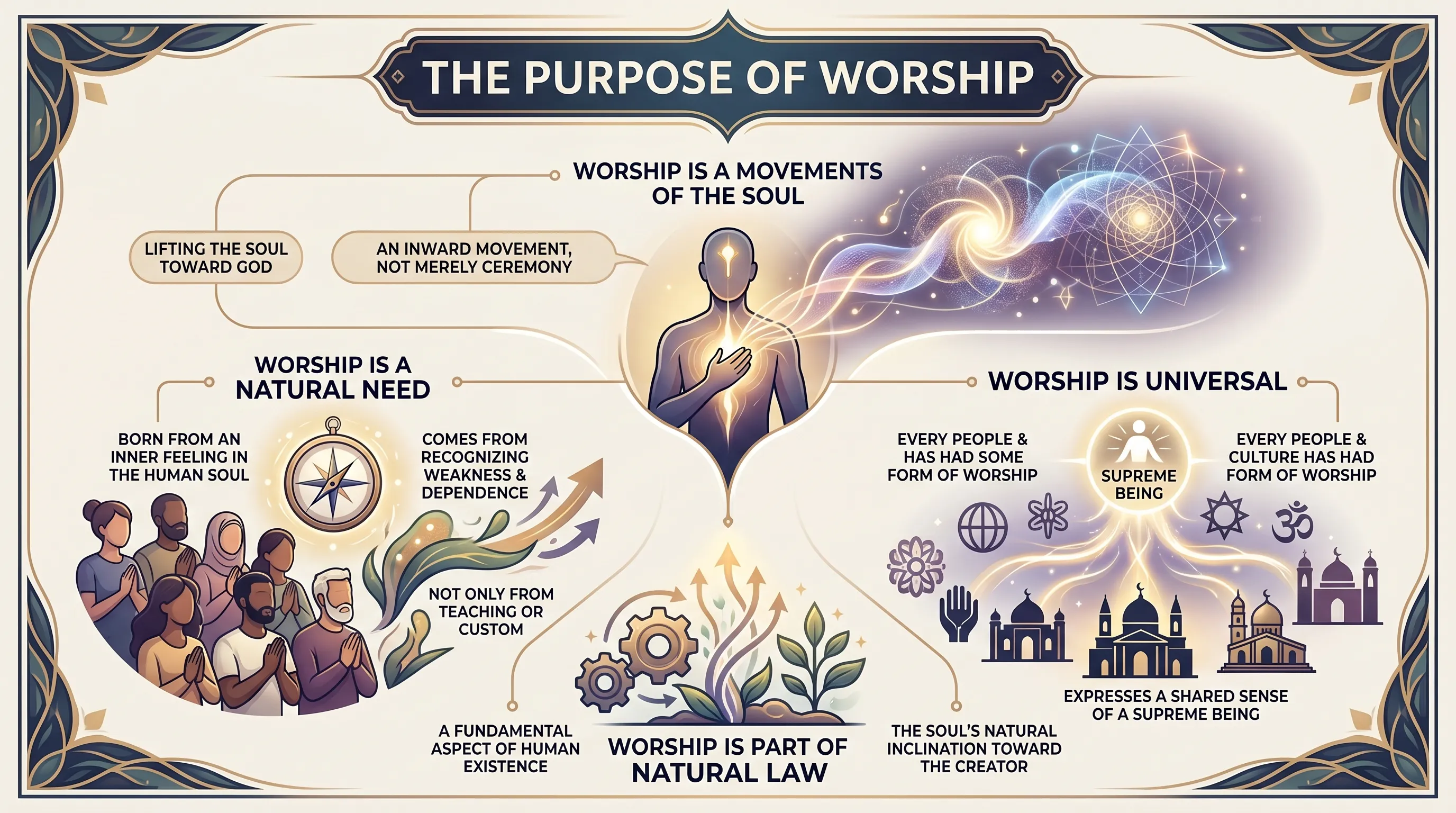
3.2.1 Worship is the lifting of the soul toward God. It is an inward movement toward the Creator, not merely an outward ceremony.
3.2.2 This need is natural in human beings. It does not come only from teaching or custom, though these influence its forms. Feeling their weakness and dependence, people turn toward a higher power.
3.2.3 That is why every people has had some form of worship. Though forms vary, there has always been some sense of a Supreme Being.
3.2.4 Worship, then, is part of natural law. It comes from an inner feeling in the human soul, which naturally rises toward God.
Outward Worship Forms
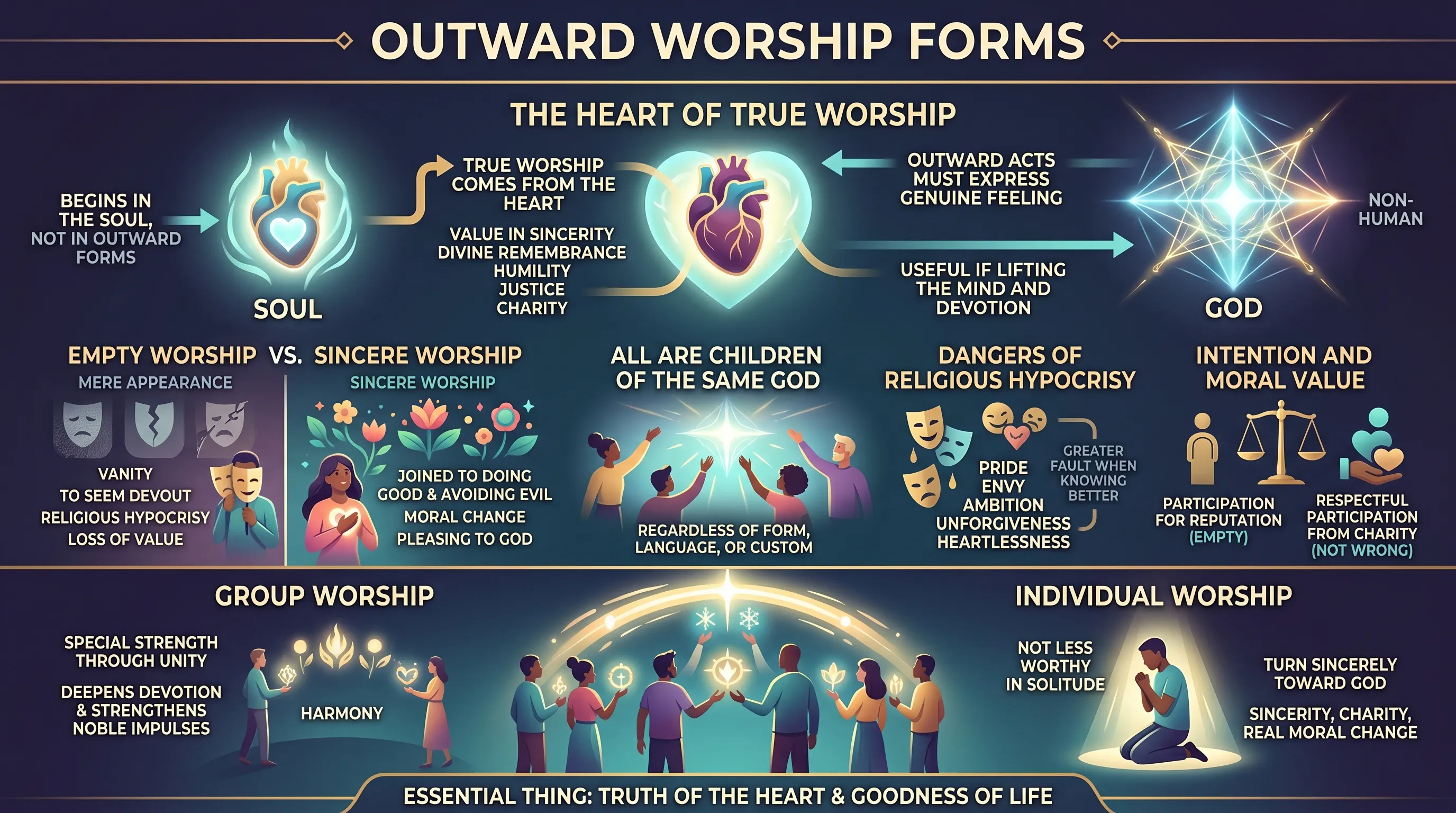
3.2.5 Worship begins in the soul, not in outward forms.
3.2.6 True worship comes from the heart. Its worth lies in sincerity, remembrance of God, and a life of humility, justice, and charity. Outward acts can be useful if they are genuine and lift the mind, deepen devotion, or set a good example. But they matter only when they express what a person truly feels.
3.2.7 When worship is mere appearance, it loses its value. If religious forms are used from vanity or to seem devout while living otherwise, they do harm. God does not favor one outward form for its own sake. What is pleasing is sincere worship joined to doing good and avoiding evil. Ceremonies alone do not make anyone better.
3.2.8 All people are children of the same God and called under the same divine laws, whatever form their worship takes. Differences of language, rite, or custom do not make one person greater before God than another.
3.2.9 Religious hypocrisy is especially serious. Outward devotion without a corresponding life betrays what it claims to honor. Pride, envy, jealousy, hardness, unforgiveness, and ambition show that worship has not truly entered the heart. When a person knows better and still acts against that light, the fault is greater than when it comes from ignorance.
3.2.10 Sometimes a person takes part in a religion without inward belief simply to avoid offending others and to respect their convictions. Then the moral value depends on the intention. Respectful participation out of charity is not wrong, but religion used for reputation, influence, or ambition becomes empty.
Group Worship and Individual Worship
3.2.11 Worship may be offered alone or with others, and both have value.
3.2.12 Collective worship is preferable because people united in thought and feeling have more power to attract good spirits.
3.2.13 Yet individual worship is not less worthy. A person can turn sincerely toward God in solitude. The essential thing is always the same: sincerity, charity, and real moral change. Whether worship is public or private, its value depends on the truth of the heart and the goodness of the life that follows.
The Contemplative Life
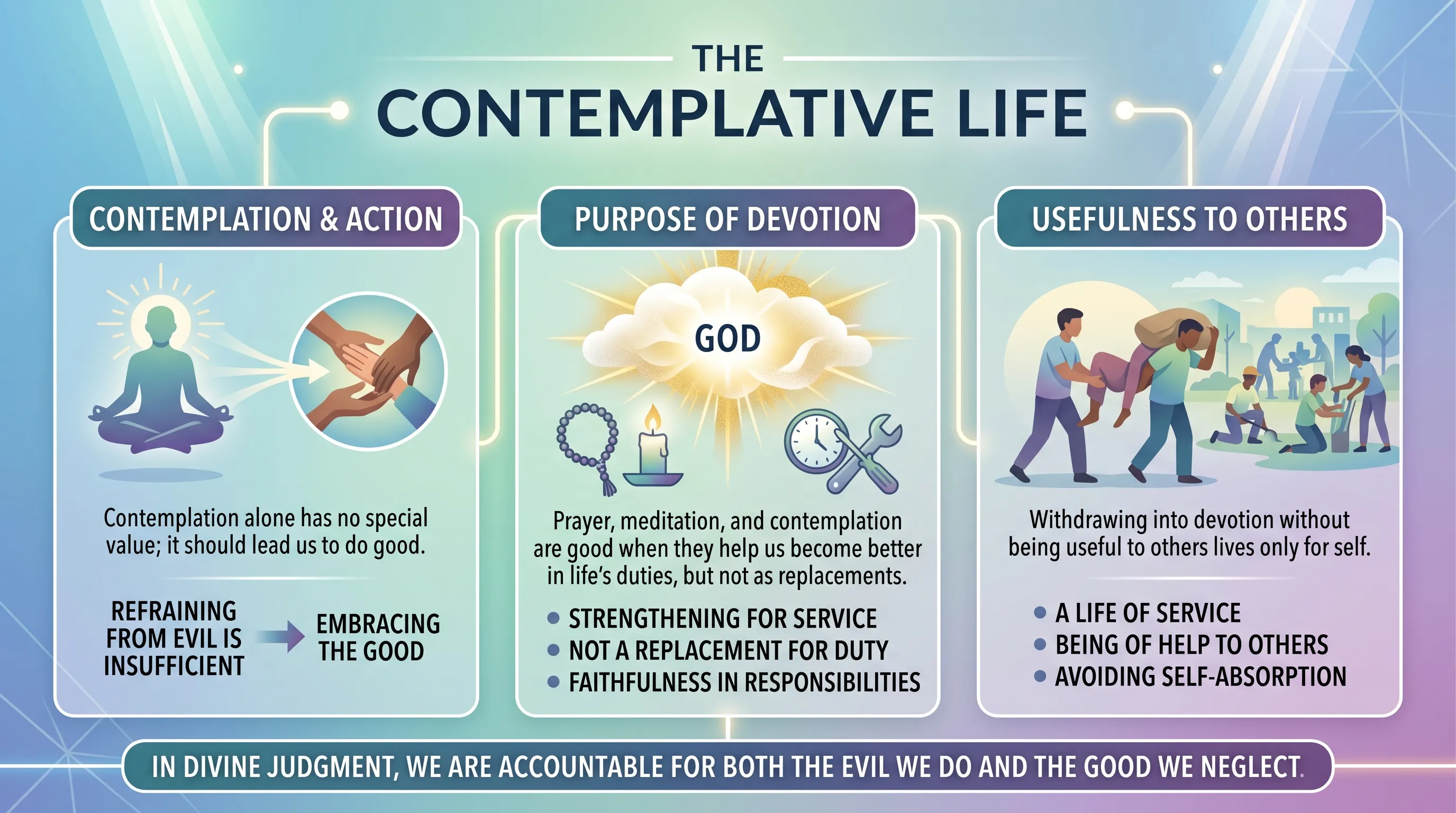
3.2.14 Living only in contemplation has no special value merely because it avoids evil and turns toward God.
3.2.15 It is not enough to refrain from doing wrong; we must also do the good we can do. Prayer, meditation, and contemplation are good when they help us become better and more faithful in life’s duties, but they are not meant to replace those duties.
3.2.16 A person who withdraws into inward devotion without being useful to others lives only for self. In God’s judgment, not only the evil we do matters, but also the good we neglect to do.
Prayer
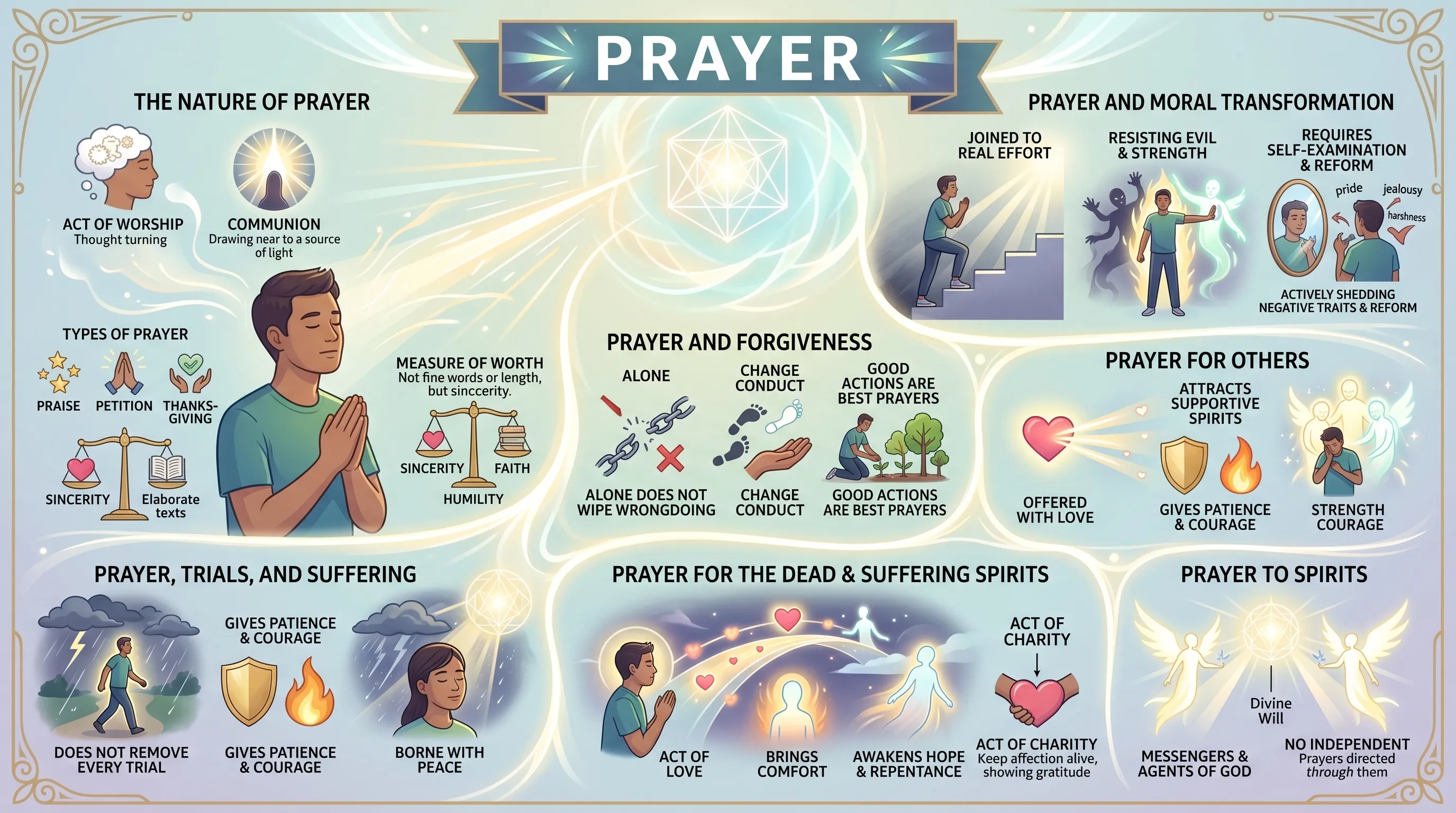
3.2.17 Prayer is pleasing to God when it comes from the heart. Its value is not in fine words or long formulas, but in sincerity, faith, and humility. Even the prayer of an imperfect person can be heard when it carries true repentance.
The Nature of Prayer
3.2.18 Prayer is an act of worship. It means turning our thought toward God, drawing near to Him, and entering into communion with Him.
3.2.19 Prayer includes praise, petition, and thanksgiving. It is not only spoken words, but an inward act of thought and will. Its worth is measured by sincerity, not by length.
Prayer and Moral Transformation
3.2.20 Prayer helps us become better when it is joined to real effort.
3.2.21 Those who pray with trust receive strength to resist evil, and good spirits come to support them. But prayer by itself does not change the heart. Many people pray while still remaining proud, jealous, or harsh. Prayer bears fruit only when it is joined to self-examination and true reform.
Prayer and Forgiveness
3.2.22 Prayer alone does not wipe away wrongdoing.
3.2.23 To ask forgiveness has value only when conduct changes. Good actions are the best prayers, and repentance must be shown in life, not only in words.
Prayer for Others
3.2.24 Prayer for others can bring real help.
3.2.25 When it is offered with love, it attracts good spirits who support that intention. A sincere prayer may bring another person strength, calmer thoughts, courage, or moral support. Here too, what matters most is the heart.
Prayer, Trials, and Suffering
3.2.26 Prayer does not remove every trial or cancel the laws established by God. Some hardships must be endured.
3.2.27 Still, prayer is never useless. It gives strength, patience, and resignation, and it draws good spirits near. Through prayer, suffering may not disappear, but it can be borne with more peace and courage.
Prayer for the Dead and for Suffering Spirits
3.2.28 Prayer for the dead and for suffering spirits is meaningful. It does not overturn divine justice, but it can bring comfort and relief.
3.2.29 A suffering spirit is touched by being remembered with love. This remembrance may awaken hope, repentance, and the desire to improve. To refuse such help is to fail in charity toward those most in need.
Why Prayer for the Dead Is an Act of Love
3.2.30 Love does not end with death. The duty to love one another includes those who have left earthly life.
3.2.31 Prayer for the departed is an act of charity. It consoles them, keeps the bond of affection alive, and may stir gratitude, love, and better thoughts in the spirit who is remembered.
Prayer to Spirits
3.2.32 Prayer may be addressed to good spirits, since they are messengers of God and agents of His will.
3.2.33 But they have no power apart from God. So such prayers have value only when they agree with the divine will. They are requests made to servants of God, not appeals to independent powers.
Polytheism
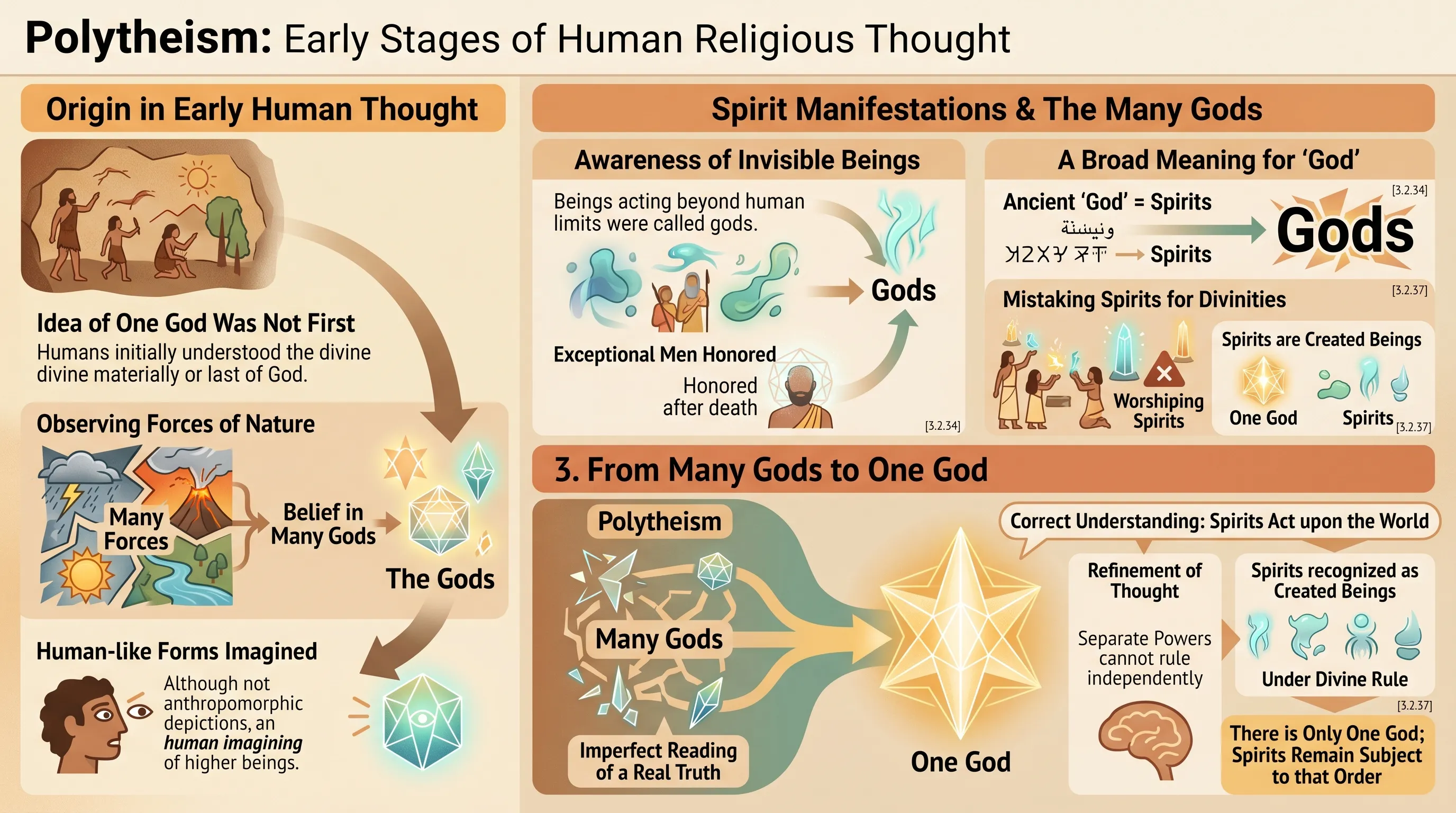
3.2.34 Polytheism belongs to the early stages of human religious thought.
3.2.35 The idea of one God was not humanity’s first idea. People first understood the divine in a material way, imagining higher beings with visible, human-like forms. Because nature showed many forces and effects, they were led to believe in many gods.
3.2.36 As reflection developed, people gradually saw that so many separate powers could not rule the world independently, and thought rose toward the idea of one God.
Spirit Manifestations and the Many Gods
3.2.37 Spirit manifestations also helped give rise to belief in many gods.
3.2.38 In every age, people have been aware of invisible beings acting beyond normal human limits. Since these beings seemed more than human, they were called gods. In the same way, exceptional men were sometimes honored after death as gods.
3.2.39 Among ancient peoples, the word god was often used more broadly than it is today. What we now call spirits were then often called gods. The error was not always in observing real beings, but in mistaking them for divinities and giving them worship.
3.2.40 Spirits are not gods in the absolute sense. They are created beings, like us, but without a material body and at different levels of advancement.
From Many Gods to One God
3.2.41 The move from polytheism to belief in one God did not require denying the facts that helped produce the older belief. It required understanding them correctly.
3.2.42 Spiritual beings did not cease to exist, but their meaning changed. Worship was directed to the One to whom it truly belongs, while spirits were recognized as created beings under divine rule.
3.2.43 So the old belief in many gods can be seen as an imperfect reading of a real truth: spirits do act upon the world. Spiritism studies these manifestations in broad daylight and helps explain them without making spirits into gods.
Sacrifice
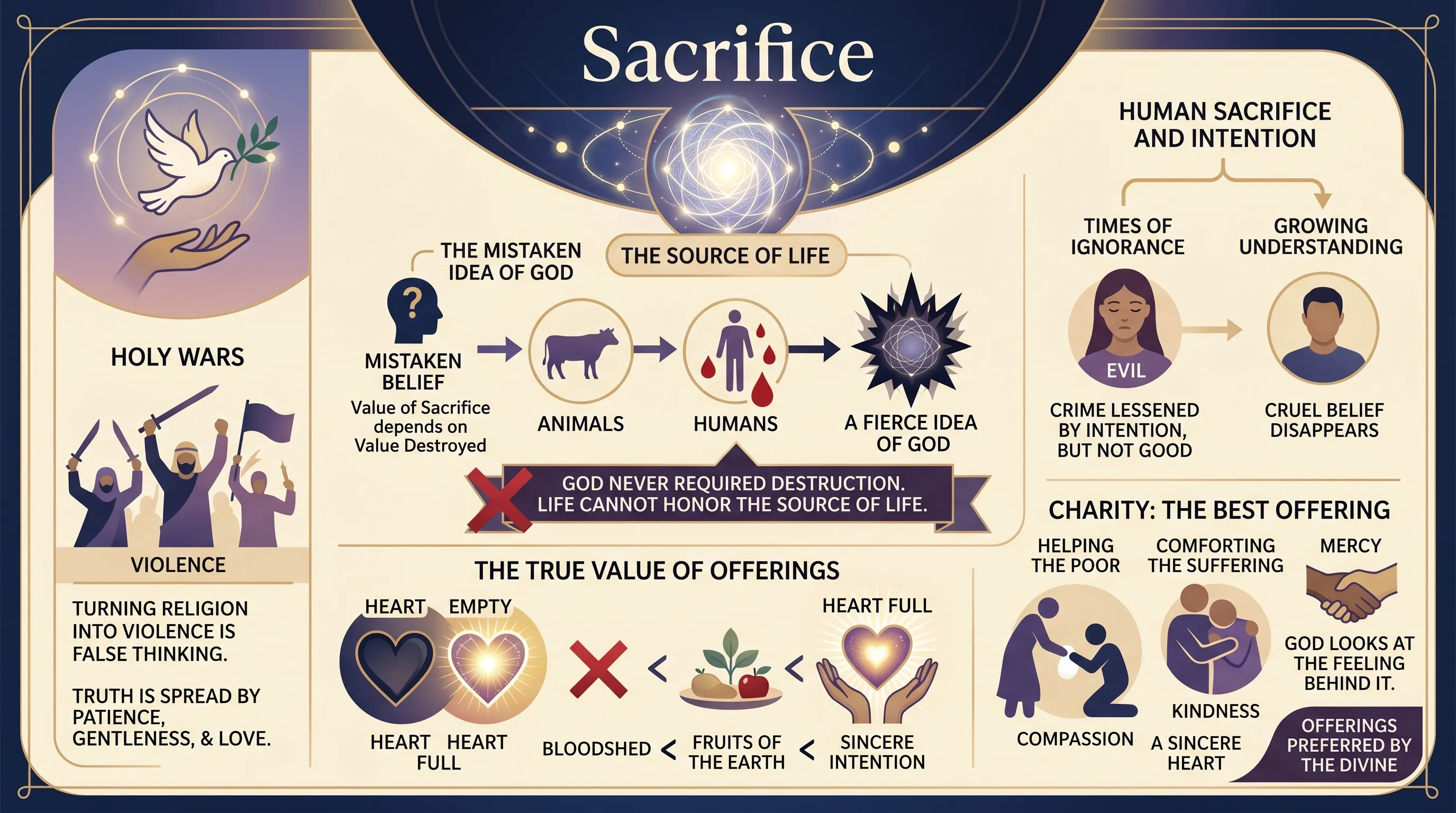
3.2.44 Sacrifice came from a mistaken idea of God. People thought the value of an offering depended on the value of what was destroyed. Since a living being seemed more precious than the fruits of the earth, they imagined that blood would please God more. From this error came animal sacrifice and, later, human sacrifice.
3.2.45 But God never required such things. The destruction of life cannot honor the source of life.
Human Sacrifice and Intention
3.2.46 Human sacrifice has always been wrong.
3.2.47 Still, in times of ignorance, many believed they were doing something pleasing to God. In judging them, intention must be considered along with the act. The crime may be lessened by ignorance, but it does not become good. As people grew in understanding, this cruel belief had to disappear.
3.2.48 And often, even among those who practiced it, there was already an inner sense that it was evil.
Holy Wars
3.2.49 The same false thinking appears in holy wars. When people believe they honor God by killing those who worship differently, they turn religion into violence.
3.2.50 God does not ask one person to destroy another for His sake. All are moving toward the same God, though they may know Him in different ways. Truth is not spread by force. It is spread by patience, gentleness, and love.
The True Value of Offerings
3.2.51 No outward offering has value if the heart is empty.
3.2.52 The fruits of the earth are worth more than bloodshed, but sincere intention is worth more than any material gift. God looks less at what is offered than at the feeling behind it.
Charity as the Best Offering
3.2.53 The best offering to God is charity.
3.2.54 What is set aside for worship should serve those in need. Helping the poor, comforting the suffering, and practicing mercy please God far more than destroying goods in ceremony. Kindness, compassion, and a sincere heart are the offering He prefers.