3.10 Freedom of Choice
Natural Freedom
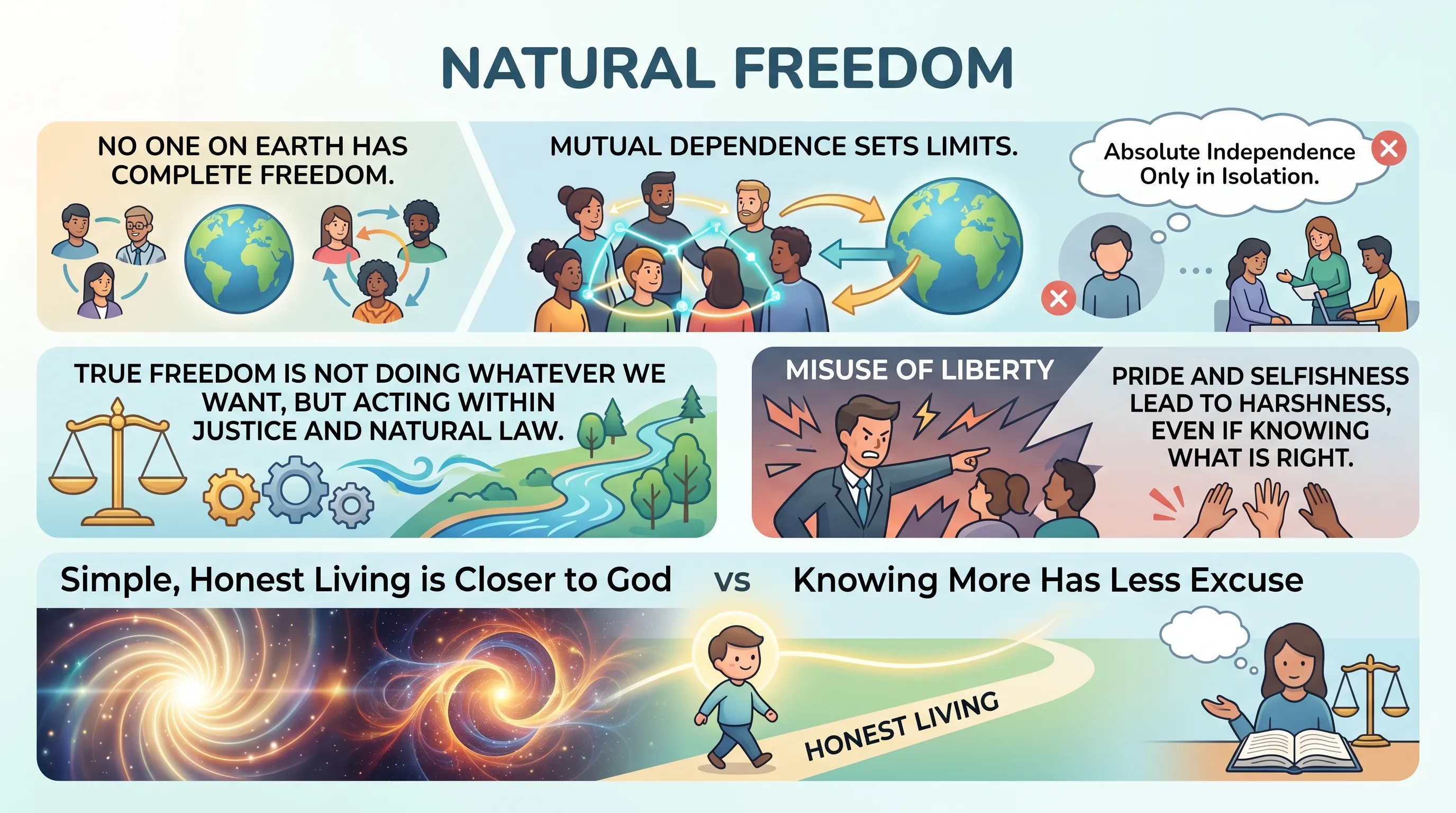
3.10.1 No one on earth has complete freedom.
3.10.2 Living together creates mutual dependence, and that sets limits. Absolute independence would only exist in isolation. Wherever people have relationships, they also have rights, and each person must respect the rights of others.
3.10.3 This does not destroy freedom. True freedom is not doing whatever we want, but acting within justice and natural law.
3.10.4 Many speak of liberty yet treat those near them or under their authority harshly. Pride and selfishness cause this. They may know what is right, but do not practice it.
3.10.5 This fault is greater when a person clearly understands the law of justice. Those who know more have less excuse. Simple, honest people who live by the good they understand may be nearer to God than those who only seem virtuous.
Slavery
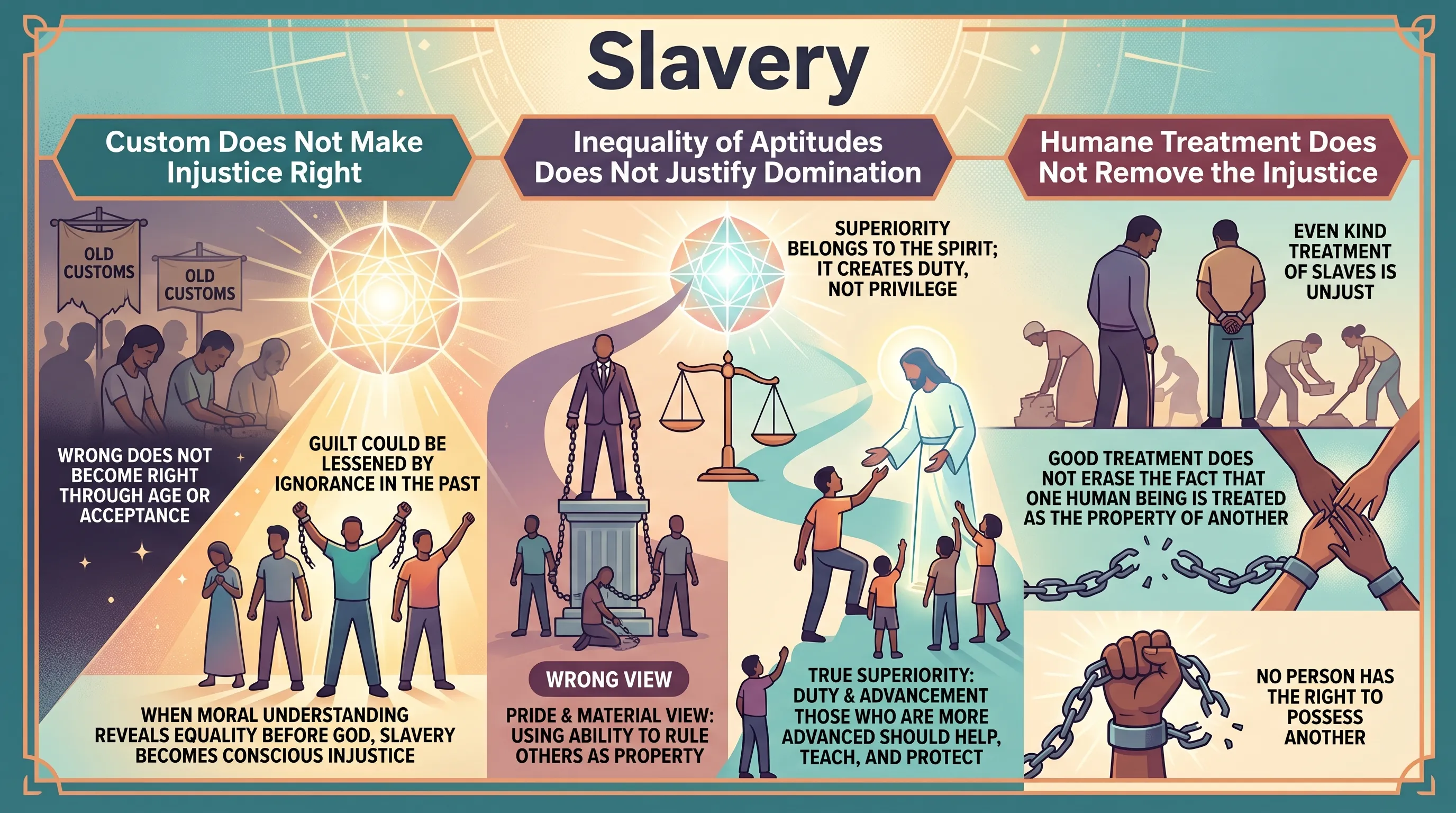
3.10.6 No one is made to belong to another person. Slavery is against the law of God and against nature. It comes from force and abuse, and it degrades both the body and the soul. Any human law that permits it is unjust. As humanity advances, slavery must disappear.
Custom Does Not Make Injustice Right
3.10.7 A wrong does not become right because it is old or widely accepted. When slavery was part of a people’s customs, many followed it without clearly seeing all its evil. Their guilt could be lessened by ignorance.
3.10.8 But once reason and moral understanding reveal that all are equal before God, that excuse no longer stands. Then slavery becomes a conscious injustice.
Inequality of Aptitudes Does Not Justify Domination
3.10.9 Differences in intelligence, ability, or development do not give anyone the right to dominate another. Those who are more advanced should help, teach, and protect those who are less advanced, not enslave them.
3.10.10 Pride has led some people to treat others as inferior and to think they have a right to rule over them as property. This is a false and material view. Real superiority belongs to the spirit and creates duty, not privilege.
Humane Treatment Does Not Remove the Injustice
3.10.11 Even when a master treats slaves kindly, slavery remains unjust. Good treatment does not erase the fact that one human being is treated as the property of another.
3.10.12 Cruelty makes the wrong worse, but the wrong already exists in the claim of ownership itself. No person has the right to possess another.
Freedom of Thought
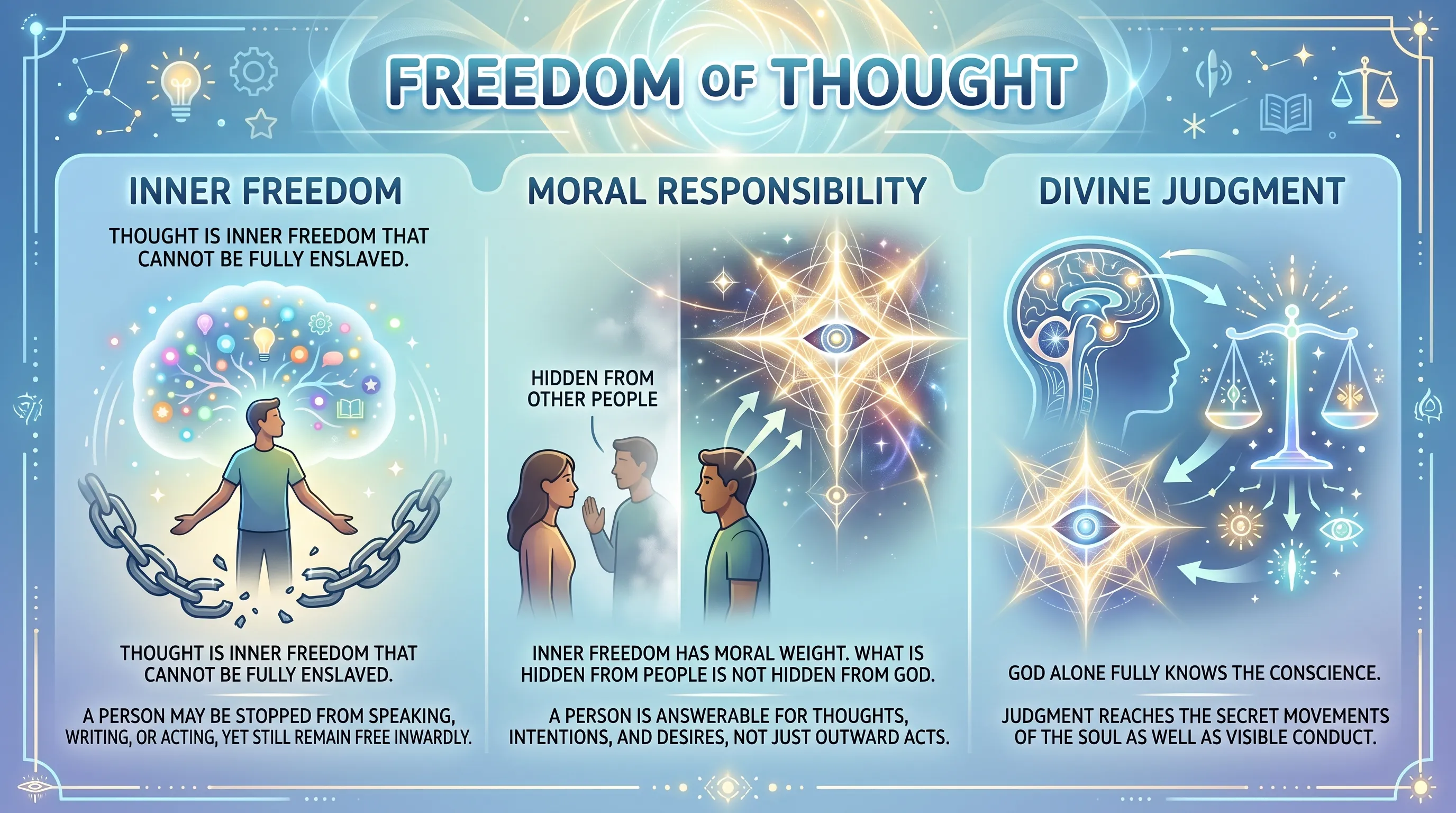
3.10.13 Thought is the one thing no outside power can fully enslave. A person may be stopped from speaking, writing, or acting, yet still remain inwardly free.
3.10.14 This inner freedom has moral weight. What is hidden from other people is not hidden from God. A person is answerable not only for outward acts, but also for thoughts, intentions, and desires.
3.10.15 God alone fully knows what passes in the conscience, and judgment reaches the secret movements of the soul as well as visible conduct.
Freedom of Conscience
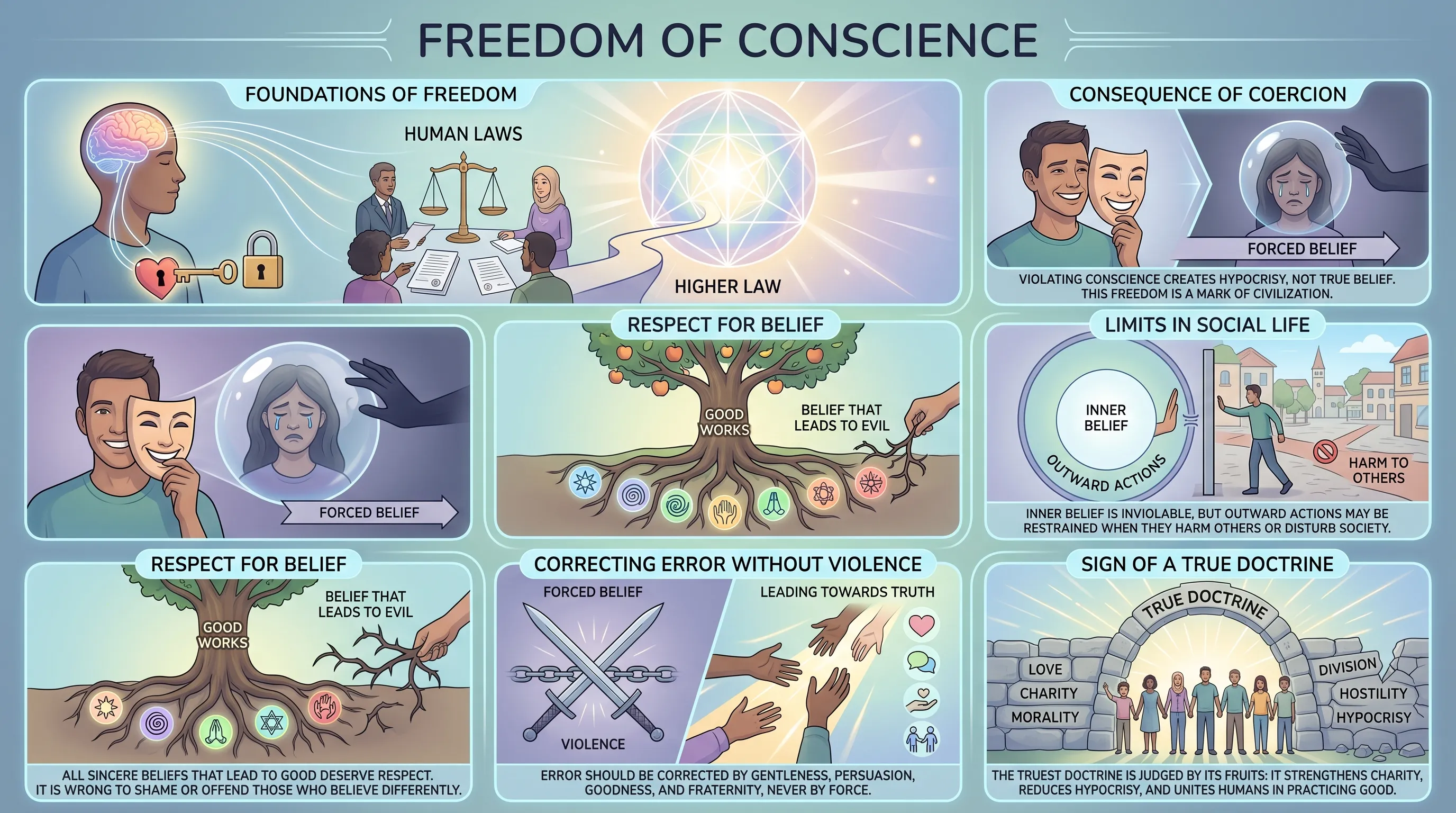
3.10.16 Freedom of conscience follows from freedom of thought. Since conscience is inward, no one has the right to constrain it. Human laws govern relations between people, but a person’s relation to God belongs to a higher law.
3.10.17 To violate freedom of conscience is to force someone to act against true belief. This produces hypocrisy, not conviction. For that reason, freedom of conscience is a mark of civilization and progress.
Respect for Belief
3.10.18 Not every belief is equally true, but every sincere belief deserves respect when it leads to good. What deserves blame is belief that leads to evil. It is therefore wrong to use our convictions to shame or offend those who believe differently. That violates charity and freedom of thought.
Limits in Social Life
3.10.19 Freedom of conscience does not mean every outward act done in the name of belief must be allowed. Inner belief cannot be forced, but outward actions may be restrained when they disturb society or harm others. Restraining harmful acts does not destroy freedom of conscience.
Correcting Error Without Violence
3.10.20 When harmful teachings spread, it is right and even a duty to lead those in error toward truth. But this must be done by gentleness, persuasion, goodness, and fraternity, never by force. Violence harms the cause it claims to defend. Forced belief is not belief.
The Sign of a True Doctrine
3.10.21 Since many doctrines claim truth, they should be judged by what they produce. A good doctrine creates fewer hypocrites and more truly moral people who practice love and charity. When a teaching spreads division and hostility, it bears the mark of error.
3.10.22 The truest doctrine is the one that most strengthens charity, reduces hypocrisy, and unites human beings in the practice of good.
Free Will
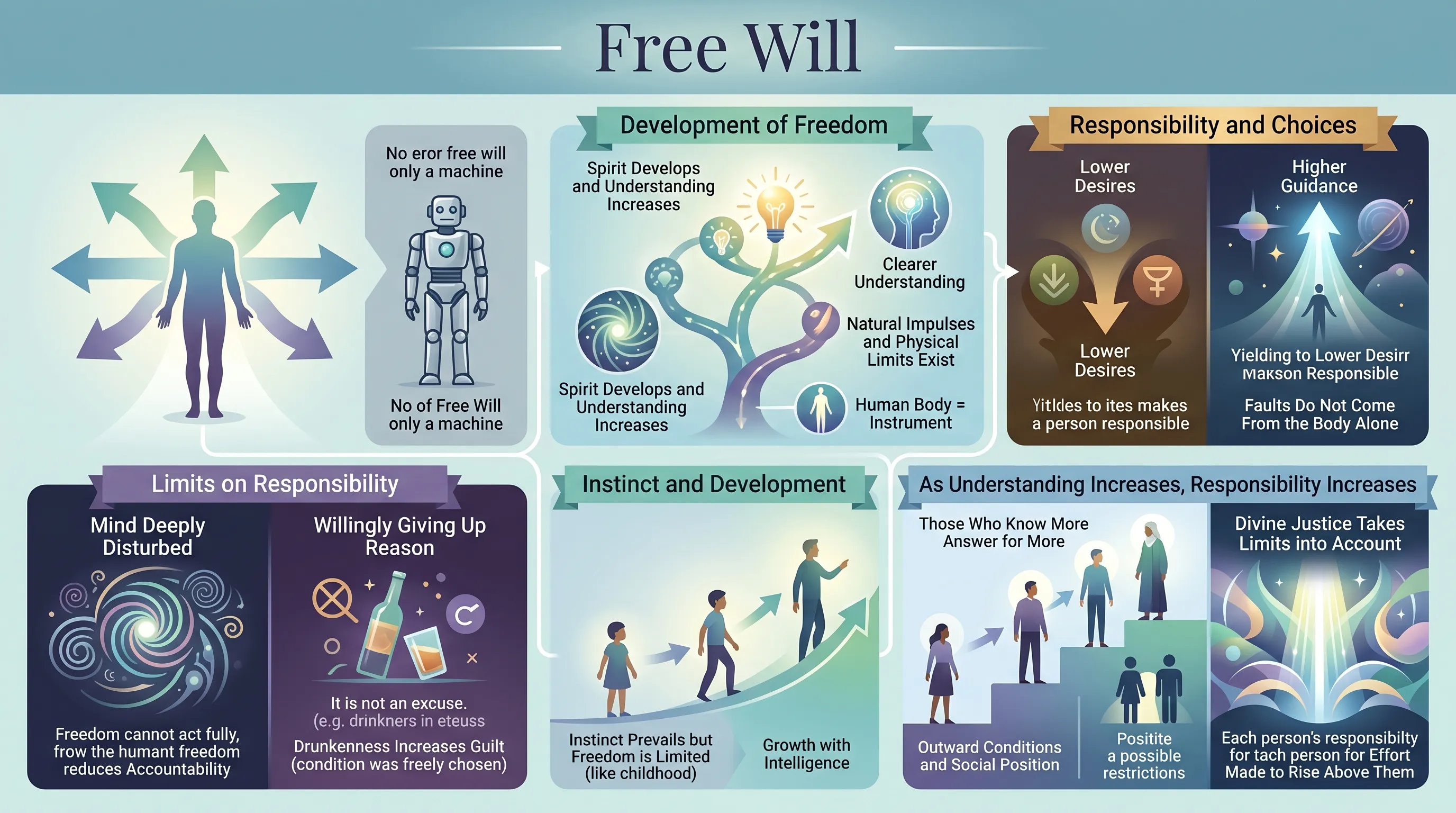
3.10.23 Human beings have freedom to choose. Without it, a person would be only a machine.
3.10.24 This freedom is not fully active from the beginning. It grows as the spirit develops and gains clearer understanding. Natural impulses may push someone in a certain direction, and the body may limit outward action, but neither destroys free will. The body is only an instrument; it does not create the spirit’s moral nature.
3.10.25 So our faults do not come from the body alone. When a person yields to lower desires instead of following higher guidance, that person is responsible.
Limits on Responsibility
3.10.26 Responsibility becomes less when freedom is seriously weakened. If the mind is deeply disturbed, free will cannot act fully, and accountability is reduced. This condition may itself be a trial or an expiation.
3.10.27 But a person who willingly gives up reason is not excused. Drunkenness freely chosen does not lessen guilt. It often increases it, because the person chose the condition that led to the wrong.
Instinct, Development, and Accountability
3.10.28 In less developed states, instinct has a larger place. Even then, freedom is not absent; it is only more limited, as in childhood, and it grows with intelligence.
3.10.29 As understanding increases, responsibility also increases. Those who know more answer for more. Outward conditions and social position may restrict freedom, but divine justice takes these limits into account. They may lessen blame, yet each person remains responsible for the effort made—or not made—to rise above them.
Fatalism
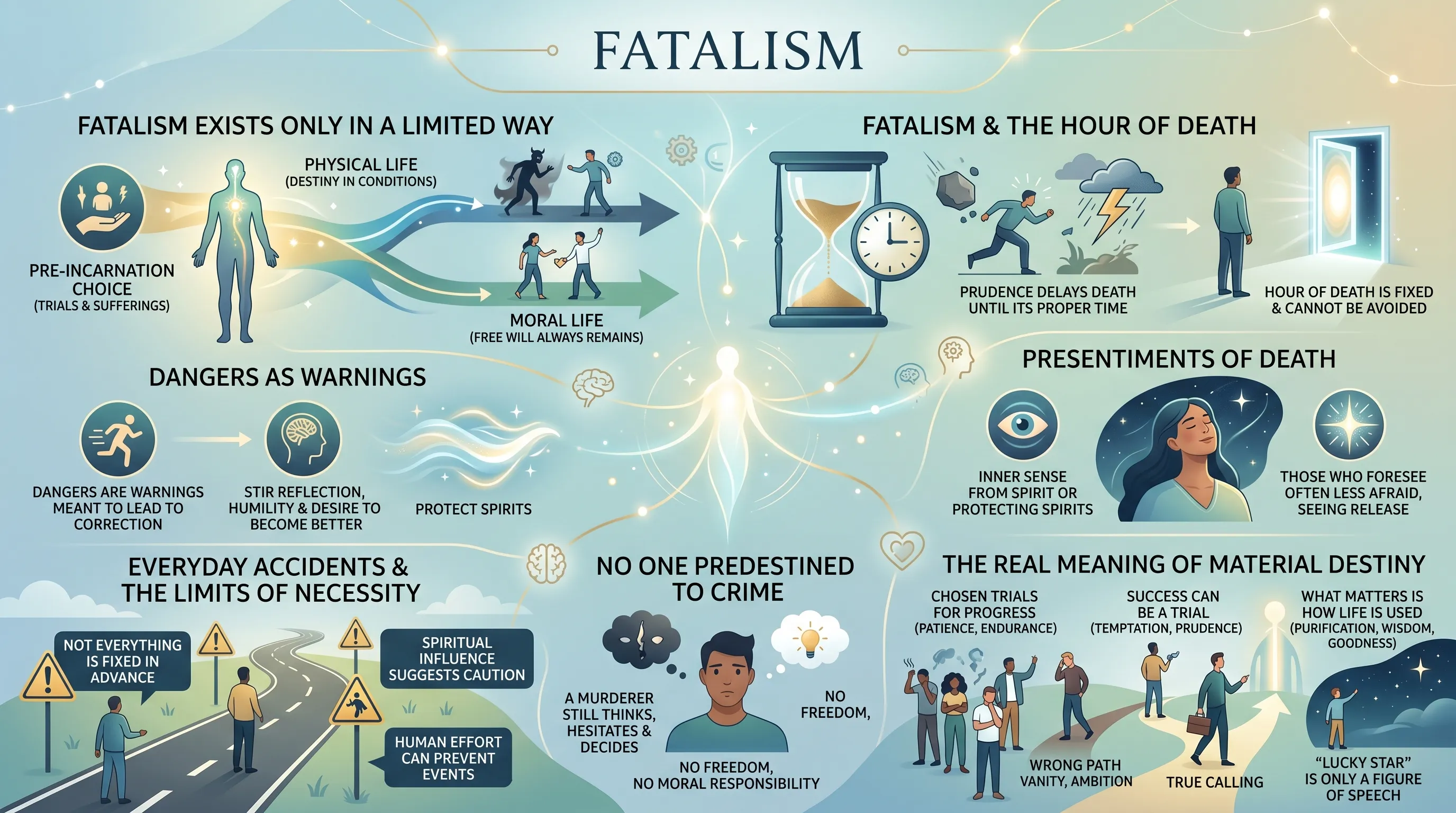
3.10.30 Fatalism exists only in a limited way.
3.10.31 It applies to the conditions, trials, and sufferings a spirit chooses before incarnation, forming a kind of destiny for physical life, not moral life.
3.10.32 In moral matters, free will remains. In temptation and in the struggle between good and evil, the spirit is always free to resist or give in. Good spirits may encourage and lower spirits may disturb, but none take away freedom. Much of what people call fate is really the result of their own actions.
Fatalism and the Hour of Death
3.10.33 Fatalism, in the strict sense, applies especially to the moment of death.
3.10.34 When the hour of death has come, it cannot be avoided. Before that time, dangers may threaten without succeeding. Yet prudence is not useless, since the care taken to avoid danger is one of the means by which death is delayed until its proper time.
3.10.35 Before incarnation, a spirit may know that the life it chooses exposes it more to one kind of death than another, without knowing every detail in advance.
Dangers as Warnings
3.10.36 Dangers are not always meaningless.
3.10.37 Sometimes a danger that passes serves as a warning. It can stir reflection, humility, and the desire to become better. Good spirits help these awakenings.
3.10.38 A danger may also be linked to some fault, imprudence, or neglected duty. It is often a warning meant to lead to correction.
Presentiments of Death
3.10.39 Some people feel that their end is not yet near, while others sense that death is close.
3.10.40 These presentiments may come from protecting spirits, who warn a person in order to prepare or strengthen them. They may also come from the spirit itself, through an inner sense of the life it chose and the task it still has to complete.
3.10.41 Those who foresee death are often less afraid of it, seeing it more as a release than an end.
Everyday Accidents and the Limits of Necessity
3.10.42 Not everything in life is fixed in advance.
3.10.43 Many ordinary accidents can be avoided. Spiritual influence may suggest caution or lead a person toward a safer choice. True fatalism applies only to birth, death, and certain major events connected with the path chosen before incarnation.
3.10.44 It is wrong to think that every detail of life is written in advance. Much happens through free action. Only the great sorrows and decisive experiences that aid moral growth belong to the larger design.
Can Events Be Avoided?
3.10.45 Human effort can often prevent events that seemed likely or even destined, so long as the change does not conflict with the overall course of the life chosen.
3.10.46 Doing good has real power. By fulfilling duty and choosing rightly, a person may avoid much evil. Destiny does not cancel responsibility.
No One Is Predestined to Commit Crime
3.10.47 No one is ever predestined to commit a crime.
3.10.48 A spirit may choose a life in which grave wrongdoing becomes possible, but not the act itself as necessary. A murderer still thinks, hesitates, and decides before acting. Without freedom, there could be no moral responsibility.
3.10.49 If fatalism exists, it concerns certain outward events independent of the will. Moral acts always remain free.
Apparent Bad Luck in Human Affairs
3.10.50 Some lives seem full of constant failure. This may sometimes be part of a chosen trial, especially to develop patience or endurance. But failure is not always unavoidable.
3.10.51 People often fail because they follow the wrong path, choosing work unsuited to their abilities or true calling. Vanity and ambition push them toward what flatters pride, and then they blame fate.
Social Customs and Free Will
3.10.52 Social pressure does not destroy freedom.
3.10.53 Customs are made by people, not imposed by God. If someone submits to them, it is usually because they prefer public approval to the cost of independence. Many would rather suffer ruin than accept modest work beneath their social position.
3.10.54 Better judgment is shown by quietly accepting a simpler place in life when circumstances require it.
Apparent Good Fortune
3.10.55 Just as some seem followed by bad luck, others seem favored by fortune.
3.10.56 Often this is simply because they are more prudent, moderate, and realistic. What looks like luck may really be good judgment. But success can also be a trial, since prosperity may lead to overconfidence.
3.10.57 Even luck in things like games of chance may have a moral meaning, as a temptation accepted beforehand.
The Real Meaning of Material Destiny
3.10.58 What seems to rule material destiny is often the result of free choices made before and during earthly life.
3.10.59 Spirits choose trials according to what can best help their progress. For that reason, many choose difficult lives rather than easy ones. Earthly greatness and pleasure do not matter much in themselves.
3.10.60 What matters is how life is used, whether suffering becomes a means of purification, whether freedom is used well, and whether the spirit grows in patience, wisdom, and goodness.
“Born Under a Lucky Star”
3.10.61 The saying that someone is born under a lucky star comes from an old superstition that connected the stars with human destiny.
3.10.62 At most, it can be kept as a figure of speech. Taken literally, it is only a mistake.
Foreknowledge of the Future
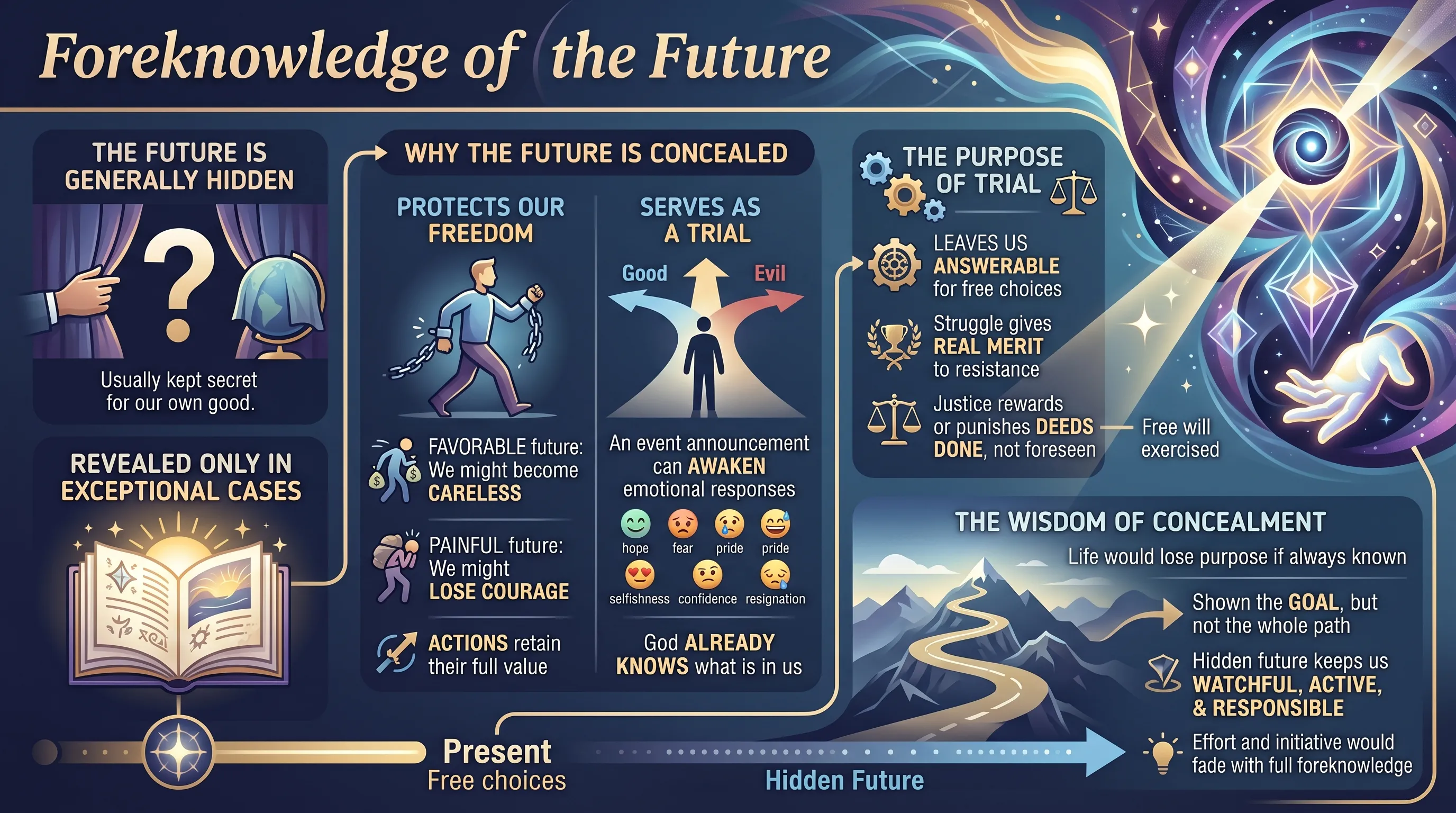
3.10.63 As a general rule, the future is hidden from us. It is revealed only in exceptional cases.
Why the Future Is Sometimes Revealed
3.10.64 This concealment is for our good. If we knew events in advance, we would often lose our freedom in the present. A favorable future might make us careless. A painful one might weaken our courage. In both cases, our actions would lose part of their value.
3.10.65 Still, the future is sometimes revealed when that knowledge can help bring about what must happen instead of hindering it. It may also serve as a trial, because the announcement of an event can awaken hope, fear, pride, selfishness, confidence, or resignation.
The Purpose of Trial
3.10.66 Trial is not given because God needs to discover what is in us. God already knows.
3.10.67 Its purpose is to leave us answerable for what we freely choose. Since we can follow either good or evil, we must face situations where that freedom is exercised. The struggle gives real merit to resistance, and justice rewards or punishes deeds that were truly done, not those only foreseen.
The Wisdom of Concealment
3.10.68 Even when a predicted event does not happen exactly as expected, the moral effect may still remain. The thoughts, desires, and choices it stirred up can still bring merit or blame.
3.10.69 If the future were always known, life would lose much of its purpose. We are shown the goal, but not usually the whole path. If every obstacle were known beforehand, effort would fade, initiative would weaken, and free will would be less active. The hidden future keeps us watchful, active, and responsible.
A Theoretical Summary on the Driving Force behind Human Actions
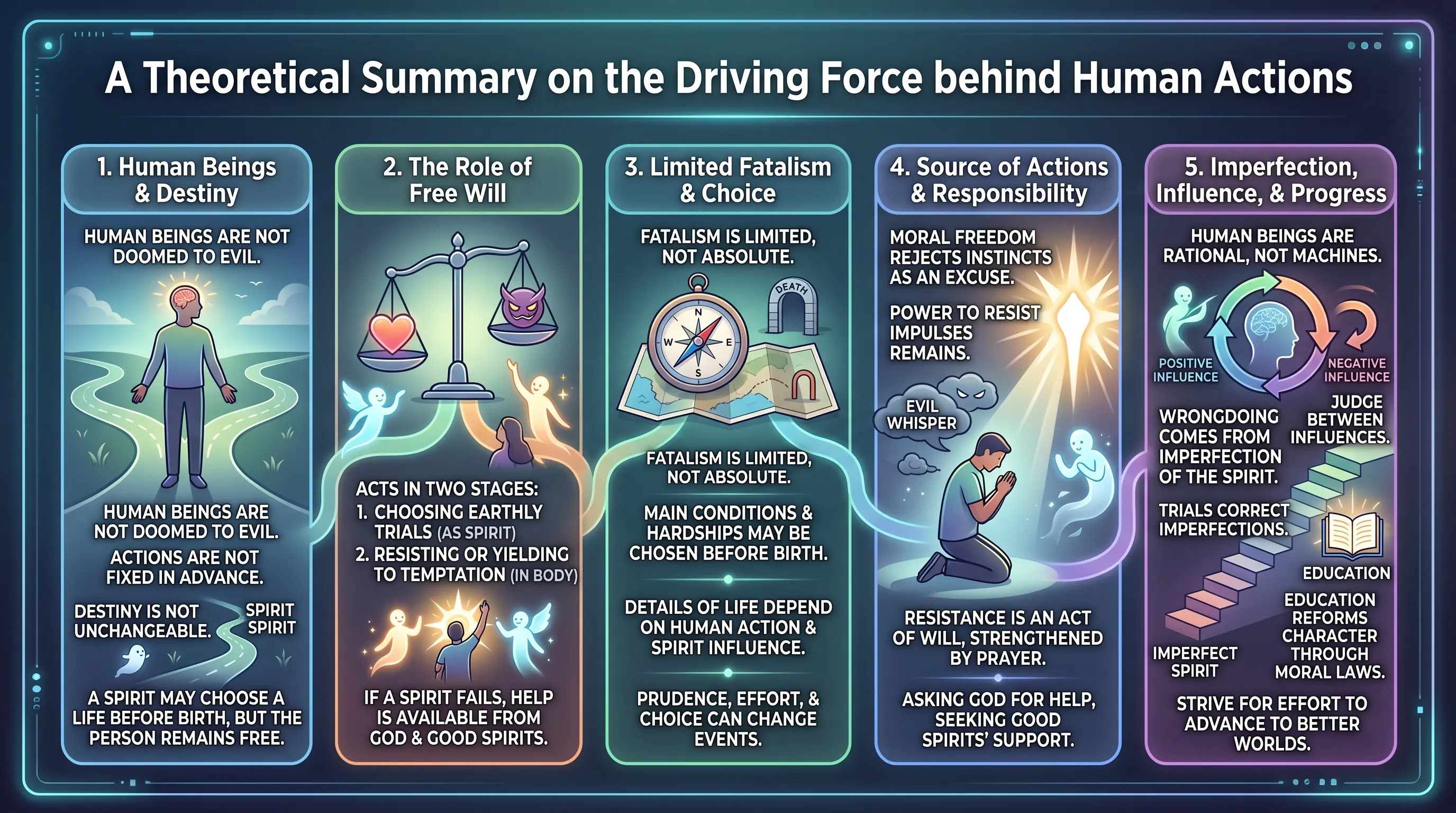
3.10.70 Human beings are not doomed to evil.
3.10.71 Their actions are not fixed in advance, and wrongdoing does not come from an unchangeable destiny. A spirit may choose before birth a life where crime is more likely, but the person remains free.
3.10.72 Free will acts in two stages: in spirit life, in choosing trials and earthly life; in bodily life, in resisting or yielding to temptation. If a spirit gives in to matter, it fails in a trial it accepted, but help is available through God and good spirits.
3.10.73 Without free will, there could be no guilt in evil or merit in good.
Fatalism and Moral Freedom
3.10.74 Fatalism, taken absolutely, would destroy responsibility and moral progress.
3.10.75 There is only a limited kind of fatalism.
3.10.76 Before birth, a spirit may choose a certain life as a trial, expiation, or mission. In that sense, the main conditions and hardships of life may be necessary. But whether a person gives in or resists remains a matter of will.
3.10.77 The details of life are not fixed absolutely. They depend partly on human action and partly on the influence of spirits. Prudence, effort, and moral choice can change events.
The Fatality of Death
3.10.78 There is one point where human beings are fully under fatalism: death.
3.10.79 No one escapes the end fixed for earthly life, nor the kind of death appointed to end it.
The Source of Human Actions
3.10.80 Many think instincts come only from the body or inborn nature. That idea can become an excuse for wrongdoing.
3.10.81 Moral freedom rejects this excuse. Even when an evil impulse comes from outside, the person remains responsible because the power to resist remains. This resistance is an act of will, strengthened by prayer, by asking God for help, and by seeking the support of good spirits.
Imperfection, Influence, and Progress
3.10.82 Human beings are not machines driven by a foreign force.
3.10.83 They are rational beings who judge and choose between influences. They also act from themselves, because as incarnate spirits they still carry the qualities and defects they had before birth.
3.10.84 The deepest source of wrongdoing is the imperfection of the spirit itself. Earthly life is given so these imperfections may be corrected through trial.
3.10.85 These imperfections also make the spirit more open to other imperfect spirits. If it overcomes the struggle, it advances. If it fails, it does not improve, and the trial must be faced again. As the spirit becomes purified, evil spirits lose their power over it.
Education and the Reform of Character
3.10.86 Education has an important role in fighting evil tendencies.
3.10.87 It must rest on a true understanding of human moral nature. Just as the mind is developed by teaching and the body by care, character can be changed by learning the laws of moral life. Evil tendencies are not final. They can be corrected and gradually transformed.
Humanity and the Condition of the Earth
3.10.88 All incarnate spirits, whether advanced or less advanced, belong to the human race.
3.10.89 Because the earth is one of the less advanced worlds, it contains more imperfect spirits than good ones. Much of the evil seen here comes from that condition. Life on earth is therefore a life of struggle, trial, and moral work.
3.10.90 The right response is effort. Each person should strive not to return to such a world through continued imperfection, but to become worthy of a better one, where goodness prevails.