1.2 The Basic Elements of the Universe
The Knowledge of the Origin of Things
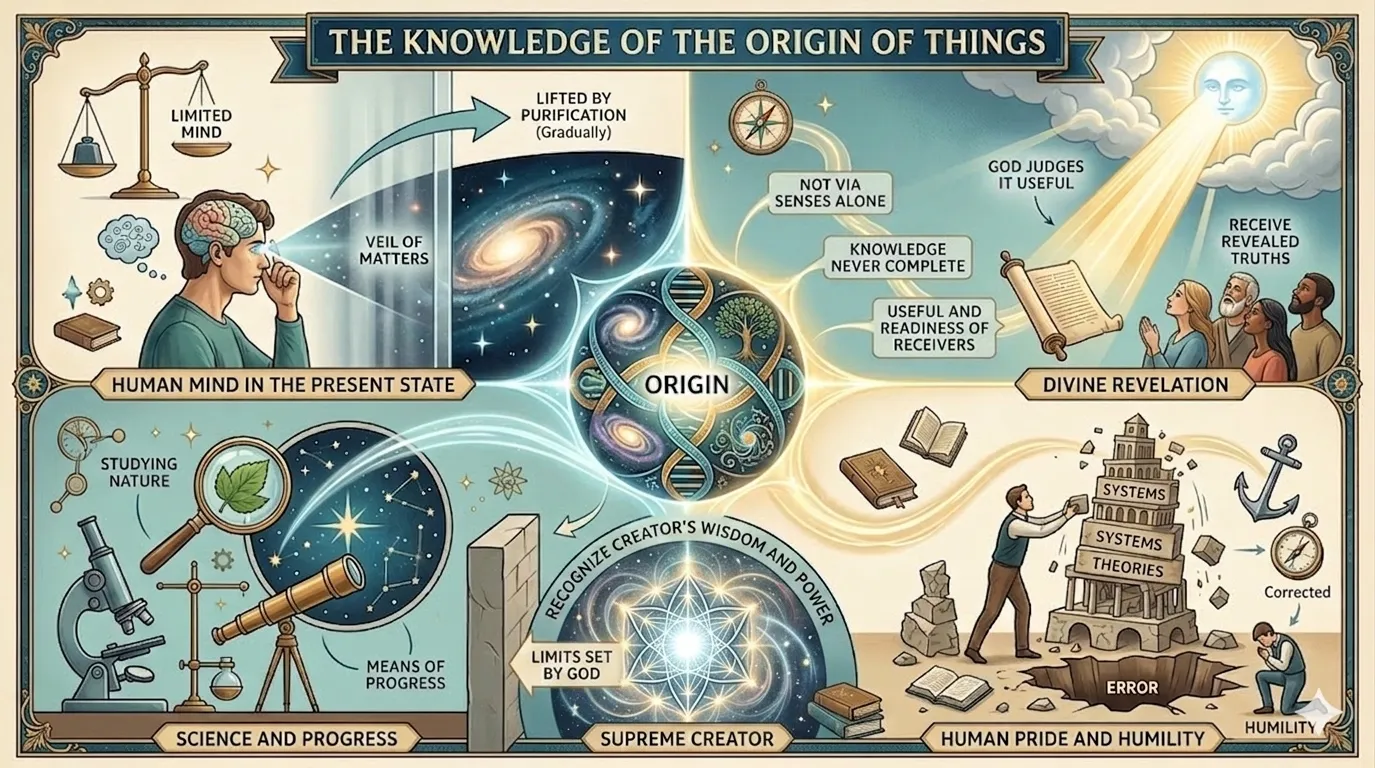
1.2.1 While living on earth, human beings cannot know everything about the origin of things.
1.2.2 Some truths remain hidden, because in our present state the mind has limits. As we become more purified, this veil is lifted little by little.
1.2.3 Science is a means of progress. By studying nature, people can learn much, but science cannot pass the limits set by God. The more creation is understood, the more one should recognize the wisdom and power of the Creator.
1.2.4 Human pride often leads to error. People make systems and theories that later must be corrected, and these mistakes should teach humility.
1.2.5 There is also knowledge that does not come through the senses alone. When God judges it useful, truths may be revealed that science cannot reach by itself. But this knowledge is never complete. It is given according to what is useful and the readiness of those who receive it.
Spirit and Matter
1.2.6 Only God knows whether matter is eternal like God or was created at some specific time in the past.
Matter
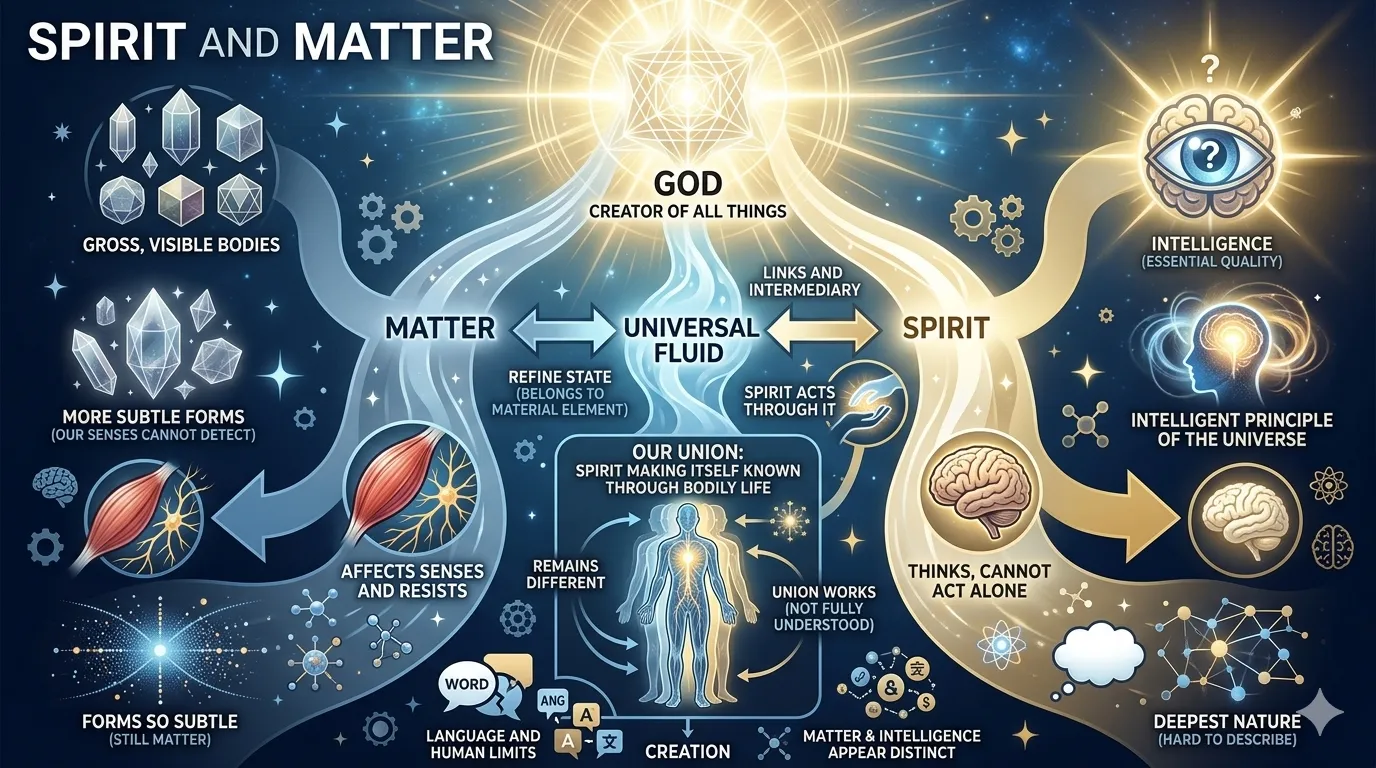
1.2.7 Matter is often defined as what has extension, can affect the senses, and can resist or block other bodies. This is useful, but too limited.
1.2.8 Matter is not only what we see and touch. It may also exist in forms so subtle that our senses cannot detect them. Even then, it is still matter.
Spirit
1.2.9 Spirit is the intelligent principle of the universe.
1.2.10 Spirit’s innermost nature is not easy to explain in human language. For human beings, it is nothing because it is not something palpable; nevertheless, for spirits it is something. Intelligence is one of the essential qualities of spirit.
The Distinction and Union of Spirit and Matter
1.2.11 Spirit and matter are distinct. Spirit is not matter, and matter by itself does not think.
1.2.12 Yet spirit needs to be joined to matter in order to act in the material world. In us, this union is what allows spirit to make itself known through bodily life. We do not fully understand how this union works, but the two principles remain different.
The General Elements of the Universe
1.2.13 The universe has two general elements: matter and spirit. Above both is God, the Creator of all things.
1.2.14 Matter must be understood in a broader sense than gross, visible bodies. Between spirit and ordinary matter there is also a more subtle element, often called the universal fluid, which serves as an intermediary.
1.2.15 This universal fluid belongs to the material element, but in a more refined state. Through it, spirit can act upon matter, and the connection between the two becomes possible.
Language and Human Limits
1.2.16 Many disputes come from words more than from the things themselves. Human language is limited when it tries to speak of what is beyond the senses.
1.2.17 Whether intelligence has its own independent existence, is only a property or effect, or even an emanation of the Divinity, is unknown. Matter and intelligence are distinct, as far as human beings are concerned.
God Above Spirit and Matter
1.2.18 Above spirit and matter is the supreme intelligence that rules all: God.
1.2.19 There are two general elements in the universe: matter and spirit. Above everything is God, the Creator and author of all. To the element of matter must be added the universal fluid, which plays an intermediary role between spirit and matter.
The Properties of Matter
1.2.20 Weight belongs to matter only in the way humans usually understand it. It does not apply in the same way to the universal fluid, the subtle substance from which denser matter is formed. Weight is relative, not absolute. Away from the pull of worlds, there is no weight, just as there is no up or down.
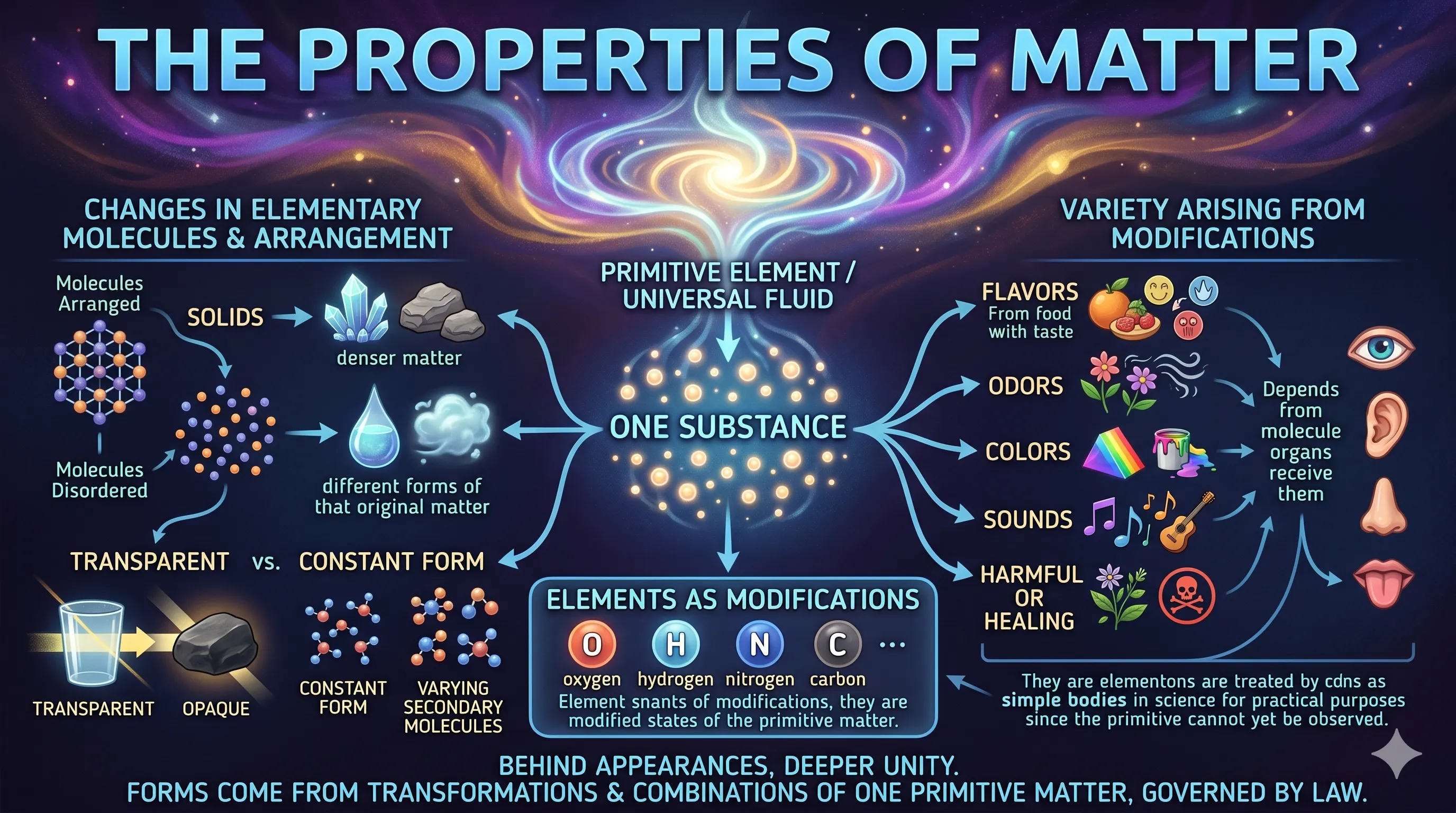
1.2.21 Matter is not made from many truly first elements. There is one primitive element. What we call simple bodies are only different forms of that original matter.
1.2.22 The different properties of matter come from changes in its elementary molecules and from the way they are arranged. The great variety of the material world comes from the different states of one same substance.
1.2.23 Flavors, odors, colors, sounds, and the harmful or healing qualities of bodies all arise from these changes. They also depend on the organs that receive them.
The General Elements of the Universe
1.2.24 The same elementary matter can undergo all kinds of modifications and take on all kinds of properties. So the diversity of bodies does not require many original substances, but many states and combinations of one primitive substance.
1.2.25 Oxygen, hydrogen, nitrogen, carbon, and the other elements treated as simple in science are only modifications of that primitive matter. Since the primitive element cannot yet be observed directly, science may still treat these as elements for practical purposes.
1.2.26 The secondary qualities of bodies also depend on force, movement, and the arrangement of molecules. A body may become opaque or transparent without changing its basic substance, simply because the arrangement of its parts has changed.
1.2.27 Primitive elementary molecules have a constant form. Secondary molecules, which are groupings of the first, can vary.
1.2.28 Behind the many appearances of nature there is a deeper unity. The forms of bodies come from transformations and combinations within one primitive matter, governed by law.
Universal Space
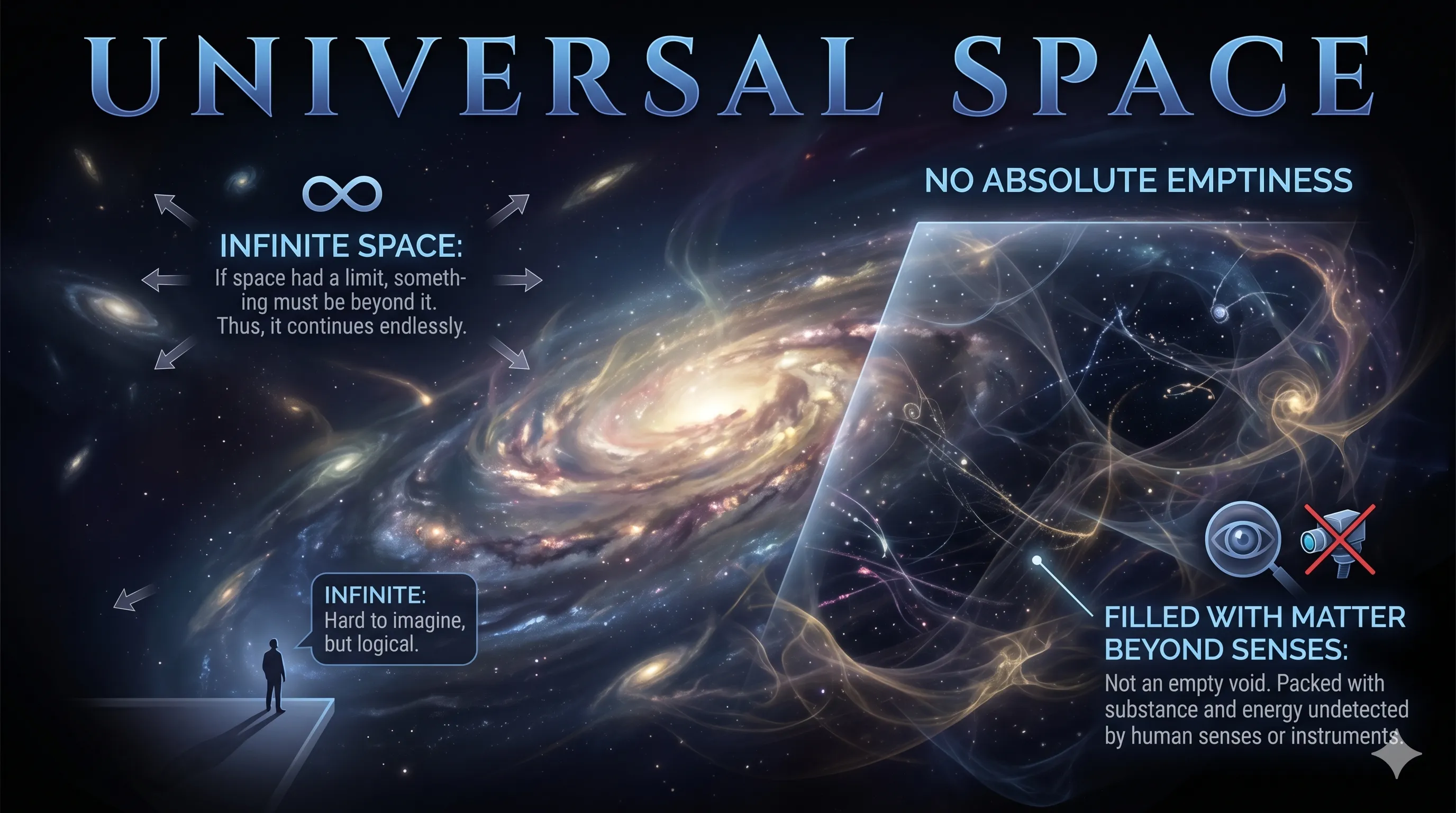
1.2.29 Universal space is infinite.
1.2.30 If space had a limit, there would have to be something beyond that limit. But then space would continue. So it cannot truly have an end, even if this is hard for the human mind to imagine.
1.2.31 There is also no absolute emptiness in universal space.
1.2.32 What seems empty is not really empty. It is filled with kinds of matter or substance that our senses, and even our instruments, cannot detect. So what looks like a void is only empty to us.