3.12 Moral Growth
Virtues and Vices

3.12.1 Virtue shows movement toward the good.
3.12.2 There is real virtue whenever a person freely resists harmful tendencies. Its highest form is giving up personal interest for the good of others, without hidden motive or desire for reward. The greatest merit belongs to the most selfless charity.
3.12.3 Some seem to do good without struggle. This does not lessen their worth; it means earlier inner battles have already been won, and goodness has become natural.
The Most Characteristic Sign of Imperfection
3.12.4 One of the clearest signs of moral imperfection is self-centeredness.
3.12.5 A person may seem moral in many ways, yet self-interest often reveals the truth. Attachment to material things also shows imperfection. The more a person lives for possessions and worldly advantage, the less clearly that person sees life’s higher purpose. Selflessness shows a wider view.
Selflessness and Discernment
3.12.6 Selflessness is valuable, but it must be joined with good judgment.
3.12.7 A person may give freely and still use resources badly, with little real benefit. Such a person deserves credit for self-denial, but not for the good that wiser use could have done. Wealth is a trust, and its owner is responsible not only for misuse, but also for neglected good.
Doing Good Without Ulterior Motive
3.12.8 Good should be done from charity, not calculation.
3.12.9 If generosity is mainly a way to gain reward, it loses much of its purity. Those who do good because they love the good, wish to please God, and want to relieve suffering are more advanced.
3.12.10 Still, the desire to improve one’s future condition is not wrong in itself. The fault lies in treating charity like a bargain. There is no selfishness in trying to correct oneself, overcome passions, and draw nearer to God.
Intellectual Progress and Material Knowledge
3.12.11 Material knowledge is not useless because earthly life is short.
3.12.12 Science and practical learning can serve others and in that way become part of moral life. They also help the spirit itself. Knowledge gained in one life prepares the spirit for quicker progress later. No true knowledge is wasted.
Wealth, Hardship, and Responsibility
3.12.13 Wealth is a moral test.
3.12.14 If two rich people live only for themselves, the one who has known poverty is more blameworthy, because that person understands suffering by experience. To keep piling up wealth without helping anyone shows disordered principles, and saving everything for heirs does not excuse it.
The Desire for Wealth in Order to Do Good
3.12.15 To desire wealth in order to do good can be admirable, but only if the motive is sincere.
3.12.16 Hidden self-interest easily enters such a wish. Often the first person one means to benefit is oneself. Its worth depends on how free it is from vanity, ambition, comfort, and disguised personal advantage.
On Studying the Defects of Others
3.12.17 Looking at the faults of others can either harm or help.
3.12.18 It is wrong when done to criticize or humiliate. It can be useful when it helps a person avoid the same fault in himself. Before condemning another, a person should ask whether the same fault is present within. The better response is self-correction.
Exposing the Ills of Society
3.12.19 It is not wrong in itself to expose social evils. Everything depends on the intention.
3.12.20 If abuses are brought to light in order to correct them, the work may serve the good. If the aim is scandal or pleasure in exposing corruption, the act is morally stained. The clearest sign of sincerity is personal example.
Morality in Words and Morality in Life
3.12.21 Beautiful principles have little value if they are not lived.
3.12.22 A person may teach noble truths that help others, yet fail to practice them. The good done by such teaching is real, but the contradiction is serious. To know moral truth and still refuse to live by it is a greater fault than ignorance.
Awareness of One’s Good Actions
3.12.23 It is not wrong to recognize the good one has done.
3.12.24 Just as a person should notice faults in order to correct them, one should also see when an evil tendency has been overcome. Then a person may feel a rightful satisfaction in moral victory.
3.12.25 The danger begins when that satisfaction becomes vanity. Quiet gratitude strengthens the soul, but pride in one’s virtue weakens it.
The Passions
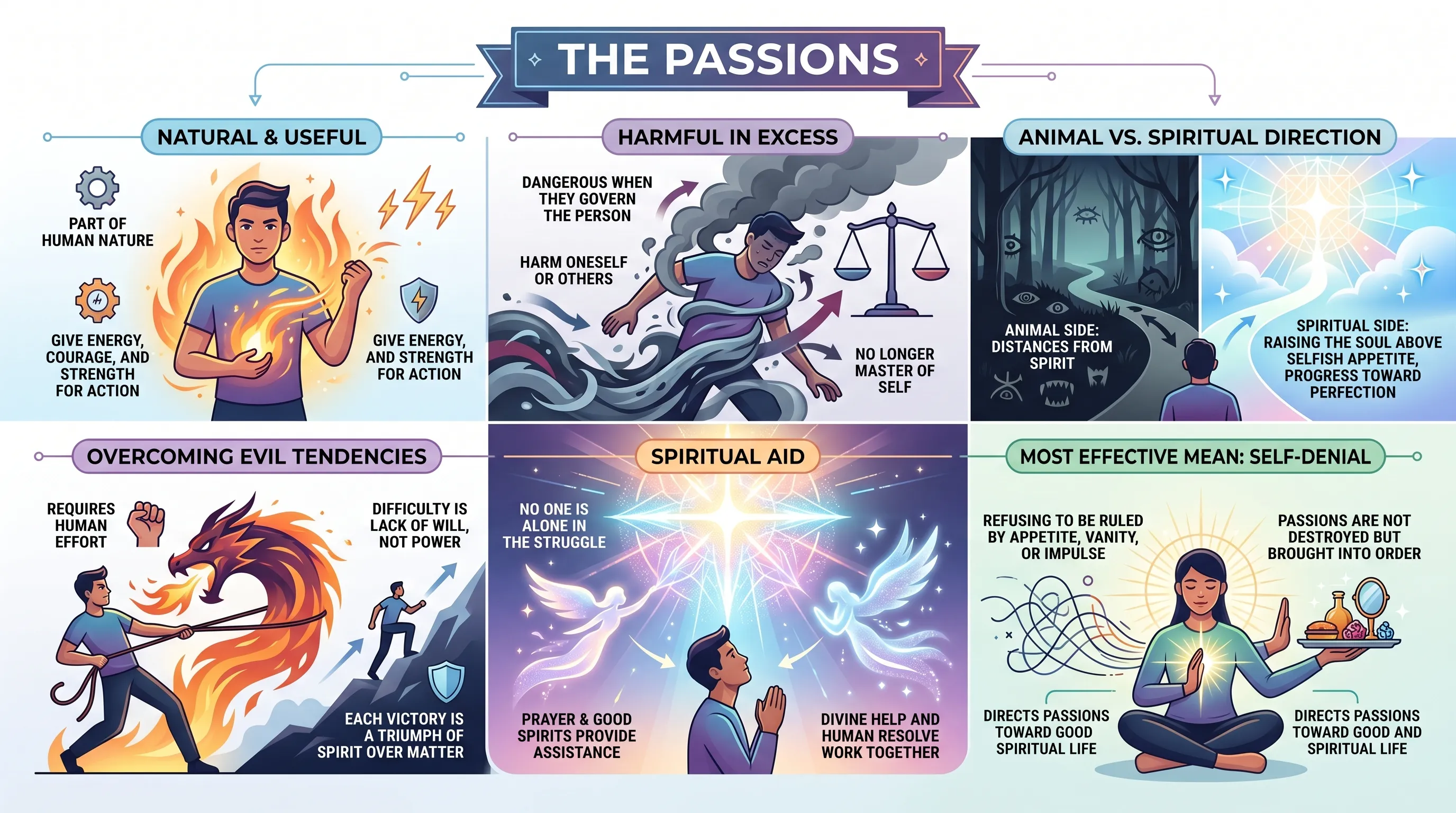
3.12.26 The passions are not evil in themselves.
3.12.27 They belong to human nature and can be useful, giving energy, courage, and strength for action.
3.12.28 They become harmful through excess. When governed by the will, they can serve good; when they govern the person, they become dangerous. A passion ceases to be good when it harms oneself or others, and when one is no longer master of it.
3.12.29 The evil, then, is not in the first impulse but in exaggeration. Spiritually, passions that draw a person toward the merely animal side of life distance that person from the spiritual side, while movements that raise the soul above selfish appetite show progress toward perfection.
Overcoming Evil Tendencies
3.12.30 Human beings can overcome their evil tendencies by their own efforts.
3.12.31 The difficulty is often less lack of power than lack of will. People may call their passions irresistible while still taking pleasure in them.
3.12.32 The struggle is therefore against inner attachment. Those who sincerely restrain their passions learn that they are more than their impulses. Each victory is a triumph of the spirit over matter.
Spiritual Aid
3.12.33 No one is left alone in this struggle.
3.12.34 If a person sincerely prays to God and asks the help of a guardian angel, good spirits come to assist. Their role includes helping people resist harmful influences and grow stronger in good.
3.12.35 Their help does not replace personal effort. Divine help and human resolve must work together.
The Most Effective Means
3.12.36 The most effective way to resist the rule of the bodily nature is self-denial.
3.12.37 This does not mean rejecting life or natural faculties, but refusing to be ruled by appetite, vanity, impulse, or self-indulgence. By it, passion is not destroyed but brought into order and directed toward good.
3.12.38 In this way, a person becomes less enslaved by excess and rises toward the spiritual life.
Selfishness
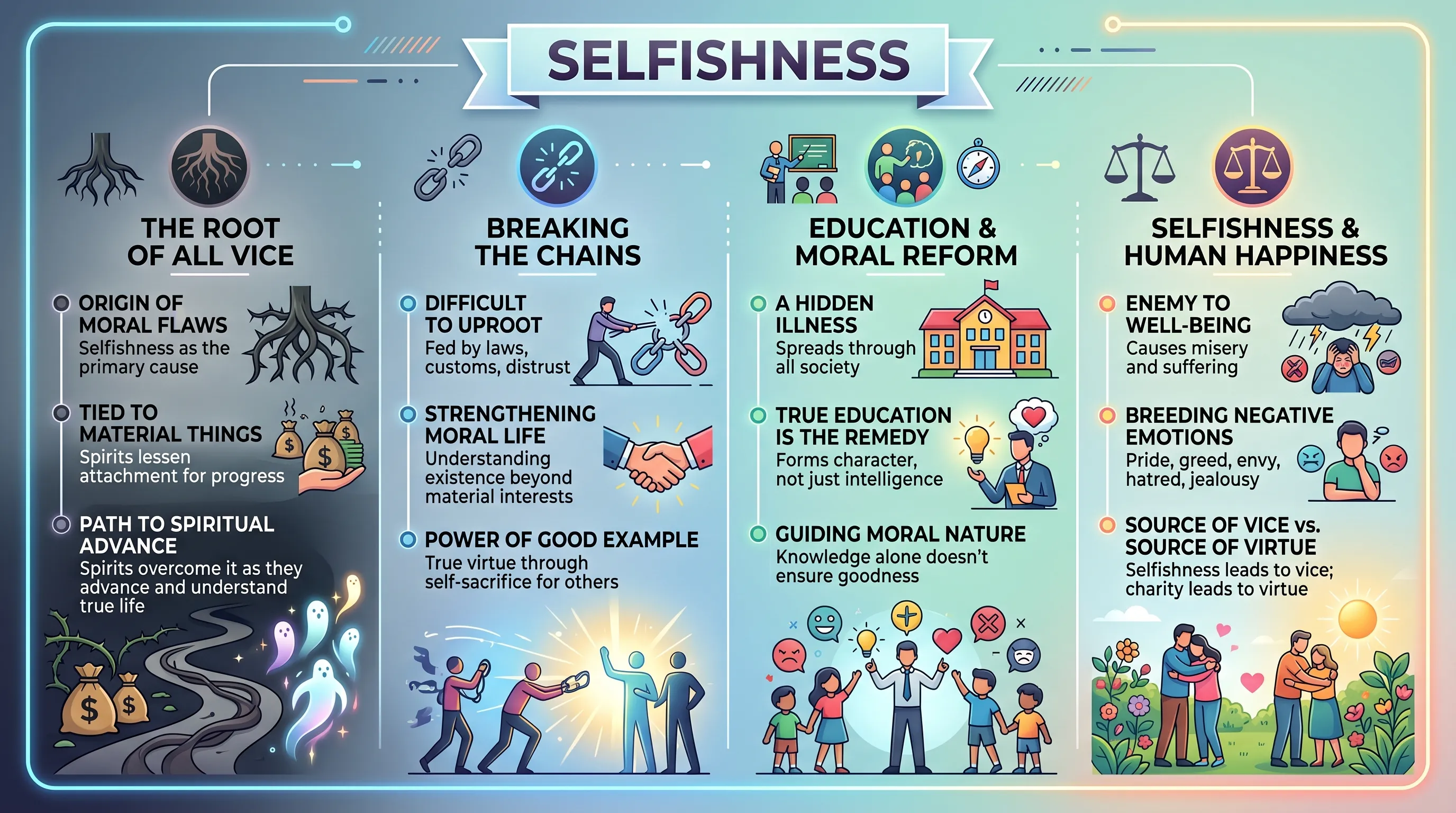
3.12.39 Selfishness is the root of all vice. If it remains in the heart, its effects remain too. Anyone who wants real moral progress must work to remove it, because it cannot live beside justice, love, and charity.
3.12.40 It seems hard to destroy because it is tied to personal interest. Yet it is not part of humanity’s true nature. It belongs to the moral imperfection of spirits living on Earth. As spirits advance and understand spiritual life better, they become less attached to material things and can free themselves from selfishness.
3.12.41 Civilization does not always lessen selfishness at once. Sometimes it even seems to increase it. But it also makes its harm easier to see. When people clearly recognize the suffering it causes, justice and mutual support can take the place of oppression.
Means of Destroying Selfishness
3.12.42 Selfishness is hard to uproot because laws, customs, and social habits often feed it instead of correcting it. It also grows through distrust. When people expect selfishness from others, they become defensive and think first of their own safety and advantage.
3.12.43 It weakens as moral life gains strength over material life. Spiritism gives of the true future state, and when it is well understood it transforms habits, practices, and social relations.
3.12.44 Good example also has great power. In times when selfishness is common, true virtue requires sacrifice. To forget oneself for the good of others, especially without seeking praise, is one of the clearest signs of moral progress.
Education and Moral Reform
3.12.45 Much has been done for human progress, yet selfishness still spreads through society like a hidden illness. To cure it, its causes must be sought in every part of social life, from the family to the nation, among rich and poor alike.
3.12.46 The deepest remedy is education—but not instruction alone. True education must form character as well as intelligence. It is not enough to fill the mind with knowledge; the moral nature must also be guided.
3.12.47 Knowledge by itself does not make a person good. Many bad influences surround children, and this helps explain later moral disorder. Even difficult natures would often improve if they were rightly trained.
Selfishness and Human Happiness
3.12.48 Human beings want happiness and try to avoid suffering. When they understand that selfishness is one of the causes of misery, they will see it as an enemy to their own well-being.
3.12.49 Selfishness gives rise to pride, ambition, greed, envy, hatred, and jealousy. It poisons social life, destroys trust, and turns friendship into rivalry.
3.12.50 So selfishness is not only a moral fault. It also stands against happiness and security. It is the source of all vices, just as charity is the source of all virtues. To destroy the first and strengthen the second should be the aim of every sincere effort.
The Characteristics of a Moral Person
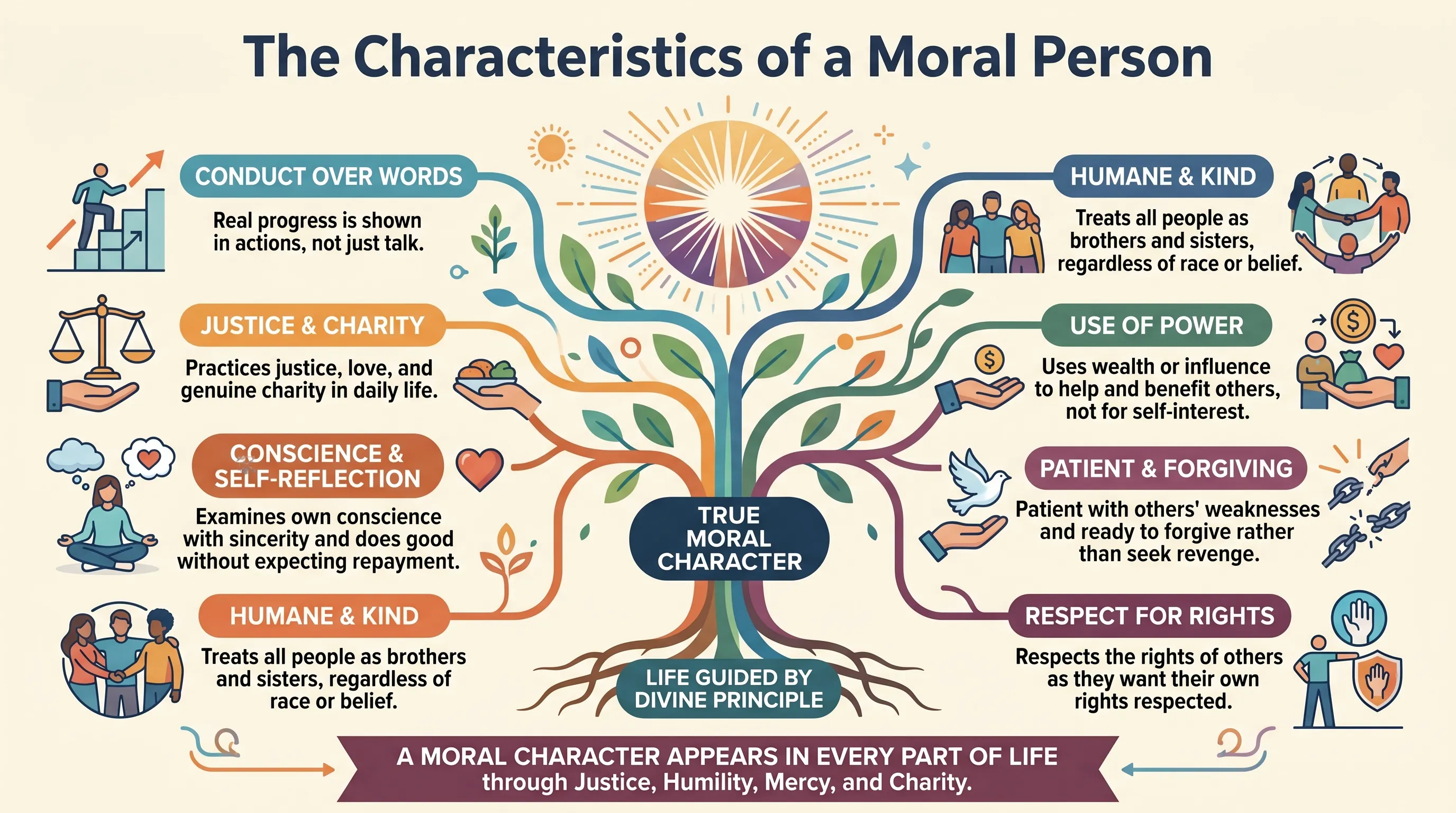
3.12.51 A person’s real progress is shown in conduct, not in talk.
3.12.52 We recognize a truly moral person by a life guided by God’s law. This is seen less in beliefs, words, or outward religion than in everyday actions. Such a person practices justice, love, and charity, and examines their own conscience with sincerity.
3.12.53 They ask themselves whether they have done evil, failed to do the good they could, or treated others in a way they themselves would reject. They do good without expecting repayment. They put justice above self-interest, and their kindness is genuine.
3.12.54 They are humane and kind to everyone, seeing all people as brothers and sisters, whatever their race or belief. If they have wealth or power, they use it as something entrusted to them for the good of others. If others depend on them, they are gentle and do not use authority to hurt, shame, or oppress.
3.12.55 They are patient with the weaknesses of others because they remember their own. They do not seek revenge, but forgive injuries and remember benefits more than offenses. They respect the rights of others as they want their own rights respected.
3.12.56 Their moral character appears in all parts of life through justice, humility, mercy, and charity.
Self-Knowledge
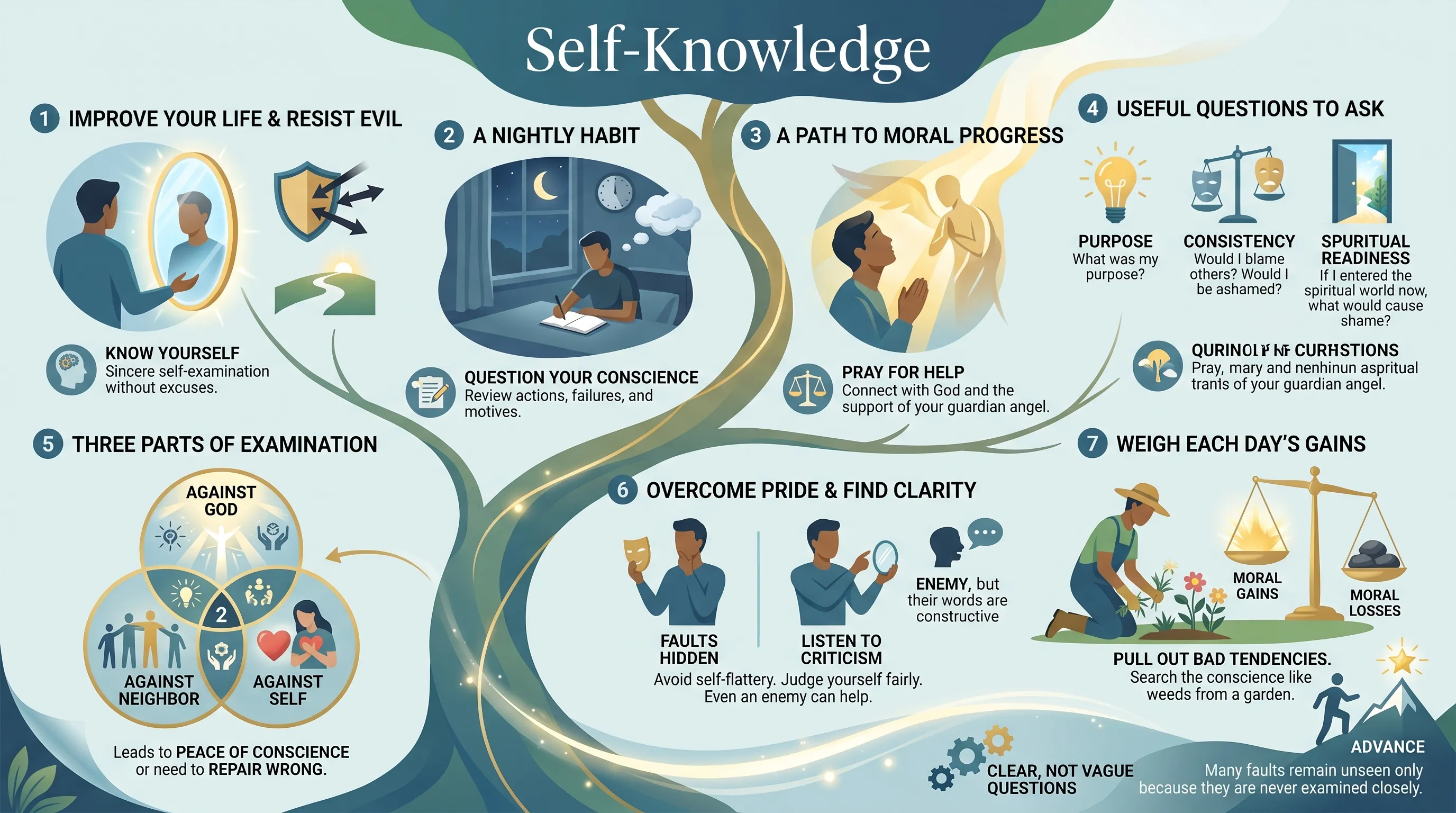
3.12.57 The surest way to improve in this life and resist evil is to know yourself. The rule is simple, but following it is not. It takes sincere self-examination and the courage to look at yourself without excuses.
3.12.58 A good habit is to review your day each night before sleep. Question your conscience. Recall what you did, what you failed to do, and what spirit moved you. Ask whether you neglected any duty, hurt anyone, or let selfishness hide behind a respectable appearance.
3.12.59 If this is done honestly, and with prayer for God’s help and the support of your guardian angel, it becomes a strong means of moral progress.
3.12.60 Certain questions are especially useful: What was my purpose in this action? Did I do something I would blame in someone else? Did I do anything I would be ashamed to admit openly? If I were to enter the spiritual world now, where nothing is hidden, what in me would cause shame?
3.12.61 This examination can be made in three parts: what has been done against God, what has been done against one’s neighbor, and what has been done against oneself. From it comes either peace of conscience or the clear need to repair a wrong.
3.12.62 Self-knowledge is the key to improvement, but it is hard to judge ourselves fairly. Pride hides our faults. One useful test is to ask how you would judge the same action if another person had done it. If you would condemn it in them, you should not excuse it in yourself.
3.12.63 It is also wise to listen to what others say about us, especially when the criticism is not flattering. Even an enemy can help, because an enemy does not usually flatter.
3.12.64 Anyone who truly wants to advance must search the conscience and pull out bad tendencies as one pulls weeds from a garden. We should weigh each day’s moral gains and losses as carefully as other matters. If good has outweighed evil, conscience may rest in peace.
3.12.65 The questions we ask ourselves should be clear, not vague. Without that, self-examination easily becomes self-deception. A few minutes each day spent in this work are never lost. Many faults remain unseen only because they are never examined closely.