2.9 How Spirits Influence Our Lives
The Reading of Our Thoughts by Spirits
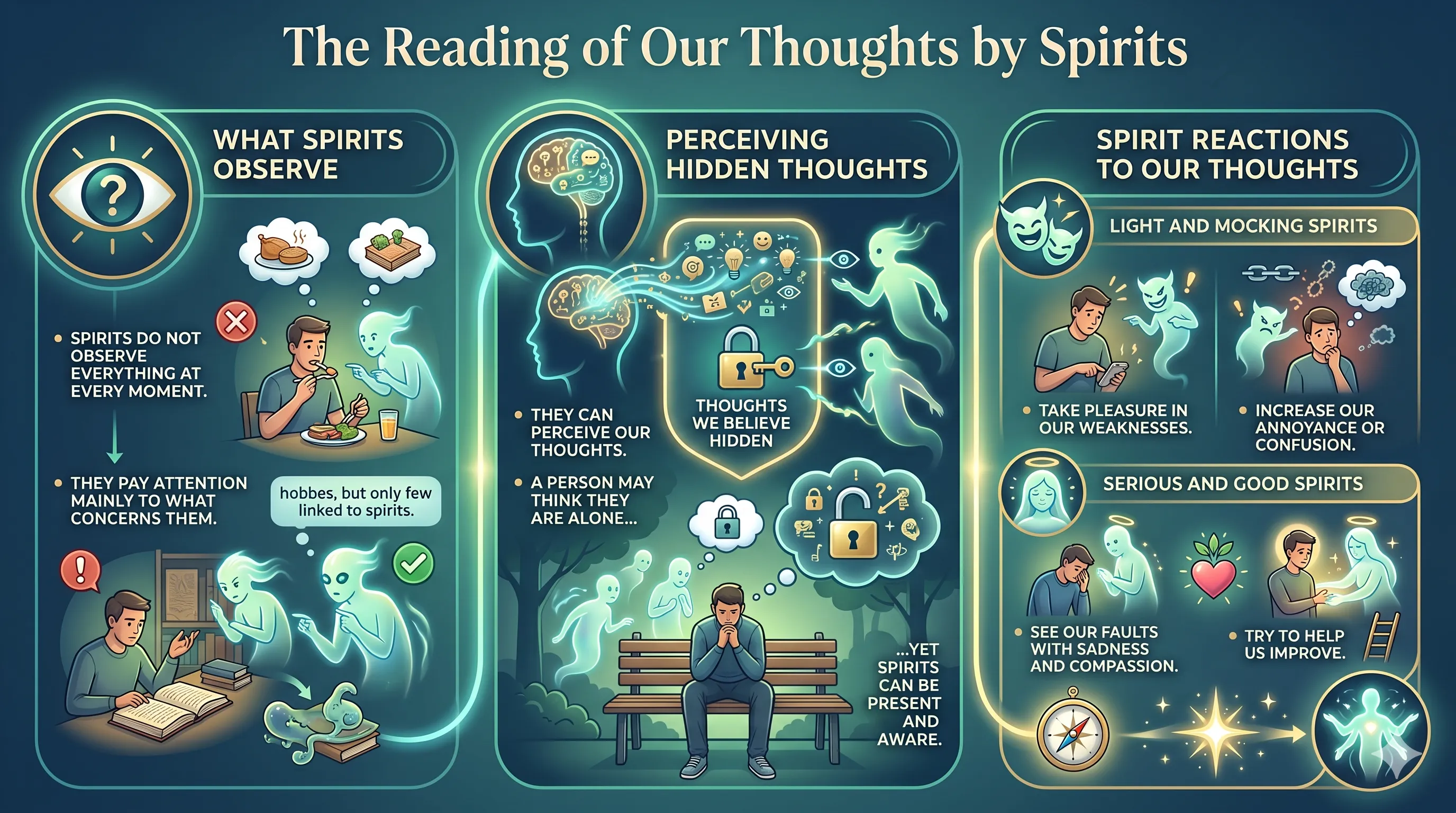
2.9.1 Spirits do not observe everything we do at every moment. They pay attention mainly to what concerns them.
2.9.2 But they can perceive our thoughts, even those we believe are hidden. A person may think they are alone, yet spirits can be present and aware of what is in their mind.
2.9.3 Their response depends on what kind of spirit they are. Light and mocking spirits may take pleasure in our weaknesses and increase our annoyance or confusion. Serious and good spirits see our faults with sadness and compassion, and try to help us improve.
The Concealed Influence of Spirits on Our Thoughts and Actions
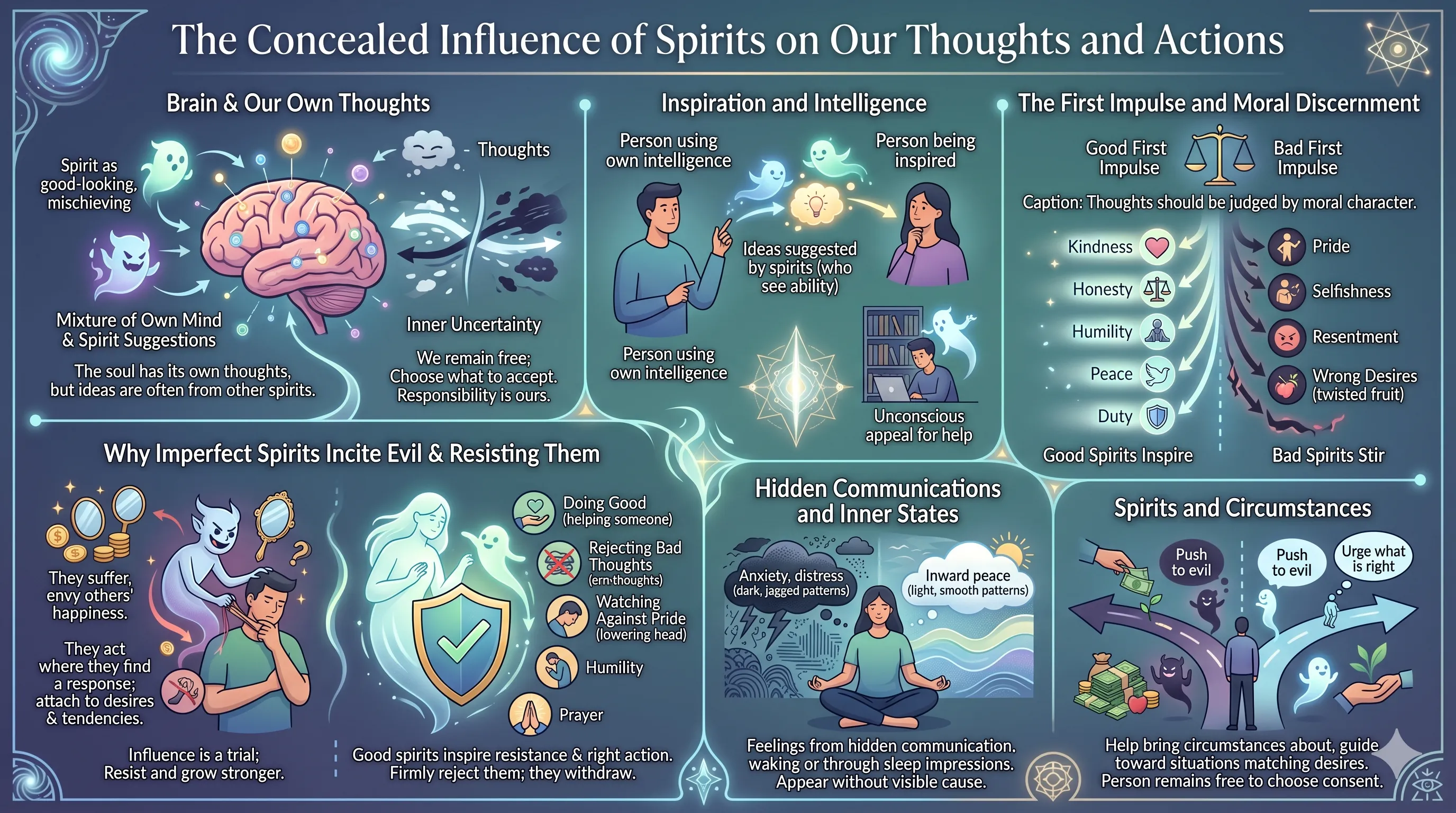
2.9.4 Spirits influence our thoughts and actions more than we usually think. The soul has its own thoughts, but not every idea comes from itself alone. The opposite thoughts we feel, and our inner uncertainty, often come from a mixture of our own mind and suggestions from other spirits.
2.9.5 Still, it is not always necessary to separate one from the other. We remain free, because we choose what to accept. Whether the suggestion is good or bad, the responsibility is still ours.
Inspiration and Intelligence
2.9.6 Intelligence and genius do not come only from an isolated self. Some ideas belong to the person’s own spirit, but others are suggested by spirits who see that the person is able to receive and express them.
2.9.7 When someone feels a lack of ideas and searches for inspiration, that person may be making an unconscious appeal for help from the spirit world.
The First Impulse and Moral Discernment
2.9.8 The first impulse is not always the best one. It may be good or bad, according to the nature of the incarnate spirit and the influence it receives.
2.9.9 Thoughts should be judged by their moral character. Good spirits inspire kindness, honesty, humility, peace, and duty. Bad spirits stir pride, selfishness, resentment, and wrong desires.
Why Imperfect Spirits Incite Evil
2.9.10 Imperfect spirits try to lead people into evil because they suffer and, out of envy, want others to share their misery.
2.9.11 But they do not take away freedom. Their influence is a trial that allows the incarnate spirit to resist evil and grow stronger. They act where they find a response in us, attaching themselves to desires and tendencies that attract them. Good spirits, on the other hand, inspire resistance and right action.
How Evil Influence Is Repelled
2.9.12 We can avoid the influence of spirits who urge evil, because they cling only to those who attract them by desire or habit. When they are firmly rejected, they withdraw, even if they may wait for another chance.
2.9.13 The best protection is moral strength: doing good, trusting in God, rejecting bad thoughts, and watching against spirits that feed pride, passion, flattery, and discord. Humility and prayer are powerful defenses.
Hidden Communications and Inner States
2.9.14 Feelings such as anxiety, distress, or inward peace do not always come only from the body. They may also come from hidden communication with spirits, whether in waking life or through impressions received during sleep.
2.9.15 That is why some emotions and moral impressions seem to appear without any visible cause.
Spirits and Circumstances
2.9.16 Spirits do not only make use of existing circumstances. They may also help bring them about, guiding a person toward situations that match that person’s desires.
2.9.17 A person, for example, may be led to a place where temptation appears. Then one influence pushes toward evil while another urges what is right. But the person remains free.
2.9.18 Human life unfolds among these hidden influences. Our thoughts are not always our own alone, yet freedom is never destroyed. Good and evil suggestions may reach the mind, but consent belongs to us.
The Possessed
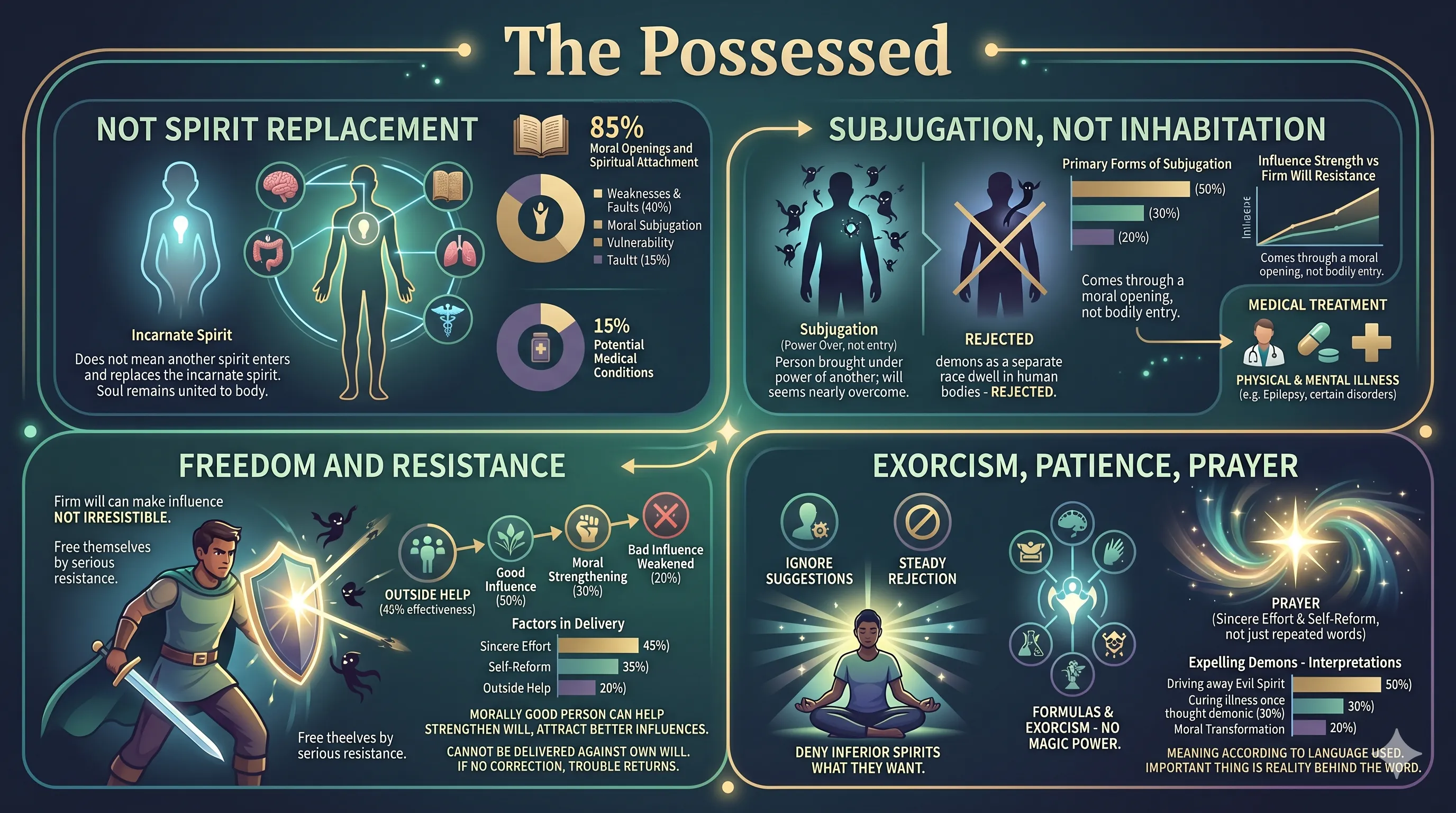
2.9.19 What is called possession does not mean that another spirit enters the body and replaces the incarnate spirit. During bodily life, the soul remains united to the body.
2.9.20 What occurs is that an evil or imperfect spirit attaches itself to a person through their weaknesses or faults, and then troubles, constrains, or dominates them. The suffering is real, but there is no substitution of spirits.
Possession as Subjugation
2.9.21 If possession means two spirits inhabiting the same body, it does not exist. If it means a person brought under the power of another spirit so that the will seems nearly overcome, the word may be used in that sense.
2.9.22 This is really subjugation. It comes through a moral opening, not through bodily entry by another being. The belief that demons as a separate race dwell in human bodies must therefore be rejected.
2.9.23 Many cases once called possession are also physical or mental illness. Conditions such as epilepsy or certain disorders belong to medicine and should be treated by a physician.
Freedom and Resistance
2.9.24 However strong the influence may seem, it is not irresistible where there is firm will. A person can free themselves if they seriously resist.
2.9.25 Outside help can assist, especially if the sufferer does not understand their condition. A morally good person can strengthen the will, attract better influences, and weaken bad ones. But no one can be delivered against their own will. If the person does not correct what gave access to the evil spirit, the trouble returns.
Exorcism, Patience, and Prayer
2.9.26 Words alone have no power over inferior spirits. Formulas and exorcisms do not act like magic.
2.9.27 One of the best ways to defeat such spirits is to deny them what they want. If their suggestions are steadily ignored, they may withdraw. Prayer also helps, not as repeated words, but when joined to sincere effort at self-reform and removal of the causes of bad influence.
The Meaning of Expelling Demons
2.9.28 When old accounts speak of casting out demons, the meaning must be understood according to the language used. If demon means an evil spirit exercising harmful influence, then driving it away is truly an expulsion.
2.9.29 If the word was used for an illness thought to come from a demon, then curing the illness could be described the same way. The important thing is the reality behind the word.
Convulsionaries
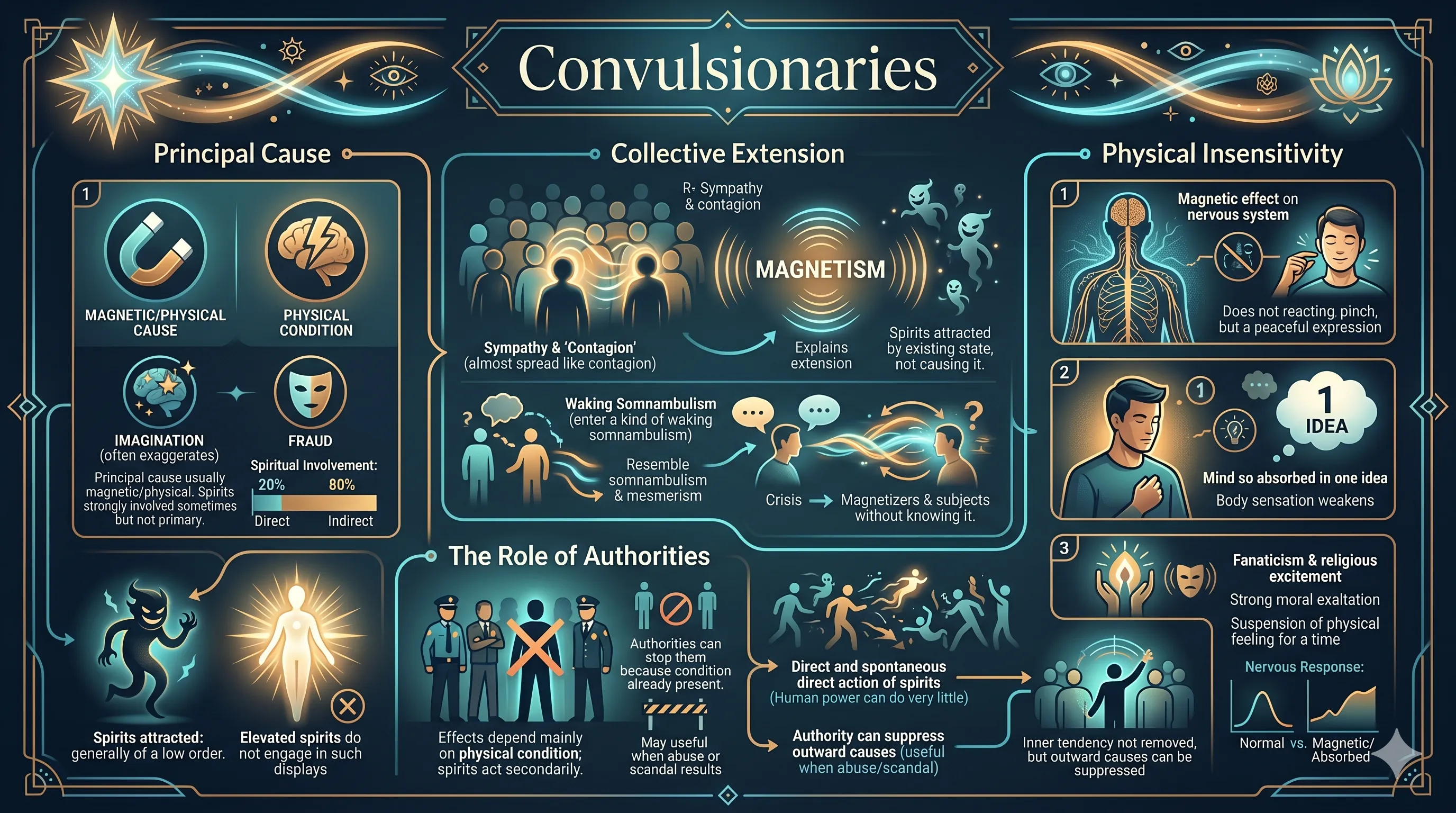
2.9.30 Spirits may be involved in the phenomena of convulsionaries, sometimes strongly, but the principal cause is usually magnetic or physical rather than spiritual. Imagination often exaggerates these events, and fraud may be mixed in. The spirits attracted to them are generally of a low order, since elevated spirits do not engage in such displays.
Collective Extension of the Phenomenon
2.9.31 The condition seen in convulsionaries, hysterical persons, and similar subjects can spread by sympathy, almost like contagion. Magnetism explains much of this extension. Spirits may also participate, but they are attracted by the existing state rather than causing it.
2.9.32 Many of the effects resemble those of somnambulism and mesmerism. In crises, such persons may enter a kind of waking somnambulism, acting at once as magnetizers and subjects without knowing it.
Physical Insensitivity
2.9.33 The absence of pain in some convulsionaries, and even in persons under severe suffering, may arise from different causes. Sometimes it comes from a magnetic effect on the nervous system. At other times, the mind is so absorbed in one idea that bodily sensation weakens.
2.9.34 Fanaticism and religious excitement can produce the same result. Strong moral or emotional exaltation may suspend physical feeling for a time.
The Role of Authorities
2.9.35 Because these effects depend mainly on a physical condition, with spirits acting only secondarily, it is less surprising that authorities have sometimes stopped them. Spirits do not create the condition; they take advantage of one already present.
2.9.36 Authorities may not remove the inner tendency, but they can suppress the outward causes that sustain and spread the phenomenon. This may be useful when abuse or scandal results. It is otherwise when the action of spirits is direct and spontaneous, for then human power can do very little.
The Affection of Certain Spirits for Certain Persons
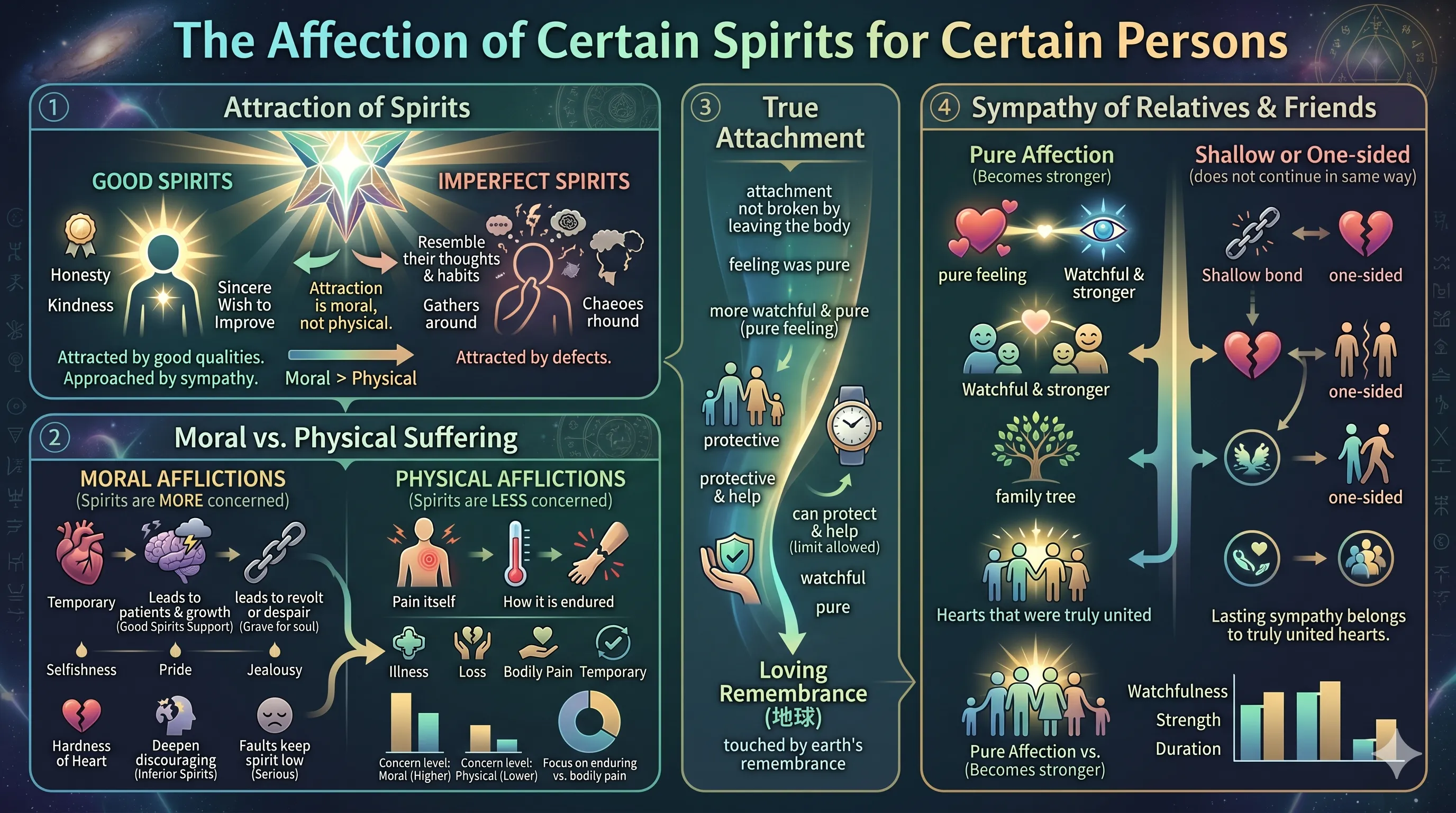
2.9.37 Spirits are not equally drawn to all people. They approach those with whom they have sympathy. Good spirits are attracted by honesty, kindness, and a sincere wish to improve. Imperfect spirits gather around people whose thoughts and habits resemble their own.
2.9.38 This attraction is moral, not physical. Good spirits care for our welfare and support what is good in us. They are less concerned with bodily pain itself than with how it is endured. When suffering leads to patience and growth, they see its value; when it leads to revolt or despair, they grieve over the harm done to the soul.
Physical Afflictions and Moral Afflictions
2.9.39 Spirits are generally more concerned with moral suffering than with physical suffering. Bodily pain is often temporary, but the faults that keep a spirit low are more serious.
2.9.40 Selfishness, pride, jealousy, and hardness of heart matter more to them than illness or loss. Many troubles of life come from these defects. Good spirits try to give courage, resignation, and hope. Inferior spirits deepen discouragement and make pain harder to bear.
The Sympathy of Relatives and Friends
2.9.41 Spirits who were our relatives or friends often keep their affection for us after death. True attachment is not broken by leaving the body; when the feeling was pure, it may become stronger and more watchful.
2.9.42 They can protect and help those they loved, within the limits allowed to them. They are also touched by loving remembrance on earth.
2.9.43 But this sympathy depends on the real nature of the bond. Where affection was shallow or one-sided, it does not continue in the same way. Lasting sympathy belongs above all to hearts that were truly united.
Guardian Angels: Protector, Familiar and Sympathetic Spirits
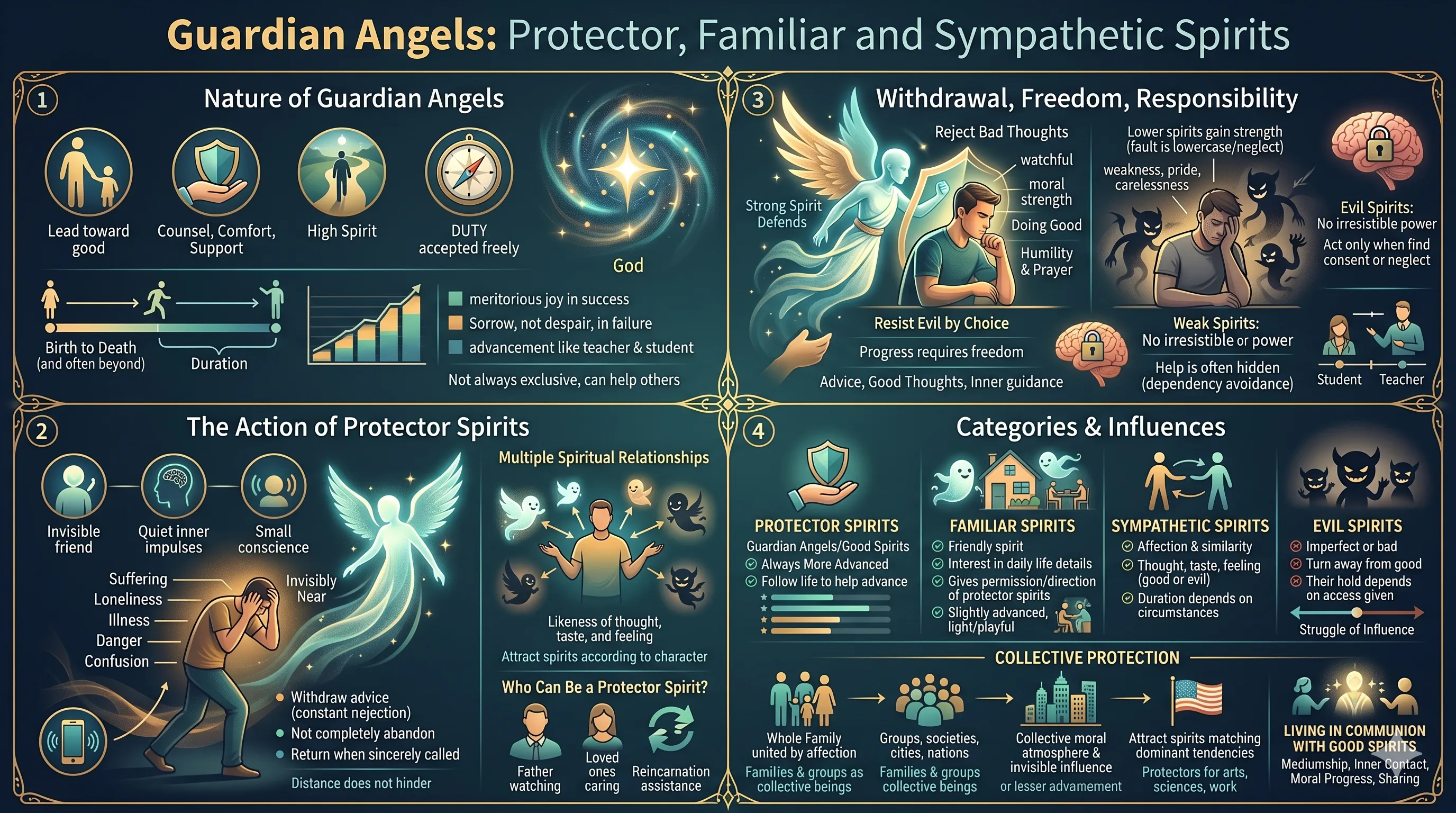
2.9.44 Some spirits attach themselves to certain people in order to protect and guide them. These are good spirits, often called guardian spirits or guardian angels. A guardian angel is a high spirit whose role is like that of a parent with a child: to lead a person toward the good, give counsel, comfort in suffering, and support in life’s trials.
2.9.45 This protection lasts from birth to death, and often after death as well. It may continue through several bodily lives, since earthly lives are only short moments in the longer life of the spirit. A protector spirit accepts this mission freely, but once it accepts it, it becomes a duty. It may feel a special sympathy for the person it guards. Even so, this care is not always exclusive. A spirit closely linked to one person may also help others. If it is called to another task, another spirit can take its place.
The Action of Protector Spirits
2.9.46 Protector spirits do not leave us just because we fail to listen. They may step back when their advice is constantly rejected and when a person willingly gives way to lower influences. But they do not completely abandon anyone. They still try to make themselves heard, and they return as soon as they are sincerely called.
2.9.47 The thought that each person has an invisible friend near them is a great comfort. Such spirits remain with us in suffering, loneliness, illness, danger, and confusion. They reach us through quiet inner impulses and through conscience. Distance does not hinder them. What seems far away to us is not far away to spirits.
Withdrawal, Freedom, and Responsibility
2.9.48 Good spirits never do evil. If a protector spirit withdraws and bad influences gain strength, the fault lies in lower spirits and in the person’s own weakness, pride, or carelessness. Evil spirits have no irresistible power. They act only when they find consent or neglect.
2.9.49 Protector spirits allow real struggle because progress requires freedom. They help by advice, good thoughts, and inner guidance, but they do not take away responsibility. Human beings must resist evil by their own choice.
2.9.50 A protector spirit is not always required to stay in a way that can be felt. Its help is often hidden, so that people do not become dependent and fail to act for themselves. There also comes a time when a spirit no longer needs this kind of guardianship, just as a student eventually no longer needs a teacher, though this does not happen during earthly life.
The Merit and Feeling of Protector Spirits
2.9.51 When protector spirits help someone stay on the path of good, they feel joy. Their success is part of their own advancement, like the happiness of a teacher who sees a student grow.
2.9.52 If they fail after doing all they could, they are not blamed. They do feel sorrow over the faults of the person they guide, but not hopeless despair. They know that no failure is final and that what is missed today may be gained later.
Names, Recognition, and Identity
2.9.53 People often want to know the name of their guardian angel, but names matter little in spirit life. A person may call on their protector by any respected and uplifting name. Good spirits are united in sympathy, and a protector may answer through such an appeal.
2.9.54 When spirits use famous names, it is not always the exact spirit once known by that name. Sometimes the name is used because it is familiar and inspires trust. After returning to spirit life, one recognizes one’s protector spirit, and often finds it was already known before incarnation.
Who Can Be a Protector Spirit?
2.9.55 Protector spirits must be more advanced than those they protect. A father may watch over a child after death, and loved ones may continue caring for those they left behind, but their power depends on their own spiritual condition and may be limited.
2.9.56 Every human being has a protector spirit, even those who are morally backward. But the kind of guidance given matches the needs of the person. A highly advanced guide is not assigned in the same way to all. As one spirit progresses, it may itself become protector to another less advanced spirit, and this good work helps its own growth.
2.9.57 If a protecting spirit reincarnates, it can no longer watch over someone in the same full way while bound to a body. Another spirit may then assist in its place.
Evil Spirits and the Struggle of Influence
2.9.58 No evil spirit is officially assigned to a person as a rival to the guardian spirit. But evil spirits do try to lead people away from the good whenever they find an opening. This creates a struggle between good and bad influences, and the stronger one is the one a person chooses to hear.
2.9.59 No one is forced to give in. Evil spirits remain only as long as they are allowed access. Some people seem to exert powerful influence over others for good or evil, and in harmful cases wicked spirits may work through them more effectively. At times a good or evil spirit may even incarnate to accompany someone more directly, though usually this help or influence comes through sympathetic incarnate persons.
Multiple Spiritual Relationships
2.9.60 A person may have not only a protector spirit but also several sympathetic spirits around them. Some care for them with affection. Others may encourage their faults. Spirits are drawn by likeness of thought, taste, and feeling, so people attract spirits according to their own character.
2.9.61 Familiar spirits are not the same as protector spirits, though they are related. A familiar spirit is usually a friendly spirit that takes interest in the details of daily life.
2.9.62 From these distinctions, four broad categories emerge.
Protector spirits, guardian angels, or good spirits
2.9.63 These spirits follow a person through life to help them advance. They are always more advanced than the person they guard.
Familiar spirits
2.9.64 These spirits attach themselves to certain persons for shorter or longer periods to help them as far as they can. They are good spirits, though sometimes only slightly advanced and at times somewhat light or playful. They concern themselves with ordinary details of life and act with the permission, or under the direction, of protector spirits.
Sympathetic spirits
2.9.65 These spirits are drawn by affection and similarity of thought, taste, and feeling, whether for good or for evil. How long they remain depends on circumstances.
Evil spirits
2.9.66 These are imperfect or bad spirits who attach themselves to people in order to turn them away from the good. They do this by their own impulse, not by assignment. Their hold depends on how much access a person gives them. The person remains free to resist.
Family, Groups, Cities, and Nations
2.9.67 Protection is not limited to individuals. Some spirits attach themselves to a whole family united by affection. Spirits also gather around groups, societies, cities, and nations whose character is like their own. People, communities, and nations attract spirits that match their dominant tendencies.
2.9.68 Because of this, families and larger groups are helped by spirits of greater or lesser advancement according to their moral state. Good communities attract better influences; impure ones attract lower spirits. Good spirits strengthen tendencies toward justice and goodness, while inferior spirits stir up harmful passions.
2.9.69 Groups can therefore be seen as collective beings moving toward shared ends. They too have protectors suited to their degree of advancement.
Protectors of the Arts and Special Activities
2.9.70 There are also special protector spirits for the arts, sciences, and other forms of work. They help those who call on them sincerely, but they do not replace effort, discipline, or real ability. They support what is genuine, not vanity.
2.9.71 Older traditions gave such protectors the names of gods or muses. In modern language, arts, industries, cities, and nations may also be said to have their patrons or protectors—high spirits working under different names.
Collective Moral Atmosphere and Invisible Influence
2.9.72 Just as individuals attract spirits according to their tendencies, so do groups. The unseen spirits around a people, city, or nation generally reflect the moral quality of those who make it up. Customs, habits, dominant character, and especially laws reveal what sort of spiritual influences are welcomed there.
2.9.73 When justice is respected, evil influence is resisted. When laws support injustice and violate humanity, good spirits withdraw and lower influences multiply, strengthening bad ideas and weakening better ones. By looking at the habits, customs, and laws of a people, one can get some idea of the unseen spirits taking part in its thoughts and actions.
Living in Communion with Good Spirits
2.9.74 Communication with protector and familiar spirits is natural. In this sense, every person is a medium, though most do not know it clearly. As spiritual understanding grows, this bond may become more conscious.
2.9.75 There is no need to fear troubling good spirits by turning to them. Regular inner contact with them gives strength, clarity, courage, and hope. Those who teach, guide, create, and uplift others often take part, knowingly or not, in a larger work of moral progress. What is received is meant to be shared.
Presentiments
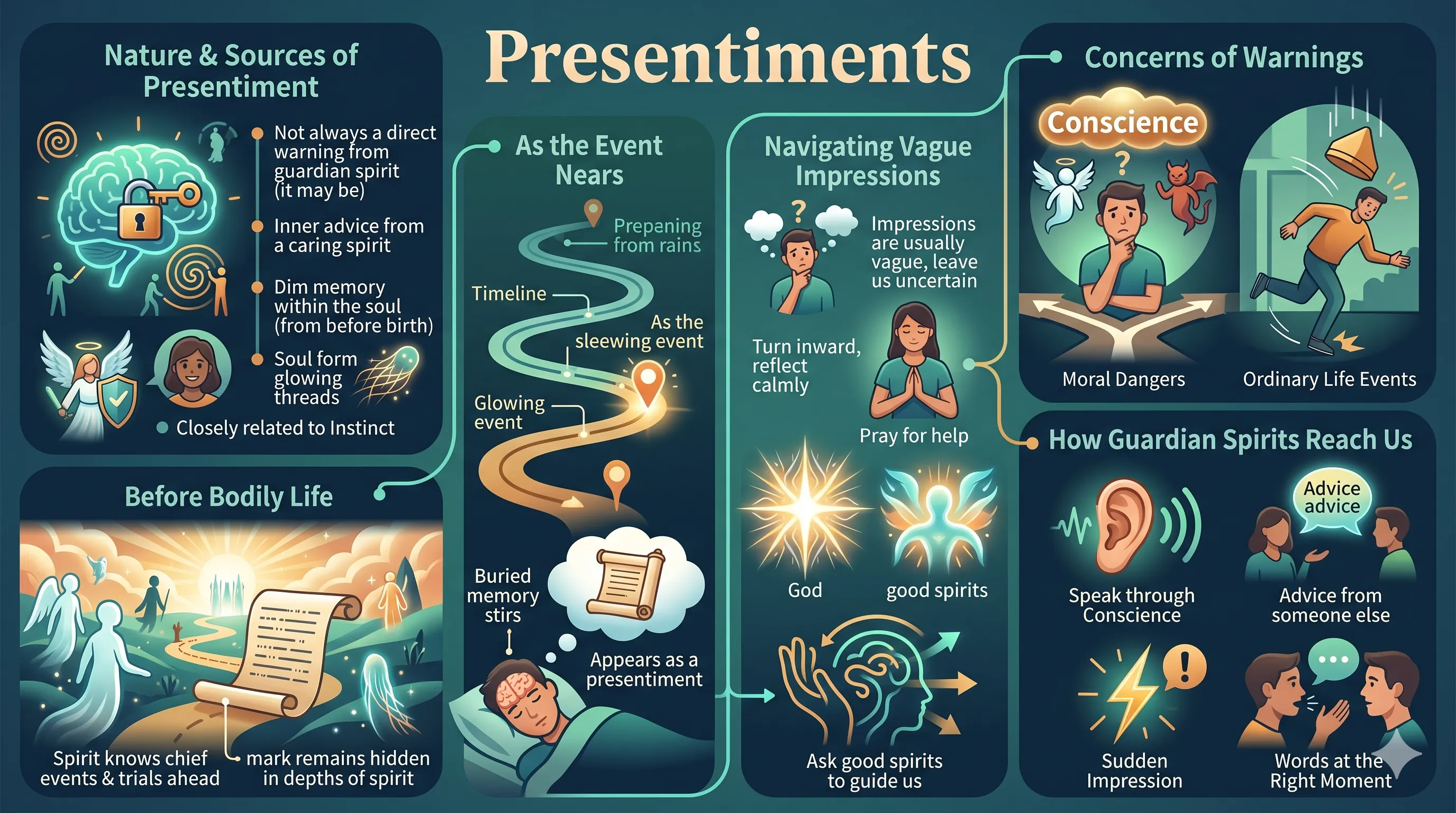
2.9.76 A presentiment is not always a direct warning from a guardian spirit, though it may be. It can also come from the inner advice of a spirit who cares for us, or from a dim memory within the soul of what it accepted before birth. In that sense, it is closely related to instinct.
2.9.77 Before entering bodily life, the spirit knows the chief events of the path ahead, especially the trials it must pass through. When one of these events is important, its mark remains hidden in the depths of the spirit. As the time comes near, that buried memory stirs and appears as a presentiment.
2.9.78 Because such impressions are usually vague, they may leave us uncertain. Then we should turn inward, reflect calmly, and pray to God for help, or ask good spirits to guide us.
2.9.79 These warnings may concern moral dangers or ordinary events in life. Guardian spirits often speak through conscience, and if that voice is not heard, they may reach us in other ways—through advice from someone else, a sudden impression, or words that come at the right moment.
The Influence of Spirits on the Events of Life
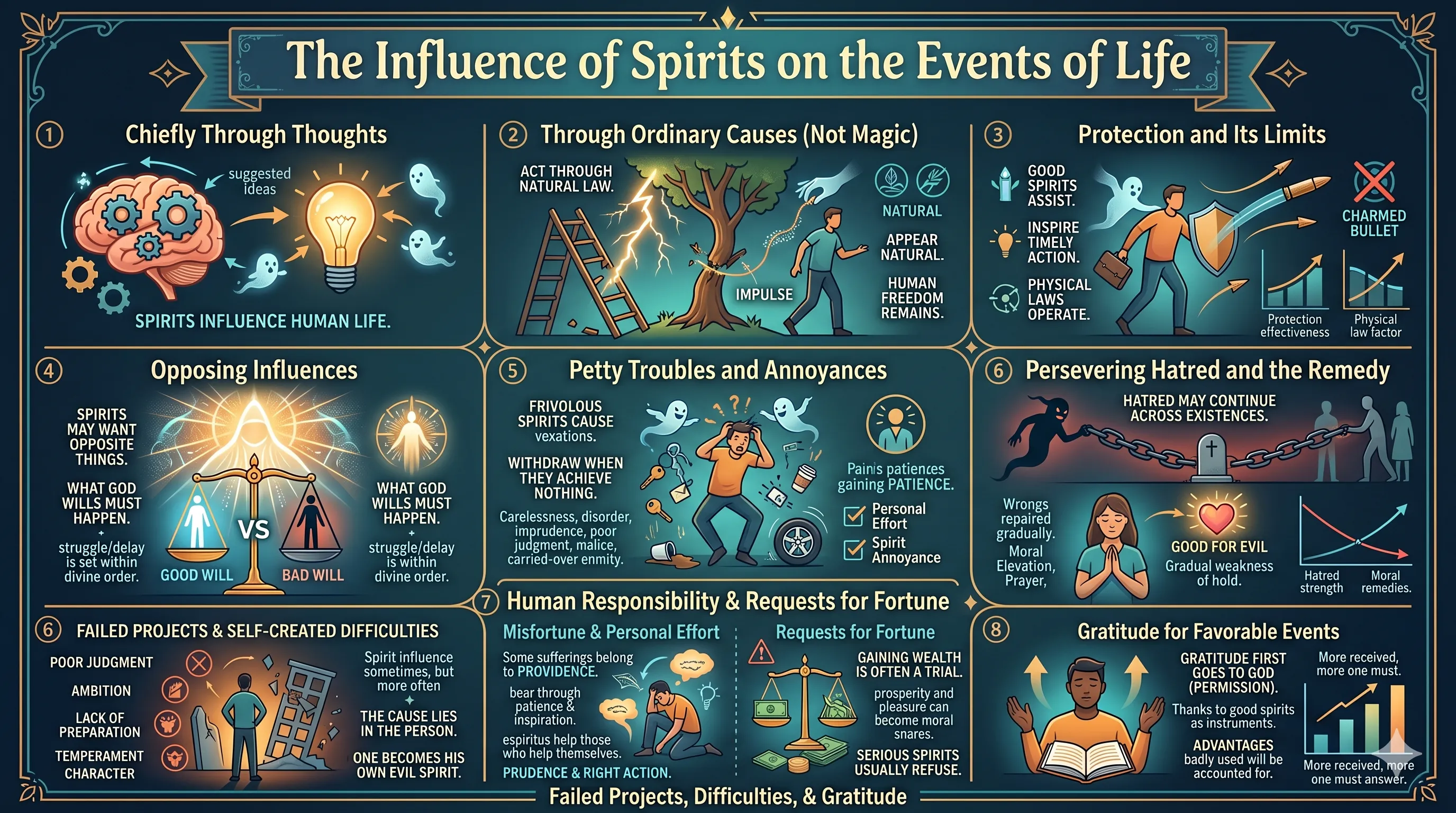
2.9.80 Spirits do influence human life, chiefly through the thoughts they suggest.
2.9.81 They may also help bring about events, but never by breaking natural law. They act through ordinary causes, so events still appear natural. Human freedom remains, since each person still acts by his own will.
Spirits and Natural Causes
2.9.82 Spirits can act on matter only within the laws of the world.
2.9.83 If a death occurs through a broken ladder or a lightning strike, the event itself follows natural causes. The spirit influence is in the thought or impulse that placed the person there at that moment.
2.9.84 So spirit action is real, but not magical.
Protection and Its Limits
2.9.85 A good spirit may help a person escape danger, but through natural means.
2.9.86 It may inspire someone to move aside in time or disturb an attacker’s aim. But physical laws still operate. Protection does not cancel the laws of matter.
2.9.87 Stories of charmed or unfailing bullets are inventions.
Opposing Influences
2.9.88 Spirits may want opposite things, but what God wills must happen.
2.9.89 Any struggle or delay between influences is itself within the divine order. No spirit can overcome the higher will.
Petty Troubles of Life
2.9.90 Frivolous or mocking spirits can cause small vexations that upset plans and test patience. When they see they achieve nothing, they withdraw.
2.9.91 Still, not every annoyance should be blamed on spirits. Many troubles come from carelessness, disorder, imprudence, or poor judgment. Sometimes such spirits act from malice or from enmity carried over from this life or another.
Persevering Hatred and the Remedy for It
2.9.92 Hatred does not always end at death.
2.9.93 Some spirits persist in troubling those they hated, and this may continue across existences until wrongs are repaired. The remedy is not revenge, but moral elevation. Prayer for such spirits and returning good for evil gradually weaken their hold.
Misfortune, Prosperity, and Human Responsibility
2.9.94 Spirits cannot remove every misfortune or grant prosperity at will.
2.9.95 Some sufferings belong to Providence, but spirits can help people bear them through patience and resignation. They can also inspire wiser choices. Still, this does not replace personal effort: spirits help those who help themselves.
2.9.96 Much that is called misfortune could be avoided by prudence and right action, and what seems evil may serve a greater good.
Requests for Fortune
2.9.97 Spirits may sometimes help a person gain wealth or success, but often only as a trial.
2.9.98 Serious spirits usually refuse such requests. When such favors are granted, they may come from good or bad spirits according to their purpose. Prosperity and pleasure can become moral snares.
Failed Projects and Self-Created Difficulties
2.9.99 When plans repeatedly fail, spirit influence may sometimes be involved, but more often the cause lies in the person.
2.9.100 Poor judgment, ambition, lack of preparation, temperament, and character often explain failure. One who stubbornly follows an unsuitable path should not blame spirits; he may become his own evil spirit by creating his troubles.
Gratitude for Favorable Events
2.9.101 When something good happens, gratitude should first go to God, since nothing occurs without divine permission.
2.9.102 Thanks may also be given to the good spirits who served as instruments of that will. Passing success without gratitude does not prove gratitude unnecessary. Advantages that are badly used will one day be accounted for, and the more one has received, the more one must answer for it.
The Action of Spirits on the Phenomena of Nature
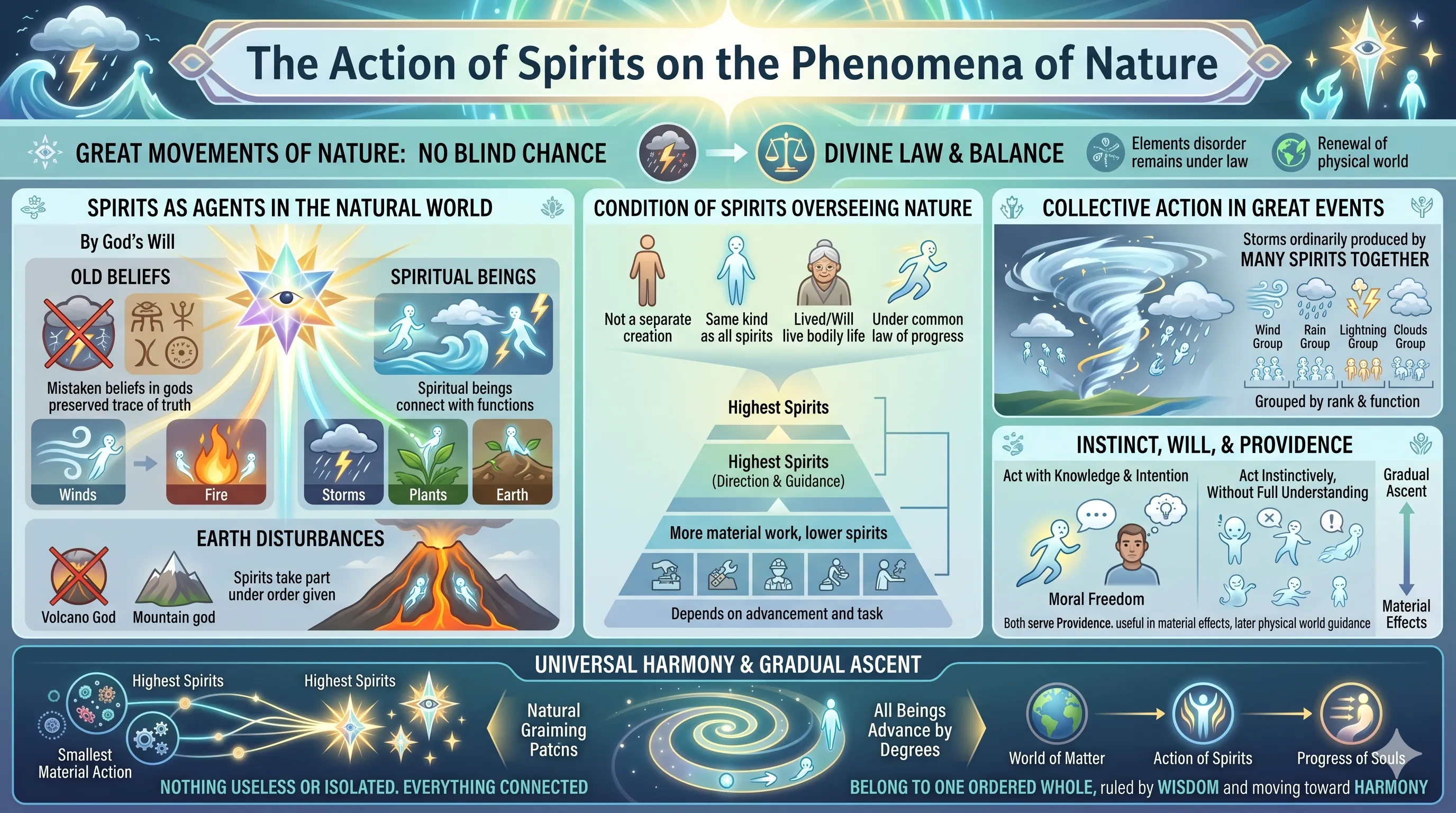
2.9.103 The great movements of nature do not happen by blind chance.
2.9.104 What seems like disorder in the elements remains under divine law. These events are not always for human beings alone, but also serve the balance and renewal of the physical world.
Spirits as Agents in the Natural World
2.9.105 Spirits can act on matter and the forces of nature.
2.9.106 By God’s will, some help move, calm, or direct the elements. Old beliefs in ruling powers of winds, fire, storms, plants, or the earth were mistaken in form, but they preserved a trace of truth. There are spiritual beings connected with these operations according to their function.
2.9.107 The same applies to disturbances of the earth. There are no gods of volcanoes or mountains, but spirits take part in such events under the order given to them.
The Condition of the Spirits Who Preside Over Nature
2.9.108 The spirits who work in natural phenomena are not a separate creation.
2.9.109 They are the same kind of spirits as all others. They have lived, or will live, in bodily life, and remain under the common law of progress.
2.9.110 Their place depends on their advancement and the nature of the task. The more material the work, the lower the spirits usually involved. Some direct; others carry out what is directed.
Collective Action in Great Events
2.9.111 In large natural events, the action is usually collective.
2.9.112 A storm, for example, is not ordinarily produced by one spirit alone. Many act together, grouped by rank and function.
Instinct, Will, and Providence
2.9.113 Spirits do not all take part in the same way.
2.9.114 Some act with knowledge and intention. Others act almost instinctively, without understanding the whole purpose. Even so, both can serve providence.
2.9.115 Before less advanced spirits are fully awake to moral freedom, they may already be useful in material effects. Later they act with more will in the physical world, and later still can take part in guiding the moral world.
Universal Harmony and Gradual Ascent
2.9.116 Nothing in creation is useless or isolated.
2.9.117 Everything is connected, from the smallest material action to the work of the highest spirits. All beings advance by degrees. So the world of matter, the action of spirits, and the progress of souls belong to one ordered whole, ruled by wisdom and moving toward harmony.
Spirits during Battle
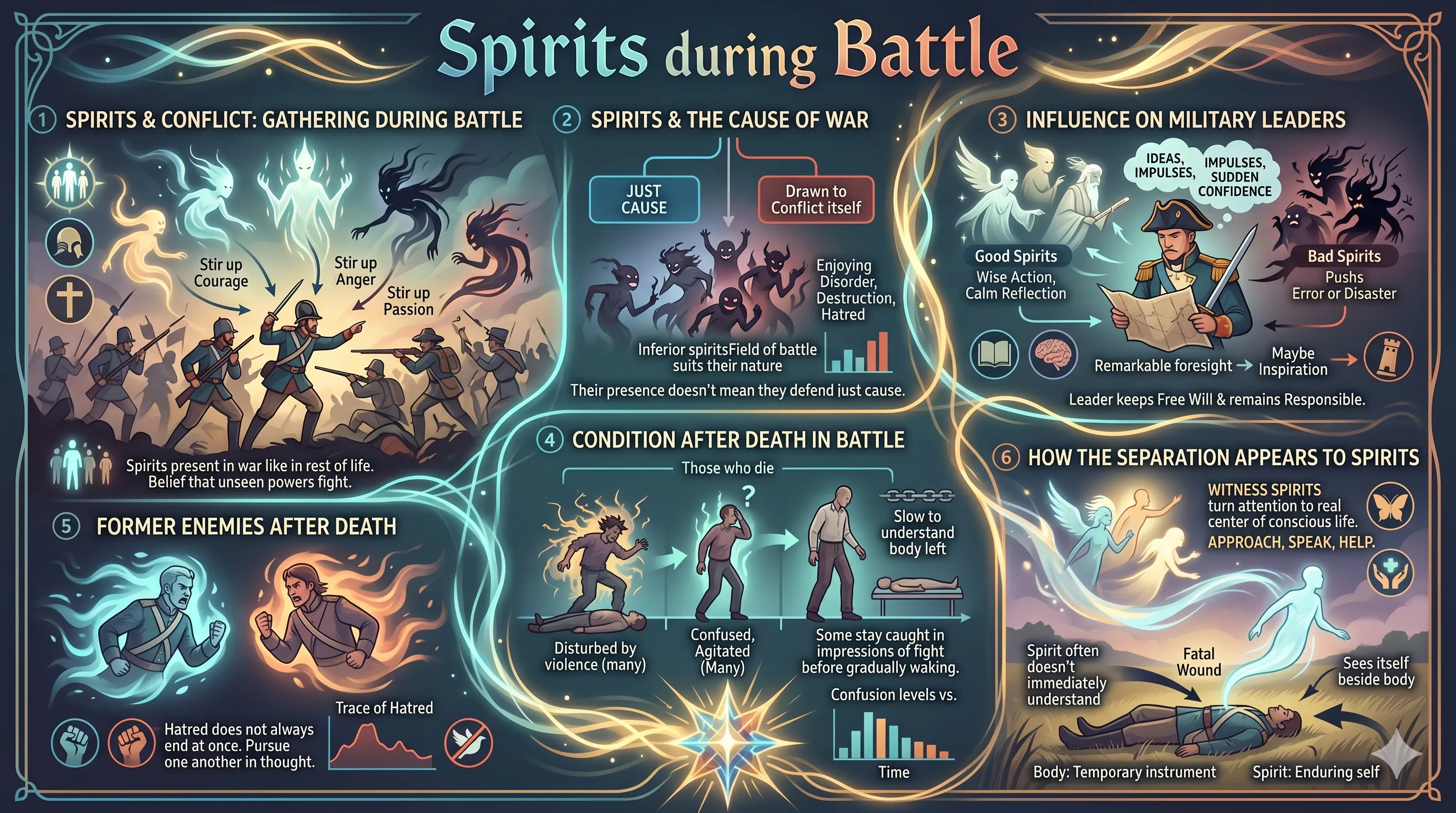
2.9.118 Spirits are present in war just as they are in the rest of human life. During battle, many gather around those who fight and stir up courage, anger, or passion. This helps explain why people once believed unseen powers were fighting for one side or the other.
Spirits and the Cause of War
2.9.119 Their presence in war does not mean they defend what is just. One side may have the right, but many spirits are drawn to conflict itself. Inferior spirits enjoy disorder, destruction, and hatred, so battle gives them a field that suits their nature.
Influence on Military Leaders
2.9.120 Spirits can influence military leaders as they influence people in other matters. A commander may receive ideas, impulses, or sudden confidence about a plan. Good spirits can support wise action, while bad spirits may push toward error or disaster. Even so, the leader keeps free will and remains responsible.
2.9.121 What looks like remarkable foresight may sometimes be inspiration. In such cases, spirits act through the abilities the person already has.
The Condition of Spirits After Death in Battle
2.9.122 Those who die in battle do not all enter the spirit life in the same way. Many remain disturbed for a time by the violence of the death. They may be confused, agitated, and slow to understand that they have left the body.
2.9.123 Some stay caught in the impressions of the fight before gradually waking to their new state.
Former Enemies After Death
2.9.124 Enemies do not always lose their hatred at once after death. For a time, they may still pursue one another in thought and keep the passions of earthly conflict.
2.9.125 But once they begin to see their new condition more clearly, this hostility weakens. Without the bodily life that fed it, hatred loses its force, though traces of it may remain longer in some spirits than in others.
How the Separation Appears to Spirits
2.9.126 To spirits who witness death in battle, the separation from the body is usually not as instant or clear as people imagine. After a fatal wound, the spirit often does not immediately understand what has happened. As awareness returns, it sees itself beside the body it has left.
2.9.127 Other spirits turn their attention less to the body than to the newly freed spirit, which is now the real center of conscious life. They can approach it, speak to it, and help it. The body is only the temporary instrument; the spirit is the enduring self.
Pacts
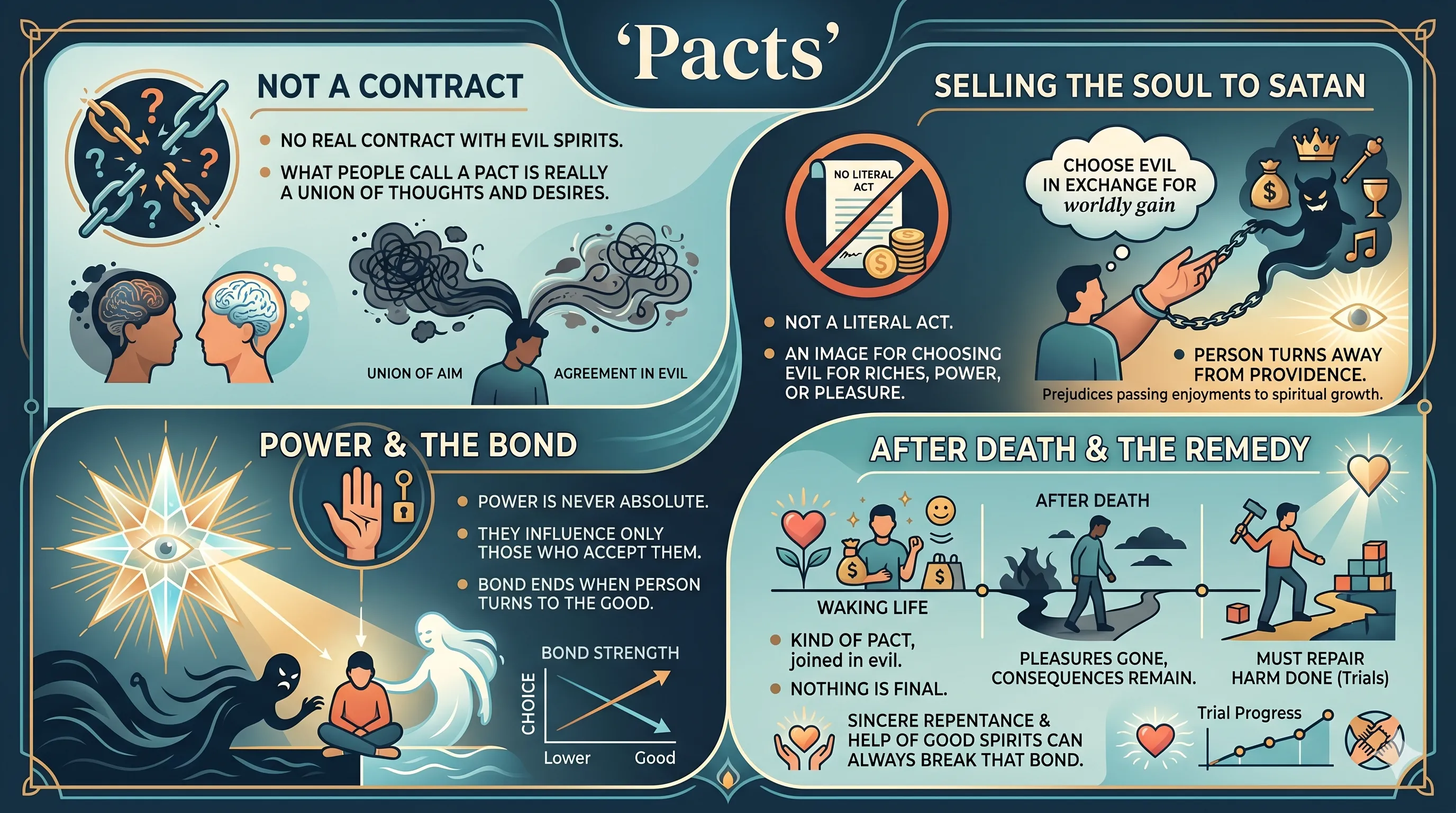
2.9.128 There is no real contract with evil spirits. What people call a pact is really a union of thoughts and desires. When a person gives themself to evil, they attract spirits who share the same aims.
2.9.129 If someone wants to do wrong, lower spirits may encourage that wish and help strengthen it. But this is not a bargain in the literal sense. It is simply agreement in evil.
2.9.130 Their power is never absolute. Evil spirits can influence only those who accept them, and the bond ends when a person truly turns back to the good.
Selling the Soul to Satan
2.9.131 Selling the soul to Satan is not a literal act. It is an image for choosing evil in exchange for riches, power, or pleasure.
2.9.132 A person who seeks help from bad spirits for worldly gain turns away from Providence and prefers passing enjoyments to spiritual growth. The suffering that follows is the natural result of that choice, not an eternal sentence.
2.9.133 After death, the pleasures are gone, but the consequences remain. The person must repair the harm done, often through difficult trials. By attaching themself to lower pleasures, they come under the influence of impure spirits. In that sense there is a kind of pact, because both are joined in evil. But nothing is final. With sincere repentance and the help of good spirits, that bond can always be broken.
Occult Power, Talismans, Sorcerers
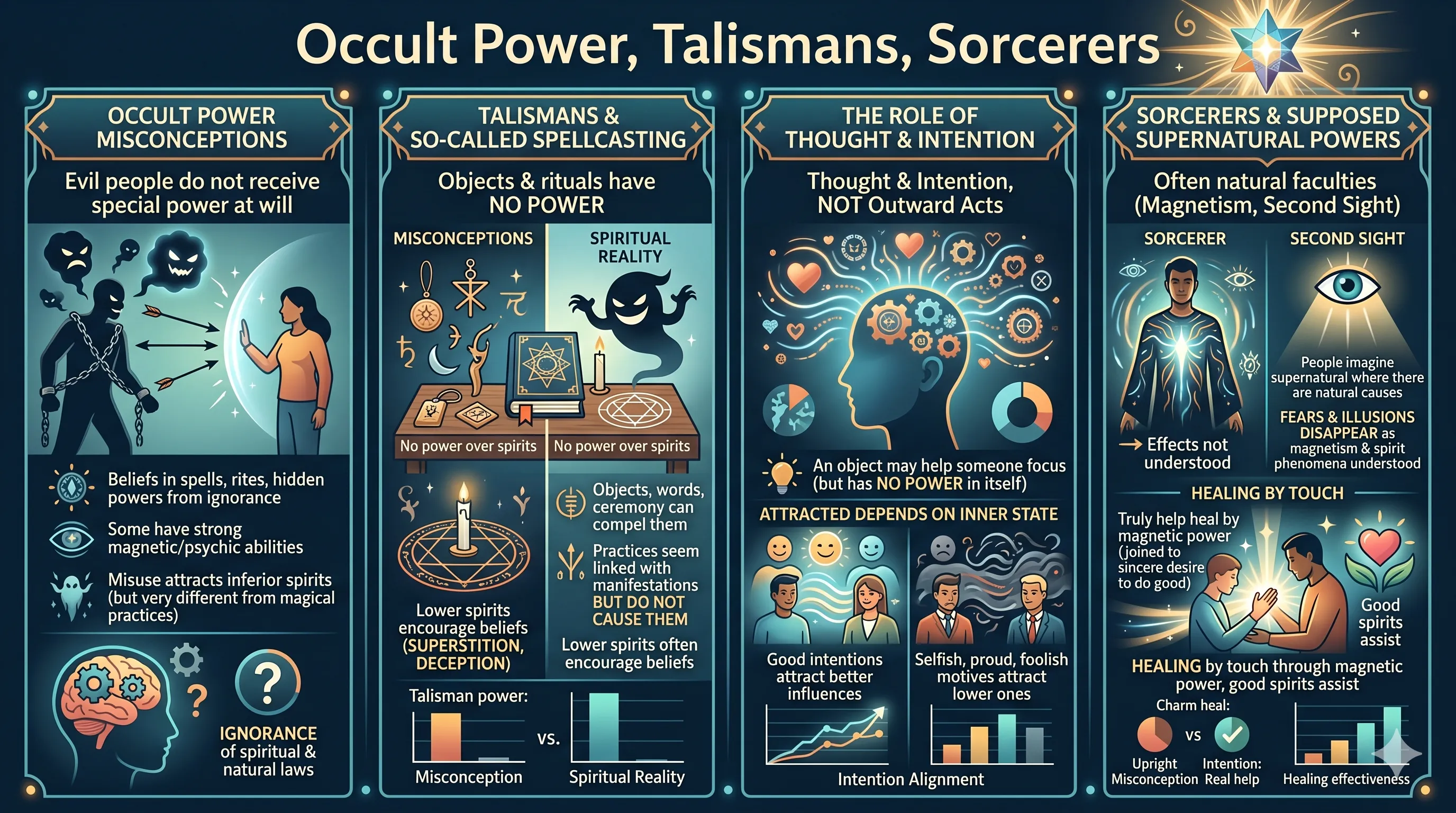
2.9.134 Evil people do not receive a special power to harm others through spirits at will. Beliefs in spells, rites, and hidden powers mostly come from ignorance of spiritual and natural laws.
2.9.135 Some people may have strong magnetic or psychic abilities, and if morally corrupt, may misuse them and attract inferior spirits. But this is very different from the supposed power of magical practices.
Talismans, Formulas, and So-Called Spellcasting
2.9.136 Talismans, formulas, signs, and rituals have no power over spirits. No object, words, or ceremony can compel them.
2.9.137 If such practices seem linked with manifestations, that does not mean they caused them. Lower spirits often encourage these beliefs to sustain superstition and deception.
The Role of Thought and Intention
2.9.138 What reaches spirits is thought and intention, not outward acts. An object may help someone focus, but it has no power in itself.
2.9.139 The spirits attracted depend on a person’s inner state. Good intentions attract better influences; selfish, proud, or foolish motives attract lower ones.
Sorcerers and Supposed Supernatural Powers
2.9.140 So-called sorcerers are often people with unusual natural faculties, such as magnetic force or second sight. Because these effects are not understood, people imagine supernatural powers where there are natural causes.
2.9.141 As magnetism and spirit phenomena become better understood, these fears and illusions disappear.
Healing by Touch
2.9.142 Some people can truly help heal by touch through magnetic power, especially when joined to a sincere desire to do good. Good spirits may also assist.
2.9.143 Still, caution is needed. Common effects are often treated as miracles, and supposed cures are easily exaggerated.
2.9.144 Real help does not come from charms, secret words, or display, but from upright intention and the lawful action of natural and spiritual forces.
Blessings and Curses
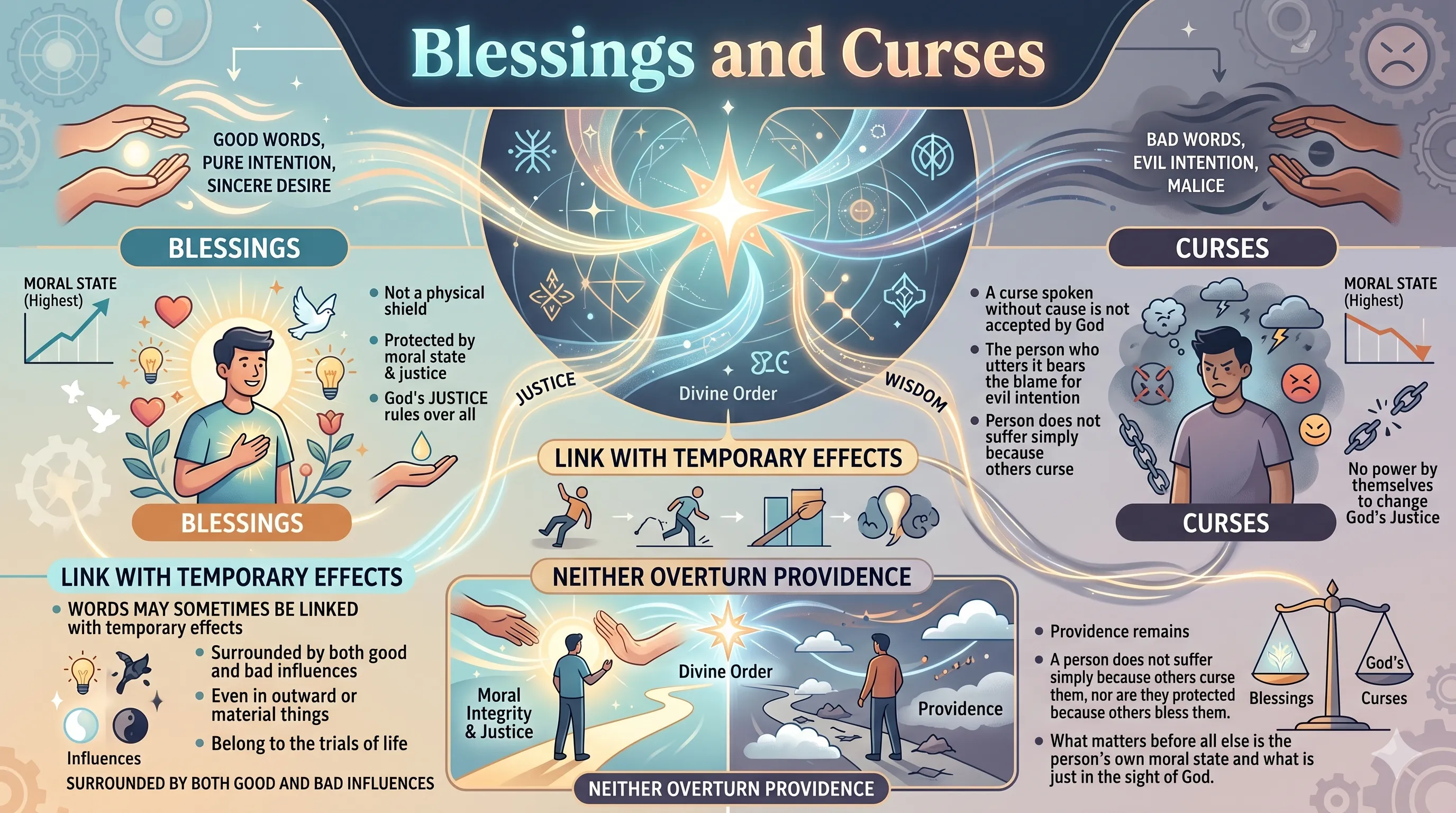
2.9.145 Blessings and curses do not, by themselves, have the power to change God’s justice. A curse spoken without cause is not accepted by God, and the person who utters it bears the blame for that evil intention.
2.9.146 Still, human life is surrounded by both good and bad influences, so such words may sometimes be linked with temporary effects, even in outward or material things. But nothing happens apart from God’s permission. If such effects are allowed, they belong to the trials of life.
2.9.147 Even so, neither blessings nor curses overturn Providence. A person does not suffer simply because others curse them, nor are they protected simply because others bless them. What matters before all else is the person’s own moral state and what is just in the sight of God.